
Cagle Cartoons


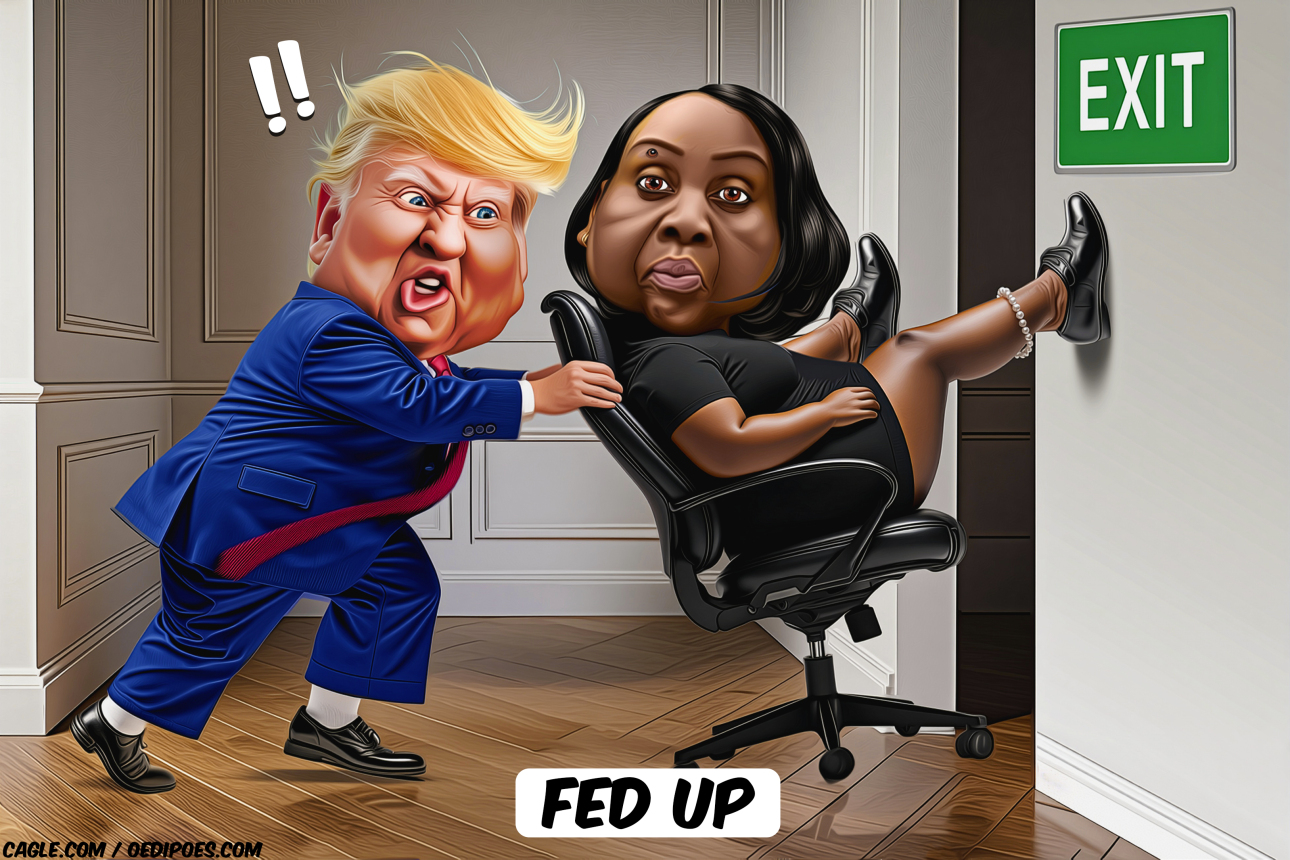
Lisa Cook as 'Low-Hanging Fruit'
Aug 31, 2025 6:33 PM
Updated Sep 1, 2025 11:10 PM
Trump Targets Lisa Cook as ‘Low-Hanging Fruit’ While Jerome Powell Remains Untouchable — What This Reveals About Race, Power, and the Federal Reserve
This week, Donald Trump announced plans to fire Lisa Cook, a governor on the Federal Reserve Board. In the nonstop churn of the 24/7 news cycle, I have repeatedly heard commentators describe Cook as “low-hanging fruit,” while the firing of Jerome Powell — the Fed chair who is the real source of Trump’s ire — is often characterized as “a bridge too far.” That framing is what compelled me to write this article.
When political commentators describe Lisa Cook as “low-hanging fruit” in discussing the reshaping of the Federal Reserve, they’re not talking about her qualifications. They’re talking about her vulnerability — grounded in her race, gender, political isolation, and a hostile media environment --these elements make her an easier target than someone like Jerome Powell, the Fed’s white, male chair. In contrast, Jerome Powell's identity, not his credentials, give him a leg up in protection. To understand this, we need to examine how Trump’s strategy blends institutional opportunism with racialized politics, and why Black women in particular have legitimate reason to fear greater precarity under his administration.
Who Is Lisa Cook?
Lisa Cook is a highly accomplished economist: a PhD from UC Berkeley, faculty roles at Harvard and Michigan State, service on the White House Council of Economic Advisers, and extensive work advising governments and international institutions. She was confirmed to the Federal Reserve Board in 2022 — becoming the first Black woman ever to hold a seat in the Fed’s 109-year history.
Yet from the beginning, her confirmation was contentious. Nearly every Senate Republican opposed her, framing her as “unqualified” or a “DEI hire,” reducing her decades of scholarship to a caricature of identity politics. Despite her credentials, Cook’s legitimacy was questioned in ways that simply don’t apply to white male economists.
Related stories
Trump’s Assault on the Federal Reserve
Donald Trump has a long, antagonistic relationship with the Fed. During his presidency, he regularly attacked Jerome Powell, whom he himself had appointed, for raising interest rates. Trump asked whether Powell could be fired outright — and was told no. The Fed’s independence, protected by law, makes it difficult for presidents to remove its leaders simply because of policy disagreements.
But that hasn’t stopped Trump from trying to assert control. His move against Lisa Cook is part of a broader strategy to weaken the Fed’s independence, purge perceived opponents, and fill key roles with loyalists who will advance his agenda — especially lowering interest rates to fuel economic growth on his political timeline.
Why Lisa Cook Is Seen as “Low-Hanging Fruit”
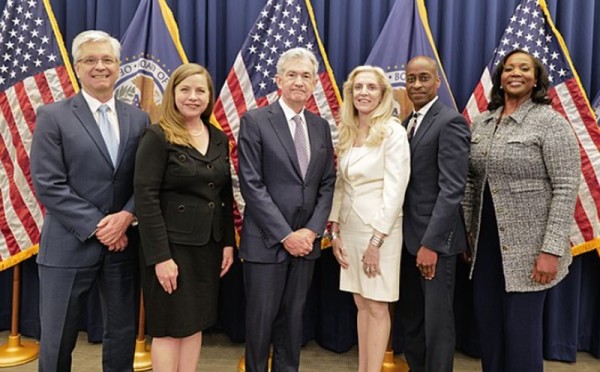
It is important that I emphasize that both Lisa Cook and Jerome Powell serve as Federal Reserve Governors. Under existing law, neither can be removed willy nilly. They are not at-will employees. If either is removed, it must be “for cause” (e.g., misconduct or neglect of duty), not simply for policy disagreements. That legal shield applies to all Fed Governors, regardless of whether they hold the title of Chair or not. So, given that they both enjoy the same degree of protection, why have several political pundits described Lisa Cook as “low-hanging fruit” while characterizing Powell as “a bridge too far”?
If Jerome Powell is the real target of Trump’s ire, why has the crosshairs shifted to Lisa Cook? Because in the eyes of the political class, she is the path of least resistance. This is not about Cook’s qualifications or experience — which are unimpeachable — but about how easily she can be framed. By labeling her “low-hanging fruit,” pundits and media outlets do Trump’s work for him, casting her as expendable without ever interrogating why. In this way, Cook becomes not just vulnerable, but a politically useful scapegoat. Four factors explain why she is singled out:
1. Political Clout
Lisa Cook has little political base among Republicans. Her confirmation passed narrowly, with GOP senators branding her “unqualified” — a charge they never felt the need to substantiate. That very ease of accusation reveals how deeply racial and gendered assumptions shape public perception. Unlike Jerome Powell, Cook has no ready-made network of bipartisan defenders or Wall Street power brokers eager to shield her. And the reason is not her credentials but the way Americans, even those who consider themselves fair-minded, tacitly accept the idea that a Black woman is more easily dismissed. In Trump’s eyes, that makes her expendable — but it is the broader culture’s silent assent that gives him permission.
Jerome Powell, the real target of Trump’s rage, commands support from both parties. He was first appointed by Trump, then reappointed by Biden. Financial elites trust him. Attacking Powell would alienate powerful allies in banking, Congress, and global markets.
2. Visibility
Cook, despite her groundbreaking role, remains largely unknown to the general public. She doesn’t hold press conferences that move markets. Her name recognition is low. That makes it easier for Trump to define her narrative — as a diversity pick rather than a respected economist — without provoking broad public backlash.
Powell, on the other hand, is the face of the Fed. His press briefings are watched worldwide. Removing him would dominate headlines, spook investors, and destabilize markets. The visibility that protects Powell leaves Cook more vulnerable.
3. Institutional Entrenchment
Jerome Powell has had more than a decade inside the Fed, and over that time he has developed the kind of entrenched networks that protect him from serious political threat. But it’s not just longevity that explains his insulation — it’s the inevitability of his social position. As a white male Republican lawyer, Powell embodies the archetype of authority in American finance. His profile makes it natural, almost automatic, for him to attract powerful allies in Congress, on Wall Street, and in international financial circles. His institutional clout compounds over time because the system is built to receive him.
Lisa Cook’s trajectory is different not because she lacks merit but because she occupies a very different place in that same system. Even if she serves a full term, she is unlikely to develop the same protective networks that Powell enjoys. Institutional racism and sexism ensure she will encounter barriers — subtle exclusions from elite circles, skepticism about her expertise, dismissals of her scholarship, and constant framing as an outsider. Her race and gender mean that the kind of effortless entrenchment available to Powell is structurally denied to her. In short: Powell’s institutional power is inevitable; Cook’s institutional marginalization is just as inevitable.
4. DEI Framing
Perhaps most importantly, Cook’s identity as a Black woman makes her vulnerable to Trump’s anti-DEI crusade. Trump has systematically dismantled diversity, equity, and inclusion initiatives across federal agencies. He and his allies have weaponized DEI as shorthand for “illegitimate,” “unqualified,” or “un-American.”
And here’s the blunt truth: Trump’s weaponization works because there is an audience not just willing, but eager, to absorb and echo anti-DEI sentiment. Yes, part of that stems from old-fashioned, explicit racism — but that’s only one slice of the picture. In American English, we use “racism” as if it were a single thing, when, in reality, it operates along a continuum: intentional racism, unconscious racism, systemic and institutional racism, structural racism, and more. That lack of language makes it easy to blur distinctions and harder to confront the subtler, more pervasive forms. The racism at issue here is not always deliberate, but it is just as corrosive: it normalizes the dismissal of Black achievement, minimizes the violence of racism itself, and severs racism from the broader destruction it wreaks on democracy for all.
By casually branding Lisa Cook as “low-hanging fruit” — without context, challenge, or explanation — corporate media performs part of Trump’s work for him, reinforcing a subtler but deeply entrenched form of racism. On the other hand, on the right, Trump doesn’t have to prove that Lisa Cook is unqualified. He only has to label her a “DEI hire,” knowing that millions of Americans will nod along. That’s the role the public plays: consuming these tropes without question, reinforcing them in conversation, and treating them as common sense rather than racist dog whistles.
In the United States, racism is so normalized and tacitly accepted that the average American doesn’t push back. Judge for yourself, just look at the institutions, public and private, who have quietly caved and removed DEI from their programs and websites.
Far from resisting Trump’s anti-DEI crusade, many Americans — including those who see themselves as fair-minded or progressive — have become its enablers. But if we are being honest with ourselves, his attacks resonate because people have been trained to doubt the competence of Black men and women no matter their credentials and people lack the courage to confront issues through a racial lens, dismiss the need for DEI as unnecessary or divisive, and deny their own complicity in keeping racism alive. This quiet compliance, especially from the so-called well-meaning, is what gives Trump’s framing its real power.
The Broader Stakes
Targeting Lisa Cook isn’t just about one person. It’s about undermining the independence of the Federal Reserve, politicizing central banking, and sending a broader message: Black women in positions of power are expendable.
- Institutional danger: Undermining the Fed’s independence could destabilize global markets and politicize monetary policy.
- Cultural danger: Making Cook a scapegoat reinforces the message that Black women’s authority is conditional, fragile, and easily revoked.
- Political danger: This strategy rallies Trump’s base around racial resentment, fueling his broader campaign against DEI and diversity in government.
Conclusion
Lisa Cook is not “low-hanging fruit” because she is less capable. She is “low-hanging fruit” because attacking her will result in less of a public outrage. Her lack of entrenched networks, her low public visibility, and the weaponization of her race and gender make her an easier target than Jerome Powell, whose whiteness, maleness, and institutional clout shield him.
This fight is bigger than the Federal Reserve; its impact will extend far beyond monetary policy. Time and again in American history, attacks on a Black leader have provided the opening wedge for power grabs that reshape the entire system. Today, Lisa Cook stands in that role. The struggle being waged against her is not hers alone — and if she prevails, the victory will ripple outward, strengthening democracy for everyone who values it.
Comments

Powered by RoundtableAn AI/DeFi-powered Enterprise Media Operating System. Learn more at Roundtable.io.© Roundtable 2026. By using this site you agree to the Terms of Use and Privacy Policy