
Attribution-NonCommercial-NoDerivs (CC BY-NC-ND 2.0)


Feb 6, 2023 3:00 PM
Southern Whites, from colonial times, saw defending the right to own slaves as a defense of liberty.
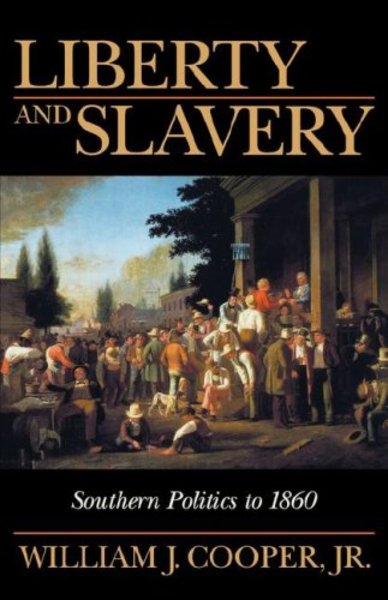
I recently read an old history book (courtesy of my favorite Mondragón Books): Liberty and Slavery: Southern Politics to 1860, by William J. Cooper, Jr. (1983). Cooper’s amply supported thesis is that Southern Whites, from colonial times, saw defending the right to own slaves as a defense of liberty. Any attempts to limit their right to own slaves and to take them anywhere in the country amounted to a violation of that liberty: slaveowners would themselves be effectively subjected to slavery, if their rights to own slaves were infringed in any way. The Jeffersonian Republicans and then the Jacksonian Democrats were primarily Southern parties dedicated to defending this liberty.
Slaveowners’ liberty thus came at the expense of Black enslavement. Southern Whites kept it that way from Independence to the election of the Republican Abraham Lincoln in 1860. When they saw that they had lost control of the national government, they seceded. When they lost the Civil War, slavery, and the liberty to hold slaves, were no more.
Radical Republicans imagined Reconstruction as a chance to radically reshape this Southern society that was premised on the oppression of Black people. But the bulk of Northern Republicans (and virtually all Northern Democrats) lacked the desire to bring that about. A corrupt deal brought the end of Reconstruction and the withdrawal of Federal troops in 1876. Southern Whites could not literally restore slavery, but over the succeeding decades built a new structure of racial domination, based on both law and terror. Blacks were systematically denied rights that were supposedly guaranteed to them by the 14th and 15th amendments to the Constitution: the right to vote, the right to equal protection of the law, effectively the right to be citizens.
This so-called Jim Crow regime was tolerated by the courts and the rest of the country, until the Civil Rights Movement challenged it in the 1950s and 1960s. Southern Whites had another century of keeping Blacks down, notwithstanding the formal end of slavery.
Related stories
With the advent of a series of court decisions and major civil rights laws (particularly the Civil Rights Act of 1964 and the Voting Rights Act of 1965), Jim Crow was finally dead. But White resistance to Black rights lived on. As Northern liberals and newly enfranchised Blacks took control of the Democratic Party, Southern Whites moved decisively into the welcoming ams of what was once the party of Lincoln. Presidents Richard Nixon and Ronald Reagan set the pattern. Half a century after Nixon’s Southern Strategy, the South is almost as thoroughly dominated by the Republicans as it was in Jim Crow days by the Democrats.
Almost. Though the mission is still to keep the Blacks down, it’s not possible under the new legal regime to disfranchise and segregate them, and certainly old fashioned lynchings have almost disappeared. More subtle means are needed. Blacks now vote in substantial numbers throughout the South, but every Southern state makes voting harder for Blacks than for Whites, and gerrymandering dilutes Black voting power. An emphasis on law and order and aggressive policing particularly targets young Black males, putting many in jail, and too many in their graves. Convicted felons are usually prohibited from voting even after they have served their time. Fortunately, in most Southern states, there is enough of a liberal White minority that, when allied with Blacks and other people of color, can win some elections. That’s how Georgia has two Democratic Senators.
Southern Whites still, even with new rules, play the same game: keeping the Blacks down.
Comments

Powered by RoundtableAn AI/DeFi-powered Enterprise Media Operating System. Learn more at Roundtable.io.© Roundtable 2026. By using this site you agree to the Terms of Use and Privacy Policy