


Aug 16, 2026 8:15 PM
Updated Aug 21, 2026 2:00 AM
Heroes and Holidays: Why "Liberals" and "Progressives" Don't Address Racial Equity the Same Way
Heroes and Holidays: Why "Liberals" and "Progressives" Don't Address Racial Equity the Same Way More Videos
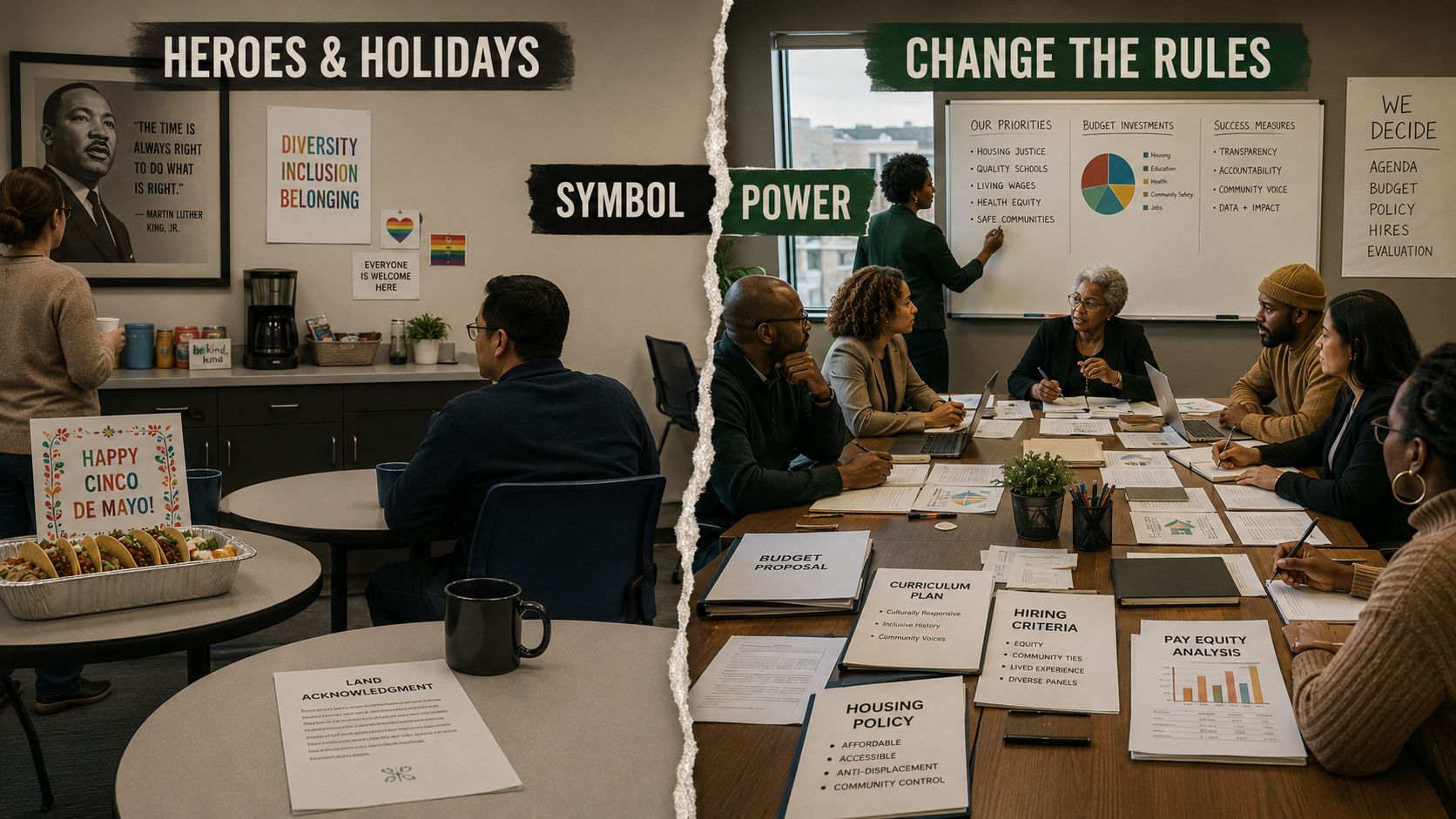
Every February, the same poster goes up in the break room. Martin Luther King Jr., mid-speech, arm raised, quote stripped of context and shrunk to fit a frame. Every May 5th, someone brings tacos to the office potluck. Every June, a rainbow logo. Every November, a land acknowledgment read aloud before the meeting starts, then never mentioned again.
None of that is nothing. But none of it is the thing itself.
That gap — between the gesture and the structure underneath it — is where "liberal" and "progressive" stop being interchangeable words people use loosely in the same sentence and start being two genuinely different theories about what's wrong and what fixes it. The confusion is understandable. Both sides vote blue. Both sides say they're against racism. But they disagree, sometimes sharply, about what racism actually is and what it would take to end it — and nowhere is that disagreement clearer than in how each camp handles race, specifically.
Two Theories of Change
The liberal approach starts from a basic faith: the system works, mostly, and where it doesn't, it can be fixed from inside. Liberals believe in gradual progress through established institutions — courts, legislatures, HR departments, school boards. The strategy is to protect rights, expand access, and promote fairness within the current system. Legal scholar Ian Haney López calls this framework "Liberal Race Theory": the belief that racial inequality can be overcome through gradual reform, legal protections, and equal opportunity, built on individual rights, colorblindness, and inclusion. In a conversation on the podcast The Weeds, López offered a shorthand for the split that's stuck with me ever since: it's like comparing Martin Luther King to Malcolm X. Same century, same enemy, fundamentally different theory of the case.
Related stories
The progressive approach starts from a different premise: the system isn't broken, it's working as designed, and the design itself is the problem. Progressives argue the system is structured to produce inequity and must be transformed, not just improved. Where liberals focus on individual rights and access, progressives focus on structural inequality, corporate power, and historical injustice — the rules, not just who gets let into the room where the rules get made.
Neither camp denies that racism exists. The disagreement is about its address. Is it a bug — a set of individual failures, outdated laws, and unconscious biases that a fairer, more inclusive version of the current system can correct? Or is it a feature — something built into the foundation, requiring not reform but rebuilding? That question is the whole argument, and almost everything downstream of it — including how each side handles Black History Month — follows from which answer you start with.
The Heroes and Holidays Approach
Nowhere does the liberal theory show its hand more plainly than in how it teaches, markets, and performs multiculturalism. Education scholar James A. Banks has a name for it: the Contributions Approach. I'd call it Performative Diversity. Most people just call it Heroes and Holidays.
The pattern is familiar because it's everywhere: feel-good celebrations and famous individuals — MLK posters in February, tacos on Cinco de Mayo — layered on top of a curriculum, a policy, or a company that stays exactly the same underneath. Recognition gets confined to festivals, food, and a handful of token "standouts," which has the effect, intended or not, of keeping people of color outside the engine rooms of power, policy, and historical recognition. You get the poster. You don't get the seat where the curriculum gets written, the budget gets set, or the promotion gets decided.
Scholars Ryuko Kubota and Angel Lin, writing on race and language education, put the critique even more bluntly: the liberal approach to multiculturalism celebrates superficial aspects of cultural difference — the heroes-and-holidays approach — in a way that evades white power and privilege entirely. It's a critique with three prongs. First, it doesn't acknowledge real difference; it flattens it into something palatable enough for a bulletin board. Second, it risks romanticizing "the other" — turning a culture into an aesthetic, a taco, a poster, a month. Third, and most importantly, it never touches power. You can celebrate a hero without ever asking who's still excluded from becoming one.
This is the liberal instinct applied to race: add a celebration, expand a mention, include a name in the textbook — and leave the system that produced the exclusion in the first place fully intact.
Change the Lens, Not Just the Symbol
The progressive answer to Heroes and Holidays isn't more inclusion of the same kind. It's a demand to change who's in the room when the rules get written.
Where the liberal approach adds representation at the surface — a face on a poster, a name on a syllabus — the progressive approach insists on embedding people of color in agenda-setting, rule-writing, and history-making, not just in holidays, food, or as token "firsts." The distinction isn't sentimental; it's practical. Diversity researcher Scott Page's work on collective intelligence backs this up with a hard-nosed argument: if your goal is quality and efficiency, performative diversity isn't just insufficient — it's wasteful. A team that adds different faces without adding different decision-making power gets the optics of diversity and none of the benefit. You've spent the goodwill and the budget line without changing a single outcome.
That distinction — symbol versus power — is the throughline of the whole liberal/progressive split, just made visible in miniature. Multicultural Night is the liberal fix. A permanent seat on the curriculum committee is the progressive one.
Why the Symbol Isn't Enough: The Data Underneath
It's worth being concrete about what gets left standing when only the symbol changes, because the numbers are stark. Audit studies out of the Rotman School of Management have found that "whitening" a résumé — stripping out racial cues — gets minority applicants more interview callbacks, and the advantage holds even at firms that publicly brand themselves pro-diversity. Separate field research has found that white job applicants with a felony record receive callback rates similar to Black applicants with clean records. Across housing, schooling, and hiring, whiteness itself functions as an unspoken quality metric — "more white" quietly read as "worth more" — not because a few bad actors are cheating the system, but because that reading is baked into how the system measures value in the first place.
A poster in February doesn't move a single one of those numbers. Neither does a taco on Cinco de Mayo. The fix, if there is one, isn't more Heroes and Holidays — it's changing how we price, rate, hire, and govern, so that measured value reflects actual results instead of racial composition. That's a progressive fix, by definition: it targets the measuring system, not the decoration on top of it.
The Safety Valve
There's a reason the liberal approach tends to stop at the poster and rarely gets to the pay scale, and it isn't just inertia. Noam Chomsky has described the function of what he calls the "liberal class" as a kind of safety valve — a mechanism that lets a system release just enough pressure, through just enough visible reform, to avoid the harder conversation about changing the system itself. Enough steam escapes that the boiler doesn't blow. Not enough escapes that anything underneath actually moves.
That's the progressive indictment of Heroes and Holidays in one sentence: it's not that the celebration is false, it's that the celebration is functional — it does real work, just not the work it appears to do. It converts a demand for structural change into a satisfied demand for recognition, and recognition is cheaper.
Where This Leaves the Argument
None of this means liberals are acting in bad faith or that progressives have some monopoly on caring. It means the two camps are answering different questions. Liberals are asking: how do we make the current system live up to its stated ideals — equal protection, equal opportunity, colorblind fairness? Progressives are asking: what if the system was never designed to deliver those ideals equally in the first place, and no amount of living up to it gets you there?
Heroes and Holidays is what the first question looks like when it's applied to a classroom, a company, or a calendar. Change the Lens is what the second question demands instead. Both are, in their own terms, sincere. Only one of them is willing to ask who gets to write next year's curriculum, not just whose face is on this year's poster.
Comments

Powered by RoundtableAn AI/DeFi-powered Enterprise Media Operating System. Learn more at Roundtable.io.© Roundtable 2026. By using this site you agree to the Terms of Use and Privacy Policy