


Sep 18, 2017 6:40 AM
Updated Feb 10, 2022 10:16 PM
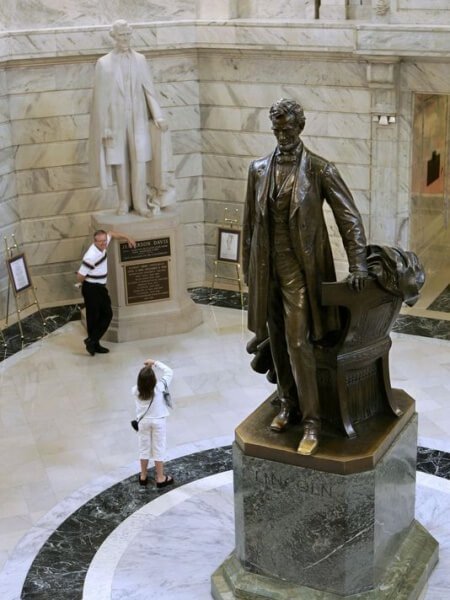
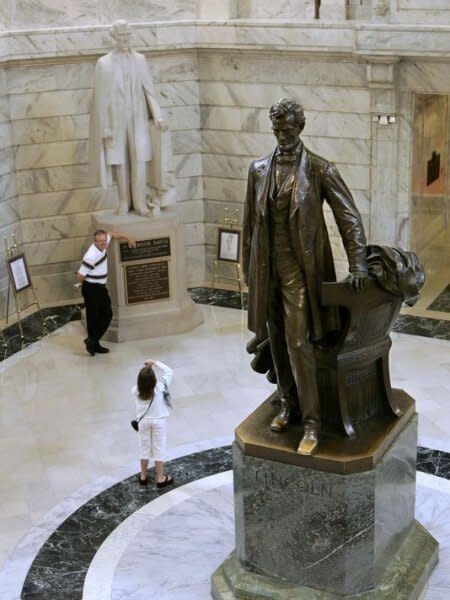
Berry Craig: Irony aplenty surrounds the creamy white—an appropriate hue—marble likeness that stands on a pedestal in the rotunda.
NAACP members and others are again trying to rid the Kentucky Capitol of an 80-year-old statue of Confederate President Jefferson Davis, who was born in the Bluegrass State in 1808.
“It’s important for all to realize how offensive these statues can be, especially to the African-American community,” Raoul Cunningham, Louisville NAACP chapter president, told the Lexington Herald-Leader.
“We are working on a meeting in a few weeks of like-minded individuals to plot a course to take the Davis statue out of the seat of state government and put it somewhere more suitable, like the Kentucky History Museum.”
Two years ago, the NAACP and other organizations and individuals pressed the state to remove the statue of Davis, a wealthy slaveholder and unabashed white supremacist who said white folks, God and the Bible all “recognize the negro” as “our inferior, fitted expressly for servitude.”
Related stories
Groups like the Sons of Confederate Veterans insist that taking down rebel statues and symbols robs them of their “heritage.” GOP Gov. Matt Bevin, echoing SCV sentiment, said banishing Confederate monuments from public property is a "sanitization of history," USA Today reported.
Irony aplenty surrounds the creamy white—an appropriate hue—marble likeness that stands on a pedestal in the rotunda.
Irony aplenty surrounds the creamy white—an appropriate hue—marble likeness that stands on a pedestal in the rotunda. A bronze plaque on the pedestal proclaims Davis a “PATRIOT,” “HERO” and “STATESMAN.”
However, Kentucky’s unionist Civil War legislature and pro-Union governors James F. Robinson and Thomas E. Bramlette viewed Davis as an arch traitor.
In a September, 1861, "Address of the Legislature to the People of Kentucky," a House committee scorned Davis as a liar for permitting his "insolent" soldiers to breach the Bluegrass State's fragile neutrality.
Afterwards, Kentucky declared forthrightly for the Union and for extra measure, the legislature made it a crime to join the Confederate army or to aid and abet the rebels.
The lawmakers represented majority opinion in Kentucky. Though a border slave state, Kentucky leaned toward the Union side.
The Davis statue has more to do with how Kentuckians later came to view the war than with America’s most lethal conflict itself. Kentucky embraced the Confederacy only after Davis’ side was licked in 1865, historian Anne E. Marshall explains in her book, Creating A Confederate Kentucky: The Lost Cause and Civil War Memory in a Border State.
“In a postwar world where racial boundaries were in flux, the Lost Cause and the conservative politics that went with it seemed not only a comforting reminder of a past free of nineteenth century insecurities but also a way to reinforce contemporary efforts to maintain white supremacy,” wrote the Lexington native, who’s a history professor at Mississippi State University.
The statue is a relic of white supremacist, Jim Crow Kentucky. It went up in December, 1936, when segregation and race discrimination were long-entrenched in law and the social order.
“It definitely reflects the time period when the United Confederate Veterans (the SCV’s predecessor), United Daughters of the Confederacy and others were declaring Confederate Memorial days, and celebrating the leaders of the Confederacy,” Marshall said.
“As far as the sanitizing history charge, that is a pretty inconsistent and vacuous argument coming from people who still want to glorify heroes of the Lost Cause, versus more moderate and even liberal people who are unsure about removal or at least want to contextualize monuments.
“It just doesn't work coming from [Confederate apologists] … I think they are worried about losing representation rather than ‘sanitizing’ history, which is their whole m.o.”
The Confederacy’s only president spent most of his life in Mississippi where he was a politician who owned a large plantation worked by many slaves.
Davis was all in for Dixie's peculiar institution. The war was only 17 days old when he effusively praised slavery in a speech to the Confederate Congress. He declared that bondage was a boon to black folks.
Never mind that their ancestors were kidnapped from their homes in Africa, crammed into hellish slave ships, and dragged off to white Europe’s New World in chains to be sold like farm animals.
Forget that their offspring, too, became slaves who had no rights. They, like their forebears, were forced to work long, grueling hours at no pay for whites who brutalized them physically and psychologically and considered them chattel—movable property—like a cow or a plow.
Davis insisted that slavery transformed African Americans “from brutal savages into docile, intelligent, and civilized laborers” and blessed them “not only with bodily comforts but with careful religious instruction.”
Davis added that “under the supervision of a superior race,” slaves were “so directed as not only to allow a gradual and marked amelioration of their own condition, but to convert hundreds of thousands of square miles of the wilderness into cultivated lands covered with a prosperous [white] people.”
The slave population, according to Davis, grew to more than four million because of “the mild and genial climate of the Southern States” and because of slave holders’ “increasing care and attention for the well being and comfort of the laboring class, dictated alike by interest and humanity.”
Predictably, Davis denounced Yankee abolitionists who dared insist that slavery mocked the Good Book—the Golden Rule in particular—and the passage in the Declaration of Independence that said “all men are created equal.” (Confederate Vice President Alexander H. Stephens said the Declaration was flat wrong. He said he was grateful to the Good Lord that the Confederacy was “founded upon exactly the opposite idea; its foundations are laid, its cornerstone rests, upon the great truth that the negro is not equal to the white man; that slavery, subordination to the superior race, is his natural and moral condition.”)
Slaves were happy and content, Davis implied, before “fanatical organizations” in the North became “assiduously engaged in exciting amongst the slaves a spirit of discontent and revolt.”
The Confederate president pilloried President Abraham Lincoln of Illinois, also a Kentucky native, and his anti-slavery Republican party—a party as different as chalk and cheese from Bevin and Donald Trump’s near lily-white GOP, which looks more like the party of Jeff Davis.

Lincoln won the presidency in November, 1860, on a platform that called for barring slavery from the federal territories in the West. Between December, 1860, and June, 1861, eleven slave states seceded because they feared that limiting slavery’s expansion was the first step toward Uncle Sam abolishing slavery, period.
Davis charged that “a spirit of ultra fanaticism” drove the Republicans. Lincoln’s "avowed object" was to use federal might to hem in the slave states with future free states, he asserted. Davis complained that in doing so, the Republicans were “rendering the property in slaves so insecure as to be comparatively worthless, and thereby annihilating in effect property worth thousands of millions of dollars.”
Davis argued that congressional foes of African American enslavement were guilty of devising “a persistent and organized system of hostile measures against the rights of owners of slaves in the Southern States.” Consequently, he said, the North forced the South to secede, thereby resuming “all their rights as sovereign and independent States.” By “rights,” Davis meant the rights of states to maintain slavery.

“Why do we want to keep his statue in our Capitol?” Cunningham asked. Why indeed?
Berry Craig
Comments

Powered by RoundtableAn AI/DeFi-powered Enterprise Media Operating System. Learn more at Roundtable.io.© Roundtable 2026. By using this site you agree to the Terms of Use and Privacy Policy