


Aug 11, 2026 6:18 PM
America’s real religion has a scoreboard—and a race problem.
America’s official religion has never been Christianity - that’s merely MAGA wishful thinking. This empire may wave the “good” book before elections, squeeze baby Jesus like a campaign stress ball, and drag God into every war, but its national faith has always been the games we play..
Our cathedrals have fifty-yard lines, our hymns are fight songs, and communion comes in a beer mug, and costs fourteen dollars. Boxing, baseball, basketball, and football are where American passion lives, prejudice hides, and tribal madness puts on a numbered jersey.
Sports explain, decode, translate, and delineate America
For generations, white men owned the teams, gates, rules, and microphones. Women were denied entrance; when men cracked open the door, they expected women to enter sideways, smiling and dressed for Sunday dinner.
They could compete—but not aggressively. Run—but remain graceful. Sweat—but never look sweaty. Women baseball players wore dresses; professionals wore skirts and attended charm school. Apparently, turning a double play without lipstick might collapse the republic before supper.
Related stories
Women could throw overhand, but men herded them toward softball and underhand pitching. The limitation was imagination. Men wrote the restrictions, then cited the results as proof: tie her shoes together, demand a race, explain why she runs funny.
White America performed the same crooked… crap with Black men.
Black athletes were blackballed, excluded not for lacking talent, discipline, intelligence, or courage, but because opportunity might puncture the fairy tale of White superiority before the seventh-inning stretch, and in front of White women and children.
To white men, undressing is akin to public castration
Black folks built their leagues and heroes through poverty, segregation, hostile crowds, secondhand equipment, and within a society constructing obstacles for amusement.
With enough righteous anger to power a freight train, we’ve forced our way onto the tilted field, showed out, and beat the hell out of men who insisted we could not play.
This is no genetic bedtime story. Melanin owns no stopwatch. The devastating point is that opportunity demolished White supremacy.
America changed the indictment. First, Black men lacked manhood. Once they won, they became too muscular, fast, aggressive, primitive, and dangerous. The accusation changed; the verdict remained preprinted.
Leather-clad gladiators supplied the Great White Hope. When Jack Johnson defeated Jim Jeffries in 1910, he punched through racial doctrine with a leather glove. America searched for a White savior to repair the world order.
That search never ended.
The NFL remains America’s soap opera: billionaires in suites, millionaires collecting concussions below, and fans believing jerseys qualify them to coach.
The league welcomed Black bodies before trusting Black authority. Black men could carry, catch, tackle, and sacrifice their knees. Quarterback meant intelligence, command, and control: field general, executive, astronaut, and homecoming king in shoulder pads.
That was the position White football intended to keep. Fair competition spoiled the arrangement.
The league packages marketable White quarterbacks as Great White Hopes. Drake Maye is the prototype. J.J. McCarthy is a born winner. Josh Allen is Buffalo’s Chosen One.
Bias lives in the second chances withheld from Black quarterbacks. A struggling White quarterback is developing; a Black quarterback is exposed. White confidence is leadership; Black confidence is arrogance.
Shedeur Sanders must improve, produce, and win. But some people do not want him coached; they want him humbled, broken, put in his place. They resent the watches, family name, and refusal to act like a grateful visitor. Deion Sanders’ self-assured son represents five felonies and an unsportsmanlike-conduct penalty to a White fan.
Meanwhile, jewelers are measuring Arch Manning’s head for a crown. If he reaches the NFL, expect a velvet pillow while Peyton and Eli hover like apostles. Arch may become great, but he will be permitted to become great. That permission—time, protection, presumed intelligence—is what Black quarterbacks fought to receive.
White American men no longer monopolize the NBA stage. European stars Nikola Jokić and Luka Dončić earned respect by playing ball—not by demanding lower rims or opponents required to dribble left-handed. Baseball became international. Boxing and track need no discussion; the evidence has calluses.
Black women transformed track and basketball. Venus and Serena Williams shook the country-club silverware; Coco Gauff, Naomi Osaka, and Simone Biles widened the breach. Whenever the racial ego feels crowded, America discovers “sports”: pickleball, cornhole, bed-making. ESPN will crown fitted-sheet folding. The word sport needs a back brace and union representation.
Perhaps this is the “replacement theory” MAGA intellectuals keep crying about. “MAGA intellectuals” —well, butter my ass and pass the grits; those two words look mighty uncomfortable together.
What reactionaries call replacement is competition arriving where monopoly once sat with its shoes off. White athletes have not been replaced. The presumption that they must always be centered, protected, and proclaimed naturally superior has been replaced.
Nowhere is that collision clearer than in the WNBA, where race, sex, sexuality, class, money, femininity, marketing, and power meet at center court.
Black women sustained that league while the media treated women’s basketball like a bake sale with referees. They accepted smaller checks, played overseas, built its culture, and kept it alive while experts explained why nobody watched.
Then Caitlin Clark arrived
Her talent is real, her influence undeniable, and the audience she attracted deserves acknowledgment. The problem is not that Clark shines. The problem is that America uses her light to pretend everybody else had been standing in darkness.
A mythology formed: Clark became the White heroine; Black veterans became jealous villains. Hard fouls became racial incidents. Trash talk became persecution. Ordinary resentment became proof that Black women were conspiring against the Great White Hope.
Clark did not invent that story or control every racist fool wearing her jersey. She has rejected racist and misogynistic agendas, called abusers trolls, acknowledged White privilege, and credited Black women with building the league.
But those words are now the easy route.
Clark keeps condemning racism in the abstract while avoiding the racists in the flesh. She says the smoke is unacceptable but will not point toward the MAGA factory belching it over the arena. Even after Republican lawmakers threatened to sic the Justice Department on the WNBA over allegedly “racially motivated” fouls against her, she offered no public divorce from the political movement trying to turn her into its Trojan horse.
One clean statement would do: “MAGA does not speak for me. Donald Trump does not speak for me. Stop using my name to attack Black women.”
She has not said it.
Instead, Clark appears to want the moral credit for declaring racism wrong without risking offense to the racially resentful portion of the audience that helped make her pop, sizzle, and sell. That silence protects the commercial coalition: decent new fans, Iowa loyalists, casual viewers—and the culture warriors who treat every hard foul on Clark like the Zapruder film.
She is entitled to political privacy. She is not entitled to pretend her silence has no political effect after powerful people place her name on their weapon. Neutrality becomes mighty convenient when the neutral party receives the shoe contract, television close-ups, and federal concern while her Black colleagues receive death threats.
Angel Reese knows the other side of that arrangement. One competitive gesture in college helped sentence her to years as America’s designated angry Black villain. The same swagger celebrated as fire in Clark became evidence of bad character in Reese. Whatever Reese says, does, wears, earns, or rebounds is fed into a machine already programmed to find jealousy.
Olivia Miles supplied a perfect example. After the Minnesota rookie scored 28 points in a victory over Indiana, an interviewer tried to frame the moment through Clark. Miles redirected the praise toward Kelsey Mitchell—the Fever guard who was torching Minnesota and finished with 37. Even when another woman owns the moment, the microphone bends toward Caitlin. That is not Clark’s fault. It is the Clark industrial complex doing what monopolies do: swallowing every story.
Then there is Sophie Cunningham, Clark’s Indiana teammate, who said transgender women should not compete in women’s sports, described her position as common sense, and insisted she was protecting girls rather than expressing hatred. The White House applauded, protests followed the Fever, and a reserve guard became a national culture-war franchise.
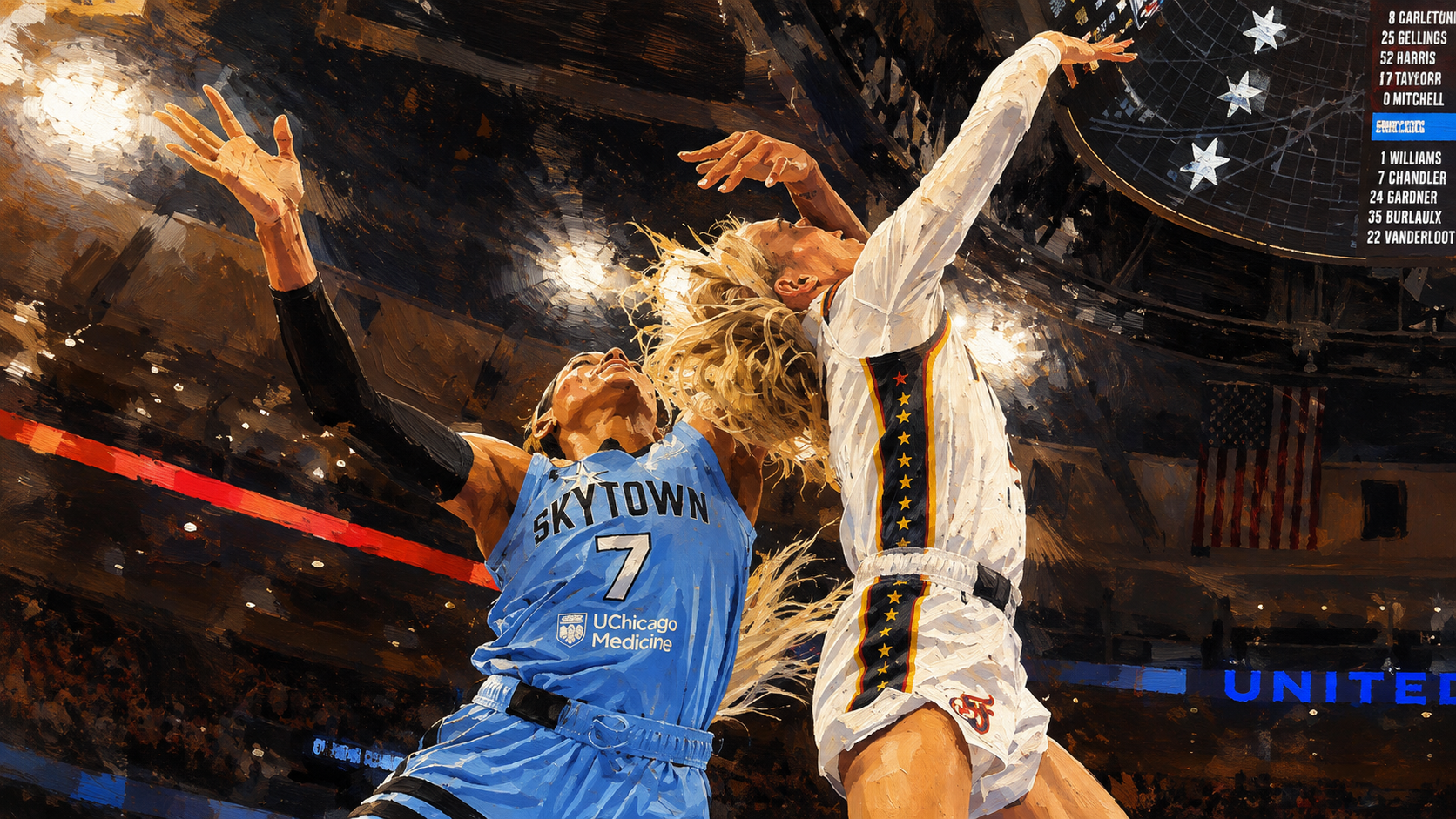
Days later, Chicago’s DiJonai Carrington came from behind on a fast break and struck Cunningham across the head and neck—a foul that looked one bad inch short of a televised decapitation. Officials called it unnecessary and excessive, assessed a Flagrant 2, and ejected Carrington. Cunningham sprang up and shoved Carrington; officials deemed her reaction understandable and did not penalize her.
From the locker room, Carrington posted two words—“WHITE PRIVILEGE”—and tagged the Fever.
White privilege is real. It shapes marketing, innocence, forgiveness, media framing, and who receives the presumption of victimhood. But a social fact does not make every individual accusation correct. Carrington nearly took Cunningham’s head off. If Carrington meant Cunningham enjoyed privilege by escaping punishment for the retaliatory shove, she needed to say that. Instead, she tossed a serious concept onto an obvious Flagrant 2 like hot sauce on burnt toast.
That does not disprove White privilege. It demonstrates how carelessly invoking it can hand MAGA exactly the cartoon it wants: Black players as violent, resentful, and forever crying race.
Carrington selected the wrong receipt from a store overflowing with legitimate evidence
And Cunningham’s transgender crusade shows the opposite danger. Politicians who spent decades dismissing women’s sports suddenly discovered sacred concern for female athletes the moment transgender people could be used as a campaign target. Their concern arrived suspiciously late and wearing a red hat.
That is why the WNBA has become America’s truth serum. Black women must be competitive but never intimidating, confident but always grateful, visible but not too loud, queer but not too visible, political only when their politics please sponsors, and marketable according to standards written elsewhere.
Racism decides who receives innocence. Sexism limits how much power women may display. Classism decides who profits. Politics selects the heroine and edits the villain before the commercial break.
Sports are not separate from America. They are America under stadium lights. The whistle blows, inherited status confronts actual performance, and old myths begin sweating through their makeup.
A fair field does not prove one race or sex superior. It proves nobody had the right to lock the gate, rig the rules, and call the resulting monopoly natural.
If your supremacy disappears when everybody receives a fair tryout, it was never supremacy. It was segregation wearing a varsity jacket, privilege holding the whistle, and fear hiding behind tradition.
It was a frightened empire fixing the schedule, choosing the officials, locking the visitors’ locker room—and still getting its ass whipped on national television.
And that, America, ain’t pretty.
But it is the score.
Comments

Powered by RoundtableAn AI/DeFi-powered Enterprise Media Operating System. Learn more at Roundtable.io.© Roundtable 2026. By using this site you agree to the Terms of Use and Privacy Policy