


Jun 17, 2020 9:00 PM
Updated Feb 10, 2022 10:10 PM
Ellen Birkett Lindeen: People of color must show up for work where they get exposed to the virus, and they are disproportionately dying in higher numbers. The pandemic has revealed racism in all its ugliness.
Health, Wealth, and Justice for African Americans
As a 65-year-old white woman, I was profoundly shocked and horrified by the brutal killing of Mr. George Floyd in Minneapolis by a white policeman with a knee on his neck. At the same time, I know many of my white friends are having a hard time understanding the violence and protests that have occurred since the killing. I hear people say: Why are people acting like this? What will make it stop? People say that they think these actions are counterproductive to changing policies for the better. Why would people hurt their own neighborhoods? This situation reminds me of the riots of 1968, which protested racism and assassinations and similarly destroyed buildings and property. Many of those areas are yet to be rebuilt. How is this time different? Will the outcome be the same? That depends, in part, on people like me, privileged white folks who somehow do not understand.
So, let us ask what is going on. What caused this horrible death of Mr. George Floyd to become the tipping point? After all, the killings of our black and brown sisters and brothers remain ongoing in our nation. Sadly, these incidents are nothing new. However, this time feels different. With phone video technology, people could view the incredibly cruel, painful suffocation of George Floyd. Additionally, when this appalling murder was taking place, many Americans were already suffering pain at home due to the pandemic and loss of jobs. Put all this together for African Americans, and 2020 has turned out to be a perfect storm of three different dangers: the COVID Pandemic, the Economic Slowdown, and Police violence.
Health: COVID and Jobs
Many of us have had our lives completely changed by necessary health restrictions to prevent the spread of the coronavirus. Most people have willingly participated in the required safety precautions to “shelter at home.” However, some jobs have been deemed essential: transit workers, grocery store cashiers, cleaning and food-processing workers, warehouse stockers, carry-out restaurant workers, and delivery persons. These dangerous jobs are disproportionally done by people of color. Journalist Kyla Mandel states “the pandemic is laying bare just how vital these workers are to keeping our everyday lives running smoothly ― and they’re among the country’s lowest paid, often with few benefits.”
Related stories
People of color must show up for work where they get exposed to the virus, and they are disproportionately dying in higher numbers. The pandemic has revealed racism in all its ugliness.
In addition to more people of color being on the front lines, the coronavirus pandemic has highlighted another crack in America’s racial and socioeconomic divisions — those who can do their jobs from home and those who cannot. Many people of color are in jobs that do not have the option of working at home, explains Danyelle Solomon, Vice President of Race and Ethnicity Policy at Center for American Progress. About 60 percent of people who said they work in “management, business and financial operations” reported to the Bureau of Labor Statistics that they could work from home. But fewer than 10 percent of workers said they could do so in categories described as “services,” “construction and extraction,” “installation, maintenance and repair,” “production” and “transportation.” As a result, people of color must show up for work where they get exposed to the virus, and they are disproportionately dying in higher numbers. The pandemic has revealed racism in all its ugliness.
This COVID-19 virus, which does not discriminate, is killing people in 213 countries, but in the United States, the group that has the most cases and deaths is African Americans. The Centers for Disease Control and Prevention released nationwide data on April 18, 2020, that revealed 30 percent of COVID-19 patients are African American, even though African Americans comprise 13.5 percent of the population of the United States. The coronavirus was initially called the great equalizer. However, this virus has only magnified the systemic inequities in this country.
Wealth: The Economy and Jobs
The United States is currently in the throes of a massive employment crisis due to the pandemic. Does this affect African American citizens differently than other Americans? The Bureau of Labor Statistics makes clear a basic fact in this country; black unemployment is generally twice as high as white unemployment. In February 2020 when the overall unemployment rate was 3.5%, a 50-year-low, the black unemployment rate was 5.8%. The white unemployment rate was 3.1%. This was true for unemployment figures during the Great Recession. The overall unemployment rate peaked at 9.6% in 2010. For black Americans, it was 16%.
The Federal Reserve explains that “the median net worth of black families is $17,600, compared with $171,000 for white families. A white family is likely to have $10 for every $1 a black family has.” Twenty two percent of black Americans lived in poverty in 2018, compared with 9 percent of white Americans. Rates of infection and death are exacerbated by the income inequities, physical health effects of discrimination, and access to health care. For fifty years, federal, state, and local government housing programs as well as private agencies used legal discriminatory practices, racial covenants, and redlining to prevent African Americans from buying homes in certain areas or from getting mortgages. This was racism by design. Decades later, these policies have made black Americans more likely to live in neighborhoods affected by environmental contamination, in turn raising rates of chronic illness. These housing restrictions, many still in place in 2020, contribute to the coronavirus killing more people of color, who have vulnerable health conditions.
Janell Ross in The Atlantic writes that, “as far back as 2013 . . . unemployment data available by both race and educational attainment [shows] 12.4 percent of black college graduates between the ages of 22 and 27 were unemployed. For all college graduates in the same age range, the unemployment rate stood at just 5.6 percent. The figures point to a devastating truth. Racism impacts black college graduates who are more than twice as likely to be unemployed.
Justice: Life and Death
The most egregious of these three threats to African Americans is the literal taking of their lives. Through video technology, millions of people recently witnessed two shocking murders. On February 23, 2020, months before the death of George Floyd, Ahmaud Arbery was “hunted down” and executed in Georgia by a white father/son duo who saw him jogging in their white neighborhood, grabbed a shotgun and a handgun, jumped in their truck, gave chase, and killed him. This video was not released until May, only weeks before the video capturing George Floyd’s murder by a white policeman on May 25. The suffocation of Mr. George Floyd, which lasted 8 min 46 seconds, struck a nerve with the American public. The arrogance and inhumanity of the police officer during the killing was shocking. This brutality will no longer be tolerated. People of all backgrounds, identities, and religions are alarmed and outraged. The protests that have not stopped speak to this new reality.
Even if one tries to discount the police killings of black men as anomalies, the criminal justice system in the United States is broken. The country has the highest incarceration rate in the world, 670 people per 100,000 population, with El Salvador second and Rwanda third. There are 2.2 million people in the United States prisons and jails, a 500% increase over the last 40 years. The Sentencing Project states that changes in law and policy, not changes in crime rates, explain most of the increase. Among these changes were harsh mandatory sentences, the “three strikes, you’re out” law, and cutbacks in parole release. While the United States makes up 5% of the world’s population, it holds 21% of the world’s prisoners. More distressing is the fact that African Americans make up 13.5% of the country’s population, but 38% of our prison population. Sociologists Krivo, Peterson, and Kuhl point out that in 2009, 62% of African Americans resided in highly segregated, inner city neighborhoods that experience a high degree of violent crime, while the majority of whites live in “highly advantaged” neighborhoods that experience little violent crime.
Often these African American neighborhoods are targeted by police. By arresting young boys and men, the school to prison pipeline trajectory begins. Today’s police culture has roots in early policing in this country. Southern states specifically began with “slave patrols” which were first used to terrorize slaves to obey plantation rules. After the Civil War, these patrols became local police departments. Their primary duty was to control freed slaves and enforce Jim Crow segregation laws. The behavior of today’s police is a direct result of their early history.
Over the last eight years, the killings of young African Americans have made the news. We know their names: Travon Martin, Eric Garner, Michael Brown, Tamir Rice, Philando Castile, Sandra Bland, and Breonna Taylor to name a few. In most cases, the police officers claiming self-defense or civilians using the “Stand your Ground” policies were not held accountable. Often the officers are not even charged, but when they are, they have been found not guilty, except once. Due to a dashcam video of a 2014 killing in Chicago, Officer Van Dyke was charged and convicted of the second-degree murder of 17-year-old Laquan McDonald. This verdict was much celebrated by the African American community, but little changed as a result.
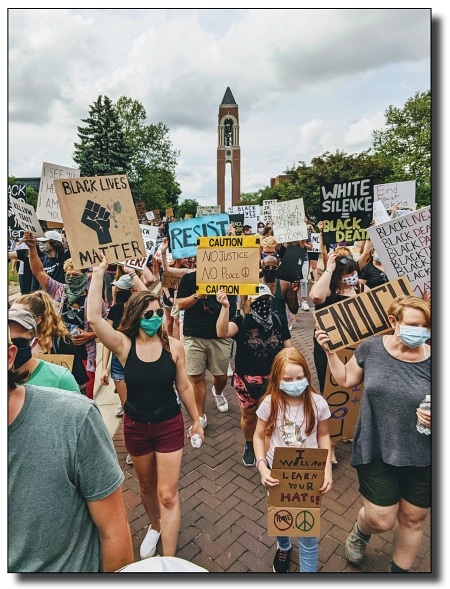
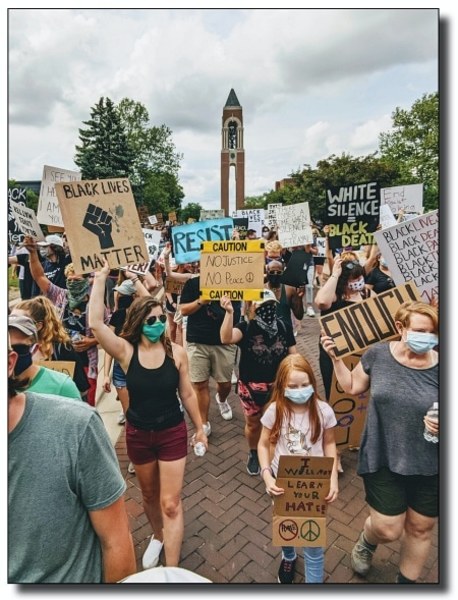
Before incidents could be documented with videos, police controlled the narrative of what was happening. With each new video, the public is becoming more and more aware. Racism is not occurring more; it is being revealed. The 2020 riots reflect the constant pain of people of color, particularly African Americans, that has reached its breaking point. I am proud that so many of my fellow white citizens have taken to the streets in massive numbers, in masks but risking exposure to COVID, to join the protests in solidarity with the Black Lives Matter movement. I do not believe that the protests will not stop until substantial legislative changes are made that work toward equality and justice.
I know that there are still people who do not understand the current protests across the country and around the globe. But letting a demonstration be judged by its most violent participants but not judging a police force by its most violent cops is wrong. The killing of George Floyd while he cried out for his mama, combined with so many lives lost needlessly from COVID, along with continued job losses, was like throwing fuel on the fire in this year of pandemic and economic uncertainty. The orderly protests and chaotic violence are both a kind of primal scream about the racist culture that we must acknowledge and change. The scream has been heard around the world.
As Rev. Dr. Martin Luther King, Jr. stated, “A riot is the language of the unheard.” African Americans have endured slavery, Jim Crow, education and housing discrimination, unjust arrests and trials, and mass incarceration. Just as Bull Connor’s brutal use of fire hoses and attack dogs in 1963 Birmingham, AL, “shocked the conscience of the nation,” this video of George Floyd’s last minutes is our country’s great white awakening to the continued prevalence of racism.
African Americans have felt the triple threats of COVID-19, job loss, and killings; this has forced all Americans to see a new reality. American lawyer, Founder and Executive Director of the Equal Justice Initiative, Bryan Stevenson, explains in his book Just Mercy, “The great evil of American slavery wasn’t the involuntary servitude; it was the fiction that black people aren’t as good as white people, and aren’t the equals of white people, and are less evolved, less human, less capable, less worthy, less deserving than white people. This is why I have argued that slavery didn’t end in 1865, it evolved.”
As a white person, I believe we can make changes. We can breathe. We can vote for change. We must work to be the change we want to see in the world.
Ellen Birkett Lindeen
PeaceVoice
Did you find this article useful? Please consider supporting our work by donating or subscribing.
Comments

Powered by RoundtableAn AI/DeFi-powered Enterprise Media Operating System. Learn more at Roundtable.io.© Roundtable 2026. By using this site you agree to the Terms of Use and Privacy Policy