
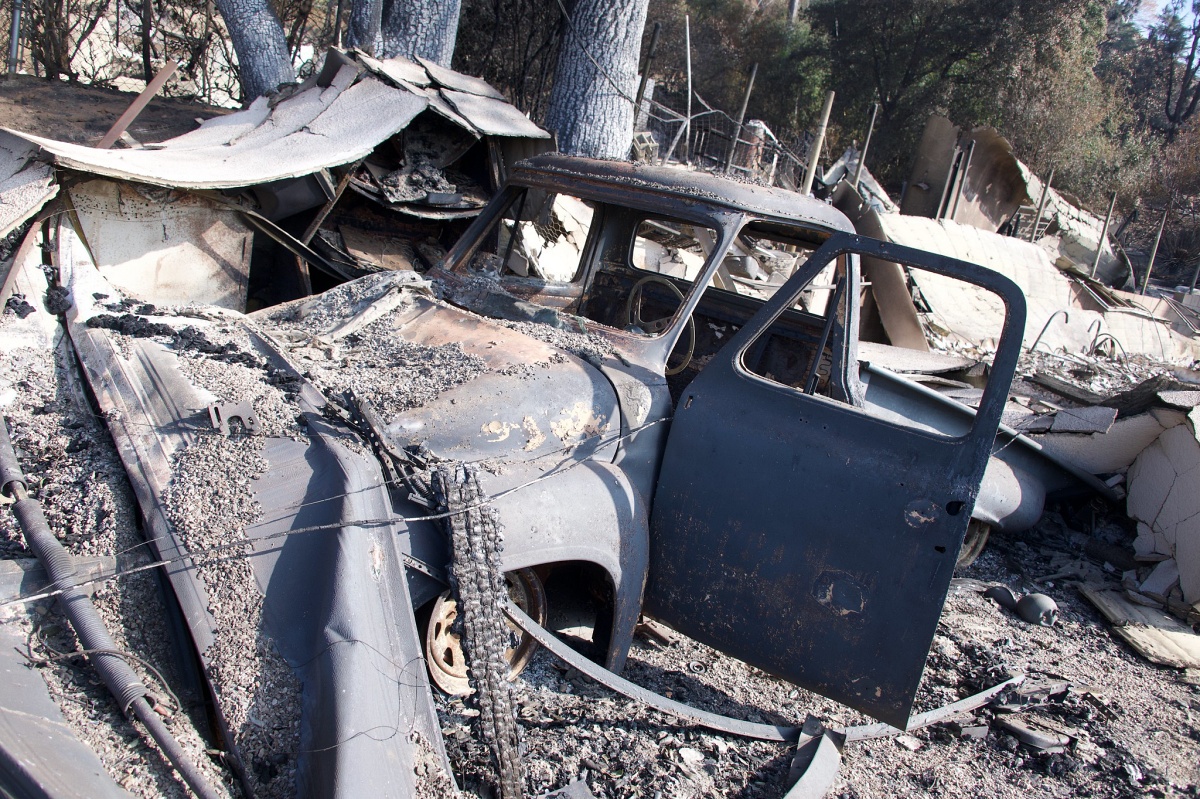
Steve Lyon • 2025 Eaton Fire • Attribution-ShareAlike (CC BY-SA 2.0) • Flickr


Public Banking Help Rebuild LA
Feb 24, 2025 5:15 AM
Updated Feb 24, 2025 5:29 AM
An assessment of the speech given by former VP Kamala Harris at the 56th NAACP Image Awards in Pasadena
There are moments in history when a leader stands before their people, eyes locked in shared struggle, voice rising to meet the weight of the occasion. This was not one of those moments.
Former Vice President Kamala Harris took the stage at the 56th NAACP Image Awards in Pasadena, a city that borders Altadena. Known as "The Denamena" to locals, introduced to the world by the Eaton Canyon wildfire, Pasadena and Altadena are governed by two separate governing bodies, separated by an invisible line, but both have a deep Black history and fresh Black pain. The moment practically begged for a speech that embraced Black folks' culture, struggle, and resilience. Instead, Harris gave us a polished, middle-of-the-road political speech that, while fine on its own, utterly failed to acknowledge the people who needed her words the most.
She didn’t center on Blackness. She didn’t embrace the culture. She didn’t speak to the kinfolk or the fam-bam or give us a universal “my people’s and ‘nem.” Sis, you were home. You were safe. You were in the community. And yet, you chose to play it safe.
A Missed Opportunity in a Historic Space
The NAACP, founded in 1909, has always been the vanguard of Black civil rights in America. The Pasadena Branch is the 16th chartered in the century-old storied legacy organization. From legal battles against segregation to present-day fights against voter suppression, this organization has been at the forefront of Black advocacy. But let’s be real: the NAACP Image Awards is more than just an awards show. It’s a moment to celebrate Black excellence, affirm our contributions, and sometimes confront the hard truths of our collective reality. The former didn't disappoint. As for Harris, it felt like the auntie didn't bother coming around the family.
Related stories
Harris, a lifetime NAACP member, certainly understands this. Yet, in a room full of Black artists, activists, and leaders, she delivered a speech that could have been given at any Democratic fundraiser or generic campaign rally. It lacked the specificity, warmth, and cultural grounding a Black audience deserved.
It was very patriotic—more Betsy Smith, not so much Harriet or Sherly.
This wasn’t just any city, either. Pasadena, specifically Altadena, has long been a historic enclave for Black families in Southern California. And just weeks before Ms. Harris took the podium at the Pasadena Convention Center, it was an emergency shelter for people displaced by the Eaton Canyon Fire. Many of them Black. Many of them had just lost everything. Many are now unhoused—an uncounted number living in cars or entire families couch-surfing.
And yet, not a single mention. No acknowledgment. There was no moment of pause for those still reeling from the devastation.
The Disconnect: A Pattern, Not an Accident
Let’s be clear: this is not just about a single speech. This is a pattern—a throughline that connects Harris and, frankly, much of the Democratic establishment to a broader issue—the inability to speak directly to the culture when it truly matters. We saw this in her presidential campaign when her messaging often felt strained when addressing Black voters. We see it now as Black communities grapple with political disillusionment, economic disparity, and ongoing racial injustice.
And let’s not pretend like this is a partisan issue, either. Trump never showed up in Altadena. But Harris did. She saw the devastation firsthand. All the more reason to question why she delivered such a canned speech. The fascist-in-chief did exactly what Black folk have come to expect from him, but the former VP surprised and disappointed many of us.
This is what happens when political figures see Black voters as a monolith to court every four years rather than a community with acute, immediate concerns. When speeches are focus-grouped into oblivion, stripped of passion, and sanded down to avoid controversy, they lose something critical: authenticity.
What She Could Have Said
Had Harris taken a moment to connect, to name the pain in the room, to acknowledge that just outside those doors, Black families were recovering from tragedy—she would have won the night. Had she invoked the spirit of past Black leaders who never hesitated to speak directly to the people, she would have left that stage with more than polite applause. She would have left with trust.
Imagine if she had said:
“I see you to the families impacted by the Eaton Canyon Fire. I honor you. This community will not forget you.”
“To the Black creatives in this room, your art is more than entertainment—it’s revolution. And I stand with you in ensuring our voices are heard and protected.”
“To the young Black activists watching tonight, know that your fight for justice is part of a long and proud legacy. Keep pushing.”
These are not radical statements. They are human ones.
VP Kamala Harris had a chance to address the moment, people, and culture, but she chose not to. This makes her speech so disappointing—not because it was terrible, but because it was safe. We do not need safety right now; it does not move us forward.
Sista, you were home.
But you spoke like a guest. And that, more than anything, was the night's unfantastical crescendo of (un)Black Excellence.
Comments

Powered by RoundtableAn AI/DeFi-powered Enterprise Media Operating System. Learn more at Roundtable.io.© Roundtable 2026. By using this site you agree to the Terms of Use and Privacy Policy