
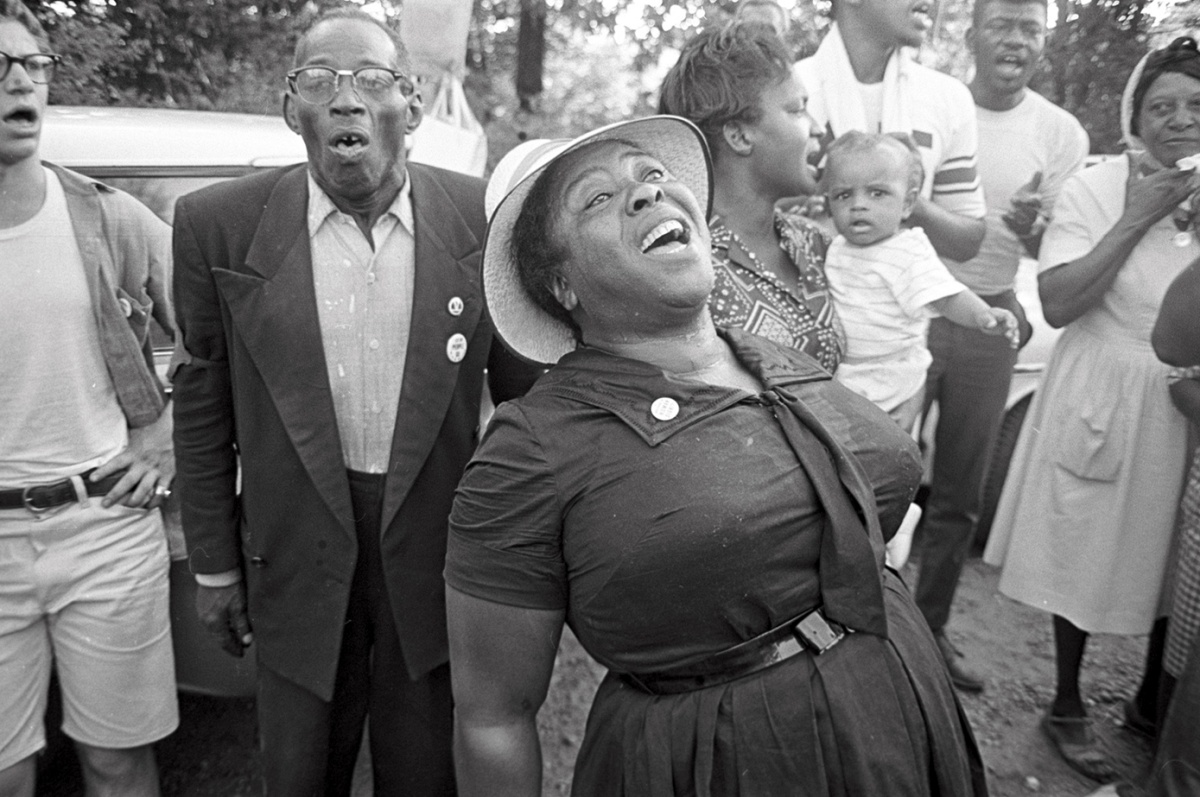
Fannie Lou Hammer • Wikimedia Commons


Cotton Picker Planted the Seeds
Sep 22, 2024 3:09 AM
It would be difficult for most of us today to imagine the terroristic regime that Blacks like Hamer lived under in former Confederate states.
When Kamala Harris accepted the presidential nomination at the Democratic National Convention in August, and even when she spoke with emotive language with Oprah Winfrey in a Sept. 19 livestream interview, it represented more than a milestone in her journey toward the country’s highest office.
For a woman of South Asian and Caribbean descent raised by a single mother, it also marked the culmination of decades of slow progress in civil rights, gender equality, and diversification of the Democratic Party—progress set in motion 60 summers ago by a Mississippi sharecropper, Fannie Lou Hamer.
Harris, of course, is refusing to respond to Donald Trump’s and J.D. Vance’s baiting over her biracial identity; a mixed heritage is commonplace and non-threatening to most Americans, anyway. While she does not make her race or ethnicity a focus of her campaign, it is worth recalling how hamstrung the Democratic Party was by racism, and overwhelmingly male and white, until after Hamer came along.
Hamer, in the summer of 1964, was relatively little-known outside of her hometown. The homegrown founder and leader of a Sunflower County, Mississippi poor-people’s movement, she put her own life at risk to register to vote and run for local office as an African American in her rural community.
Related stories
On a stifling August day, visibly weary after a bus ride of more than 20 hours, the activist arrived at the Jersey Shore boardwalk with her fellow members of her Mississippi Freedom Democratic Party (MFDP). They demanded that the omnipotent, lily-white Mississippi Democratic Party delegation to the Democratic Convention being held in Atlantic City be dissolved and immediately reconstituted with members of the MFDP.
It would be difficult for most of us today to imagine the terroristic regime that Blacks like Hamer lived under in former Confederate states, or the radical nature of her demand for equality. The head of the Mississippi delegation was a proud member of the “states’ rights” voting bloc in Congress, James Eastland. As the son and the nephew of a pair of catalysts of a white mob that notoriously burned, mutilated, and lynched an African-American couple on the grounds of a church at the turn of the 20th century about two miles from where Hamer would be born, one of 20 children in her family, Eastland was known as the face of Jim Crow in the U.S. Senate.
Hamer insisted on knowing whether the Democratic Party celebrated for the newly minted U.S. Civil Rights Act “takes its place with the oppressed Negroes of Mississippi or their white oppressors, with those loyal to the National Democratic National Party, or those who have spewed hatred upon President Kennedy and President Johnson and the principles to which they dedicated their lives.”
Permitted to testify before the convention’s credentials committee, Hamer limped to a chair and set her white handbag on top of the table in front of her, wearing a short-sleeved dress and earrings. With a blood clot in one eye from an injury she incurred from a jailhouse beating by police, she spoke of how, after attempting to register to vote, she was fired from the Sunflower plantation where she had worked for 18 years, how night riders sprayed the homes of her African-American neighbors with bullets to keep them from voting, and how she was bludgeoned on her way home from a citizenship training school.
“All of this on account of we want to register, to become first-class citizens,” the civil rights activist said plaintively, cameras rolling. “And if the Freedom Democratic Party is not seated now, I question America. Is this America…?”
President Lyndon Johnson, though he had just signed the landmark Civil Rights Act, tried to preempt the broadcast of Hamer’s testimony with a news conference, fearing a walkout by the Mississippi segregationist delegates and other white supremacists.
President Lyndon Johnson, though he had just signed the landmark Civil Rights Act, tried to preempt the broadcast of Hamer’s testimony with a news conference, fearing a walkout by the Mississippi segregationist delegates and other white supremacists. But when the president finished talking, the networks re-broadcast Hamer’s quietly powerful remarks—now in prime time, with millions watching on TV.
Democratic Party lawyers and operatives dispatched by Minnesota Sen. Hubert Humphrey, whom LBJ was soon to name as his running mate, tried to convince Hamer and her associates to accept as a compromise a pair of at-large nonvoting seats along with unspecified pledges of greater representation at the convention to come in 1968.
At the same time, Democratic civil rights champions, including New York lawyer and councilman-at-large Paul O’Dwyer and Bob Moses of the Student Nonviolent Coordinating Committee, stood by her side. “We didn’t come all this way for no two seats,” she declared at a meeting with fellow activists and party officials in a church off the boardwalk.
“The Mississippi Freedom Democratic Party has met all the requirements of the law, and the law of the state of Mississippi,” O’Dwyer declared, “while those who are seated in their place have qualified by violence, arson, threats, discrimination, bigotry, tyranny, and every form of intimidation imaginable.” The regular Mississippi delegation, said the firebrand lawyer, who grew up in a tiny rural hamlet in western Ireland during the Irish War of Independence and emigrated to America in 1925, ”come with the sponsorship and approval of apostles of hate.”
This past August, the presence of African-American women on the credentials committee for the Democratic convention in Chicago was a reminder that the party is different today, and Hamer’s memory was honored with a “Freedom Trail” marker at the Atlantic City boardwalk, the first of its kind outside Mississippi.
But voting rights and representation for American Blacks and others are again at risk as Trump insults factuality with bogus claims of election fraud, which he appears poised to press if he loses the election but not, of course, if he wins.
Hamer died in 1977 at the age of 59. If she were living now, she’d be gratified by Harris’s nomination for president. Saying she was “sick and tired of being sick and tired,” she blazed the trail that led to Harris, and was a true democratic hero whose remarkable courage remains relevant today.
Robert Polner and Michael Tubridy are the coauthors of “An Irish Passion for Justice: The Life of Rebel New York Attorney Paul O’Dwyer,” published by Cornell University Press/Three Hills.
Comments

Powered by RoundtableAn AI/DeFi-powered Enterprise Media Operating System. Learn more at Roundtable.io.© Roundtable 2026. By using this site you agree to the Terms of Use and Privacy Policy