
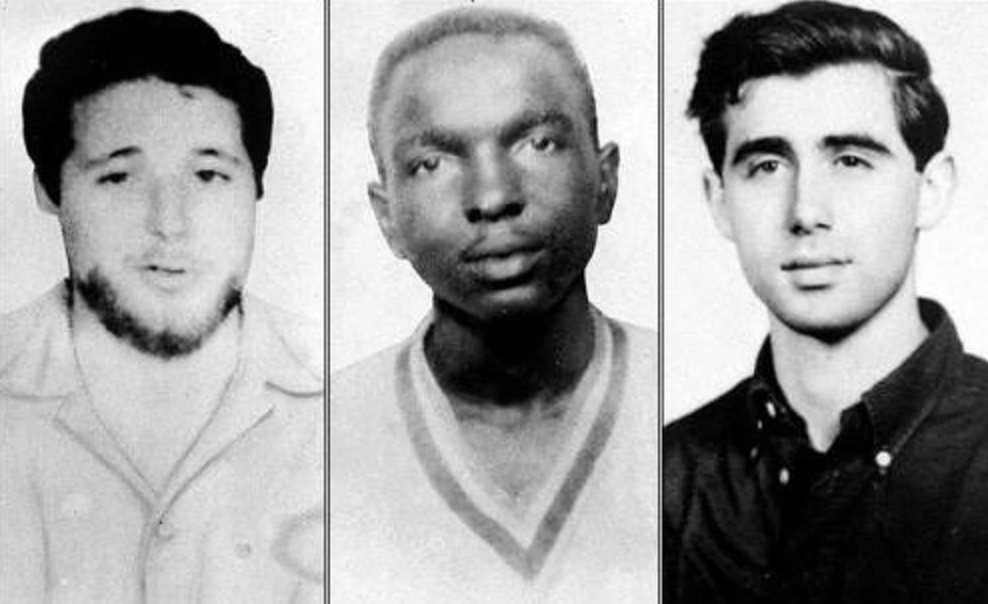


Three Civil Rights Workers
Jun 21, 2024 7:00 AM
Their murders shocked the nation 60 years ago today
On the night of June 21, 1964, the phone rang in my apartment. I answered it. Without even saying hello, my mother blurted out, “Mickey’s missing.”
I knew immediately what she meant. Mickey Schwerner had gone missing in Mississippi. He was the son of Nat and Annie Schwerner, best friends of my parents since before I was born. Mickey and I had both gone to Cornell, he graduating in 1961, me a year later. On New Years Day 1964, we were with our families at an annual gathering hosted by mutual family friends. He and I talked about his plans to go live in Mississippi with his wife Rita and work for the civil rights group CORE, the Congress of Racial Equality, registering Blacks to vote. I knew Mickey as a very sociable guy at college, but now I realized that he was also a very dedicated one. It was the last time I ever saw him.
According to the sketchy information on TV, Mickey had driven from Meridian to Philadelphia, Mississippi, to investigate the burning of a black church there which housed a CORE Freedom School. He was accompanied by James Chaney and Andrew Goodman. For James, a young Black man born in Meridian and a Freedom Rider, working with Mickey on voter registration was at great risk to himself. For Andy, a student from New York, it was his first day in Mississippi working for CORE’s Freedom Summer voter registration project.
Merely driving around rural Mississippi at night in mixed racial company was dangerous. We all feared the worst, but didn’t speak of it.
Related stories
When they hadn’t returned to Meridian by evening, people became alarmed. Merely driving around rural Mississippi at night in mixed racial company was dangerous. We all feared the worst, but didn’t speak of it.
Family and friends had always called him Mickey, but the TV and newspaper reports referred to him as Michael, his given name. That added to the sense of unreality about what was happening, as though it was a story about someone else. Inevitably, Rita became a target of the news media. A TV reporter stuck a mic in her face and asked, “Did you love your husband?”
I joined demonstrators demanding that the federal government look for them, chaining ourselves to the federal courthouse in lower Manhattan. I stayed there a couple of days, sitting on the stone steps and sleeping on them one night. I kept to myself and didn’t tell anyone of my relationship with Mickey. I didn’t want to talk about it. I just wanted to feel that I was doing something by being there.
On June 24, we were horrified when we saw on TV that their station wagon had been found, a burned-out shell. President Johnson called Annie and Andy’s father Robert to tell them that FBI Director J. Edgar Hoover had informed him that there were no human remains in the car. That raised a glimmer of hope, which faded as several more days passed with still no sign of them.
It was maddening watching reports in which the local police in Mississippi claimed that they were in hiding, a stunt to get publicity and bring the feds to town. The same story line was parroted in Washington by Mississippi’s two U.S. Senators, staunch segregationists. One of them, James Eastland, was chairman of the Judiciary Committee.
The lack of concrete news led to a bizarre turn of events: my father consulted with a psychic. He was normally a man of logic, a Phi Beta Kappa graduate in chemistry from City College of New York, a businessman, and a part-time math teacher at CCNY. For him to do something so totally out of character showed just how much stress everyone was under.
An acquaintance of his in the New York City police department told him about a psychic in Holland, Gerard Croiset. Apparently, he had been helpful to the police there in solving a number of cases. So my father contacted Jack Harrison Pollack, author of Croiset The Clairvoyant. He also contacted Congressman Ogden Reid, who represented the district in Westchester where Nat and Annie lived. Reid agreed to transmit to the U.S. Justice Department any information Croiset provided.
Pollack immediately set up a call with my father to Croiset, whose first words were, “The three boys are dead.” That was reluctantly becoming obvious to all of us, but it was chilling hearing it spoken aloud for the first time. Croiset also provided a description of where their bodies were, “about fifteen to twenty miles from their car in a deep, swampy place near some kind of construction.” That information was relayed to the FBI. Three weeks after the call, my father flew to Holland and spent several hours with Croiset, tape-recording their conversation, a transcript of which was sent to the FBI.
Then, on August 4, the FBI dug up an earthen dam near Philadelphia, and found the bodies of Mickey, James, and Andy. After being beaten and shot near their car, they had been brought there and buried by a large bulldozer.
For weeks, there was nothing new to report out of Mississippi. We were suspended between knowing but not knowing. Then, on August 4, the FBI dug up an earthen dam near Philadelphia, and found the bodies of Mickey, James, and Andy. After being beaten and shot near their car, they had been brought there and buried by a large bulldozer. The FBI said it was acting on a tip from an informant, Croiset hadn’t helped solve the case. But his mental image uncannily evoked the burial scene.
That evening, President Johnson went on national TV to announce that the U.S. was conducting air strikes against military facilities in North Vietnam. It was the beginning of the escalation of the Vietnam War, which would leave many more bodies in its wake.
I went to New York to attend a memorial service on August 9. Mickey and Andy’s parents and James’s mother were there, as were my parents and some 2,000 other mourners, including civil rights leaders John Lewis and James Farmer.
After the service, I waited outside for Annie. She had been a vivacious woman but now was withdrawn and subdued, looking older and shorter than she had at the party on New Year’s Day. When she saw me, she stopped, said “Hi sweetie” in a weary voice, and put her hand on my cheek. She’d known me since I was born, as my mom had known Mickey. It was as though Annie touched me to assure herself that I was still there. Her son was gone.
Comments

Powered by RoundtableAn AI/DeFi-powered Enterprise Media Operating System. Learn more at Roundtable.io.© Roundtable 2026. By using this site you agree to the Terms of Use and Privacy Policy