
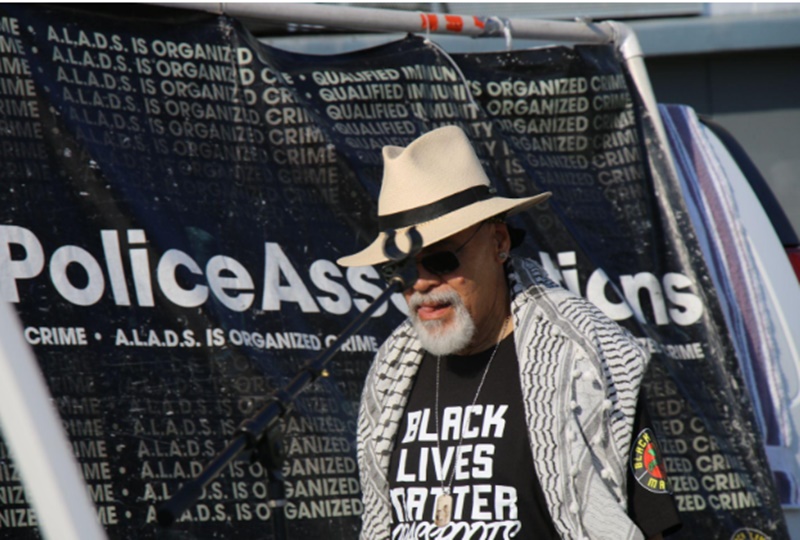


Greg ‘Baba’ Akili a storied activist has been on the frontline for over 50 years.
Jul 20, 2024 5:47 PM
BLM Grassroots provides hope, comfort, and a sense of community for families who have lost loved ones to police violence or white supremacist terrorism.
For 178 straight weeks, sometimes drawing crowds in the hundreds and other times gathering only a few dedicated souls, Black Lives Matter Los Angeles (BLM LA) has rallied outside the LAPD Protective League's downtown headquarters. Long-time activist Sheila Bates delivers her impassioned weekly call to action: “Just do the M-F’ing work.”
The work Bates refers to is the relentless activism that has fueled the global Black Lives Matter movement, even under the punishing, near triple-digit heat of Los Angeles. Despite the sweltering temperatures, tears and sweat mingled on the pavement while joyful laughter echoed off the walls of the ACLU SoCal building and the nearby fortified police sanctuary. This juxtaposition symbolizes the arduous struggle for justice.
This grassroots dedication began to take shape in February 2012, following the tragic death of fourteen-year-old Trayvon Martin. Targeted, stalked, and killed by George Zimmerman in the teen's gated community in Sanford, Florida, Martin's untimely homicide sparked a firestorm of righteous outrage and a movement that has yet to wane.
For over 4,015 days, Trayvon Martin’s name and image have remained symbols of the fight against racial injustice. His death illuminated the pervasive issues of racial profiling and vigilantism, igniting a digital uprising through the hashtag #BlackLivesMatter. This powerful phrase, coined by three digital organizers—Alicia Garza, Patrisse Cullors, and Opal Tometi—resonated deeply within a nation forced to confront its biases and systemic racism.
Related stories
Los Angeles quickly became a pivotal center for this movement. Local activists assembled under the Black Lives Matter banner, where the concept of group-centered leadership began to crystallize. The first chapter of Black Lives Matter Los Angeles took shape in Saint Elmo's Village. Dr. Melina Abdullah, a Pan African Studies professor, emerged as a co-founder, thrusting herself into the center of the movement, transitioning online messaging into offline activism.
Though not often credited as the true founder of the national movement, those familiar with its origins understand the distinction between ‘organizers,’ mobilizers‘ and ‘activists.’
In 2020, the movement reached a fever pitch. The murder of George Floyd galvanized the world, making Black Lives Matter a household name. Corporations, eager to align with the rising tide of social consciousness, pledged support to the movement, resulting in an influx of at least $90 million, according to a 2022 IRS 990 filing.
Dr. Abdullah reflected on this in an October 2023 interview with the LA Progressive: “As we were building towards freedom, others were building their own fortunes. In particular, the Black Lives Matter Global Network Foundation (GNF) was the legal entity receiving the bulk of the donations. Most on-the-ground organizers were too busy doing frontline work to be sidelined by what was largely seen as administrative functions.”
At the same time, Cullors, one of the BLM co-founders, wrote a transition plan designating the movement’s resources to BLM Grassroots while granting temporary legal authority to Christman “Shalomyah” Bowers, a highly paid political consultant with no background in community organizing. Bowers is now primarily responsible for the foundation’s finances, once estimated at $100 million.
However, the initial surge of resources and attention has since waned, leaving the movement under-resourced and underfunded. Yet Abdullah, Executive Director of Black Lives Matter Grassroots, remains undeterred. She has vowed to continue their efforts as a “movement, not a moment.”
While the public may be confused about the different iterations of BLM, Abdullah clarifies: “Black Lives Matter Grassroots is Black Lives Matter.” She emphasizes their role as the ‘boots on the ground’ since day one.
Just Do the M-F’ing Work
Despite these challenges, BLM Grassroots provides hope, comfort, and a sense of community for families who have lost loved ones to police violence or white supremacist terrorism. Testimonies from family members consistently reveal two common threads: overwhelming grief and the realization that their deceased relative was often asking for help during a mental health crisis.
Take the case of Vanessa Marquez, a 49-year-old Latina actress fatally shot by South Pasadena police officers. Minerva Garcia, a close friend of Marquez, found solace in BLM LA after the incident. Marquez, who was experiencing a mental health crisis, was shot after allegedly brandishing a BB gun at officers conducting a welfare check. Garcia recalls the tragic day: “Vanessa was murdered because she asked for medical help, and that haunts me. She was very ill; she had four autoimmune diseases, and there was no help to be found. The only answer from the system was to murder her.”
BLM LA not only supported Garcia emotionally but also helped her navigate the social complexities following the tragic loss. Garcia speaks to the importance of community support: “I am forever grateful that Black Lives Matter gives us this opportunity and the space to tell our stories, as hard as it is. In that spirit, I am going to keep fighting. [I feel like] if I had this community around her, I might have saved her.”
Similarly, the story of Jonathan Hart, a Black transgender man killed by a Walgreens security guard, highlights the intersecting injustices of racism and transphobia. Hart, accused of shoplifting, was shot, and his family turned to BLM LA for support.
Hart’s cousin, Cori, regularly speaks at the weekly ‘End Police Associations’ protests, emphasizing the broader implications of their fight: “My cousin was targeted and killed because of systemic racism and transphobia. The support from BLM LA has been invaluable in our pursuit of justice.”
BLM LA also extends its reach into diverse communities. The story of Yin and Yong, twin brothers from the Korean community, underscores the movement’s intersectionality. One brother, suffering from a mental health issue, was fatally shot by police. The surviving brother found an ally in BLM LA, which has worked to bridge gaps between Black and Asian communities, advocating for justice across racial lines.
In a tragic incident, LAPD video showed officers shooting a mentally ill man seconds after entering his Koreatown home. Yong Yang, 40 years old, was being evaluated by a mental health clinician when the shooting occurred. Despite the clinician’s recommendation for inpatient treatment, armed officers were called to the scene, leading to the tragic shooting. The surviving brother reflects: “My twin brother was having a mental health crisis, and instead of receiving help, he was met with violence. The support from BLM LA has been crucial in our fight for justice.”
Not many in his homogenized, close-knit pocket of LA understand.
“I never knew about qualified immunity,” Yin confessed.
Additionally, some have lived for decades in the aftermath of police violence. Verneen Mincey’s brother, James Thomas Mincey, was killed by LAPD officers on April 5, 1982. Mincey has spent much of the past 42 years organizing and advocating for justice.
Mincy shares kinship with others affected by police violence, often sharing ways to learn from the painful consequences of invitations they had no say in declining.
A key aspect of BLM Grassroots work is its Rapid Response Team, which travels across the country to provide immediate support to families affected by police violence. This team, an indispensable part of the movement, offers emotional and logistical assistance, helping families in their most vulnerable moments.
They have come closer than most families following an eight-year quest to have their day in court.
An opportunity that ended favorably for the Joesphs.
Now they face an appeal from the Hilsbourgh County Sheriff's Department seeking to use ‘qualified immunity’ to avoid paying out an eight-figure jury award to the family, finding the department negligent in the 14-year-old death in February of 2014.
As the rally outside the LAPD Protective League headquarters winds down, the sun sets on another blistering day. The participants' unity and purpose are undeniable.
Solidarity is vital for those affected by loss. BLM Grassroots has become more than just a movement; it is a lifeline, providing families with the strength to confront systemic injustices while fostering a community that empowers them to share their stories.
Each week, they come together, standing firm against their challenges and reminding the world that the fight for justice continues.
In a time when hope can feel elusive, BLM Grassroots is a reminder that together, communities can heal, fight back, and demand justice
The work is far from over, but it is being watered by resilience.
Greg ‘Baba’ Akili, a veteran activist, captures the movement’s spirit in his closing remarks: “We are here not just for ourselves, but for every life unjustly taken, for every family left to mourn. In the face of adversity, we stand together to demand justice and equality for all.”
Comments

Powered by RoundtableAn AI/DeFi-powered Enterprise Media Operating System. Learn more at Roundtable.io.© Roundtable 2026. By using this site you agree to the Terms of Use and Privacy Policy