
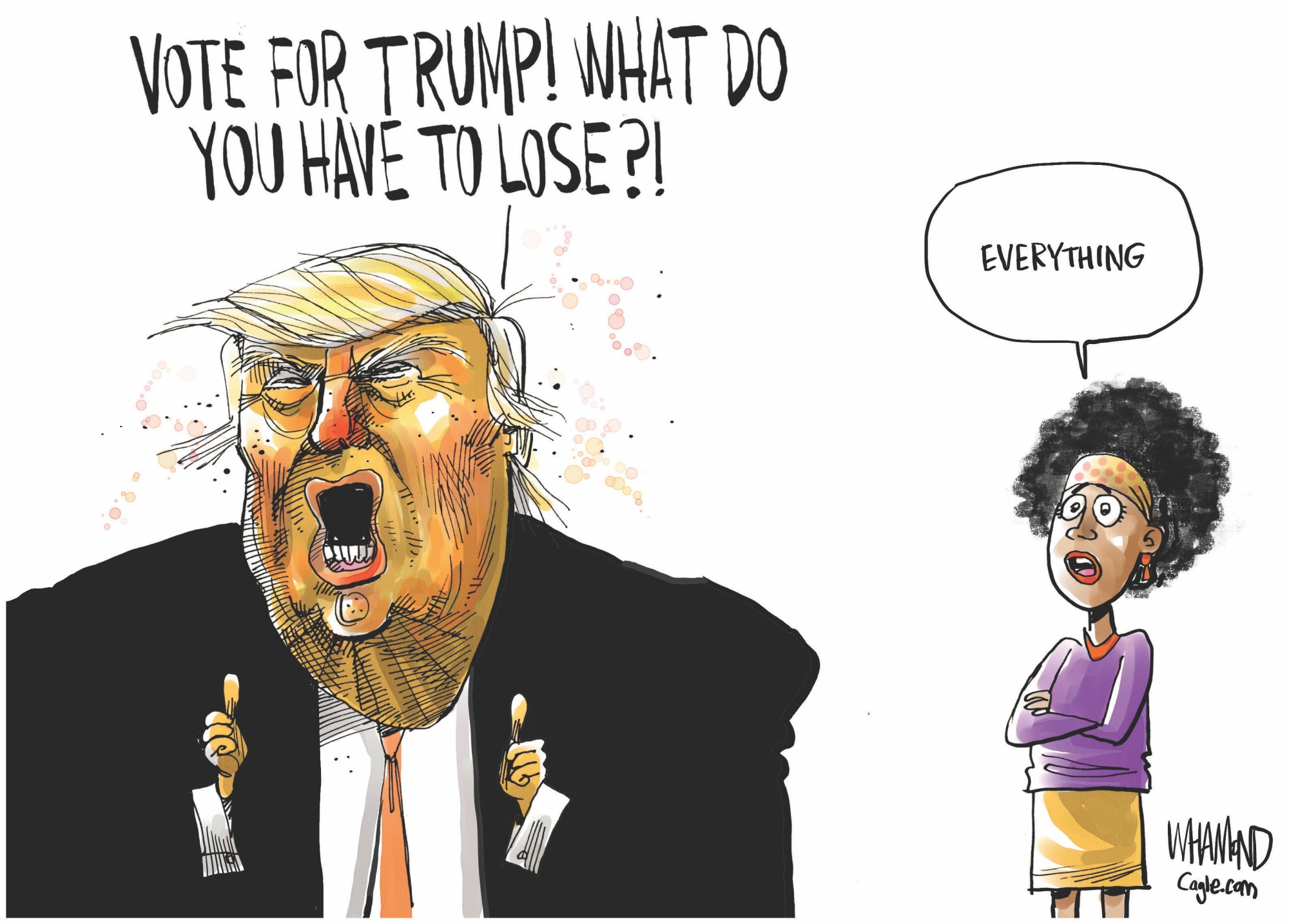


Vance knows he lives in a world made for him and others like him.
Feb 4, 2026 5:05 PM
Vance wants to rant about how whites don’t have to apologize for being white, that’s his privilege, but he knows no white person has ever had to apologize for being white.
Speaking at a Turning Point event in Phoenix last December, our vice president told the audience, “In the United States of America, you don't have to apologize for being white anymore.” Any more? When did any white person in the United States of America ever have to apologize for being white?
Don’t get me wrong: we white people have plenty to apologize for, just not our color. Being white, by itself, doesn’t make us racists. But we should consider apologizing for some of the things we’ve done under the cover of our whiteness, in a system that favors our lighter color.
Without a swift kick to our awareness, most of us don’t even realize how our color shields us from challenges those with darker skin have to cope with all the time.
Years ago, I served on a task force charged to write a racial harassment policy for the college where I was teaching. When we presented our initial thinking to the full faculty, some of the older white guys took offense. Apparently they thought we were calling them racists, and they got up and walked stiffly out of the room.
Related stories
Later, one of our black colleagues told me, “We black folks have to watch you white folks all the time.” That was a rude awakening for me. That was my swift kick. I had not realized how the color of my skin made me safe in a world that was potentially lethal for people with darker skin. I was completely unaware of how I took my own safety for granted, and how that was a luxury my darker neighbors couldn’t enjoy—how any darker person could look at me and see a potential threat. (And, perhaps inevitably, that led me to the realization that, because I’m not just white but also male, the same would be true of any woman looking at me, regardless of color.)
It was embarrassing, to say the least, especially as I had always prided myself on being critically aware of inequalities in American society. My heart was in the right place, but my ignorance sheltered me from some very uncomfortable realities. I suspect that’s true for most white people. We deplore racism, but we don’t have to live with its consequences. We benefit from being white, and we have no idea of how racism operates, because it doesn’t affect us.
That’s why it’s called white privilege.
Some would accuse me of “reverse racism” for that remrk, but the fact is there’s no such thing. Certainly darker people can be prejudiced against their lighter neighbors, but if they act on it, they nearly always pay a dramatically higher price. In the last fifty years, a little over twenty white people have been executed for killing a black person. In the same half century, nearly three hundred black people have been executed for killing a white person. A ratio of fifteen blacks executed for every one white looks like a pretty spectacular imbalance in favor of whiteness.
But most white people have no idea how often, how consistently, the justice system and the social order favor them over their darker neighbors. That’s what critical race theory is all about. And our whiteness also enables us in ways some of us understand all too well. As Toni Morrison puts it in Beloved, “...anybody white could take your whole self for anything that came to mind. Not just work, kill, but dirty you. Dirty you so bad that you couldn’t like yourself anymore.” Need an illustration?
In 1955, two white men took Emmett Till’s whole self, beat him, killed him, and threw his mutilated body into the Tallahatchie River. A month later they were acquitted. In 1964, James Chaney was killed, along with Michael Schwerner and Andrew Goodman, while doing civil rights work in Mississippi. Their whole selves were taken by a group of Klansmen, supported by local law enforcement. After the state of Mississippi refused to prosecute, federal authorities indicted eighteen people, but only seven were convicted. The other eleven were acquitted.
Recently we watched in horror as agents of ICE and the border patrol summarily executed Renee Good and Alex Pretti in Minneapolis. But since the beginning of the Trump era in 2015, in that same city, police have killed:
- Jamar Clark
- Philando Castile
- Justine Diamond
- George Floyd
- Dolal Idd
- Daunte Wright
- Winston Smith
- Leneal Frazier
- Amir Locke
- Ricky Cobb
Except for one white woman, all of them were black men.
Clearly, though many whites have taken the whole selves of blacks for anything that came to mind, and some have been prosecuted, most of them have faced no consequences. A few of them eventually apologized for what they did, none of them has ever apologized for being white.
That’s white privilege in action, and it’s not surprising if Vance doesn’t want to admit that he enjoys that privilege. Like other whites, he’s never had to live on the opposite side of it.
If you think you see a pattern here, you’re right. White privilege shelters us—it sustains us—almost entirely without our awareness. So if Vance wants to rant about how whites don’t have to apologize for being white any more, that’s his privilege, but surely he knows that no white person has ever had to apologize for being white. He just doesn’t want to admit the truth about skin color in America.
Vance knows he lives in a world made for him and others like him, even if he doesn’t want to let himself know that he knows. As the old saying has it, “We don’t know who discovered water, but we do know it was not a fish."
Comments

Powered by RoundtableAn AI/DeFi-powered Enterprise Media Operating System. Learn more at Roundtable.io.© Roundtable 2026. By using this site you agree to the Terms of Use and Privacy Policy