
History Channel


Anti-DEI Mandate
Apr 12, 2025 3:10 PM
Already under President Trump’s anti-DEI mandates precious history on Civil War soldiers, the Underground Railroad, and more were scrubbed or altered at federal institutions.
As the nation commemorates the 250th anniversary of the War for Independence, the contributions of Black patriots are at risk of erasure. Already under President Trump’s anti-DEI mandates precious history on Civil War soldiers, the Underground Railroad, and more were scrubbed or altered at federal institutions. And threatened cuts to public schools may pressure educators to omit or distort information as well.
What follows is a cursory account of the valiant Black Minutemen that you may not have learned about – but would be better off if you did. The American Revolution (1775-1783) was the first – and last – time that soldiers would serve in integrated units until President Truman’s Executive Order desegregating the military in 1948.
Black patriots loomed large in Boston’s emergence as the "birthplace of the revolution." The maritime town was a center for whaling and the transatlantic slave trade with a politics of home rule. It was the colony's third largest municipality (after New York and Philadelphia) with a difficult geography to police. Of the 15,000 people, there were 800 Blacks – 500 males and 300 females – some free and some enslaved. There were about 3500 white women and 2900 white men. When Britain stationed 4,000 soldiers to enforce unpopular tax measures, and monitor the waterfront, it created a garrison atmosphere that ignited tensions like the Boston Massacre in March 1770.
Crispus Attucks, a 27-year old Black seaman, was the first casualty in the confrontation. He was a runaway slave from rural Framingham, Massachusetts, who assumed an alias and became a sailor. On March 5, he was part of a crowd heckling seven soldiers near the waterfront. When soldiers fired into the crowd, two musket balls fatally struck Attucks, with four others killed and six wounded. It was a dramatic episode of interracial resistance.
Related stories
Five years later, Black patriots were involved in the Battles at Lexington and Concord that marked the beginning of the war. On April 18, 1775, Paul Revere, William Dawes and Samuel Prescott, rode from Boston to warn of “the regulars” marching to secure weapons in an armory. On April 19, armed colonists engaged in hit-and-run skirmishes with soldiers. New Englanders re-enact the battles in period costumes annually but the Black Minutemen who fought alongside are often forgotten.
Yet, their participation is documented in “Blacks in America’s Wars” and “Black Patriots and Loyalists: Fighting for Emancipation in the War for Independence,” among other histories. The Minutemen included the likes of Cuff Whittemore, Caesar Bailey (Dickerson), Cato Stedman, Cato Woods, Prince Estabrook, Samuel Craft, Lemuel Hayes, Caesar Ferritt, Pompey Blackman, and Peter Salem. It was common for Blacks to either adapt names from Africa memory or be assigned names of historic figures of Rome and Britain.
Cuff Whittemore was a free Black living in Menotomy, a rural village between Cambridge, Massachusetts, and Lexington. His first name was a variation on the Ashanti word “Kofi” meaning “born on Friday.” He enlisted on April 6, 1775, and records show he was one of three Blacks in the Menotomy Minutemen. Caesar Bailey (Dickinson) was a slave who likely served in place of his owner, Samuel Dickinson. Peter Salem was the slave of a Continental Army officer who granted emancipation so he could join the militia.
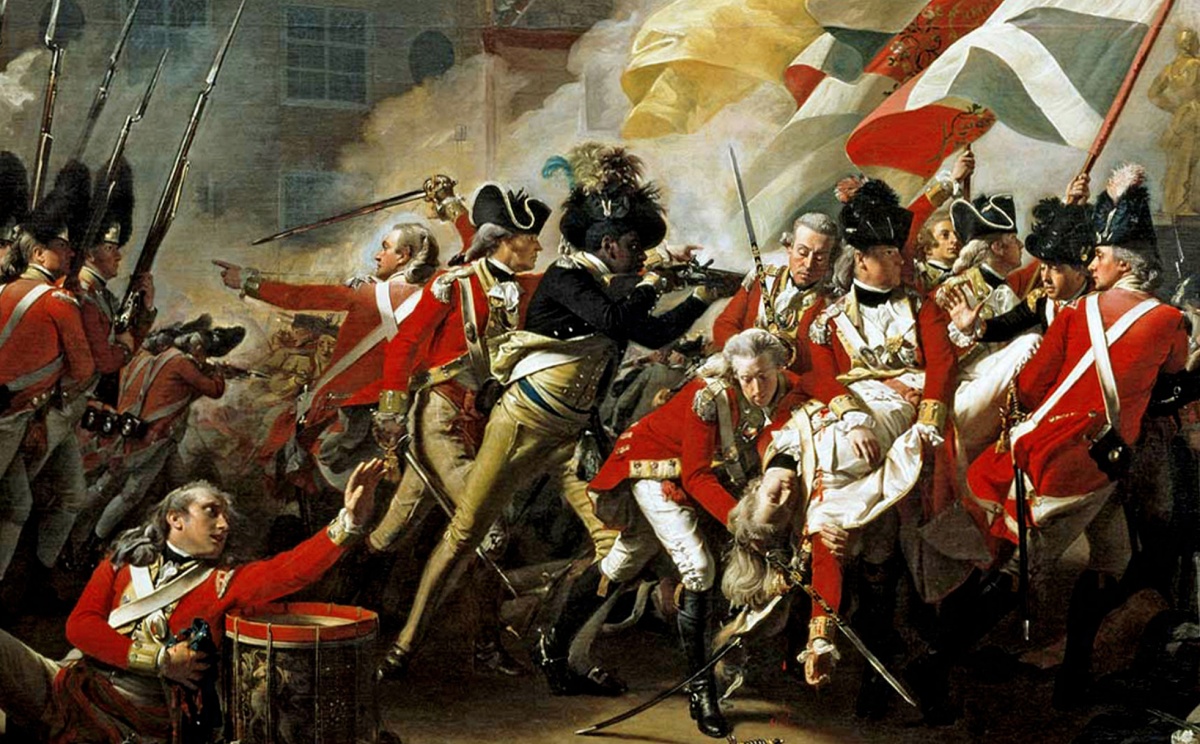
Black patriots served in the pivotal Battle of Bunker Hill as well. The June 17, 1775, clash was the first time colonial fighters engaged in direct combat with British regulars. About 1,000 Minutemen from across Massachusetts, Connecticut, and New Hampshire fought 2,200 regular soldiers on a hilly landscape along the Charles Rivers. The British victory came at the cost of severe casualties including the fatal wounding of Major John Pitcairn by Peter Salem.
Among the patriots were Titus Coburn, Pompey Fisk, and Prince Hall, the outstanding leader of the free Black community. Hall was the former property of William Hall, a Boston tanner, who granted emancipation after the Boston Massacre. He served as a Minuteman and lobbied for the formation of a Black militia company. He and 14 other soldiers established Boston’s African Masonic Lodge No. 459, a springboard for community organization.
The British army was forced to evacuate Boston in March, 1776, and the war spread across the colonies. Then, about 2.5 million people lived in the 13 colonies; of these, 500,000 were Black – 450,000 enslaved and 50,000 nominally free. One of the most fortuitous events for Black people was a shortage of troops in both armies. In November, 1775, to address the problem, the British and the colonists had to promise freedom to recruit Black soldiers.
At first, General George Washington expressed doubt over the merit of the recruits. However, he would soon entrust Black oarsmen for the strategic crossing of the Delaware River on Christmas, 1776, to attack enemy positions at Trenton, New Jersey. One was Oliver Cromwell, a free man who earned distinction in battle; the other, though debated, was Prince Whipple, a slave that fought in Saratoga and Delaware and petitioned the New Hampshire legislature for freedom in 1779.
By 1783, when the war ended, about 230,000 men served in the Continental Army - though never more than 48,000 at the height. Around 8,000 Blacks served in the Army and thousands more in state militias. Meanwhile, some 20,000 Blacks stayed loyal to the British forces; Among these was Ralph Henry, the 26-year old runaway slave of Patrick Henry, adding new meaning to the declaration “give me liberty or give me death.”
For veterans, the motivation was emancipation, citizenship and pensions. The early republic banned the transatlantic slave trade (as the domestic trade emerged in the Cotton Kingdom). There was gradual abolition in the northern states and asserted freedom for thousands that ran away in the chaos. Many formed camps and villages on the isolated islands and swamplands of Virginia, Georgia and Florida. Meanwhile, about 20,000 Blacks loyal to Britain were resettled in places like “Africville” in Halifax, Nova Scotia, and others transported to Sierra Leone, a colony for free Blacks in West Africa.
In closing, the American Revolution reshaped the conditions of slavery and Black community life in the postwar decades – and our schools and cultural institutions have a responsibility to tell the story.
Comments

Powered by RoundtableAn AI/DeFi-powered Enterprise Media Operating System. Learn more at Roundtable.io.© Roundtable 2026. By using this site you agree to the Terms of Use and Privacy Policy