
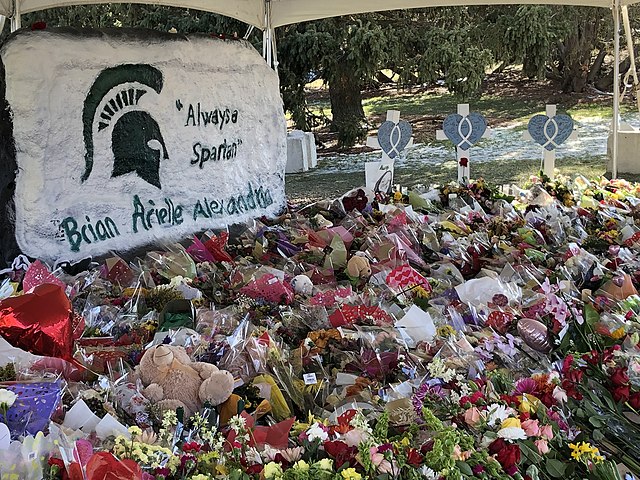
Memorial to the victims of the 2023 Michigan State University shooting • Creative Commons Attribution-Share Alike 4.0


Feb 24, 2023 6:37 PM
There is the critical matter of having the political will to enact public policies that address what happened that night and why.
Note: The author, an MSU emeritus professor, worked at the university for nearly forty years.
On a personal, visceral level, what happened on Monday night, February 13, is about Michigan State University and what happened there. A gunman entered the campus, killing and injuring students in a classroom and elsewhere before fleeing the grounds. In the end, three students died, and five others were seriously injured. Two of the five injured students remained in serious condition a week later.
More than once, I have heard the words “sacred place” to describe how Spartans feel about their Alma Mater and their personal experiences there, and what the institution means to them. That sacred place was violated on February 13. It was terrorism through and through, and the pain and fear are palpable. In response, I have observed hundreds of comforting gestures and acts in the hours and days since. Many of those acts are happening on campus; others, from a distance, are coming from fellow Spartans and supportive persons and institutions. The behaviors are heartwarming and reassuring.
But what happened in East Lansing could have happened on another campus, at a Target, Walmart, or you-name-it location anywhere in America. Indeed, my words—“could have happened” are inaccurate. Better word choices? “Has happened” (past), “is happening” (present), and (sadly) “will (likely) happen again” (future). There were ten mass shootings in the U.S. the weekend following February 13, from February 17-19, with more than fifty victims from across the country—in Georgia, Mississippi, Tennessee, Illinois, and Louisiana. Children shot. People in a parade shot. Folks at a gas station shot. I could go on.
Related stories
So, in addition to grieving and offering support to those affected—and doing all the other things that show we care for those affected personally—there is the critical matter of having the political will to enact public policies that address what happened that night and why. Will this be “the time” when loss of life and intolerable suffering lead to tangible outcomes? Activism and legislative pronouncements suggest it might.
Students and others are speaking out, rallying, and demanding Michigan legislative action; at least some legislators intend to make it happen. Michigan House Rep. Ranjeev Puri put it this way: “F___ your thoughts and prayers. We do not need to live like this. The United States is the only country where this happens. Mass shootings have left us desensitized, waking up each day to a seemingly never-ending horrific cycle of gun violence.”
Like many times before, the proof will be in the pudding. Outrage needs to translate into action.
The first order is enacting meaningful gun control, capitalizing on public outrage to pass needed legislation. But the stark reality is that it is still a tall climb even after many other gun-related mass incidents—Sandy Hook (26 died), Parkland (17 died), Pulse (49 died), and Uvalde (21 died), to name just four. And let us not forget the most extensive campus-based incident in U.S. history—the 2007 Virginia Tech “mass murder from within” (a student perpetrator), where 32 died, and 17 others suffered injuries.
I use the words “political will” because that is the stumbling block—not just among elected officials but among many of the Americans they represent. That said, of all the descriptions I have read about what it will take, the commentary authored recently by Professors Rajan (Columbia), Branas (Columbia), and Kaplan (UCLA) and published in the LA Times is the most succinct: “They (victims) deserve a comprehensive, science-informed, thoughtful gun violence prevention plan that puts them first and works to change the structures that can lead to shootings like the one at MSU. The good news is that those solutions exist. We now need to start carrying them out.”
Note the words “gun violence prevention plan,” which suggests the focus includes, but goes beyond, gun laws (state and Federal). Indeed, the challenge extends beyond guns. Consider what happened recently (mid-November 2022) in Moscow, Idaho. There, a Washington State University graduate student allegedly murdered four University of Idaho students in their off-campus residence as they slept—not by using a gun, but via a knife attack.
That example puts meat to the bones of a never-outdated sociological expression. In this case, more restrictive gun control legislation is necessary but insufficient. The easy-reach answer to “What Else?” involves mental health and the ease/affordability of accessing mental health services. While important, improvements in mental health support are not the silver bullet (no pun intended) when it comes to reducing the number of mass murders. Per Columbia University’s Department of Psychiatry and research conducted by Prof Ragy Girgis, “Approximately 5% of mass shootings are related to severe mental illness. A much larger number of mass shootings (about 25%) are associated with non-psychotic psychiatric or neurological illnesses, including depression, and an estimated 23% with substance use. In most cases, these conditions are incidental.”
Indeed, in “America’s Long-Suffering Mental Health System,” Professor Zeb Larson (Ohio State) documents what is widely known: that the mentally ill are far more likely to be victims of crime than perpetrators of it. That said, the overarching issue may not be mental illness as much as mental healthiness. Larson cites U.S. government findings that “1 in 5 five Americans has experienced issues with mental health, and 1 in 10 youth has suffered a significant bout of depression.”
Still, what we know about the three campus-related incidents—Virginia Tech, Idaho, and Michigan State—pinpoints the relevance of more robust gun control, improved mental health support services, and the related matter of offering hope to those who otherwise feel hopeless.
It seems odd that what happened at Virginia Tech has not been more prominently featured in the news in the wake of the mass murder at Michigan State, and (admittedly) I had to brush up on what happened there. The perpetrator had a history of mental unhealthiness before he enrolled in college, including severe depression and anxiety with a manifest symptom, selective mutism. Due to Federal privacy laws, though, Virginia Tech officials were unaware of those conditions. Later, behaviors expressed while enrolled at the Blacksburg school (stalking female students) led to an investigation and subsequent judgment that he was mentally ill. Legal prohibitions entered again: he could purchase guns legally because the student was not institutionalized after being declared mentally ill. The perpetrator used two semi-automatic weapons during his campus assault. There were other signs before what amounted to a campus rampage, killing over a score of people in multiple buildings and classrooms. Signs included disturbing renditions read in his class-related writings and mobbing behavior (collective bullying) directed at him. Faculty and staff did reach out and offer assistance, most notably Prof. Lucinda Roy, who later authored a book about the experience, No Right to Remain Silent.
The alleged perpetrator of the University of Idaho murders also carries a storyline of mental unhealthiness. The doctoral-level graduate student enrolled at Washington State University in Pullman, Washington (about ten miles from the University of Idaho campus), was terminated from his teaching assistant position because of repeated and unacceptable behavior, including stalking female students. He also had two “altercations” (the word used) with a WSU professor. According to records, “the department decided to remove him from his position as a teaching assistant, cutting off his pay and saying that he ‘had not made progress regarding professionalism.’” As a youth, the alleged perpetrator “struggled with emotional problems and drug addiction.”
A similar storyline—at least in part—is associated with the Michigan State perpetrator. As one authority said about him, "this appears to be yet another in a growing list of angry, isolated, socially disconnected individuals who ultimately decided that violence is an appropriate way to express their anger at society and their personal existence." He had been arrested locally three years earlier on a gun charge (loaded weapon in his car) and had a history “of mental health issues.” Found on his person (after he committed suicide) was a note threatening two schools located in New Jersey. His sister told CNN that “her brother was also prone to transience, would sporadically leave town and struggled to hold down jobs.” He was “getting more and more bitter,” she said. “Angry and bitter. So angry, evil angry,” after his mother passed away two years earlier.
There are many narratives associated with those who commit horrendous acts, and these are only three. But, as a group, the takeaways from Virginia Tech, Idaho, and Michigan State are compelling, namely, instituting more stringent gun control, engaging those struggling with mental health professionals and other services, and helping people live lives of hope rather than hopelessness.
What happened at Michigan State will not be forgotten. Neither will the reality that what happened there has happened before, and—unless we make remedies a priority—will happen again and again.
Comments

Powered by RoundtableAn AI/DeFi-powered Enterprise Media Operating System. Learn more at Roundtable.io.© Roundtable 2026. By using this site you agree to the Terms of Use and Privacy Policy