


Jul 19, 2026 6:59 PM
Updated Jul 19, 2026 7:18 PM
The Weathermen’s campaign of political violence failed to build a revolution, but COINTELPRO, television coverage and decades of cultural fascination turned the group into an enduring radical brand.
He wants to be the synthesis—he is a composite error. —Marx on Ferdinand LaSalle.
When this writer was in high school, he was a bit of an angry young man, disgusted at what “the powers that be” were attempting to make him—John Lennon’s “Working-Class Hero” resonated. So, it is little surprise when the uber-radical Weathermen broke on the scene in late 1969-1970, the notion of running away and joining “The Underground” was a passing adolescent notion. All of which is to say there was an appeal, if one of pure fantasy. To this day, the rebellion against the indoctrination and asking of first-order questions still sits well. However, as time has gone on, any romanticism for that particular model of revolutionary activity has turned to dust with the understanding of how wrongheaded it was.
Here, however, a caveat. The disgust and anger of people such as Bill Ayers and Bernardine Dohrn, key leaders of the radical Weathermen, at the catalyst that set them on this course, particularly the Vietnam War, was legitimate. For those too young to remember, the United States was engaged in a war that would slaughter up to two million Vietnamese and take the lives of 58,000 US soldiers. To be a young man in the US approaching your 18th birthday, you had hanging over your head literal existential questions of how you were going to navigate the draft. That in turn led to unprecedented protest. By 1967, things had escalated to resistance. By 1969 it took a further leap for some, to aspirations of revolution. There was, for the hardcore, a sense that everything else had been tried. That is where people like Ayers and Dohrn came from, and context is important.
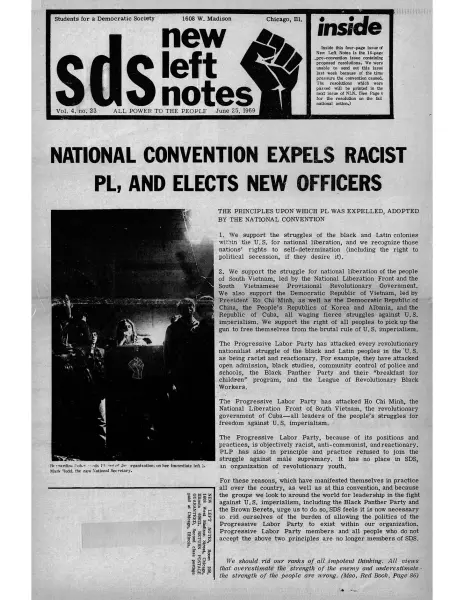
Which brings us to the impetus for this piece, the release and extensive attention surrounding Zayd Dohrn Ayers memoir about his life with his parents, Bernadine and Bill, navigating an underground existence. Firstly, it needs to be said we do not begrudge him for writing a memoir to try and get his mind around that experience and the unexpected and unasked-for impact it had on his life. However, while the book is fine as a memoir—if less so as a history—that is not what drew this writer’s interest. Rather, its appearance raised a question: Why, sixty years after the fact, is the opinion apparatus in the US still fixated on a small far-left sect that, for a brief time, set on a campaign of political violence that ultimately led those who undertook it nowhere.
Related stories
The Rise and Breaking Apart of SDS
The Weathermen were the smallest of three factions to emerge from the ashes of Students for a Democratic Society, a group that had a presence on nearly every major college campus in the US, and by 1969 had become exceedingly radical.
A bit of history. SDS held its first protest against the war in Vietnam in 1963, with a small, if vocal, calling out of Madam Nhu—the wife of the soon-to-be-assassinated President of South Vietnam Ngô Đình Diệm, a man the US had propped up as a bulwark against a communist takeover of the country. The demonstrators were not very popular—a group of Polish anti-communists and American Nazis got near as much press as the Student Peace Union, who co-sponsored the protest—SDS was not even mentioned. In 1965, another group, the pro-Chinese Communist Progressive Labor Party (PL), mounted protests in New York. In the aftermath, they formed a coalition known as the May 2nd Movement (corresponding to the date of one of the demonstrations). As things developed, PL would fold its antiwar work into SDS and send a hefty number of their cadre into that organization. This would at once make SDS stronger and lay the seeds for its breaking apart.
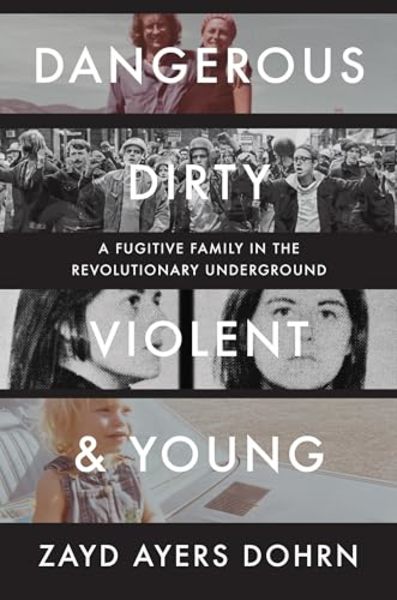
As such, by March 1969, PL was seen less as an ally to SDS and more as an organizational threat, wanting to take control of the group. They were especially not welcome by the national officers of the group based in Chicago (the NO)—people like Bernardine Dohrn, Bill Ayers, Jeff Jones, and John “JJ” Jacobs. That core was developing a position of “action,” laid out in a broadside titled “You Don’t Need a Weatherman to Know Which Way the Wind Blows” (taken from Bob Dylan’s “Subterranean Homesick Blues”). Then SDS National Secretary Mike Klonsky also had issues with PL, as did a significant cohort of activists who would come to be called the Revolutionary Youth Movement II (the NO being RYM I). While RYM II did not share the Weatherman’s eagerness to unleash urban guerilla hostilities, they did share their disdain—as did the Black Panther Party—for PL (and the BPP really did not help matters in this whole episode, but that’s another story), who were seen as too doctrinaire and intolerant of revolutionary nationalism, both among the Vietnamese and Black people in the United States.
Matters came to a head in Chicago in 1969 at the final SDS convention when the group split three ways: PL, Weatherman, and RYM II (after a brief alliance with the Weathermen faction, then calling itself RYM I... yes, it is difficult to keep track).
However, along with this was the activity of the FBI, which objectively constituted a fourth faction, by way of its disruptive COINTELPRO operations and instructions given to its informants. In the case of the Chicago convention, they told their informants to vote against PL control—and as is documented in this writer’s forthcoming book, this was not the sole instance. Their rationale being that voting with the Weathermen was desirable because, “PLP control of SDS would transform a shapeless and fractionalized group into a militant and disciplined organization.”
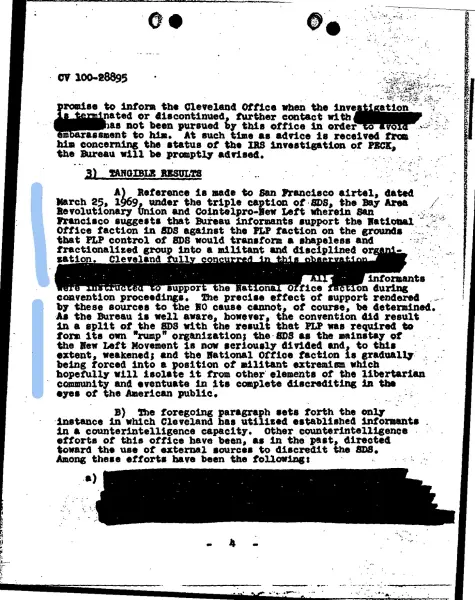
In the convention’s immediate aftermath, they ticked this off as a win: “The convention did result in a split of the SDS with the result that PLP was required to form its own ‘rump’ organization.” In their assessment, “the SDS as the mainstay of the New Left Movement is now seriously divided.” As for the Weathermen, they offered the appraisal that “the National Office fraction is gradually being forced into a position of militant extremism, which hopefully will isolate it from other elements of the libertarian community and eventuate its complete discrediting in the eyes of the American public.” In the long term, they were correct, though in the more immediate term, the group’s actions caught them on the back foot.
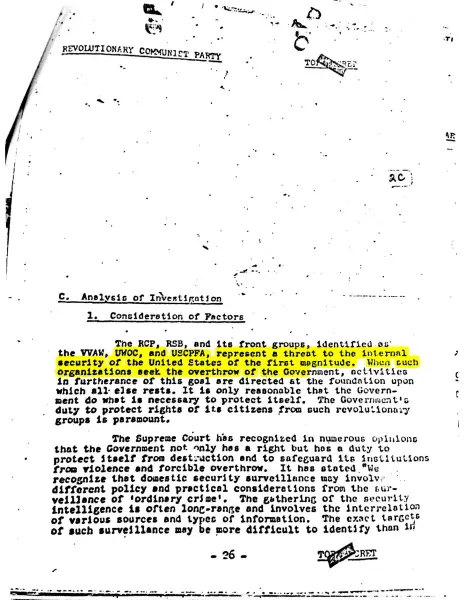
As for the rest of SDS, the factions would go their separate ways. PL would continue on as an organization and assign cadre to carry on under the SDS name. A significant number in RYM II would adopt positions in line with a manifesto, the Red Papers, published by the newly formed Maoist entity the Revolutionary Union. As scholar David Barber noted, the Red Papers “represented the future of where most of RYM II were headed.” It was a conclusion also held by the FBI, which would say of the RU, after it became the Revolutionary Communist Party, USA, that it was “a threat to the internal security of the United States of the first magnitude.” Along with this, there would emerge out of RYM II an array of smaller groups that would come to be called the New Communist Movement. Pop culture and the dominant media—to say nothing of most historiography—have largely overlooked such facts, fixating instead on the Weathermen.
Saying that, the Weathermen were for a time, a problem for the powers that be. Between October 1969 and March 1970, they undertook a campaign of political violence, first by bombing the Haymarket statue of a police officer in Chicago, then initiating street violence to “Bring the War Home” in what came to be called the Days of Rage. There was more, and for those wanting a deeper dive Arthur Eckstein’s monograph, among others, is helpful. However, things came to a head on March 6, 1970 when Terry Robbins, Diana Oughton, and Ted Gold died in an explosion while constructing a bomb meant to be deployed at a non-commissioned officer’s dance at Fort Dix. That ended the Weatherman project as it had been envisioned. Thereafter, the group was mindful of fatalities and focused on planting bombs in less-lethal locations, focussed on various and sundry restrooms in symbolic targets and phoning in a warning in advance. The most notable in that regard was a bomb ignited in a US Capitol restroom in March 1971, a month before the massive protests in Washington DC. Pointedly, the net effect of that action was to give license to the FBI to descend on various elements of the movement, ostensibly in pursuit of the Weathermen.
That last point is of some importance. Whatever their intentions, and this goes not only for the Weathermen but all the other bombers, assassins, and anarchists, whose actions generally have the highly consequential effect of setting loose the hounds of repression against all activists on a certain side of the barricade. This has been true from the bombing of A. Mitchell Palmer’s townhouse that set off the Palmer Raids to the Reichstag fire that allowed Hitler to implement the fascist Enabling Act to the frenzy of repression that followed the killing of Charlie Kirk. Whatever the characters at the center of such things think they are doing, they are not helping. Instead, they present an abiding challenge for those seeking profound social change working within standing legal constraints. This is a problem not likely to disappear any time soon.
The Weatherman “Brand”
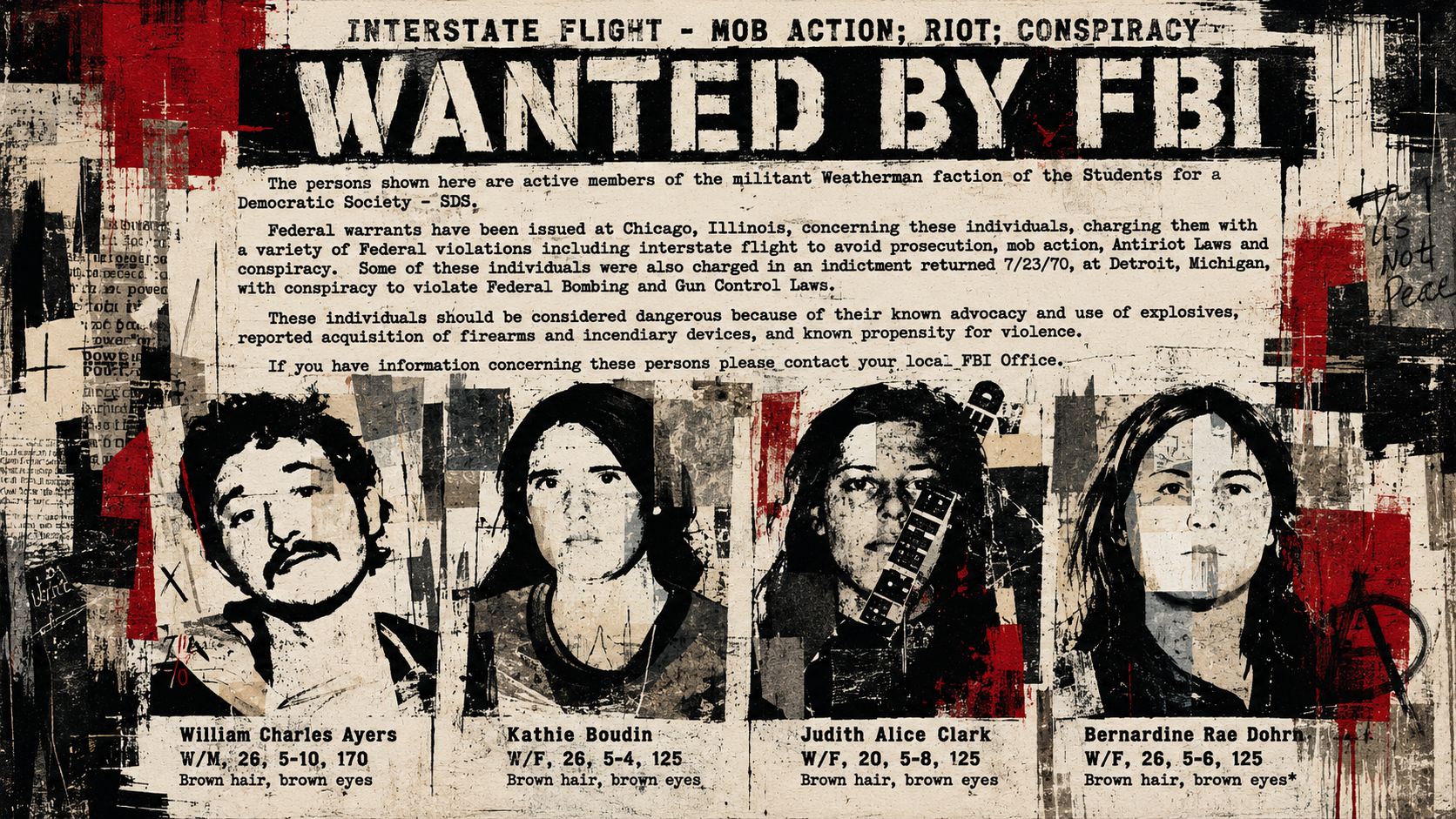
Which brings us to a final point: It is the view here that the reason we know about the Weathermen today is not because of their abiding political and social significance—it’s difficult to point to much in that regard. Instead, we know of them because law enforcement and the popular media machinery gave them a “name,” one that transcended Warhol’s fifteen minutes. Here, the FBI played no small role. At one point, Bernardine Dohrn was on the Bureau’s Top Ten Most Wanted List, and Walter Cronkite dramatically played her “Comminque” on the nightly news. The net effect of all this was to turn her into a celebrity. At the risk of sounding cynical, Dohrn-Ayers’s book shows just how much of a marketable commodity that remains.
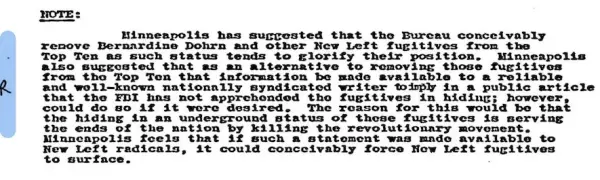
On that... there is, in the corpus of FBI COINTELPRO-New Left memos, a missive from February 1971. The memo, from the Bureau’s Minneapolis office, proposed to “remove Bernardine Dohrn and other New Left fugitives from the Top Ten” most wanted list because keeping them there “tends to glorify their positions.” As an alternative, they suggested “that information be made available to a reliable and well-known nationally syndicated writer to imply in a public article that the FBI has not apprehended the fugitives in hiding; however, could do so if desired.” As Minneapolis outlined, this would suggest that radicals “hiding in an underground status” are “serving the ends of the nation by killing the revolutionary movement.” The rationale being, “It would conceivably force [shame] New Left fugitives to surface.” It was an intriguing notion. Hoover responded, saying the suggestion would be “carefully evaluated for possible use in the future.” As things turned out, that March, a group of peace activists in Media, Pennsylvania, broke into an FBI regional office and carted off sensitive files, including ones that exposed COINTELPRO, moving Hoover to immediately shut down that program. What is revealing here is the self-awareness by both the Minneapolis office and Hoover, that the Weatherman’s status and prestige had been inflated by their own actions.
When all is said and done rather than heroic domestic Che Gueverists, the story of the Weathermen is one of a passionate group of young people who set out on a course of political violence and quickly discovered—their fuller history shows them quickly realizing the isolating limits of ‘the underground’—it was not going to advance their cause in any meaningful way. The reason the Weathermen remain a subject of interest, outside the small cohort of boomers and academics fascinated by them, is what they can ‘do’ for the larger status quo. Here, there are two things. Firstly, the notion of going all in on radical change, including revolution, is put forward as the quintessence of infantile impetusness—a view reinforced by the Weatherman’s own actions—from two hundred of them taking on the Chicago Police in the Days of Rage to Bernardine Dohrn’s sound bites extolling Charles Manson, or referring to her group as a bunch of “crazy motherfuckers.”
The other utility is the way in which politics which intentionally operates far outside the law, gives the authorities the ability to bring the full power of that law to bear. As William B. Quandt, of the Brookings Institution, said in 1985 ”Hard-core terrorists are relatively isolated; they can be dealt with primarily as a police problem.”
While these are not the only reasons why a recent memoir—and it will not likely be the last word on this group—is so welcome by those intent on protecting the standing order, it is hard to imagine this level of interest without them.
Comments

Powered by RoundtableAn AI/DeFi-powered Enterprise Media Operating System. Learn more at Roundtable.io.© Roundtable 2026. By using this site you agree to the Terms of Use and Privacy Policy