


Jul 15, 2026 6:52 PM
Updated Jul 15, 2026 7:11 PM
How a tasteless watermelon reveals an economy—and a democracy—designed to serve corporations while treating people as an afterthought
Like most children, I loved summer and looked forward to its arrival.
Growing up in New York, where we experienced four distinct seasons, summer was a welcome reprieve from winters that sometimes seemed to extend well into spring. I loved the warmth of the sun, the long hours of daylight and the freedom to go outside without first wrapping myself in layers of clothing. Most of all, I loved not having to get up early for school.
But one of my favorite things about summer was the fruit.
When Summer Fruit Still Tasted Like Summer
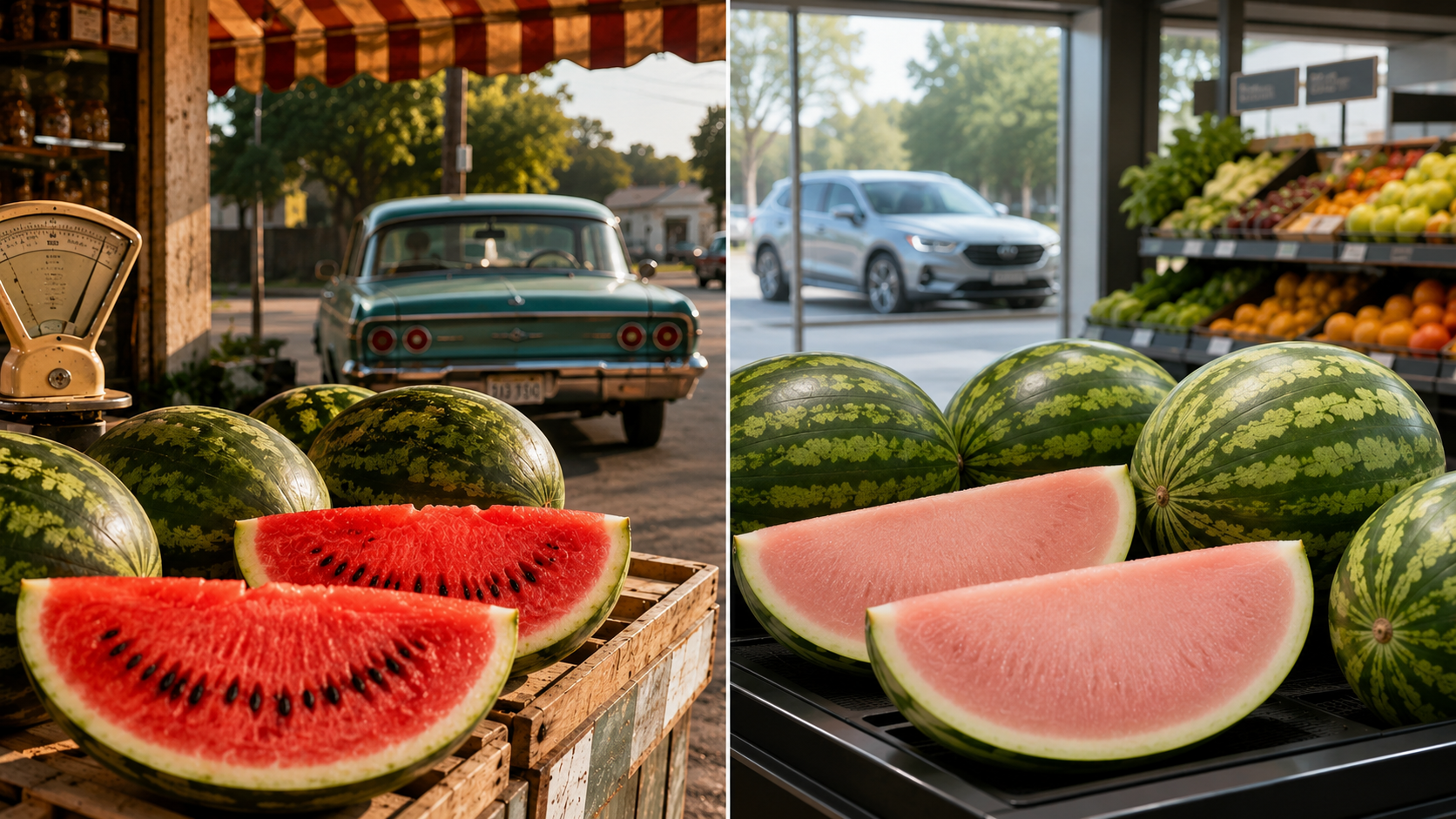
I especially loved cherries and melons. This was more than sixty years ago, when summer fruit announced the season as clearly as the temperature did. Cherries tasted like cherries. Peaches were fragrant before you even bit into them. And watermelons were sweet.
Related stories
Back then, you did not need special expertise, a YouTube tutorial or knowledge inherited from three generations of farmers to choose a good watermelon. You either picked a sweet watermelon or an even sweeter one. Those were your choices.
Although the memory is now distant, I can still hear the watermelon man slowly driving his enormous truck through the Morrisania neighborhood of the South Bronx, where my grandmother lived, calling out:
“Watermelon! Watermelon!”
That cry was part of the soundtrack of summer.
Today, I find myself standing in my Los Angeles kitchen, thoroughly disgusted, after slicing yet another large, impressive-looking melon only to discover a tasteless hunk of pink substance that is more similar in flavor to wet Styrofoam than the juicy sweet watermelon of my youth.
What a disappointment.
I don’t know why this particular disappointment triggered me to draw comparisons between another constant drumbeat of political disasters and disappointments since Trump returned to office, but I began to connect the watermelon to something much larger.
The modern watermelon may be one of the best metaphors for what is increasingly being served to the American people—not only in our supermarkets, but in our politics, public institutions and economy.
We are repeatedly sold products, policies and institutions that resemble what we think we are getting, only to discover, upon closer examination, that they aren’t at all what they appear to be.
The romantic version of this story would be that watermelons were once grown entirely for flavor and are now bred without any concern for taste. The truth is more complicated.
Modern breeders still care about sweetness. But flavor is no longer ranked more highly than other factors associated with efficiency and profit.
When the Consumer Becomes an Afterthought
Today’s commercial watermelon must satisfy an entire industrial system. It must produce high yields, resist disease, mature predictably and possess a rind tough enough to survive harvesting, stacking, trucking and supermarket handling. It must remain visually attractive after traveling hundreds or even thousands of miles.
That list tells the story.
The watermelon is no longer simply food, that, of course, should be tasty.
It is a shipping unit.
Its journey through the supply chain has become more important than the experience of the person who buys it and eats it.
Watermelons, unlike bananas or pears, do not continue becoming sweeter after they are picked. Once removed from the vine, their sugar content is essentially fixed. A melon harvested before reaching peak ripeness will never become the melon it could have been.
Yet a national distribution system rewards predictability, durability and transportability. The fruit must survive the journey.
Whether it delights the customer becomes almost secondary.
“We Got It Done”
This is where the story becomes larger than agriculture.
Politicians of every persuasion love to use the phrase, “we got it done.”
A phrase that has become so common it often substitutes for explanation. It conveys competence, effectiveness and leadership. It is designed to end the conversation rather than begin it.
But “it” is rarely defined.
In the case of the watermelon, over these past few decades, what exactly got done?
If the objective was to create a product that could be shipped farther, stacked higher, stored longer, suffer fewer losses in transit and generate greater profits throughout the supply chain, but taste like styrofoam then today’s watermelon is a remarkable success.
Somebody unquestionably got it done.
But if the objective was to produce a watermelon that families enjoy during summer picnics and barbecues because of its extraordinary sweetness, then “it” was not accomplished at all.
The accomplishment depends entirely upon whose objective we are measuring. In this case, the objectives of those who want the profit margin to grow, or those who want to spend their hard earned money on something that delivers what they expect.
The same question applies to public policy.
When politicians proudly announce that they “got it done,” we should immediately ask:
Got what done?
Who benefited?
Who paid the price?
A tax bill may “get done,” but did it primarily enrich investors or improve the lives of working families?
A trade agreement may “get done,” but did it strengthen communities or make it easier for corporations to relocate production thereby increasing community unemployment?
A housing bill may “get done,” but did it produce affordable homes or create another investment vehicle for institutional capital?
The phrase celebrates activity while avoiding purpose.
The watermelon did not accidentally become less satisfying to the end consumer. The consumer’s loss of satisfaction became the predictable result of changing how success was defined.
Success was no longer measured primarily by how much people enjoyed eating the fruit. It came to be measured by efficiency, durability, uniformity and profitability.
That same transformation has occurred across much of American life.
The Pink Appearance of Democracy
At first glance, this may seem like a story about agriculture.
It is not.
It is a story about how success is defined in modern America.
Once the objective shifts from satisfying the person at the end of the process to satisfying the institutions that control the process, the watermelon becomes more than fruit.
It becomes a metaphor for our political economy.
Our institutions still look like democracy.
We hold elections.
Candidates campaign.
Legislators conduct hearings.
Citizens answer polls, attend meetings, testify before committees and cast ballots.
The rind looks fine.
But when we cut through the surface and ask whose preferences actually shape public policy, the inside often disappoints.
How corporations became the real customers of American agriculture, government and democracy
Political scientists Martin Gilens and Benjamin Page examined nearly 1,800 policy decisions and compared them with the preferences of average Americans, affluent citizens and organized interest groups.
Their conclusion was startling: economic elites and organized business interests exert substantial independent influence over public policy, while average citizens exert little or none.
Translated into everyday language, when ordinary Americans want something that powerful economic interests oppose, ordinary Americans usually lose.
When public opinion happens to overlap with elite interests, government may appear responsive. But that is not the same as democratic responsiveness.
That is the watermelon economy.
The public is still called the customer.
The voter is still called sovereign.
The worker is still described as the backbone of the economy.
Yet the system is increasingly organized around the priorities of investors, corporations, lenders, insurers, developers and major campaign contributors.
People want affordable housing.
The system produces investment portfolios.
People want healthcare.
The system produces billing systems, insurance networks and pharmaceutical monopolies.
People want dependable public transportation.
The system produces privatization contracts and toll lanes.
People want secure retirement.
The system produces financial products and management fees.
People want food that is nutritious and delicious.
The system produces products optimized for packaging, storage, transportation and shelf life.
The original human purpose remains just visible enough to sell the product. But it has become subordinate to the machinery built around it.
When People Forget What Sweetness Tasted Like
Those of us born before 1980 remember a different watermelon.
While it is true that memory is not scientific proof and nostalgia can exaggerate the past, still, millions of Americans remember tomatoes that tasted like tomatoes, peaches that perfumed the kitchen before they were sliced and watermelons that rarely disappointed.
Those who never experienced the earlier version face a particular disadvantage. They may assume today’s watermelon is simply what watermelon is supposed to taste like.
That is true politically as well.
People who have grown up amid stagnant wages, unaffordable housing, crushing student debt, privatized public services, weakened unions and money-saturated elections may assume this is simply how democracy works.
They learn to lower their expectations before they even have the opportunity to form them.
A generation that has never experienced widespread economic security may not realize that a full-time union job once offered a realistic path toward buying a home, raising a family, taking family vacations and retiring with dignity.
A generation raised while public institutions were deliberately weakened may conclude that government is naturally incompetent.
A population exposed only to corporate-dominated politics may mistake choosing among preselected options for democratic self-government.
Once people forget what sweetness tastes like, it becomes much easier to sell them flavorless fruit.
Is the Economy for People—or Are People for the Economy?
The point is not that corporations are uniquely evil. Nor is it that modern agriculture has produced no genuine improvements.
Disease resistance matters.
Food safety matters.
Shelf-life matters.
Farmers need crops capable of surviving pests, drought and increasingly unpredictable weather.
The problem begins when the supporting requirements of a system replace its original purpose.
A watermelon should survive transportation.
But it should also taste like watermelon.
A healthcare system must pay doctors and sustain hospitals.
But it should also provide healthcare.
An economy must encourage investment and productive enterprise.
But it must also allow the people whose labor sustain it to live securely.
A democracy requires elections, legislatures and administrative institutions.
But it must ultimately respond to the people themselves.
Every society answers the same question, whether it realizes it or not:
Is the economy for people, or are people for the economy?
The modern watermelon suggests we already know how America has been answering.
We have accepted too many institutions that preserve the appearance of serving human beings while quietly reorganizing themselves around serving systems and serving profit.
Schools increasingly serve testing regimes.
Healthcare increasingly serves billing systems.
Housing increasingly serves investment strategies.
Work increasingly serves shareholder value.
Democracy increasingly serves campaign finance.
Everything looks approximately right.
Nothing tastes quite as it should.
Perhaps that is why my disappointing watermelon irritated me so much.
It was not merely a piece of bad fruit.
It was another reminder that I had paid full price for an appearance—the suggestion of sweetness, the memory of nourishment, the promise of satisfaction—and received a product optimized for everyone except the person expected to consume it.
Whenever I hear a politician declare that they “got it done,” I think about that watermelon.
Yes, somebody got it done.
They created a fruit that ships farther, stores longer and generates greater profits.
Our political system often works the same way.
Democrats and Republicans pass laws wrapped in the language of jobs, affordability and help for working families. But as Martin Gilens and Benjamin Page found, public policy is far more responsive to economic elites and organized business interests than to ordinary people.
The modern watermelon looks right but disappoints—and so do too many institutions built to serve profits rather than people
Once corporate priorities outweigh the needs of the consumer, people are no longer the purpose of the system. They become an afterthought—the ones expected to buy the product, accept the policy and pay the bill.
The legislation looks right.
The title sounds reassuring.
But when we cut it open, corporations get the sweetness while the public gets the rind.
The question is not whether something got done.
It is what got done.
Who benefited.
And who was disregarded.
I want watermelons grown to be sweet.
And I want an economy—and a democracy—designed to nourish the people waiting at the other end.
Comments

Powered by RoundtableAn AI/DeFi-powered Enterprise Media Operating System. Learn more at Roundtable.io.© Roundtable 2026. By using this site you agree to the Terms of Use and Privacy Policy