
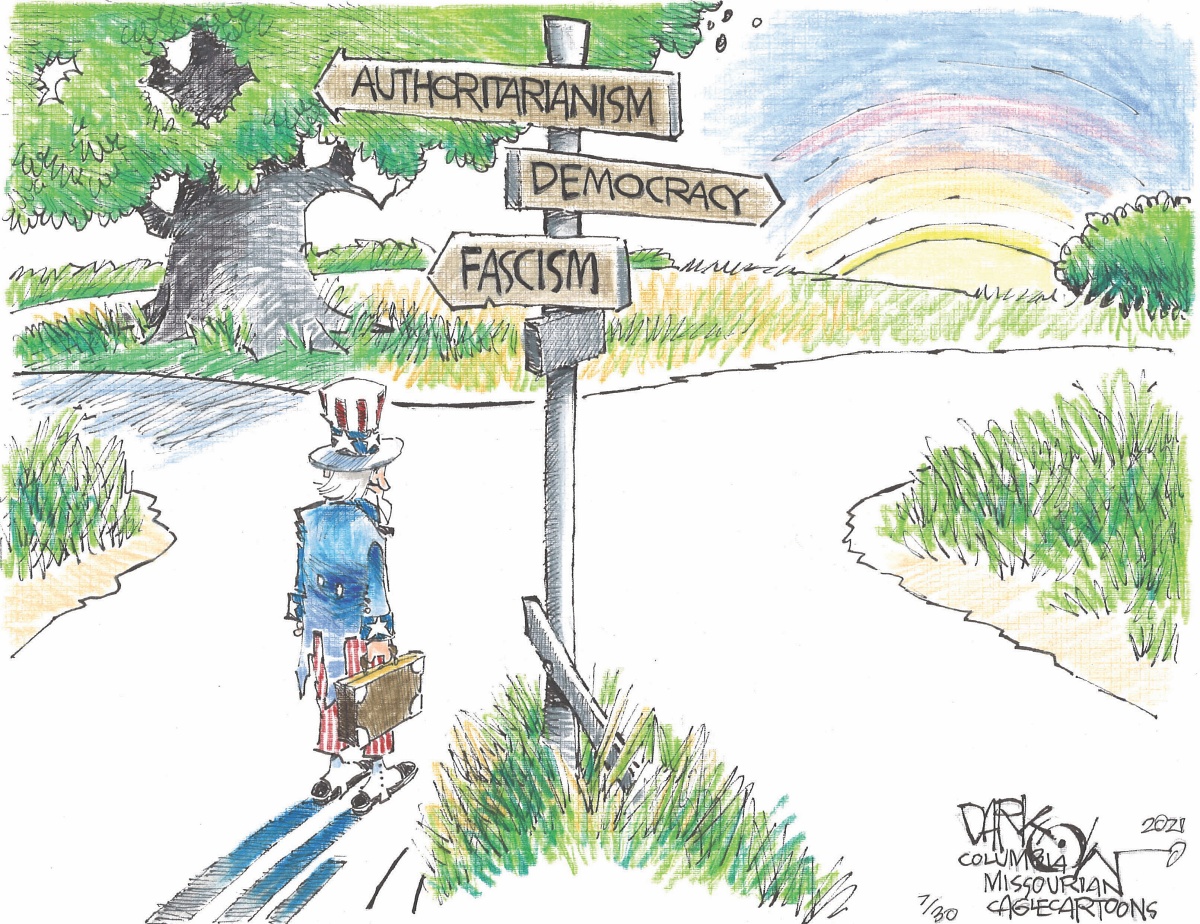


Crossroad
Jul 10, 2024 2:52 PM
We will have to make a choice whether we wish to continue in our democratic tradition or resort to more authoritarian ways
With a presidential election coming up in less than four months, we once again find ourselves at a crossroad. Will we continue to make some progress—although more would be desirable—in addressing problems like climate change, as President Biden and Senator Sanders have tried to do? Or will we retreat further into the unreal world of Donald Trump, the world of climate change being a hoax, the 2020 election being “stolen” from him, and of authoritarian, white, Christian rule being the ideal? Moreover, while speaking of unreality, one could cite innumerable Trump statements such as, “Sorry losers and haters, but my I.Q. is one of the highest—and you all know it!” and I also have “the world's greatest memory.”
Despite Trump living in make-believe land, our future now looks murkier than ever. Why? Because after the Biden-Trump June debate debacle, despite Biden assurances, we are not even sure yet whether Biden will be the Democratic nominee.
But whether Biden prevails and is the nominee or some other Democrat rises to head his party’s ticket, we will still be at a crossroad. We will still have to make a choice whether we wish to continue in our democratic tradition or resort to more authoritarian ways, whether we wish to take measures to address climate change or regard it as a hoax, whether we wish to abide by elections or claim they’re a sham if lost, and whether we wish a political order dominated by white Christian men or finally embrace a true multi-ethnic society that values women as much as men. (See here and here for more on such choices.)
For much of our history we have thought of ourselves as an “exceptional” country. Although Democrats have sometimes expressed such a belief, more recently it is more characteristic of Republicans. President Reagan loved to talk about how we were the exceptional “city upon a hill”—as the Puritan John Winthrop declared in 1630. The 2016 Republican platform (which Trump ran on) started off, “We believe in American exceptionalism. We believe the United States of America is unlike any other nation on earth. We believe America is exceptional because of our historic role—first as refuge, then as defender, and now as exemplar of liberty for the world to see.”
Related stories
Democrats are more likely to suggest that we aspire to be exceptional, that it’s not a “done deal.” In the midst of Reagan’s presidential years, Democratic Governor Mario Cuomo of New York noted Reagan’s fondness for referring to the USA as the “shining city on a hill.” And the governor confessed that in “many ways” we were, but he tacked on some additional words. In “part of the city there are more poor than ever, more families in trouble, more and more people who need help but can't find it. Even worse: There are elderly people who tremble in the basements of the houses there. And there are people who sleep in the city streets, in the gutter, where the glitter doesn't show. There are ghettos where thousands of young people, without a job or an education, give their lives away to drug dealers every day. There is despair, Mr. President, in the faces that you don't see, in the places that you don't visit in your shining city.”
What Mario Cuomo’s words indicate is that like many other nations we have our plusses and minuses. As Seymour Martin Lipset pointed out in his 1996 book American Exceptionalism: A Double-Edged Sword, “We are the worst as well as the best, depending on which quality is being addressed.” In regard to such matters as income inequality, elevated crime, and intolerance, he didn’t think we ranked very high.
Moreover, just as it is inappropriate for a person to claim he or she is “exceptional,” so it is unfitting for any of us to brag about the superiority of our nation. “National egoism” was the term the Russian philosopher Vladimir Soloviev used for such boasting.
As early as John Winthrop’s words about being a “city upon a hill” (1630) some of our ancestors had slaves, and the Whites were taking land away from Native Americans, and for over two centuries these practices continued. As much as we revere George Washington and Thomas Jefferson and admire their noble qualities, they were also slave owners.
And so this “double-edged sword” or two-faced appearance continued throughout our history. We had Lincoln, Frederick Douglass, the Progressives, Franklin Roosevelt, Martin Luther King, Jr., and the Civil Rights legislation of the 1960s, but also—in addition to slavery and the treatment of Native Americans—the Ku Klux Klan, southern segregation (all the way up to the 1960s), and George Wallace darkened the pages of our history—not too much later President Nixon’s Watergate behavior was another stain on our historical record.
We also had our earlier prejudices against certain types of immigrants—Trump’s preference for northern Europeans is nothing new. In 1924,Congress passed the Immigration Act, containing an Asian Exclusion Act, almost banning Asian immigrants, and a National Origins Act, limiting European immigrants but favoring those from northern Europe. As Robert Dallek tells us, in the early 1930s, there was still strong prejudice against southern and eastern European immigrants: “The belief that these groups could never be turned into citizens who fully accepted Anglo-Saxon economic and political traditions” was widespread.
Abroad we also had our ignoble days or years. At the very beginning of the twentieth century, here is what one U. S. officer had to write about our treatment of Filipinos as we fought a war to take over their island lands: “Our men have been relentless, have killed to exterminate men, women, children, prisoners and captives, active insurgents and suspected people from lads of ten up, the idea prevailing that the Filipino as such was little better than a dog.”
In 1967, King had this to say about what we were inflicting on Vietnamese peasants: “So they go, primarily women and children and the aged. They watch as we poison their water, as we kill a million acres of their crops. They must weep as the bulldozers roar through their areas preparing to destroy the precious trees. They wander into the hospitals with at least twenty casualties from American firepower for one Vietcong-inflicted injury. So far we may have killed a million of them, mostly children.”
Thus, we have demonstrated both noble and ignoble behavior, both here and abroad. And we have been at crossroads before. Think back to the 1860 election. Lincoln’s chief rival was the pro-slavery Kentuckian John C. Breckinridge, who was sitting President James Buchanan’s Vice President and won nine southern states. If he had bested Lincoln, slavery would not have ended when it did. But on that occasion, to use Lincoln’s phrase just months after his election, “the better angels of our nature” triumphed. Will they do likewise in November 2024?
Comments

Powered by RoundtableAn AI/DeFi-powered Enterprise Media Operating System. Learn more at Roundtable.io.© Roundtable 2026. By using this site you agree to the Terms of Use and Privacy Policy