


Jun 9, 2025 8:56 PM
Updated Jun 9, 2025 8:57 PM
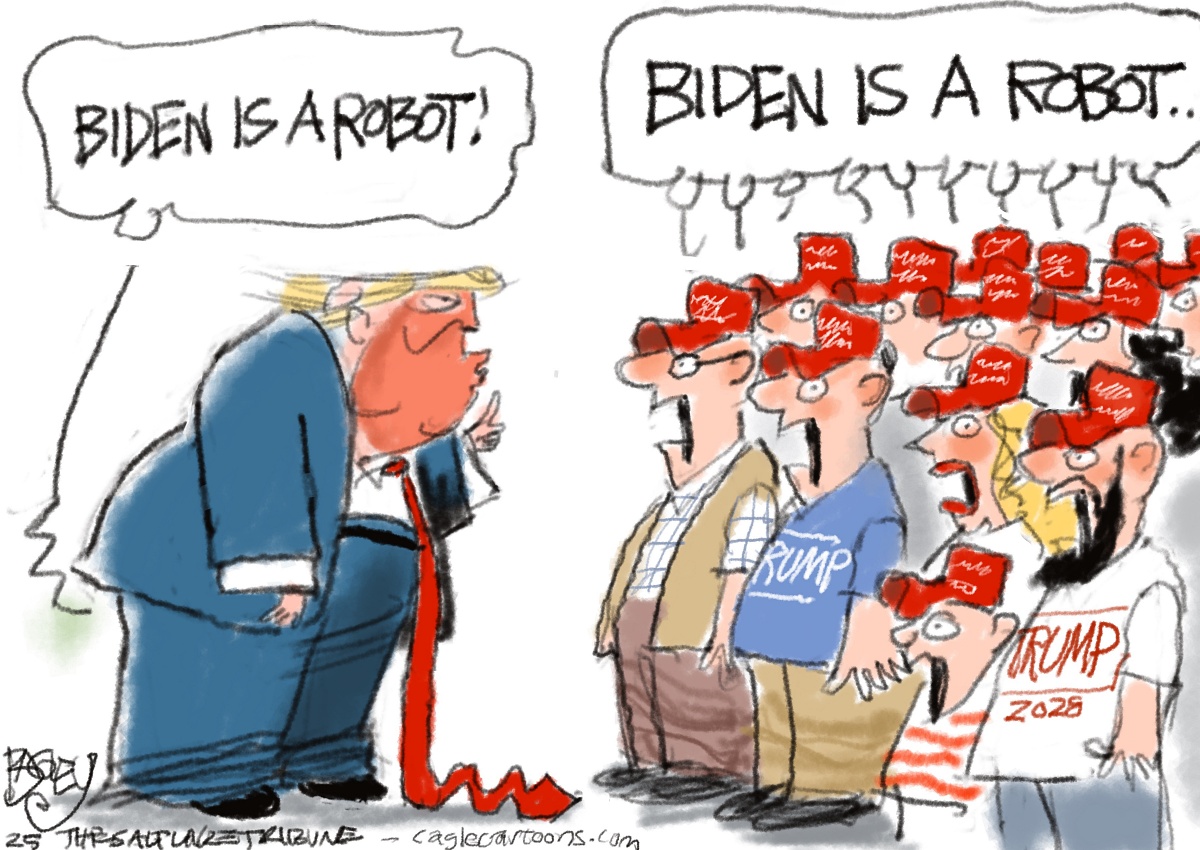
Understanding Trumpian support must begin with some grasp of the nature of human discontent.
“My God, a sex offender, felon, grifter, inveterate liar, six bankruptcies, called our fallen soldiers suckers and losers, tried to overthrow an election, unravelling democracy, a wannabe dictator. How could anyone be so stupid as to vote for and support Trump?” Such a question, carried out with a dazed look from dilated eyes, has been asked often in some variation or another since November 5, 2024.
There’s a pathway to better understanding the phenomenon, but it leads down some winding steps into the nature of the human species. That is, to Us and the powerful forces that underlie tribal allegiance. At a certain point you must forsake your faith in reason and facts—to reach a logical conclusion. The 2020 stolen election claim by many Trump supporters provides a classic example of the limits of facts and logic in persuading others to change a belief based on emotion and tribal allegiance. Consider a common exchange:
“The election was stolen pure and simple.”
“Good lord, man, there’s no evidence of any wrongdoing that could have changed the outcome of that election. And all the lawsuits brought by Trump’s cronies challenging the results have been lost in court after hearings on the merits or they’ve been dismissed as irrelevant – even by judges Trump hand-picked. What don’t you get?”
Related stories
“Fake news, you lib-tard!”
“You deluded MAGA pinhead!”
In this example, the non-Trumpian is relying on logic and fact-based evidence to counter the Trump supporter’s belief of a stolen election. It’s illogical that solid factual evidence doesn’t penetrate the Trump supporter’s alternative reality. It doesn’t make sense. But it will when you lay aside your logical approach. Then comes the opportunity for understanding.
Discontent is the Fertile Ground
Understanding Trumpian support must begin with some grasp of the nature of human discontent. Its source can be varied but typically involves lack of meaning or purpose in life that often stems from economic hardship, lack of opportunities, or a sense of isolation. It’s notable that over the last forty-five years in America, a highly prominent discontented group emerged. This was the white working class whose grievances had begun to merge closer to those of less advantaged minority communities already well acquainted with socio-economic inequities. Globalization and technological change hit hard into the lifestyle expectations of this large swath of American workers. Jobs shipped overseas; trade unions weakened; the flood of big money into politics due to Citizen’s United; and the unfathomable gap of income inequality were gut punches to many of the working class who saw themselves as having lost previously held wealth and status. The discontent provides fertile ground to be exploited and from which an alternative reality can arise. And when this reality, fueled by grievance and anger, begins to take shape by a demagogue’s rhetorical manipulations, strange things happen.
The Demagogue’s Messaging of Victimization, Fear, Anger, and Scapegoating
And this brings us to the next important piece of the puzzle to understanding unyielding allegiance to Trump—the messaging of victimization, fear and anger. When such language falls upon the receptive ears of the discontented it can ignite and sustain a hot cluster of emotions in the expectant crowds. These emotions—fear, anger, and resentment are directed at opportunistic enemies, real or imagined. In the attentive crowds comes the feeling that somebody listens and feels my pain. Excitement becomes contagious as purpose and a sense of belonging catalyze into a tribal body. The demagogue has targeted an enemy or enemies out there who are to be denied, defeated, and punished. He captures the fire he’s lit in the hearts of the discontented and draws the emerging tribal body into his own with the icing on the cake— “I alone can fix it.” Stuff like, “In 2016, I declared: ‘I am your voice,’ “Today, I add: I am your warrior. I am your justice. And for those who have been wronged and betrayed: I am your retribution.”
The language embedded in Trump’s speeches, tweets, and interviews over the years are loaded with messaging of victimization, anger, and degradation always aimed at a purported enemy. Take, for example, the Liberation Day speech on April 2, 2025, announcing worldwide tariffs. “For decades, our country has been looted, pillaged, and plundered by nations near and far, both friend and foe alike. American steelworkers, auto workers, farmers, and skilled craftsmen – we have a lot of them here with us today – they really suffered gravely. They watched in anguish as foreign leaders have stolen our jobs, foreign cheaters have ransacked our factories, and foreign scavengers have torn apart our once beautiful American dream.”
Trumpian language also carries with it the dangerous element of what might be called “verminism”, the language used by autocrats to dehumanize political opposition to the level of moral disgust. For example, in a 2023 New Hampshire speech he espouses to a New Hampshire crowd, “We pledge to you that we will root out the communists, Marxists, fascists, and the radical left thugs that live like vermin within the confines of our country.” Immigrants have often been described by Trump as “poisoning the blood of our country.”
Peter Wehner of the NY Times described Trump’s persistent fear and anger language succinctly. “Almost every day since (the golden escalator descent), he (Trump) has selected targets to channel his hate, which appears to be inexhaustible, and ramped up his rhetoric to the point that it now echoes lines from Mein Kampf. In the process, he has fueled the rage of his supporters.”
That rage, that anger, whether flaming or smoldering, is never allowed to go out. It's the autocrat's life blood.
The Messaging Never Stops
And this brings us to yet another piece of the puzzle to understanding the resilience of Trumpian tribalism—the vast modern day technological media complex. Trump’s fear messaging doesn’t end after passing from his oval-shaped mouth. It continues to reverberate through the vast echo chambers within both cable and social media domains that have profit as their primary guiding force.
Beginning in the 1980s and 90s as network news shifted from its focus on providing accurate information to entertaining to generate more revenue, journalistic objectivity diminished. Sensationalistic story telling became a greater priority. Trumpian outrageousness fuels the messaging that pounds the brains of the discontented, especially through what's now a vast right wing media network. His outrageous antics and rhetoric are dream-worthy for a news media and the vast social media ecosystem that hungers for the stuff that sells advertising and draws clicks—sensationalism. And for Trump, his repetitive messaging of fear, anger and resentment is essential in the maintenance of power. And this brings us to the heart of understanding the phenomenon—the brain.
The Heart of the Matter is in the Brain
The final piece of the puzzle lies within the often overlooked neurobiological-evolutionary basis to the power of fear messaging. Language that triggers fear and anger in a discontented group and aimed at an “outside-group” leads to transformations in normal brain circuity. Trump’s fear messaging “lights up” more primitive brain regions that have far out names, such as the amygdala and insular cortex. When you’re pissed off at a particular group or person and you’re thinking, "What an asshole," the neurons of these brain regions are firing away. And guess what, the amygdala, in particular, is shutting down access to more highly developed parts of your brain, such as the frontal cortex, that deal with rational thought and factual analysis. The ol’ amygdala has kicked in to put you into survival mode and is focused on conserving energy to do "fight or flight." Therein lies the rub. In our evolutionary history, analyzing and reasoning didn’t do much for increasing your chance of survival when a hostile group of human beings swinging axes were charging at you. In these states of existential threat, real or imagined, the amygdala is saying, “Screw that, no time for contemplation now, just run or hit the dude back so maybe we can pass on our genetic material to the next generation—we’ll contemplate the stars when we got some down time.”
But the final piece of the puzzle doesn’t end there. Also, along our evolutionary course, the greater coordination, cooperation, and allegiance to each other in the group—and to the group leader—the greater chance for survival as well. Maintaining loyalty to the tribe and its leader was as essential to survival as water and air. A matter of life and death. Empathy for the hostile “outside-group” by use of rational thinking necessary to compromise and negotiate were subsumed by the immediate goal of survival—to vanquish and control the enemy, typically, in bloody terms. And the more vile and more dehumanized the enemy, (think "verminism" and the insular cortex) the easier the task of committing the necessary violence to survive.
Imprinted Deeply into Our Genetics
These mechanisms of behavior are imprinted deeply into our genetics. Trumpian fear messaging and the echo system of right-wing media, “fires up” the human brain to react to thousands of years of evolutionary influence. Facts and appeals to reason have little effect in conditions where your group perceives existential threat. In fact, a paradox appears—the presentation of facts typically strengthens the Trump supporter’s loyalty to the Trumpian tribe and to the Leader. Simply put, the more facts you give, the less you are believed.
As you approach the Trump supporter, with the question, “How could you vote for and support Trump?” and you hold your quiver of facts and logical reasoning to counter the Trump supporters’ beliefs, pause to appreciate that you are up against the imprint of millennia of evolutionary induced behaviors rooted in our neurobiological makeup. Generations upon generations before us did not pass on their genetic material by cooperating and negotiating with the purported enemy who in their minds, real or imagined, posed as a threat to their existence. They survived by banding closely together in defensive mode and destroying the approaching hostile “outside-group”. Tribal cooperation and allegiance were adaptive for surviving and that memory is ingrained within the blood and bone nature of our being. To put it bluntly, the need to belong is more powerful than facts.
The demagogue, the so-called Leader, knows the power of fear and knows that he must keep the flames alive lest rationality slip through cracks in the tribal wall and weaken his support.
Curiosity and Open-Ended Questions
Cognitive science research illustrates the limitations of facts and logic in the context of tribal identity, both political and personal. However, there is power in knowing the shortcomings. Rather than asking how can a person be so stupid to vote for Trump, the more relevant question becomes, Can we give up our own long held belief that getting facts out to a person will guide them to reason? If we can answer yes, the next question becomes, Are we curious enough to try and understand how the Trump supporter arrived at his or her beliefs? Approaching with curiosity is less threatening. It gives us a greater opportunity to understand more deeply the mind work of the Trump supporter but might also encourage more in-depth responses from the Trump supporter. The possibility for the person to reengage more fluid access to higher reasoning centers of the brain increases. In a non-threatening encounter, people can more easily analyze the accuracy of their beliefs and motivations.
But here’s another reality. The process of such engagement isn’t easy and it comes with cautionary notes signified by the lyrics from a Kenny Roger’s song: “You've got to know when to hold 'em. Know when to fold 'em. Know when to walk away. And know when to run.”
With caution in mind, asking open-ended questions such as, Can you help me understand how you got your information? Or, How do you see Trump’s platform and policies helping you and the country? And then listening and maybe asking for information sources for your personal investigation will go further to establishing a basis for meaningful conversation. And for both us and the Trump supporters, a greater opportunity to identify shared values and beliefs.
Comments

Powered by RoundtableAn AI/DeFi-powered Enterprise Media Operating System. Learn more at Roundtable.io.© Roundtable 2026. By using this site you agree to the Terms of Use and Privacy Policy