
Progressive-Moderate Paradigm


Jul 26, 2026 1:32 AM
Can Democrats stop the reflexive infighting, rescue their deflated brand, and reconnect with voters' actual needs?
I'm borrowing from the concept of "the tyranny of the left-right paradigm" to make a point about Democrats. That framework critiques the notion of a rigid, simplistic, misleading, one-dimensional line that categorizes all political ideas — a framework that limits debate and fosters tribalism by forcing diverse issues into just two opposing buckets.
Writ large, the left-right linear spectrum fails to capture the full complexity of political views, since individuals often hold a diverse mix of beliefs. That insight deserves special attention now, as the number of voters who call themselves independent has grown significantly. Gallup reported in 2025 that 43% of American voters self-identify as independents, considerably more than either the Democratic or Republican Party (both at 28%), underscoring how unpopular both parties have become.
It's obvious why the country is polarized under Trump and MAGA extremism. But Democrats are polarized too. The moderate and progressive camps seem reflexively at each other's throats, and that tension is likely one reason the party is unpopular. Democratics rarely focus on what the party broadly agrees on — instead many push hard on the differences, leaving voters confused about what Democrats stand for.
The recent success of a handful of DSA-backed candidates has only intensified the moderate-progressive tension, in some cases to hysterical proportions. Instead of acknowledging the reasons for insurgent success, some Democrats are indulging in “red baiting,” claiming the Democratic Socialists will ruin Democrats election chances.
Related stories
Who Wins, Moderates or Progressives?
The perpetual debate over whether moderate Democrats are better positioned to win elections has grown more intense — and, oddly, is now being led by the New York Times editorial board. Political scientists argue it's a false dichotomy. Stanford's Adam Bonica writes that the Democratic establishment is building its comeback strategy on the premise that moderates win, a premise the Times editorial just gave its most prominent endorsement. But Bonica argues the paper's "moderation advantage" is a statistical illusion: once you account for money and incumbency — the two most powerful forces in American elections — the supposed electoral bonus for moderates vanishes entirely.
The Brand Is in the Dumps
Stepping back, many Democrats feel positive about the party's political future. Many are fans of the pendulum theory of politics — that things always swing back. Signs point to a good chance of winning back the House majority: polling shows Democrats with a 6.2-point generic-ballot advantage heading into the 2026 midterms, and several Senate races are closer than expected, so there's hope there too.
Optimists also point to Trump's sinking favorability, tracked constantly by the media. But those numbers don't tell the full story. RealClearPolitics' June compilation of reputable polling put Republican Party favorability at -17%, Democratic favorability at --18.3%, and Trump's own favorability at -15.9% — a few points better than the Democratic Party itself. A poll commissioned by the Democratic super PAC Unite the Country found voters see the party as "out of touch," "woke," and "weak." It's hard to ignore that the two most recent presidential losses to a never-broadly-popular Trump were fundamentally botched — and Democrats may be poised to do it again.
The Ken Martin Problem
National Democrats are playing with a very weak hand, and the DNC has exacerbated the problem at a moment when a turnaround is badly needed. DNC chair Ken Martin recently fumbled a badly executed election postmortem, the latest in a string of DNC problems eagerly amplified by the media. These unforced errors have deepened public skepticism and fueled increased calls for Martin to step aside — mostly from progressives who backed Ben Wikler, the former head of the Wisconsin Democratic Party, for the chair job. But there's no realistic path to dislodge Martin unless he chooses to go on his own. So whatever new ideas and energy get pumped into the party will need to come in partnership with the party establishment.
Hollow Parties
The national Democratic Party clearly needs a fresh start: a rebranding that includes tangible restructuring and authentic action against corruption and oligarchy. Micah Sifry, in his Substack The Connector, cites Daniel Schlozman and Sam Rosenfeld's book The Hollow Parties, which argues that American political parties have become increasingly incapable of organizing broad constituencies — "hollow shells of what they could be, locked in a polarized struggle for power and unrooted as civic organizations."
The Importance of Brand
Political consultant Rachel Bitecofer, author of Hit 'Em Where It Hurts, gained fame for accurately predicting the 2018 Democratic wave. She argues the brand matters more than anything else on the ballot, even a candidate's name — pointing to former Senators Sherrod Brown and Jon Tester, both strong incumbents who fell victim to a demonized Democratic brand.
"Brand" is a term that makes some people uncomfortable, given its predominance in all things commercial and entertainment. But think of it as shorthand for reputation, trust, confidence, being heard and seen, integrity, fighting corruption, and favoring positions in sync with what voters want. And consider how achieving these positive feelings of hope among voters must be the product of conscious party change — including, in my view, far more intense grassroots political organizing.
Two Political Earthquakes
Two recent elections showed what striking political branding and mobilization look like: the decisive election of democratic socialist Zohran Mamdani as mayor of New York City, and the landslide defeat of Viktor Orbán's regime in Hungary by Péter Magyar and the Tisza Party. Pulitzer winner Masha Gessen wrote a striking account of the Hungarian campaign for the Times, arguing the formula that defeated Orbán could defeat Trump too.
Mamdani's decisive win addressed two interlinked Democratic fears: the ongoing erosion of male voter support and the broader panic about losing young voters. Overall. He showed how the youth vote can be powerfully organized. And, as I wrote in January, he did it with the highly unusual total absence of a gender gap — appealing equally to men and women.
At the center of both campaigns were the fundamentals of grassroots politics and the ingredients of brand: hands-on visibility, listening, mobilizing thousands of volunteers, directly attacking corruption in the system, aligning with progressive advocacy allies, and speaking clearly to voters' needs.
Fresh Thinking About Candidates
Washington Post columnist Perry Bacon interviewed Bonica and his colleague Jacob Grumbach, who argue many Democrats remain stuck in outdated thinking. Their advice: “stop chasing policies or phrases meant to perfectly appeal to centrist voters, and instead harness what's driving politics — attention-grabbing politicians, partisan media, anti-establishment sentiment, passionate activists, and voters who hate both parties.” The rise of partisan media, they note, makes it nearly impossible for candidates to be seen as centrist anyway, since outlets like Fox News portray all Democrats as "super-liberal."
Their prescription: “Democrats should choose candidates based not on centrism or fundraising ability but on youth, charisma, and working-class backgrounds — the qualities that shape which occasional voters turn out. A charismatic candidate or a smart social media strategy can inspire voters who lean left but often sit out elections, in a way that a "perfectly calibrated" centrist message cannot. “ "The issues that matter most right now transcend left-right ideology," Bonica said. Their prescription is to “run against the establishment and the super-wealthy with ‘interesting" candidates’ — not predictable, aging lawyer-types captured by the old ways of doing politics.
That aging is not an abstract point. The Times has reported that when the current Congress convened in January, nearly 120 members were 70 or older, unmatched in modern history, and that the age issue is particularly acute among House Democrats, who had nearly double the share of members 70 or older that House Republicans did at the start of this term.
Brand also means aligning with issues voters already care about. Bonica points to “overwhelming cross-partisan agreement that corruption is a serious problem — 73% of Americans believe a member of Congress would likely accept a bribe if offered one.” He sees anti-corruption as a bridge across ideological divides: "The way out isn't about left versus right; it's about clean versus corrupt, reform versus a rigged system, the people versus oligarchs." Framing the stakes that way turns the debate into a universally resonant moral question rather than a rigid ideological one.
Another roadblock is the party's dependence on elite consultants and insiders who don't grasp the motivations of the voters Democrats need — often non-college, and intermittent voters. G. Elliott Morris, author of Strength in Numbers, argues that the entire moderate-versus-progressive, centrist-versus-left debate is an elite discourse largely disconnected from how most voters actually reason about politics. Christopher Achen and Larry Bartels made a similar point in their 2016 book Democracy for Realists, describing the political belief systems of ordinary citizens as "generally thin, disorganized, and ideologically incoherent." Morris calls the error of projecting elite-level ideological coherence onto a largely disengaged public the "Strategist's Fallacy.” Confirmation bias and cognitive dissonance likely explain why party insiders resist necessary change, since abandoning long-held assumptions in the face of new evidence is psychologically painful.
The Outside/Inside Organizing Strategy
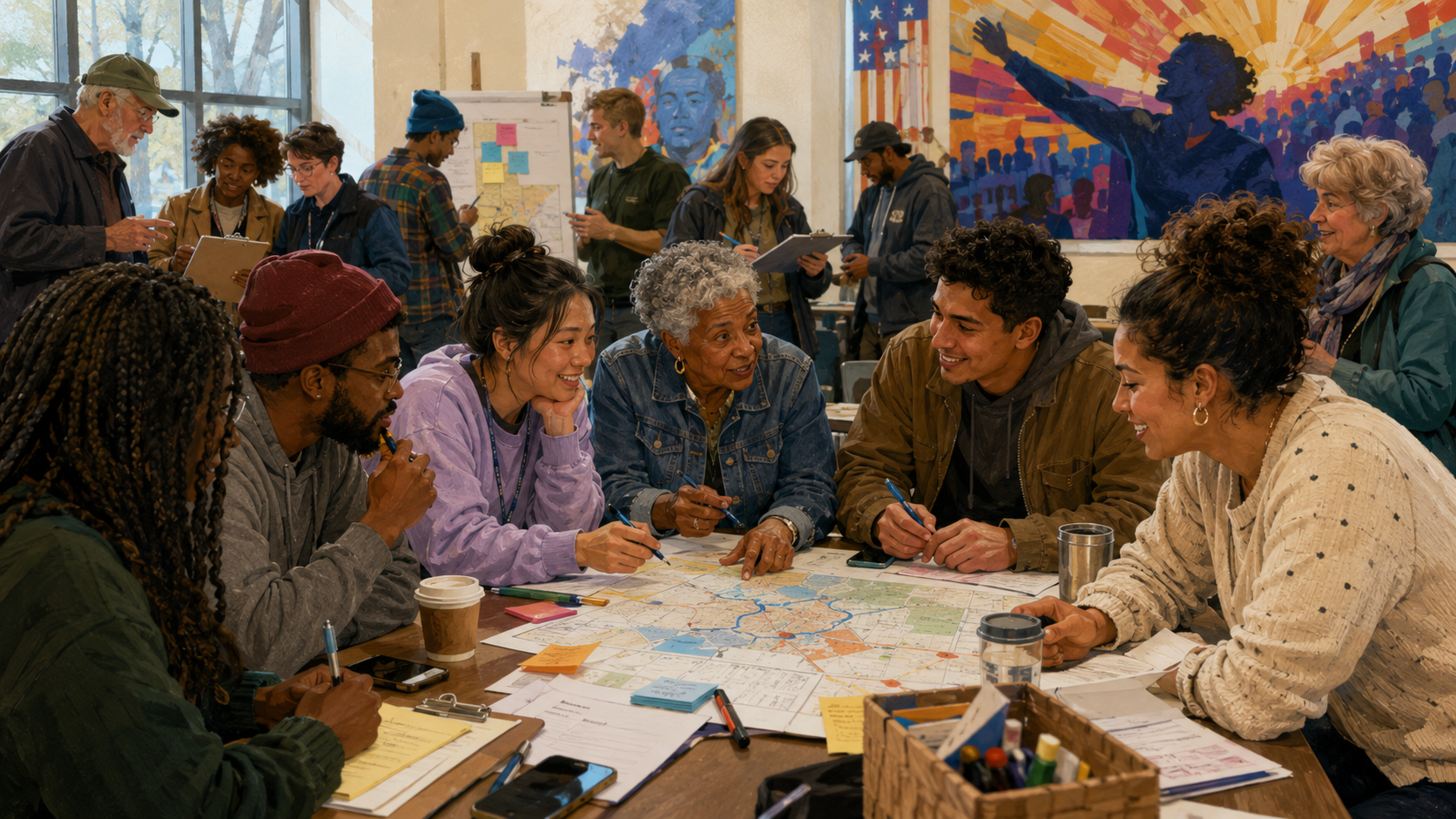
Here's the big idea — and, if done right, potentially a big boon for rebuilding the brand: create a parallel, grassroots-oriented, deeply funded national campaign, with thousands of full-time organizers working as part of the Democratic Party. The goals: listen to, sign up, support, protect, and mobilize millions of new and intermittent voters; organize reliable Democratic voters into volunteers and organizers; and promote widely shared values like affordability and anti-corruption on the party's behalf. These organizers would remain neutral until a nominee is chosen.
Picture thousands of full-time organizers in place for at least a year to 18 months — essentially a semi-permanent campaign operation — starting as quickly as possible, but certainly by early 2027. Funding would be separate from DNC coffers, though the two operations would need to work in tandem; the DNC already has its hands full organizing debates, overseeing the primaries, running the convention, and managing the party platform.
Alongside the organizing would be ongoing barnstorming events with candidates, celebrities, and artists showing up at the grassroots level — town halls, picnics, community events. Every targeted area would have social media experts working hand in hand with organizers, coordinating with the large network of progressive media makers and podcasters. Some districts already have well-organized local party clubs, and others have active union engagement; the goal there would be to complement and support that ongoing work while also trying new ideas and tactics.
An effort this ambitious needs skilled leadership. Ben Wikler, who has just written a book on ending America's political meltdown, would be a natural fit — he knows how to build this kind of infrastructure. If not him, there's plenty of talent to draw on.
It sure sounds ambitious, right, and there will be resistance. But these are desperate times. Martin and the DNC establishment should feel vulnerable enough to see a bold strategic shift as their best chance at both winning and claiming credit — or at minimum, covering their bases. If Democrats lose again in 2028, the legacy of this DNC leadership may follow them for the rest of their lives.
How Do We Pay for It?
Stop wasting hundreds of millions on media monopolies and consultants — it clearly didn't work in 2024. Fox Business reported that the Harris campaign and its allies spent $1.4 billion on ads, out of more than $2 billion spent on the campaign overall. As one insider put it, "we had so much money that we had a hard time shoveling it out the door." By rough math, half a billion dollars — barely a third of that media budget — could fund 10,000 full-time organizers for a year at $50,000 each. Obviously such an ambitious number would not likely be the goal. But it offers an idea of what could be possible given the large amounts of cash sloshing around presidential campaigns.
Granted, a lot of 2024's money came in during the latter stages of the campaign. Experts felt Trump's ad spending had to be countered. But with a clear plan explained well in advance, plenty of low-dollar donations can be raised earlier — and there are large donors who would go for this too, willing to invest in real change in the Democratic Party. Instead, in 2024, massive amounts of money went to monopoly media corporations, and consultants took healthy cuts of the arrangements, some pocketing millions — one obvious way Democrats can get tarred with the corruption label. For the depressing details of who got rich (or richer) off the campaign, see Andrew Cockburn's well-informed takedown of the Democrats' election failure in Harpers: "Playing Dead: Do the Democrats Really Want Reform?"
Supercharged Activism, Outside the Party
A number of independent groups are working hard to connect with potential voters for the ’26 Congressional elections. A national grassroots-supported campaign would collaborate with them, bringing synergy to the effort — leadership and talent could be drawn from MoveOn, Swing Left, Indivisible, the Working Families Party, and others.
The No Kings marches, well organized by Indivisible, engaged 7 million or more people. Roughly 2.3 million individual donors contributed to the Kamala Harris campaign's joint fundraising committees in the weeks after President Biden withdrew from the race. About 70% of those donors — more than 1.5 million people — were entirely new donors. Say, conservatively, that 8 million or more people have marched or donated since Trump regained the presidency. Just 10% of that total would be 800,000 potential volunteers — the ingredients of a powerful, enthusiastic grassroots army. But they need to be organized.
With a two-year buildup and enthusiasm from leaders, candidates, and icons like Bernie and AOC (building on the wisdom of their successful "no oligarchs" tour), a muscular ground game could help turn the tide. Some participants may want to call themselves "grassroots Democrats," or independent Democrats, or something more creative — the primary goal is simply to elect a Democrat as president.
In the past, most local electoral organizing for the national party has been left to local parties, political clubs, and nonprofits funded to register and mobilize voters. In some states the existing apparatus and hired consultants were effective, in others, not so much. The bottom line: in 2024, it was not enough. Trump made inroads among young men, Latinos, and even some Black voters. Fifteen percent of people who voted for Biden in 2020 didn't vote for Harris, and the gender gap shrank.
Turnout Is the Goal
Bitecofer argues that who decides to come out and vote determines elections, not candidates' positions — and swing voters break for change; they don't vote based on careful assessment. So, there's the challenge: Democrats must be seen as the party of change, to mobilize the numbers needed to overcome the obstacles that will be strewn in their way. Turnout is key. That's what this proposal is about. The brand must be more compelling, and of course so must the candidates — people need to be genuinely excited about what a newly configured Democratic Party can bring.
We should remember that Democratic leaders have known how to mobilize in the past. Barack Obama, a trained organizer, built neighborhood teams. Howard Dean pioneered grassroots fundraising and meetups. Bernie Sanders pushed a decentralized organizing culture. There's a deep history of creativity and success to build on.
Still, more voters are needed — there's no avoiding it. A New York Times deep dive into voter registration statistics across 30 states found Democrats lost about 2.1 million registered voters between the 2020 and 2024 elections, while Republicans gained 2.4 million and continue registering voters at a brisk pace.
In 2024 in the range of 90 million eligible voters did not vote. The largest pool of available voters falls into a few categories including new voters, mostly young people (only a third of whom are registered), and inconsistent voters with no regular voting pattern. One striking statistic that belies logic: roughly 30% of the voters in a presidential election are different from the 30% who showed up in the previous one.
Jane McAlevey and Relational Organizing
Deep canvassing relies on extended, non-judgmental conversations that explore voters' deeper feelings and beliefs, in contrast to the short, scripted digital outreach often used to identify targets. Imagine deep discussions happening at front doors, in parks, at meet-and-greets and picnics. Swing Left's Ground Truth project aims for hundreds of thousands of such conversations ahead of the 2026 midterms, gathering voter information while building relational-organizing networks.
Relational organizing turns social networks into political ones. It trains and empowers volunteers to engage their own communities — neighbors, coworkers, friends — in ways that foster commitments transcending traditional partisan boundaries. My good friend Jane McAlevey, the renowned labor organizer and theorist who recently passed away, felt strongly about this model, calling it “whole worker organizing.”. She used the same dynamics in labor organizing — with nurses considering a strike, for instance, it was important to bring in family, neighbors, and opinion shapers, the whole community of allies, to provide support and pressure the employer.
When I interviewed Jane ahead of the 2020 election, she put it this way: “You must commit to doing more than ever before and make that commitment publicly to friends and family. All politics is local — talking to strangers far away doesn't work nearly as well. Politics is a team sport: work with neighbors, union members, fellow alumni, colleagues. The best place to organize is with people you already know — what are other parents' priorities, for example? Join groups, locally and nationally, and recruit others. Recruiting new voters, from the 90 million who don't vote in presidential elections, is a better use of energy than trying to convince MAGA supporters to think otherwise. Getting involved, she said, is the best antidote to paralysis or feelings of depression — "and you will feel much better when we win."
This has also been Ben Wikler's approach. In Wisconsin, “his team built a permanent campaign infrastructure — dozens of storefront offices, hundreds of neighborhood action teams working out of coffee shops, bars, and living rooms, talking to neighbors friend-to-friend and door-to-door, and communicating year-round through email lists, group chats, Facebook groups, radio call-ins, roadside signs, and weekly newspapers — wherever persuadable, largely apolitical voters might actually see the message.”
Research from Washington University in St. Louis backs up these tactics: voting habits are fundamentally social, driven more by peer networks than individual ideology. Party loyalty rises when close friends are committed, and people routinely outsource political decisions to trusted figures in their lives — even more reason to invest in relational organizing.
What's Coming in 2028
Even if Democrats make progress in 2026, 2028 is a whole different story — a question of whether authoritarian consolidation can be stopped. The political future is being greased by rapid technological change and shaken by relentless, trauma-inducing bullying, trolling, disinformation, and lies. It's dominated by a new breed of super-billionaires — an oligarchy of wealth never seen before in America, most of whom have bent the knee to Trump and MAGA. (Musk, for one, could give away billions without blinking.) A few priorities to keep in mind:
- Voter suppression tactics will be at their most aggressive, with ICE at the polls and intimidation everywhere. Veteran campaign strategist Joe Trippi warns that AI is already invading everything and will accelerate and amplify the most negative attacks while pinpointing their delivery.
- Young men remain up for grabs. They've been strongly encouraged to blame women for their economic and job struggles and feelings of failure. A "bro culture" has developed appeals to young men that lean on video game culture, risk-taking, sports betting, and cage wrestling — all wrapped in misogyny.
- Misogyny has been a constant centerpiece of Trump and MAGA politics for eleven-plus years now, and the resulting trauma likely affects women voters' psychology and motivation.
- The media disadvantages are striking, as more media falls under the control of oligarchs favored by Trump, even as bro-culture social media stays dominant. The right's propaganda and disinformation efforts are relentless, and AI threatens to make things much worse.
In the end, we must never forget that voting is emotional. Bitecofer describes Democrats as being "flattened by a fascist movement that figured out 20 years ago that emotion beats policy, fear beats fact, and offense beats defense every damn time." As I've quoted Anand Giridharadas elsewhere, we live in an era where emotion carries more persuasive power than facts and rationality — and history shows that makes us vulnerable to authoritarians who delight in swaying mass sentiment and fanning mobs.
To fight back, we must empower the opposite of MAGA's divisive rhetoric. We must capture and promote the positive emotions of hope, enthusiasm, and safety. That feeling of belonging to something larger — the strength in numbers that comes from standing with friends, neighbors, and communities in sync around a shared purpose — is essential for our future.
Comments

Powered by RoundtableAn AI/DeFi-powered Enterprise Media Operating System. Learn more at Roundtable.io.© Roundtable 2026. By using this site you agree to the Terms of Use and Privacy Policy