


Feb 3, 2026 6:36 PM
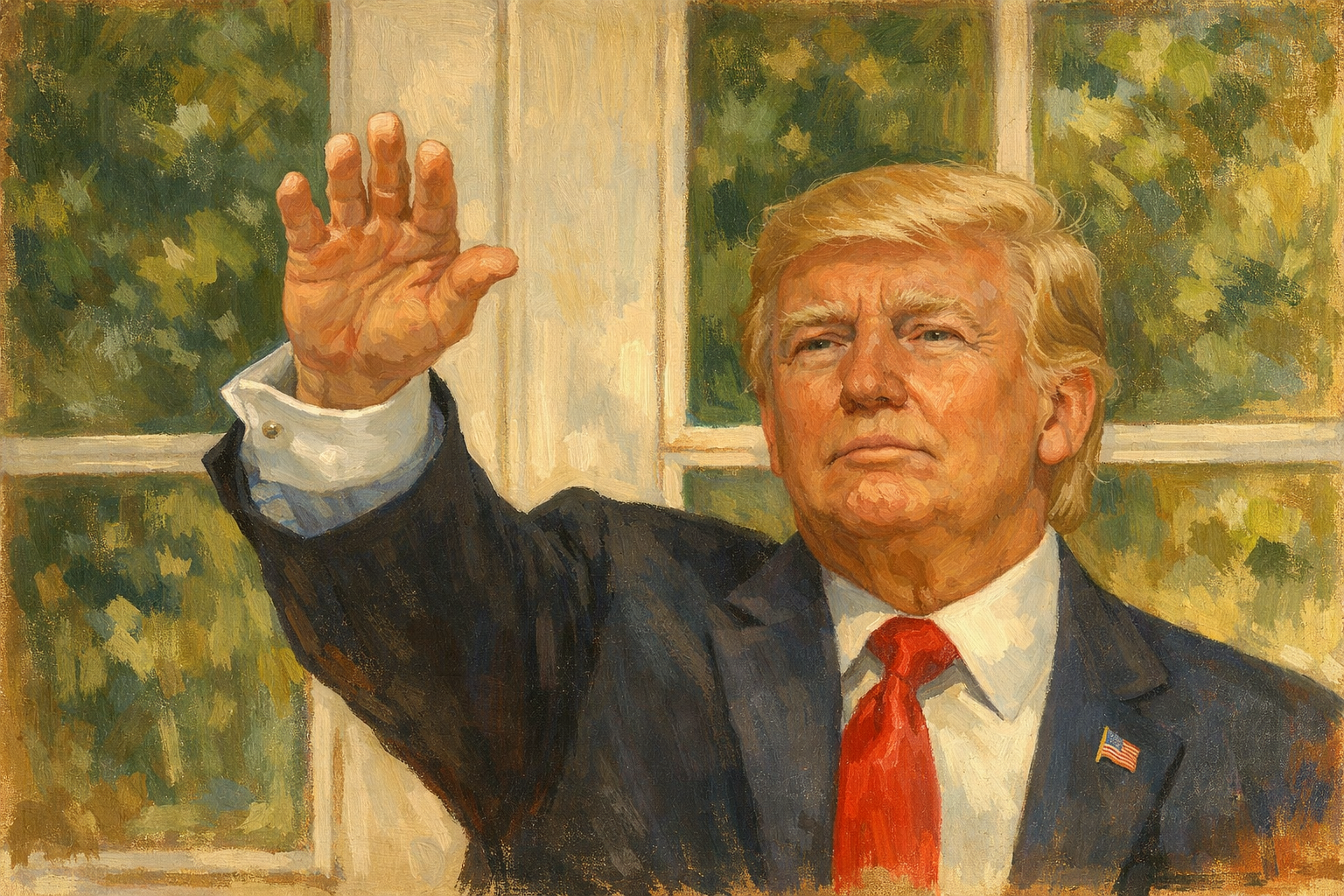
Trump governs as though the presidency were not a covenant with a people but a platform under hot lights. Politics collapses into performance; performance congeals into law.
Colleagues and friends often speak of Donald Trump’s “God complex,” as though the danger were merely psychological, a private excess of ego. But the phrase itself diminishes the threat.
What Trump exhibits is not too much faith in himself, but devotion to a god small enough to be staged. He enters public life like a counterfeit coin loosed into circulation—bright in the palm, convincing at a glance, hollow when struck. His authority does not arise from weight or legitimacy but from repetition. Passed often enough, the fake acquires the feel of the real. Strength becomes something to be performed rather than exercised, volume a substitute for power, spectacle a proxy for rule.
Trump governs as though the presidency were not a covenant with a people but a platform under hot lights. Politics collapses into performance; performance congeals into law. Truth is reduced to a prop, law to an inconvenience, humiliation elevated into a governing method. What is rewarded is not judgment but submission, not competence but fealty. Cruelty, stripped of shame, is renamed resolve. This is the logic of idols. They demand constant attention because they possess no inner gravity. They rule by glare rather than substance, by domination rather than consent. And like all false gods, they require sacrifice—not of the ruler, but of the people: of language hollowed out, of memory vandalized, of the moral inheritance that holds a democracy together.
When the applause fades, what remains is not strength but emptiness, not greatness but residue. The damage is not merely political; it is theological in the deepest sense. A society that mistakes spectacle for authority will eventually discover that it has been governed by reflections—and that mirrors cannot hold a nation together.
Related stories
Trump’s comedy is never generous. It falls downward, like spit from a balcony. Rivals, journalists, judges, entire institutions are reduced to caricature so that one figure may loom larger in the frame. Secure leaders endure comparison. Insecure ones erase it. Berlusconi trusted the camera. Nixon trusted the secret. Trump trusts ridicule—the corrosive laughter that dissolves norms and calls the acid wit.
And so the age is marked by noise: a blizzard of words meant to bury thought, a carnival of insults meant to drown conscience. Yet beneath the din, the old questions persist, as they always do, as they always will:
Who rules?
For whom?
By what right?
But power did not listen. The cry rose clearly enough—unmistakable, collective, human—but authority chose silence, that most ancient technology of rule. What it could not refute, it ignored. What it could not answer, it entombed.
Both Alex Pretti and Renée Nicole Good were killed by federal immigration enforcement agents in Minneapolis in early 2026—Pretti shot in the back multiple times by Border Patrol/CBP officers and Good shot several times in the face by an ICE agent during an enforcement operation. They are physically gone, but their deaths continue to resonate as testimonies against a system that distinguishes force from justice. Even in death their names speak to us: echoing through protests, investigations, and the moral reckonings of their communities. Their loss is not a metaphor but a summons—a reminder that when the instruments of the state become instruments of death, the body may fall, but the question of justice endures.
History will not ask whether the people spoke. It will ask who listened.
Trump believes not merely that he should lead, but that Americans must take his views whole—on loyalty, grievance, truth, nationhood. Disagreement is not difference; it is betrayal. The republic becomes, in his imagination, not a plural argument but an audience awaiting instruction. This is why he speaks admiringly of strongmen—especially his friends Putin and Orbán—men who mistake domination for legitimacy and treat the state as a personal extension of will. He does not admire their policies so much as their freedom from constraint.
Trump rallies are saturated with diatribe and joke alike. But it is the laughter that matters. His supporters laugh the way people laugh at an off-color joke—half entertained, half electrified by the breach itself. The pleasure does not lie in wit, but in permission. Each laugh ratifies the transgression, signals belonging, rehearses cruelty as camaraderie.
This laughter is not incidental; it is disciplinary. It teaches what may now be said, whom it is safe to mock, which boundaries have been dissolved. In the echo of that laughter, norms do not merely erode—they are publicly buried. What begins as amusement hardens into assent. The crowd learns, together, how to enjoy the sound of harm.
Each laugh becomes a small moral waiver. Each joke bends reality just enough to make the next distortion survivable. This is the ancient method of the cult figure: stretch meaning incrementally until no one can say with certainty whether words are jest or threat.
When challenged, he retreats into humor. When believed, he advances as truth. Irony becomes armor. Cruelty passes through disguised as wit.
What begins as performance hardens into power. The joke lingers after the laughter fades, leaving behind a residue of acceptance. The unimaginable becomes controversial, then familiar, then forgettable. Reality is not shattered; it is warped slowly, patiently, until it conforms to the shape of the man insisting he is only kidding. The phrase becomes reflexive, almost soothing: that’s just Trump being Trump.
This deformation does not remain rhetorical. It migrates into policy—most starkly, most brutally, in immigration enforcement.
ICE is introduced under Trump as procedure: professional, efficient, no-nonsense. “Zero tolerance” is framed as resolve. Family separation is presented as deterrence. The language is managerial, antiseptic. Enforcement is described as law applied without passion in a country that claims to take the rule of law seriously. Even many who favor mass deportation reassure themselves that this is about order, not punishment.
But on the ground—the ground such as Minneapolis and beyond—the reality is different.
Raids unfold like paramilitary operations conducted against the defenseless. Agents arrive without judicial warrants, relying on intimidation rather than due process. Mothers are pulled from cars. A pregnant woman is dragged by the arm. Another is forced face-down into the snow. Parents are detained while children watch. People are arrested at workplaces, in parking lots, outside courthouses—spaces that once signaled civic protection. The choreography is deliberate: suddenness, overwhelm, visibility.
This is not enforcement drifting into excess. It is enforcement redesigned to produce fear.
Under Trump, ICE abandons discretion as a governing principle. Longstanding priorities—violent crime, demonstrable threats—are displaced by numerical targets and public display. Arrests become metrics. Suffering becomes evidence of seriousness. Detention expands. Conditions deteriorate. Medical neglect becomes routine. Family separation is not an unintended consequence; it is a strategy, defended as necessary, later minimized, and finally disavowed without accountability.
What becomes unmistakable is that cruelty is not incidental—it is operational. Paperwork absorbs screams. Bureaucracy sanitizes harm. Each incident is explained away as an exception, a misunderstanding, an unfortunate necessity. But the pattern clarifies. The uniform no longer signals order; it signals dread. The badge no longer restrains power; it licenses it.
Trump’s incuriosity makes him dangerous. He knows little of American history and less of Latin America’s. Venezuela becomes a slogan rather than a country shaped by extraction, inequality, and revolt. Chávez’s attempt to nationalize oil as part of the Bolivarian Revolution is reduced to a talking point, stripped of context, consequence, or comparison. Complexity irritates him. And yet he speaks casually of force—of seizing tankers, of interdictions at sea, of destruction as leverage—without regard for international law or civilian life. Leaders drift toward criminality not only through ideology, but through ignorance armored with confidence.
The same contempt governs his relationship to knowledge. Scientific institutions studying climate, public health, and the future are defunded or politicized. Data becomes disloyalty. Expertise becomes sabotage.
Like many strongmen before him, Trump experiences reality as an insult when it refuses to flatter him. Instead, he obsesses over surfaces. Ballrooms. Gold leaf in the Oval Office. Chandeliers. While institutions thin, his properties flourish. His family amasses billions through proximity to power. The boundary between public office and private enrichment dissolves—not furtively, but proudly. The presidency becomes a brand accelerator. History has a long memory for such arrangements.
Fox News performs the essential work of state regime media—normalization! It does not merely defend Trump; it anesthetizes the audience. Politics is framed as tribal combat stripped of consequence. Felonies become persecution. Law becomes tactic. The presidency—custodian of nuclear codes, steward of alliances—is reduced to a jersey in a permanent culture war. What matters is not the country, but the team.
This is why millions are encouraged not to see what is in front of them: a man unmoored from restraint, animated by grievance, incapable of kindness. Trump never shows mercy because mercy requires security. He shows vengeance because vengeance reassures him. He belittles female reporters. He lies reflexively, including about his relationship to Epstein. Truth is not something to be defended, only evaded.
He insists America is the “hottest” country in the world and he is not referring to the weather. America under Trump is “respected again,” that it thrives in the greatest economy in its history, even as tariff wars punish consumers and fracture alliances. Next door, the verdict is clearer. Canadians recoil not out of ideology but recognition—recognition of contempt for shared history, of diplomacy treated as extortion. Across much of the world, Trump is not feared so much as despised: vulgar, unreliable, unserious.
Trump’s admiration for Vladimir Putin is perhaps the clearest signal that his instincts favor fascism over democracy. Putin is an infamous architect of war, a fascist who hungers for the ghosts of the Soviet empire, a man for whom law, institutions, and international norms are obstacles rather than guides. Epstein’s newly released files show the contours of this world: thousands of mentions of Putin and Russia, attempts to arrange meetings, and reports of Epstein as a “wealth manager” tied to the Russian leader. The documents do not confirm a meeting, nor suggest Putin participated in Epstein’s crimes—but they illuminate a shared ecosystem of influence, secrecy, and the pursuit of leverage.
To praise Putin is to signal allegiance to a logic of power unbound by accountability, a politics where dominance is measured not by service or justice but by how completely one can bind others to silence. And Trump, in his rallies and diatribes, in his laughter and spectacle, performs the same calculus: cruelty rehearsed as entertainment, obedience substituted for competence, authority enacted as performance. The two men occupy different stages, but their methods converge: law becomes ritual, institutions tools, and public norms are recast as optional props in a theater of domination.
Where liberal leaders seek legitimacy through accountability and public consent, Trump celebrates the spectacle of obedience, the conquest of rivals, the consolidation of authority—not as cautionary examples, but as virtues to emulate. In Putin, Trump sees the reflection of his own impulses magnified: the conflation of personal loyalty with national interest, the equation of domination with respect. This is not foreign policy; it is aspiration. Admiration for a man who weaponizes the state against dissent, concentrates authority, and diminishes law to a tool of survival illuminates the fissures in American institutions as starkly as any audit or indictment.
Then the mask slips entirely.
He turns his cruelty on private citizens—mocking, humiliating, savoring degradation for its own sake. When he targets Rob Reiner and his wife, there is no policy aim, no strategy. Only pleasure. Biographers recognize this moment. This is instinct revealed. The insult is not a mistake; it is a confession.
History does not record slogans. It records patterns. It notes how democracies rarely fall to a single blow, but erode through normalization—each outrage explained, each violation contextualized, each leader insisted upon as uniquely necessary. It remembers how laughter often precedes silence, how cruelty arrives dressed as strength, how indifference becomes a civic habit.
America does not fall all at once. It is worn down, like stone beneath a drip of acid, by a politics that mistakes brutality for authority and calls it virtue. The old promises still hang overhead like faded banners. Beneath them moves a people trained to endure injustice without naming it.
And history, patient and unsentimental, writes the final line:
that the deepest violence was not what was done to the body,
but what was taught to the conscience—
until the nation learned how to stop feeling.
I live adjacent to Los Angeles. It is a flashpoint for ICE. Not because it is lawless, but because it is visible. A city of migrants, labor, contradiction, and memory—where enforcement cannot hide behind abstraction. Here, ICE does not merely arrest; it demonstrates. Raids are timed for maximum disruption. Agents appear at dawn, at job sites, outside schools and clinics, counting on fear to do what law cannot. The objective is not simply removal, but reverberation. One arrest is meant to echo through an entire neighborhood.
In Los Angeles, the choreography becomes unmistakable. Officers refuse warrants. They lean on threat rather than statute. They separate families not because separation is necessary, but because it is effective. The body becomes a message. The child becomes leverage. This is what happens when enforcement ceases to be a means and becomes an identity.
What is unfolding today in Minneapolis is not mere enforcement; it is a crucible—a proving ground for the expanding reach of federal power under the banner of immigration operations. In late 2025 and into 2026, the Trump administration launched Operation Metro Surge, deploying thousands of U.S. Immigration and Customs Enforcement (ICE) and Department of Homeland Security agents to Minnesota’s Twin Cities in what officials have described as the largest such immigration enforcement operation in U.S. history.
The aim, in official terms, is to arrest and remove undocumented immigrants with criminal records. But the effects on the city have gone far beyond what was scripted. The operation has touched off protests, community defiance, and a widening sense of fear. In neighborhoods across Minneapolis and St. Paul, the presence of heavily armed ICE agents has transformed everyday life into a tense street theatre, where the possibility of being stopped or detained haunts even those with papers in hand.
Two U.S. citizens—Alex Pretti and Renee Nicole Good—have been killed in confrontations with federal agents, deaths that have become national touchstones in the backlash against the operation. These killings have ignited protests and memorials that have spread beyond Minnesota, including nationwide bike rides and solidarity actions.
Locally, communities are devising their own forms of resistance: whistles and horns signal the approach of agents, neighbors warn one another of patrols, and vigils mark the mortal costs. Minneapolis residents describe an atmosphere of constant vigilance—a high alert that persists even in stillness.
Civil authorities have pushed back. Minnesota’s attorney general, along with the cities of Minneapolis and St. Paul, filed a federal lawsuit seeking to halt Operation Metro Surge, arguing that the mass deployment of armed agents violates constitutional rights, state sovereignty, and procedural norms.
So far, federal courts have been hesitant to stop the operation altogether. A judge recently denied a request to temporarily halt the surge, allowing it to continue even after acknowledging the profound disruptions it has caused. At the same time, another court ruling has placed limits on how ICE agents may interact with peaceful protestors, barring retaliation or arrests absent clear legal cause.
The surge has rippled outward into the life of the city. Minneapolis businesses report losses, schools have gone into lockdown out of fear of sudden enforcement actions, and local police are strained as they respond to the instability federal actions have stirred.
Even corporate America, once cautious to weigh in on immigration debates, has felt compelled to respond; some CEOs have publicly criticized the killings and disruptions, signaling a broader unease with the human and social costs of the operation.
In this crucible, Minneapolis is testing more than an enforcement strategy; it is testing the limits of federal authority, public dissent, and the resilience of communities caught between law and coercion. The city has become a stage on which questions long simmering in the American polity are now being acted out in real time: What does public safety mean when enforcement instills fear? What does the law protect when its execution feels arbitrary? How does a community retain its sense of home when every street corner can feel like a frontline?
In this moment, Minneapolis is not just witnessing federal action—it is challenging it. The city’s response, its legal pushback, its civic resistance, and the very way its people navigate their own streets have turned it into a proving ground—not merely for enforcement tactics, but for the larger questions of authority, belonging, and democratic life in the twenty‑first century.
Community members learn quickly what the law no longer guarantees. That the courthouse is no longer sanctuary. That work is no longer protection. That pregnancy is no shield. That compliance does not ensure mercy. The social contract thins. People stop reporting crimes. Stop seeking medical care. Stop trusting the institutions meant to serve them. Fear becomes ambient, a condition of daily life rather than an emergency.
What is striking—what history will underline—is how administrative language masks moral collapse. “Detainers.” “Processing.” “Operational necessity.” These terms do not merely obscure violence; they metabolize it. Harm is rendered procedural. Pain is rendered logistical. The paperwork moves forward even when the human being does not.
This is how democracies degrade without announcing themselves as tyrannies. The violence is outsourced to agencies. The cruelty is distributed across forms and signatures. No single actor feels responsible, which is precisely the point. The system functions because conscience is diffused.
And yet, even here, resistance flickers—not as spectacle, but as witness. Teachers who shield students. Neighbors who document arrests. Lawyers who insist on naming what is happening. This too belongs to the historical record: that authoritarian systems depend not only on cruelty, but on exhaustion—on the hope that those who see clearly will eventually tire.
The Trump era reveals something older than Trump himself. Republics do not collapse when leaders become cruel; they collapse when cruelty becomes administratively normal.
Rome did not fall when emperors grew decadent. It fell when citizenship lost meaning, when law became discretionary, when loyalty mattered more than justice.
Late republics always look functional from a distance. Roads still work. Markets still open. The rituals continue. What decays is not structure but spirit.
History shows that imperial decline rarely announces itself with catastrophe. It arrives through habituation. The expansion of executive power justified by emergency. The vilification of internal enemies framed as purification. The celebration of strength unmoored from restraint. In every age, there are citizens who mistake domination for order and call it realism.
Trump does not invent this pattern; he accelerates it. He strips away pretense. Where others cloak ambition in ideology, he exposes appetite. Where others invoke destiny, he invokes grievance. His presidency is not strategic; it is instinctual. And that is what makes it revealing.
Trump delights in reducing Canada to a footnote in his theater of power. He calls prime ministers “governors,” hints at folding Canada into the United States as a 51st state, opens secret channels with separatists in Alberta, and wields tariffs like a sledgehammer across trade. Greenland, too, becomes a pawn in his imagination, a distant prize to annex. Each gesture is performative, a demonstration of dominion.
It is not mere commerce or diplomacy he seeks—it is total submission to his will. In this world, national boundaries exist only to mark the terrain of his ego; treaties are props, and global leadership is a stage on which he alone is allowed to speak. To Trump, the map is less geography than a mirror of his ambition, and every nation is measured not by its people or institutions, but by how loudly it can acknowledge his supremacy.
In these actions, every insult, every tariff, every whispered conversation with separatists, is a rehearsal for a larger truth he lives by: that the world exists to validate him, and that leadership is the performance of power, not its stewardship.
Strongmen of the past often spoke of destiny, race, or history. Trump speaks of himself. The nation becomes a mirror in which he seeks affirmation. Institutions exist insofar as they reflect him. When they do not, they are declared illegitimate. Courts become enemies. Scientists become traitors. Journalists become vermin. This language is never accidental. It is preparatory.
Fascist republics always produce a media ecosystem that confuses loyalty with truth. Fox News does not merely misinform; it reorients moral gravity. The question ceases to be what is happening and becomes who benefits from believing it. Politics is reduced to identity warfare, and the country itself becomes collateral damage.
This is how a man holding nuclear codes can be discussed as entertainment. How felony charges are reframed as persecution. How cruelty is laundered into authenticity. The audience is not asked to judge consequences, only to choose sides.
History is unsentimental about such moments. It does not ask whether leaders were liked or disliked. It asks whether institutions held. Whether laws applied. Whether violence was restrained. Whether cruelty was resisted or rationalized.
America is not unique in facing this test. What is unique is how loudly it insists on its innocence while rehearsing the same errors. The belief that “it can’t happen here” has always been the prelude to its happening.
The Trump years teach a brutal lesson: that barbarism does not arrive roaring. It arrives joking. It arrives bureaucratic. It arrives with paperwork, with ratings, with laughter. It arrives disguised as strength.
And when history closes the file—as it always does—it will note not only the man, but the conditions that allowed him to flourish. The exhaustion. The cynicism. The willingness to accept suffering as inevitable so long as it is someone else’s.
America does not fall all at once. It erodes. It acclimates. It learns how to look away. History records with severity how republics die—not by conquest, but by consent, given quietly, one shrug at a time.
The God Complex
Trump is the leader of the most powerful military in history—a force vast enough to shape continents, to project violence across oceans, to remake the map of the world. Yet he wields it not as a steward of strategy, law, or collective security, but as a personal instrument: a stage prop in the theater of his ego. Strength becomes spectacle, soldiers become actors, and the machinery of defense is reduced to applause and intimidation. In the hands of a man who mistakes obedience for loyalty and cruelty for resolve, even the mightiest army becomes a mirror of its master’s vanity.
We mortals, tethered to time, live in an hour when a man in an orange mask and yellow bouffant—an idol lacquered by spectacle and screens—drapes himself in the algorithms of divinity, strutting as though he were the measure of truth, the fountain of law, the pivot on which reality itself must turn, and by this grotesque illusion of grandeur commands the most powerful military ever assembled in the long, blood-written chronicle of the human race. But this does not make him God. But this does not make him God. Theologically, it is absurd. Power, even absolute power, does not sanctify; it only amplifies character. God, in every tradition that matters, is not a spectacle, nor a show of force, nor a wielder of armies for vanity. God creates, sustains, and judges; God binds the universe with law and love, not with bluster and fear. To call a man with troops at his command a deity is to mistake volume for divinity, obedience for covenant, cruelty for providence. Trump’s throne may be vast, his army unmatched, his rallies dazzling—but these are not the marks of God; they are the mirrors of a man, and nothing more.
The man who ‘flips the bird’ at protesting workers and soils the air with lustful boasts about his press secretary’s ‘machine gun’ lips dares to speak in the first-person singular as though it were the first-person eternal. He mouths his name as if it were a sacred syllable. He poses as the King of Glory yet confuses the roar of crowds with the voice from the burning bush, the thunder of creation itself. He mistakes applause for revelation, dominance for divinity, the swelling of ego for the descent of the Holy. In the echo chamber of his adoration, he hears not the whisper of conscience but the pulse of life itself and mistakes it for God.
He would be Caesar and prophet, king and messiah, idol and priest, who struts before the world as though he were the measure of truth, the source of law, the arbiter of reality itself. Yet he is no more than a lower-case tyrant, a creature of contingency, a bundle of carnal appetites wrapped in power, a will unmoored from any objective good. He bows to no moral law beyond himself. He moves only when it fattens his coffers, flatters his vanity, or feeds the hungers of his clan and his cult. He confuses domination with destiny, impulse with providence, self-interest with sovereignty. He claims all North America as his legitimate sphere of influence, his geopolitical playground. And so, at this precise and perilous moment in history, it becomes urgent again to ask the existential question: Why do so many Americans worship Trump as if he were God, and why does Trump act as if he were some divine agent.
How can so many Americans place their hope and their trust in Donald J. Trump when clearly he is a tyrant, head of a crime family, godfather of bitcoin, a creature of contingency, a mere mortal with a voracious appetite for self-adoration who follows no moral law that does not first flatter him. He kneels before no truth that does not enrich him. He moves only when it fattens his coffers, when it launders the ambitions of his crime-entangled house, when it polishes the mirror of his vanity, when it indulges the hungers of flesh and spectacle. He does not govern by justice but by grievance, not by covenant but by transaction, not by truth but by the currency of lies. He confuses domination with destiny, impulse with providence, self-interest with sovereignty. He would have a nation bow to his moods as if they were commandments, and history itself pause to admire his name carved in gold. He rolls out his commandments on a digital scroll called Truth Social. And so, why do they put their faith in such a monster? Why do millions bend the arc of their hope toward a man whose hands are bright with spectacle but empty of covenant?
The answer is never simple. People are drawn to force when they have been taught that fear is guidance, to bluster when tenderness has been punished, to loyalty when justice feels distant. They worship the show because the world has offered few alternatives, and in the theater of cruelty, the loudest voice promises safety—even as it betrays it. Faith, in this house, is not devotion to truth; it is surrender to performance, a bargain struck with shadows and roars.
And so, at this precise and perilous moment, when a man who would enthrone himself as an ultimate being has access to the nuclear codes, it becomes necessary again—terribly, luminously necessary—to ask the ancient question: Who or what is God?
A number of ideas come to mind. I’ll take a chance on an abstract description. God is not a traveler from somewhere, but the wellspring from which “somewhere” itself first flowed. Not a being caught in the river of time, but the one who carved its banks and called the waters into motion. God is the cause behind every cause, the fire behind every spark, the silence in which all words are conceived. Before clocks learned to tick, before light learned to run, before space learned to stretch, He was. And when time itself, like a fallen star, bent under the rebellion of an angel of light and became wounded by pride, God did the unthinkable: He stepped into the very current He had authored. He joined the human race.
But why would the Author of humankind enter His own story? Put in a more Biblical language: why would God choose to walk into the dust, the terror, the hope and messy terrain of human history as Jesus? Because love, unlike abstraction, refuses to remain distant. God is not the despot of naked power but the wellspring of self-giving communion. God is love, and love does not erect monuments to its own magnificence, be they triumphal arches or ballrooms; love raises shelters for the abandoned and sets tables for the forgotten. Love does not hunger for applause or genuflection; it stoops. It binds wounds. It kneels in the dust and washes the feet of those the world would rather trample.
“I AM WHO I AM.” No origin, no genealogy, no opening page before the first word. Being itself speaking in the first person, existence awakening to its own name. Not a thing among things, but the ground on which all things stand. Not a resident of the universe, but the reason the universe is able to reside anywhere at all. To imagine God as merely another tenant of time is a category mistake, like trying to weigh a melody or photograph a thought. Time does not cradle God; God cradles time. Eternity is not an endless corridor of seconds—it is the vast, living fullness in which every moment finds its home.
How small, then, how pitifully small, is the man who rages on Truth Social at dawn and calls it sovereignty. How microscopic the will that demands loyalty but cannot bear truth, that craves worship but cannot suffer for the weak, that sells lies as if they were sacraments and calls cruelty “strength.” He is not “I AM.” He is “I WANT.” He is not necessity; he is accident. He is not the source of law; he is its violator. He is not the ground of being; he is dust temporarily enthroned, a pulse that will soon still, a voice that will one day echo only in court records and footnotes.
Long before the first star learned to burn, before angels learned the grammar of praise, before silence itself had a name, there was the One who spoke Himself:
I AM.
Not born, not begun, not summoned from any womb of time, but self-existent, self-defining, the fire that needs no fuel, the light that borrows nothing from the sun. He did not emerge; He is. He did not become; He was, and is, and shall be, in one indivisible act of being.
Before mountains shouldered the sky, before oceans learned their boundaries, before the dust of worlds was even imagined, God already stood—Creator before creation, Sovereign before subjects, Love before there was anything to be loved.
God is not a tenant of the universe but its Architect, not a voice within time but the One who taught time how to speak. Space unfolds because He wills it; matter coheres because He sustains it; history breathes because He remembers it.
We, whose minds are stitched to seconds and whose memories wither like autumn leaves, cannot fathom what has no beginning. Our neurons spark and gutter; eternity neither ignites nor goes dark. We are creatures of the clock, fashioned by a will beyond the clock, and this is why infinity makes us dizzy: the finite mind peering over the edge of the immeasurable, trying to hold what it was never designed to contain—the brain trying to grasp what it was never built to hold.
God is beginning and end in one indivisible act. Pure actuality, no shadow of becoming other than what it already is. Necessary being, whose non-existence is impossible. Everything else might not have been except for God. God must be. All contingent things lean on causes the way arches lean on keystones; remove the keystone and the structure collapses. God is that keystone of reality, the uncaused cause, the Prime Mover who Himself is unmoved, the infinite act of being that holds the cosmos in existence as a thought is held in a mind.
Before Abraham, I AM.
God is not assembled, not improvised, not packaged for applause. He is not a brand, not a slogan, not a chant stitched on red hats and sold like cheap prophecy. He is not a crowd whipped into frenzy by a flabby man with a microphone, gyrating in awkward pantomime while mistaking spectacle for spirit and noise for glory. God is not a performance. God is not a product. God is not the echo of a rally; He is the stillness in which truth is born.
Listen carefully, Mr. President: moral truth is not a poll, and justice is not the echo of a political rally. Goodness is not what fattens the strong, the oligarchs, the tech princes, the iron-handed “leaders” who menace borders and trample nations. Reality itself murmurs of a holiness that cannot be purchased, a law that cannot be bribed, a truth that cannot be summoned by a tweet or bullied into being by power, especially if that power is compromised by frontotemporal dementia.
Here the counterfeit god stands unmasked: his rancid smelling, dimpled buttocks swaying in crude triumph to the roar of the crowd, a carnival idol in orange makeup gyrating in self-adoration while mistaking the frenzy of spectators for the trembling of the heavens. The ruler who demands adoration with every fist pump but offers no mercy, except for other rulers convicted of crimes. Hello Honduras! Hello Brazil. Bolsonaro, are you there? Would you both like to join the felonship of the ring leaders?
We are talking about the strongman who promises greatness but traffics in fear. The demagogue who anoints his own appetites as destiny and calls his own image “the nation.” He is not the light; he feeds on the darkness. He is not the Word; he lives by distortion. He is not the shepherd; he is the wolf wrapped in patriotic cloth.
Now, by contrast, consider the Author who steps into the novel. The ink does not create the hand that writes it. The story does not generate the storyteller. Yet in an act of unfathomable mercy, the Author of Eternity enters the plot—not in a palace of gold, not surrounded by courtiers and cosmetic idols, not grabbing forbidden body parts as trophies of power, but born in a borrowed stable, living without property, dying without defense. The Word becomes flesh. Eternity learns to breathe. The timeless enters the clock.
As Stephen Meyer has professed, the universe itself is tuned like a fragile instrument, its constants balanced on a razor’s edge. Shift them by a whisper and stars never ignite, chemistry never sings, life never awakens. This is not proof by microscope but by awe: the sense that the cosmos is not a brute shout but a meaningful sentence. As we trust in electrons and gravity by their explanatory power, so we trust in God because He alone explains why there is something rather than nothing, order rather than chaos, law rather than appetite, truth rather than propaganda. The inference to the best explanation that accounts for the code found inside human DNA points to a divine being.
Science measures; philosophy asks why measurement is possible at all. Logic, coherence, intelligibility—these are the silent pillars beneath every experiment, and they cannot be manufactured by the instruments they sustain. Faith is not the enemy of reason; it is reason’s horizon, where explanation bows before mystery without surrendering to nonsense.
And then the great drama: rebellion and restoration, the angel who would be God and became a serpent, the nations scattered, the powers that ruled unjustly and were judged, as Eden lost and Eden promised again. Heaven and earth meant to be one household, one family, one reign of justice. “Let us make humankind,” says the plural music of divine communion—not “Let one man rule as if he were the law.”
God appears as fire and whisper, as angel and as man. He walks in gardens, wrestles in the dark, thunders on mountains, and finally hangs on a cross. The necessary being enters necessity’s victims. The uncaused cause submits to cause and effect. The Author bleeds into His own story.
Power does not save the world; love does. Domination does not redeem; sacrifice does. Empire does not heal; communion does.
This is the scandal and the glory: that the infinite chose finitude, that the timeless carried an hourglass, that the ground of being learned to say, “I thirst.” Not because He needed the world, but because the world—lied to, brutalized, dazzled by false messiahs—needed Him.
And therefore no Caesar may claim divinity. No president may enthrone himself as ultimate. No strongman may confuse his will with providence.
The cross forever unmasks the lie of the little gods: the gilded idols who speak in boasts, who hunger for adoration, who build monuments to themselves, who dream of palaces and crowns and bodies as spoils, who would rule not as servants but as owners.
I AM THAT I AM.
The sentence in which all sentences are written.
The light in which all seeing sees.
The beginning that has no beginning,
The end that has already begun.
God is not a body among bodies, not a thing stitched from parts, not a mechanism assembled in time. God is pure mind, sheer being, the flame that burns without wick or fuel. In Him there is no composition, no fracture, no becoming—only the absolute simplicity of existence itself. He is worthy of worship because He is not one more object in the universe; He is the reason there is a universe at all.
God exists by the necessity of His own nature. He does not happen; He must be. Some truths are so deep they cannot be erased by any possible world: that love is better than cruelty, that justice is higher than theft, that being is better than nothingness. If moral truth is real in every conceivable world, then its ground must also be real in every conceivable world. The greatest conceivable being cannot flicker in and out of existence. God is not optional. God is unavoidable. His non-existence is impossible. He is the One of whom it must be said: He cannot not be.
The philosophers name Him necessary, self-existent, metaphysically indestructible. There is no world in which He is absent, no timeline in which He is not already there, no void deep enough to swallow Him. He is the ground beneath all grounds, the pulse beneath all pulses, the “I AM” that underwrites every “I am.”
God stands beyond the clock as Father, Son, and Spirit, yet enters the hours without surrendering eternity. He is not composed of matter, yet matter trembles at His address. He is not bound by finitude, yet all finitude leans upon Him; every force in heaven and earth draws its breath from the hidden furnace of His will. Time turns, worlds wheel, histories rise and fall—but God abides, neither hurried nor diminished, the quiet gravity by which all things are held.
What compelled the Author to write Himself into His own story? Nothing but love. Authors do not require their books in order to exist; books require their authors. So too God does not depend on creation in order to be God. He was not summoned into being by any regime, not conjured by the clenched fists of a would-be Gestapo led by Reichsführer-SS Stephen Miller, not anointed by propagandists such as the loathsome Megyn Kelly who believes American citizens should not intervene when five ICE gestapo agents tackle one unarmed woman. God was not manufactured in the studios of a state media chorus, not born from the womb of chance or the fever of history. He was not forged by power, nor licensed by empire, nor validated by the chants of crowds. He was not forged by time spent in the ranks of Trump’s state regime media hosts collectively known as FOX NEWS or birthed by chance. He cannot be glimpsed among the crooked smiles of Laura Ingraham, Jesse Watters, Greg Gutfeld, Sean Hannity, and the other marionettes parading across a stage that groans and fractures under its own pretense. Their voices blare like tin horns; their gestures mimic authority; their laughter echoes hollow. God is not found in manufactured spectacle, in applause bought and sold, or in the theater of the petty and the profane. He dwells beyond the stage, beyond the mirrors, beyond the fleeting glare of mortal vanity.
He simply is.
“I AM WHO I AM.”
Before Abraham, I AM.
Before the first star flared into brightness, I AM.
Before time learned how to count itself, I AM.
Those who cannot imagine any being greater than Trump—save, perhaps, for figures like Charlie Kirk, who has spoken admiringly of executions as “public,” “quick,” and “televised,” even suggesting that witnessing death should serve as a kind of initiation for children—often profess skepticism toward any metaphysical Being at all. They ask, with performative triumph, Who created God? as though the grammar of reality were a toy to be rearranged at will. But the question betrays its own captivity to time: it seeks a cause for the uncaused, an origin for what has no beginning, a source behind the source of all sources. It is not inquiry but category error—the mind pacing inside the clock and mistaking its ticking for the structure of existence itself.
God already was when space unfurled, when time learned to count, when matter leapt into being. He is not eternity stretched thin across hours; He is eternity complete, a plenitude beyond measure. He is the infinite act of being itself, the ultimate ground of all that is. The One God. Uncreated. Necessary. Absolute.
Do you see the point now, President Trump? Not all truth resides in the mind of a would-be Caesar, a man more entranced by gilded ballrooms than by the price of bread on the tables of the poor. Some truths arrive bearing tragic weight. They expose the hidden scaffolding of sin and power—the structures that allow palaces to rise while predators move through the shadows, protected by wealth, silence, and impunity. These are truths that indict not merely individuals but entire systems, truths that reveal how splendor is often mortared with suffering, how silence itself can become a sanctuary for the unspeakable. “Let us make humanity,” says the eternal We, inviting us into a love older than time.
The truth of God’s existence cannot be settled by Christian Nationalists speaking in tongues who fawn over Trump and do his bidding.
A chain of causes cannot stretch back forever into nothing. There must be an eternal fire that lights all other fires, an uncaused cause that gives being without receiving it.
We do not worship a created god. Created gods are idols—fragile, finite, breakable, dependent. The true God is the one who never came to be but always was. The One who does not evolve, does not decay, does not wait to be validated by time. The One whose name is existence—is love itself.
Before Bethlehem, before Nazareth, before the wood of the cross had grown in the forests of the earth, grace already lived in the heart of God. Redemption was not an afterthought; it was an eternal intention. Love was never lonely in God.
Do not confuse the lavishness of Mar-a-Lago with divinity. Such confusion is the liturgy of cults. It is the ancient error of mistaking noise for thunder, glare for light, appetite for authority. MAGA’s faithful do not so much worship a man as surrender themselves to the intoxicating image of power he projects—a triumphalist mirage conjured by lies and narcissistic self-regard, in which they may bathe and feel themselves enlarged. They graft their longings onto his silhouette and name it destiny. They absolve in him what they would condemn in any other, because he offers them the narcotic of dominance: the fever of the chase, the primal thrill of seeing rivals marked, mocked, and symbolically crushed.
The movement speaks in talismanic code—constellations of slogans, acronyms, algorithms, bots, memes, and chants orbiting a single gravitational center. These words do not describe reality; they summon desire. They are not maps of the world but spells cast upon it, attempts to bend it toward what their speakers wish it to become. In this lexicon, power is truth, victory is virtue, and the will to prevail is baptized as righteousness. This is not faith; it is fixation. Not reverence, but rapture at the spectacle of force—the same rapture cultivated in 1930s Germany, where mass pageantry trained the eye to mistake domination for destiny. Triumph of the Will did not merely document power; it taught an audience how to feel it. Trump has learned that lesson well.
Authoritarianism always begins by severing memory from place. Memory resists empire because it insists on continuity—on before and after, on comparison, on judgment. A people who remembers how things were are dangerous to those who intend to rename them. So memory must be ridiculed: the years before recast as weakness, prudence dismissed as nostalgia, restraint mocked as naïveté. Appetite is dressed up as realism; amnesia is sold as strength.
Empires always claim necessity as their defense. History records otherwise.
No, Donald J. Trump—you are not God. History, that cold archivist with inked fingers, will not record you as a statesman but as a felon who clawed at a second crown. You returned to the hustings not to heal a republic but to settle scores—to convert grievance into policy, ridicule into ritual, vengeance into law. You sought the presidency as a cudgel: to jeer at enemies, to crush rivals, to turn the machinery of the state into an instrument of spite. And beneath the bluster, like a watermark on a forged bill, lay the old poison—the fantasy of a whitened nation, an America First past scrubbed clean of its many voices.
Thus you will be remembered: not for governing, but for haunting the house you once occupied, rattling its doors in pursuit of retribution, mistaking power for absolution.
May the ballroom you dream of—soon to be lacquered with mirrors and boast—be given over, instead, to cots and quiet prayers: a hospice where the poor are tended, and the noise of wealth is finally hushed. May the Oval Office be stripped of its garish gold, returned to the gravity of public trust. May the golden arch you would raise be loosened from the sky and lowered like a false idol, its sheen dulled by daylight and truth. And may whatever residue of your name survives in the ledgers of history tell it plainly: that here was a man who mistook cruelty for strength, spectacle for sovereignty, and who beckoned fascism into the American house, believing it a servant—only to leave it as an inheritance.
And may Trump, in his compromised mental state, come to believe he is the UFC’s heavyweight champion—strapping on diapers like a soiled thong, his McDonald’s gut spilling over the waistband—as he moonwalks across the octagon, imagining himself a colossus. The lights glare, the crowd roars, and every step becomes a parody of strength, every pose a pantomime of dominance. His hand-picked opponent, former Special Counsel Jack Smith, waits like fate itself—patient, unamused. And then, as all illusions meet reality, Smith leaps high into the air, and Trump is felled by a spinning wheel kick. The echo of the fall rings far beyond the octagon: a warning that no throne, no ballooning ego, no gilded spectacle can substitute for accountability, nor shield one from the reckoning that awaits all who mistake performance for power. A collision of spectacle and truth, the body that once mocked gravity is humbled by it, knocked down by the very rules he sought to bend. MMA Joey does a feature column on the match and derides Trump and Smith as industry plants given Dana White privilege. Smith moved up in his rankings to challenge for the interim belt. Trump cried foul and accused the match of being rigged. Sound familiar?
Comments

Powered by RoundtableAn AI/DeFi-powered Enterprise Media Operating System. Learn more at Roundtable.io.© Roundtable 2026. By using this site you agree to the Terms of Use and Privacy Policy