
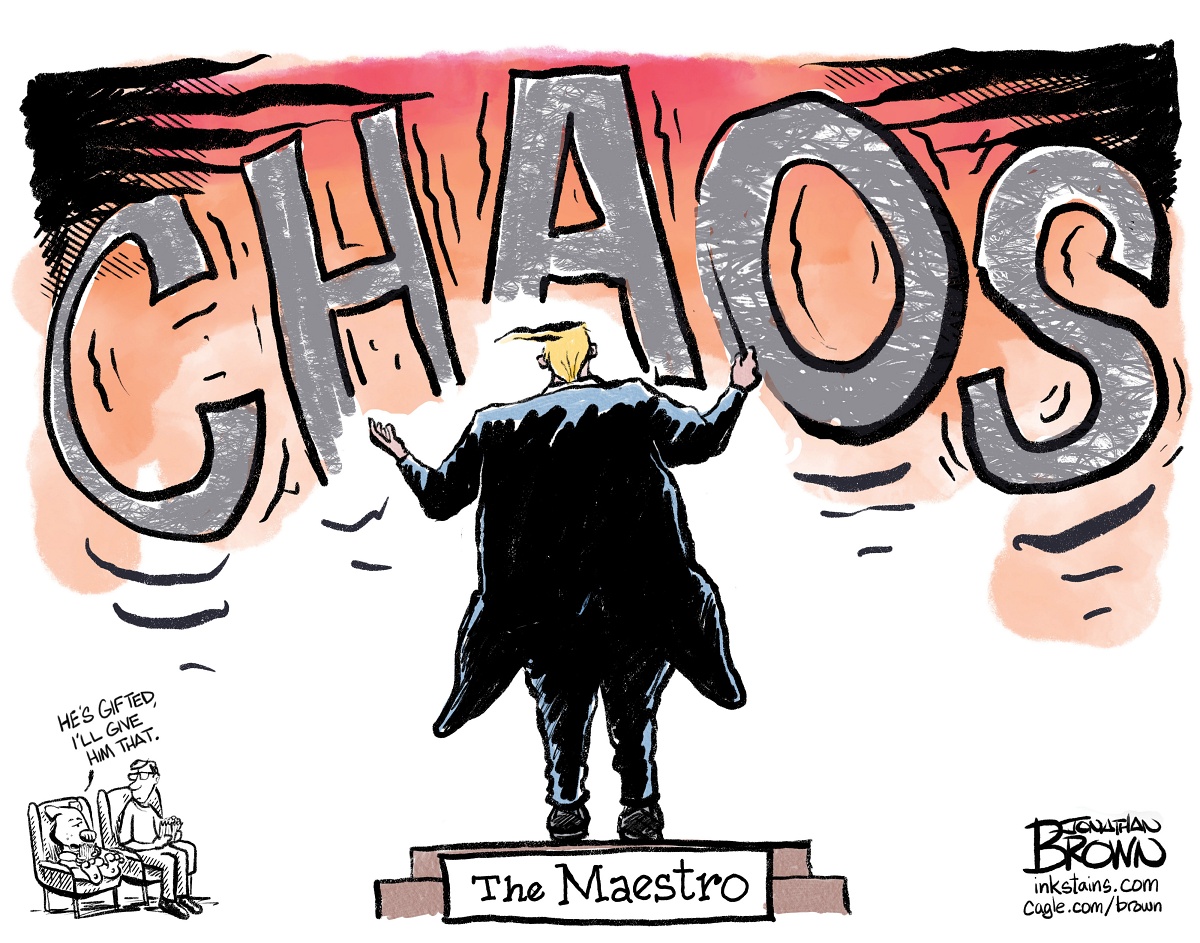
Cagle Cartoon: Jonathan Brown


Trump Administration Is NOT Democratic
May 17, 2025 5:30 PM
Among Democrats and other non-Republicans, the unprecedented anti-democratic onslaught of the Trump 2 attack seemed to leave them befuddled. They simply had never before experienced anything like it.
In a recent New York Times opinion piece, Steven Levitsky, Lucan Way, and Daniel Ziblatt update (see here for an earlier analysis) their view of the Trump Administration. Trump 2 (the second-term Trump presidency) is not democratic; it is authoritarian. They write, “How, then, can we tell whether America has crossed the line into authoritarianism? We propose a simple metric: the cost of opposing the government. In democracies, citizens are not punished for peacefully opposing those in power. They need not worry about publishing critical opinions, supporting opposition candidates or engaging in peaceful protest because they know they will not suffer retribution from the government. In fact, the idea of legitimate opposition—that all citizens have a right to criticize, organize opposition to and seek to remove the government through elections—is a foundational principle of democracy.”
Judging by this criterion, Trump 2 fails the democracy test. The three authors cite Trump 2 authoritarianism across a broad spectrum where “punitive measures” are applied: “Politicians...investigated and prosecuted on baseless or petty charges, media outlets...hit with frivolous defamation suits or adverse regulatory rulings, businesses facing “tax audits or...denied critical contracts or licenses, universities and other civic institutions...[losing] essential funding or tax-exempt status, and journalists, activists and other critics...harassed, threatened or physically attacked by government supporters.”
The authors also provide numerous specific examples where Trump 2 “has taken (or credibly threatened) punitive action against a strikingly large number of individuals and organizations that it considers its opponents.” One example is the steps it has taken against universities. “The Department of Education opened investigations into at least 52 universities for their participation in diversity, equity and inclusion programs, and it has placed some 60 universities under investigation for antisemitism, threatening them with severe penalties.” Trump 2 “illegally suspended hundreds of millions of dollars in approved funding to leading schools such as Brown, Columbia, Princeton and the University of Pennsylvania. It has frozen $2.2 billion in government grants to Harvard, asked the I.R.S. to revoke the university’s tax-exempt status and threatened to revoke its eligibility to host foreign students.”
The Trumpian actions have had some chilling effects. The three authors quote Trump himself, who observed, “You see what we’re doing with the colleges, and they’re all bending and saying, ‘Sir, thank you very much.’” But it’s not just universities. Democratic and progressive donations have decreased, and the media and law firms have become more cautious about supporting progressive causes.
Related stories
The three authors also note that Trump 2 government attacks “have occurred with even greater speed and force than equivalent actions taken by elected autocrats” in earlier “competitive authoritarian” regimes in “Hungary, India, Turkey or Venezuela during their first years in office.”
All of the above brings us to the question, “So what do we do?” The authors conclude that so far our response “has been underwhelming—alarmingly so.” Many politicians and organizations “are silencing themselves or retreating to the sidelines.” Although most of the targeted individuals and institutions “want to end this abuse...they have incentives to appease, rather than oppose, the Trump administration.”
But, as Great Britain and its Prime Minister Neville Chamberlain learned in the 1930s, appeasement often does not work. The authors indicate that it “will probably embolden the [Trump] administration, encouraging it to intensify and broaden its attacks. Autocrats rarely entrench themselves in power through force alone; they are enabled by the accommodation and inaction of those who might have resisted.”
One of the reasons for the “underwhelming” opposition is fear. The NYT piece states, “America has, with stunning speed, descended into a world in which opponents of the government fear criminal investigations, lawsuits, tax audits and other punitive measures.” Republican politicians have their own special fears. They “face threats of violence if they oppose Mr. Trump.” Perhaps more commonly, Republican legislators feared being opposed by Trumpsters in Republican primaries and ending up as Liz Cheney did in Wyoming's 2022 Republican primary, where she obtained just 29 percent of the vote. “Profiles in Courage,” unlike John Kennedy’s thusly titled book of 1956, were especially uncommon among Republican congressional representatives.
Among Democrats and other non-Republicans, the unprecedented anti-democratic onslaught of the Trump 2 attack seemed to leave them befuddled. They simply had never before experienced anything like it. (The authors of the NYT piece had to go all the way back to 1790s and “the Adams administration’s persecution of the Jeffersonian Democrats” to discover an earlier administration that systematically targeted “both the mainstream partisan opposition and a broad sector of civil society.”)
Amid this befuddlement, Democrats have taken different approaches. One has been to advise waiting it out, i.e., let Trumpian incompetence display itself to the extent that it alienates many who voted for him in November 2024. For a variety of reasons, however, I prefer Sen. Bernie Sanders more activist opposition.
The advice of Levitsky, Way, and Ziblatt is that the “descent into authoritarianism is reversible.” They cite countries where “pro-democracy forces have successfully resisted or reversed backsliding in recent years, including “Brazil, Poland, Slovakia, [and] South Korea.” They note that “American civil society has the financial and organizational muscle to resist Mr. Trump’s authoritarian offensive.” Some, judges, despite violent threats and actions, have already defied Trump. But the three authors insist that “civil society must act collectively. Chief executives, law firms, universities, media outlets and Democratic politicians, as well as more traditional Republicans, [in addition to judges] have a common interest in preserving our constitutional democracy.” (Former Republicans like David Brooks and Liz Cheney have added powerful voices to the anti-Trump movement.)
The NYT opinion piece sees some signs of hope, especially “from everyday citizens, showing up at congressional town hall meetings or participating in Hands Off rallies,” plus Harvard’s refusal to buckle under Trumpian demands. But other prestigious leaders, including politicians, need to demonstrate “profiles in courage,” and stop wimping out—factual history will judge them harshly.
Of course, not everyone agrees with Levitsky, Way, and Ziblatt. An April 2025 NPR piece cites James Campbell, an emeritus political scientist at the University at Buffalo, SUNY, who says “Trump is using legitimate presidential powers to address long-standing problems, and the retired professor “thinks many political scientists may see Trump as autocratic because they don't like him or his politics.” But the NPR article also notes that “a survey of more than 500 political scientists finds that the vast majority think the United States is moving swiftly from liberal democracy toward some form of authoritarianism.” (In our expanded social media universe, various podcasts, and Fox News, we’re always going to have diverse opinions, and audiences will just have to discover for themselves which are likely to be most truthful.)
Two more points before this present essay ends. One: other authors who see authoritarianism on our horizon provide different answers to the question, “So what do we do?” One such author is Jonathan Rauch, who writes for The Atlantic. In a February essay on this site I cited him as indicating that “progressives and Democrats should emphasize Trumpian corruption...And that corruption involves handing out government jobs to unqualified loyalists and firing competent experts.” The anti-Trump barrage should be “organized, systematic, coherent, day and night, [a] nonstop message that this is the most corrupt presidency ever. First, because it is, and second because...anti-corruption is how you take these guys down. That's something that people understand and do react to.”
And Rauch wrote this before Trump said he would accept an airplane from Qatar to be used as Air Force 1 while he is president and then be transferred to his library afterward. The comment of one legal scholar on this announced deal? “This appears to be an illegal, unconstitutional payoff from a foreign government to the president at a scale we actually have never seen, on the order of $400 million...I use the word payoff because it implies corruption, and that's what we're talking about here. This scholar cited the Constitution, which “includes this Emoluments Clause and says that the president and others cannot accept such gifts, unless Congress specifically authorizes it.”
Despite some push-back, even from some in his own party, the clueless Trump merely replied, “This big savings will be spent, instead, to MAKE AMERICA GREAT AGAIN! Only a FOOL would not accept this gift on behalf of our Country.” (See here for more on Trump and his family profiting from his policies, but it should be noted that the liberal New Republic cast doubt on how much voters care about such corruption.)
Two (our second and final point): Democrats would be foolish to oppose ALL that Trump tries to change. True, most of his proposed policies—like those affecting climate—would be disastrous for our country. But he is not an ideologue; he’s a pragmatic egotist. He might be acting like a fascist now, but “egoism is Trump’s most glaring trait. (Thus, unless it serves his ego, Trump will dismiss any ideology that fails to serve it.)”
Just one example—Trump recently lifted sanctions on Syria. An Arab-American on the PBS News Hour, Mouaz Moustafa, ended being interviewed by saying, “And we have to say there's a thank you to President Trump for giving Syria this chance, a chance to be a democracy.” Trump might not have done it for honorable reasons, but he still did it. Populist authoritarians, for example in Brazil and Hungary, don’t come to power by coups, but (like Trump) by the ballot box, which means (at least for a while) they have popular support. Those of us who are Democrats or progressives should remember that. We should also remember that polls show that their own economic welfare is most important to voters. Thus, linking Trump’s corruption—and his favoring the rich—with any economic troubles that average voters may face seems like a good strategy.
Comments

Powered by RoundtableAn AI/DeFi-powered Enterprise Media Operating System. Learn more at Roundtable.io.© Roundtable 2026. By using this site you agree to the Terms of Use and Privacy Policy