


Jun 29, 2026 4:39 PM
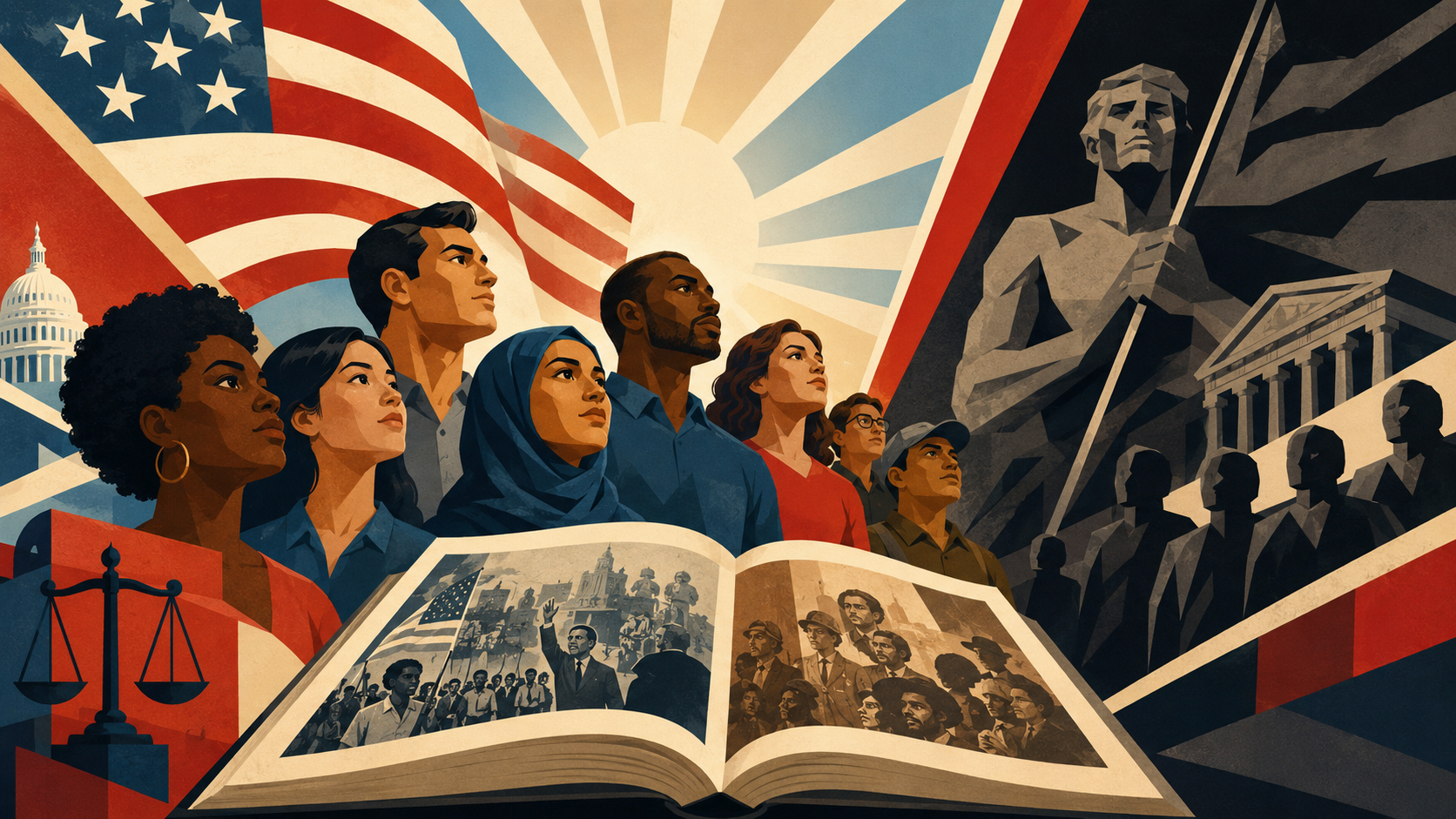
Real love of country demands truth, compassion, dissent and a willingness to confront injustice—not blind loyalty, historical denial or hostility toward fellow Americans.
The Stanford Encyclopedia of Philosophy (SEP) states that the standard dictionary defines patriotism as “love of one’s country.” And that “the first philosophical book-length study of the subject....defines patriotism as involving:
- Special affection for one’s own country
- A sense of personal identification with the country
- Special concern for the well-being of the country
- Willingness to sacrifice to promote the country’s good.”
Moreover, it adds, “There is little to cavil about here.”
In a recent piece in The Atlantic magazine, Yoni Appelbaum suggested that patriotism, understood correctly, could be a concept that unites people in our country, a nation that now seems more divisive than any time since the Civil War (to me at least, who has lived through more than half of those years).
Related stories
I am not new to defining “True Patriotism.” About a dozen years ago, on this very LAP site, my “True Patriotism: Veterans Day Reflections” appeared. In that essay I quoted Martha Nussbaum’s Political Emotions: Why Love Matters for Justice, where she defines patriotism “as a strong emotion taking the nation as its object....It is a form of love....[It] can play....an essential role in creating a decent society, in which, indeed, liberty and justice are available to all.”
In that same essay I also quoted Wendell Berry and Carl Sandburg (who did not think of the USA as an exclusionary “Christian nation”). And I wrote that “the best patriotism involves not just love of country, but also valuing compassion, justice, equality, freedom, toleration, and inclusiveness. And it yearns for peace, even if war is sometimes necessary.”
Six years later (in 2019) I revisited “true patriotism” in my “Veterans Day Reflections on Pseudo Patriotism and Half-Baked History.” It includes these lines: “Patriotism does not demean other nations, but wishes them well. It is not self-satisfied, but values critical dissent and realizes much work is still necessary if one’s country is to live up to its highest ideals.” And, “Pseudo patriots, however, wish only to emphasize a country’s heroes and heroics, and minimize or ignore its villains and villainy. In response to critics, they reply ‘love it or leave it,’ believing love does not criticize. They think that historians should help inculcate patriotism, but they want only half-baked history.”
That 2019 essay also stated that historians “main allegiance should be to truth-telling in all its fully-baked complexity....Our main job is not to glorify a country....but to tell the truth, warts and all. Like all countries, the past of the USA has its glorious, sublime moments, but also its nasty, disgraceful ones. Neither can be ignored.”
In his Atlantic essay, Appelbaum identifies three competing versions regarding our history:
- It is a work in progress, containing much that is good, but it has also fallen short in various ways;
- it is “a litany of sins requiring atonement"; and 3) our history should be one that praises the “‘greatness’ of American achievements,” ignoring or downplaying any failures.
After indicating the complexity of Jill Lepore’s highly-praised These Truths: A History of the United States, Appelbaum adds that “the Trump administration seems allergic to this kind of complexity,” citing an executive order (of March 2025) that called for “restoring truth and sanity to American history,” and instructing “the National Park Service to remove signs that ‘inappropriately disparage’ historical figures instead of focusing on the ‘greatness’ of American achievements.” (The March order wrote of our “unparalleled legacy of advancing liberty, individual rights, and human happiness” being “reconstructed as inherently racist, sexist, oppressive, or otherwise irredeemably flawed.” And added, “Rather than fostering unity and a deeper understanding of our shared past, the widespread effort to rewrite history deepens societal divides and fosters a sense of national shame.”)
The executive order of 2025 is further proof of what outgoing Republican senator from Arizona, Jeff Flake, stated during Trump’s first term: “2017 was a year which saw the truth—objective, empirical, evidence-based truth—more battered and abused than any other in the history of our country, at the hands of the most powerful figure in our government. It was a year which saw the White House enshrine ‘alternative facts’ into the American lexicon, as justification for what used to be known simply as good old-fashioned falsehoods. It was the year in which an unrelenting daily assault on the constitutionally protected free press was launched by that same White House, an assault that is as unprecedented as it is unwarranted.”
Not only has the Trump administration disrespected truth, but it has also undervalued love, as in loving one’s country. For that phrase does not suggest ignoring the loved one’s faults, but rather helping to overcome them.
St. Paul’s words about love come to mind: “Love is patient, love is kind. It does not envy, it does not boast, it is not proud. It does not dishonor others, it is not self-seeking, it is not easily angered, it keeps no record of wrongs. Love does not delight in evil but rejoices with the truth. It always protects, always trusts, always hopes, always perseveres.” Patient, kind, unenvious, non-boasting, humble, “does not dishonor others....not self-seeking....not easily angered....keeps no record of wrongs”—does anyone think any of these words or phrases describe Donald Trump?
Whatever Trump’s merits, does anyone think he loves the people of this country—all of them? The poor as well as the rich, Democrats as well as Republicans, darker skinned people as well as whites, immigrants and refugees as well long-standing citizens?
Last October I quoted Trump: In the summer, he said about Congressional Democrats, “I hate them, too. You know that? I really do, I hate them. I cannot stand them.” And a few months later, at a memorial service for conservative activist Charlie Kirk, he stated, “I hate my opponent and I don’t want the best for them.”
In his Atlantic piece Appelbaum states, “Without a coherent national story, we will fail to be coherent nation.” He is right. A patriotic history, as he suggests, would be one that acknowledges much that is good in our nation, but also addresses the ways it has fallen short. He writes, “By an almost nine-to-one margin, they [Americans] think it’s at least as important to learn about other racial and ethnic communities as about their own. And they overwhelmingly agree on the importance of learning about past harms, even when doing so makes them uncomfortable.”
Thus, a good place to start healing our divisive nation is learning or refreshing our national story. In the early days of Trump’s first presidential term, conservative New York Times columnist Ross Douthat wrote of the historical preferences of many of Trump’s supporters: they preferred “the melting pot to multiculturalism, assume a Judeo-Christian civil religion rather the ‘spiritual but not religious’ version. Trump’s ascent is in part,” he wrote, “an attempt to restore their story to preeminence.”
But history does not invite us to pick a version that coincides with the story we want to hear. As Jill Lepore—mentioned favorably by Appelbaum—writes in her These Truths, “the work of the historian” includes being “the teller of truth.” And in her history, she tells us both comfortable and uncomfortable truths—like slavery and our treatment of Native Americans. She adds, “There is, to be sure, a great deal of anguish in American history and more hypocrisy....But there is also, in the American past, an extraordinary amount of decency and hope, of prosperity and ambition, and much, especially, of invention and beauty. Some American history books fail to criticize the United States; others do nothing but. This book is neither kind.”
Perhaps, her book can be the “coherent national story” we digest in beginning to heal our divisiveness.
Comments

Powered by RoundtableAn AI/DeFi-powered Enterprise Media Operating System. Learn more at Roundtable.io.© Roundtable 2026. By using this site you agree to the Terms of Use and Privacy Policy