
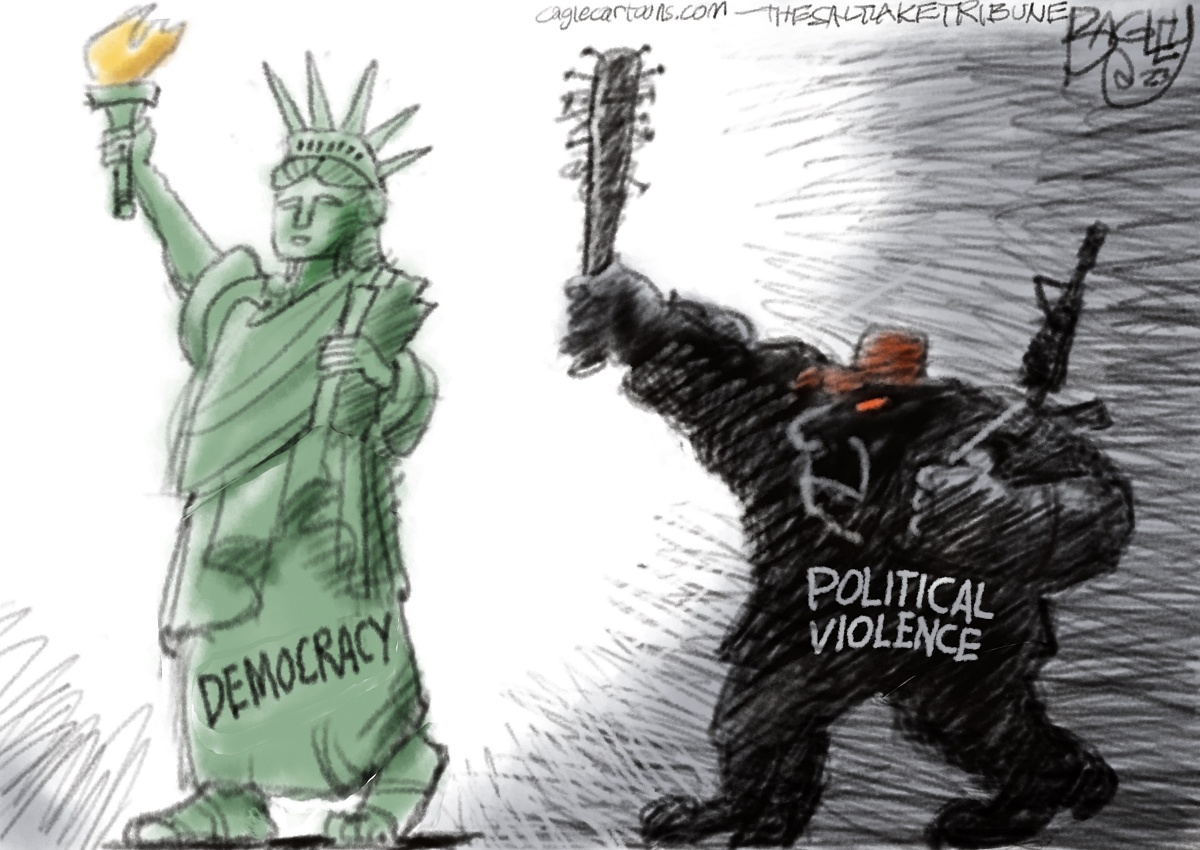
Cagle Cartoons: Pat Bagley


Tolerance
May 25, 2025 4:35 PM
While admitting that intolerance can be displayed by the Left as well as the Right, there is no denying that at present it is primarily the Trumpian right-wing intolerance that is most virulent.
In his First Inaugural Address in 2009 President Obama mentioned various “values upon which our success depends.” One of them was tolerance. Now, 16 years later in the early days of Donald Trump’s second presidential term, our tolerance for “the other side,” continues to erode.
I was reminded of this a few nights ago listening to Judy Woodruff interview Tim Shriver (nephew of President John Kennedy) on the PBS News Hour. He told her that we Americans agree “that we're much too divided to be productive, much too divided to be healthy, much too divided to be optimistic about the future.” We are, he said, in “an us-versus-them country.”
Last September on LA Progressive, I began an essay with these words, “Since I first voted for John Kennedy in 1960, I can't think of any other presidential candidate worse than Donald Trump–both as a person and as a president.” Yet, I also counseled a charitable and empathetic attitude toward Trump voters–as misguided and mistaken as I might think they are.
Now, although Trump has displayed even more negative traits than previously, I still agree with Obama and Shriver: We need to adhere to that great liberal value of tolerance, as well as another one that Obama greatly values–empathy.
Related stories
Tolerance was not valued much in medieval times, nor in fact until after the 16th century Reformation had spilled much blood. Back then, neither Luther, Calvin, Henry VIII of England, nor the Catholic Church were advocating religious tolerance. Only a few isolated individuals like Erasmus (1466-1536) and the Anabaptist B. Hubmaier (1481-1528) urged it.
But gradually over the next few centuries, following decades of religious wars, religious toleration became more acceptable. As one survey of Western Civilization (Goff, et al.) indicates, “The Thirty Years’ War [1618-48] brought the wars of religion to an end...Rulers became less insistent on religious unity within their realms.”
In the few centuries that followed, writings like John Locke’s “A Letter Concerning Toleration” (1685) and Voltaire’s “Treatise on Toleration” (1763) broadened the case for that value, as did the rapid spread of Freemasonry in the 18th century. Developments in colonial America also furthered it.
In her U. S. history, These Truths, Jill Lepore writes, “The restoration of the monarchy [in England], in 1660...represented not a lessening but a deepening commitment to religious toleration, the new king pledging ‘that no man shall be disquieted or called in question for differences of opinion in matter of religion.’ This spirit extended across the ocean, especially in the six Restoration colonies, those that were founded or came under English rule during Charles II’s reign. New York and New Jersey became religious asylums for Quakers, Presbyterians, and Jews, as did Pennsylvania, granted by Charles II to the Quaker William Penn in 1681... In his [Penn’s] 1682 Frame of Government, a constitution for the new colony, he provided for a popularly elected general assembly and for freedom of worship.” As Lepore notes, “Peace rested on tolerance.”
Among our Founding Fathers, Ben Franklin was not only a Freemason, but (in the words of his biographer Walter Isaacson) “a prophet of tolerance,” believing that “liberty and tolerance were the foundation for a civil society.” In her history, Lepore also points to Jefferson, especially in his 1801 Inaugural Address where he “tried to wave aside the bitter partisanship of the election and to defeat the spirit of intolerance.”
During the 19th and early 20th centuries, tolerance was still often violated, and not just by far-Right groups like the Ku Klux Klan. Segregation was widespread throughout the U. S. southern states until the early 1960s. And one of the most popular Evangelical preachers of the 1950s and 1960s, Billy Graham, had little use for it. Lepore quotes him as stating, “The tool of the enemy (and of the devil) was ‘the sin of tolerance.’ The word ‘tolerant’ means ‘liberal,’ ‘broad-minded,’” he said, and ‘the easy-going compromise and tolerance that we have been taught by pseudo-liberals in almost every area of our life for years means nothing so much as appeasement to communism.’”
Yet, not all conservatives were as opposed to “compromise and tolerance” as taught by those whom Graham called “pseudo-liberals.” Russell Kirk (d. 1994), sometimes considered “the Father of American Traditionalist Conservatism” wrote, “Ideology makes political compromise impossible: the ideologue will accept no deviation from the Absolute Truth...Ideologues vie one with another in fancied fidelity to their Absolute Truth; and they are quick to denounce deviationists or defectors from their party orthodoxy...[but] the prudential politician...is well aware that the primary purpose of the state is to keep the peace. This can be achieved only by maintaining a tolerable balance among great interests in society. . . .When ideological fanaticism rejects any compromise, the weak go to the wall.” Moreover, in the late 20th century intolerance–as James Hunter pointed out in his 1991 book Cultural Wars–was sometimes displayed on the Left–nd not just the far Lef–as well as the Right.
While admitting that intolerance can be displayed by the Left as well as the Right, there is no denying that at present it is primarily the Trumpian right-wing intolerance that is most virulent. My earlier conviction that Trump is the worst president we have had in our last 60 years–maybe ever in our history–remains, but that does NOT mean that all of those who voted for him are equally bad.
Eight years ago on LA Progressive I wrote, “In our time of bitter political rancor, when the excesses of the Trump administration are so egregious and we are tempted to lash out at any Trump supporters in anger, [George] Saunders and other politically wise voices suggest we should temper our passion for justice and truth with kindness, love, empathy, humility, humor, and tolerance.” Today, I would advise the same.
And I am not alone. As indicated above, Tim Shriver bemoans the “us-versus-them country” that we have become. He believes that “all the name-calling and the relentless surround sound of contempt...has a corrosive effect not just on our political debates, but on the mental health of our country, and especially of our young people.” It also “leads to increases in violence...the risk of family division... and dehumanization.”
In 2022, Shriver helped launch The Dignity Index, “a method of evaluating language” that measures the amount of contempt that we express for others. At the bottom are words that treat another “with such dehumanizing hatred that I think you should be killed even, and then you move gradually up the scale of less and less contempt.” As he told Judy Woodruff, “At the highest levels of dignity–you see this in great leaders in our own country–no matter what, even after horrific violence, I want you to know I will treat you with dignity.” In summary, Shriver believes that if we don’t change our ways, which he believes are being exacerbated by social media, we won’t “have a country in 25 years.”
Another source encouraging mutual respect of those different from us and with whom we differ is the Catholic papacy. We saw this with Pope Francis. In his 2015 Address to the U. S. Congress he emphasized that the aim of politics was the improvement of the common good–not just our individual preferences--and used the word “dialogue” a dozen times–in an earlier encyclical on climate change, he used the word on about two dozen occasions.
If anything, the newest pope, Leo XIV, is even more insistent on people of different ethnicities and views coming together. His own family background encourages this, reflecting French, Spanish, Italian, Afro-Caribbean, and Creole ancestry. So too does all the time he spent in Peru, first as a missionary and later as a bishop. As a Washington Post article noted, “In an era marked by the rise of nativism, racism and contempt for migrants–encouraged at the highest levels of power by such figures as Trump–the election of a pope who has consistently defended the dignity of migrants is no small matter.”
All of the above does NOT mean that we liberals/progressives/anti-Trumpsters should reduce our opposition to Trump’s plethora of policies, many of which (e.g., those affecting climate and immigrants) are terribly destructive. Nor should we reduce the passion with which we wage our struggle. Balancing our passion for justice with a like-minded tolerance and willingness to compromise is a tough balancing act. Soon after Sen. Ted Kennedy’s death in 2009, good friend but ideological opposite of him, conservative Republican Senator Orrin Hatch, appropriately said, “I hope that America’s ideological opposites in Congress, on the airwaves, in cyberspace, and in the public square will learn that being faithful to a political party or a philosophical view does not preclude civility, or even friendships, with those on the other side.”
We have all had different experiences, often in different decades and places from one another, and these have shaped our views. Thus, it is not surprising that many of us see things differently. Nevertheless, as Tim Shriver insists, we should all treat others with respect for their dignity. And as Pope Francis emphasized, what we need more of is not name-calling but–as the national organization Braver Angels stresses–dialogue.
Comments

Powered by RoundtableAn AI/DeFi-powered Enterprise Media Operating System. Learn more at Roundtable.io.© Roundtable 2026. By using this site you agree to the Terms of Use and Privacy Policy