


May 8, 2026 7:55 PM
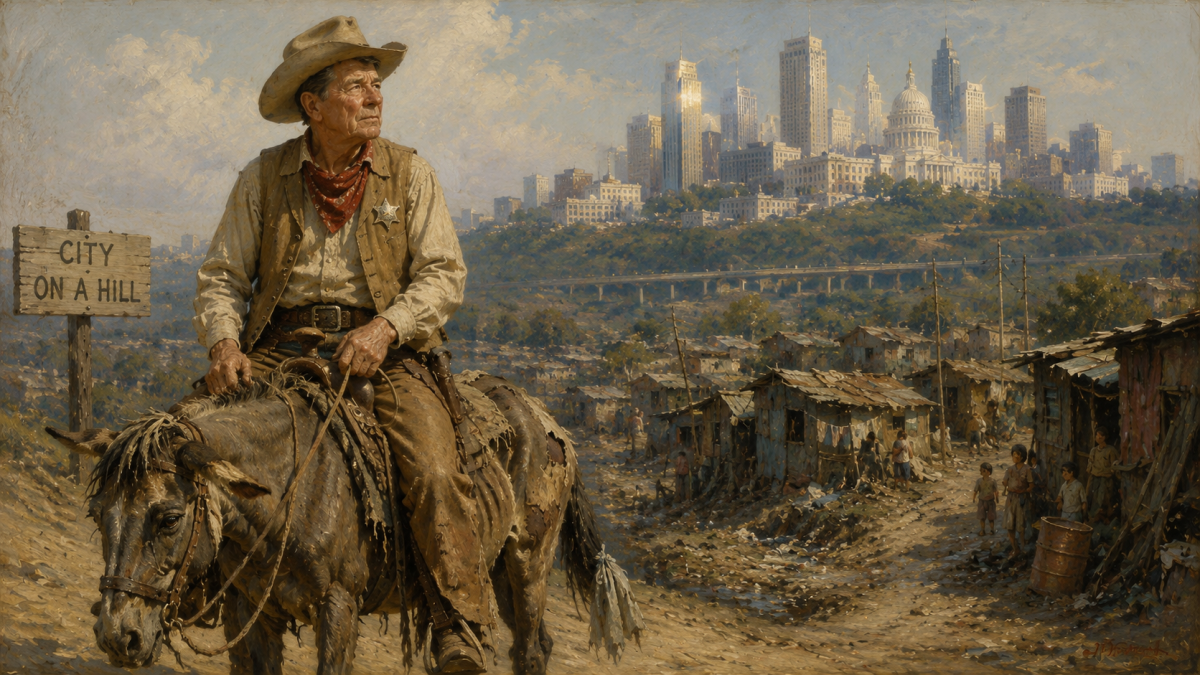
As America’s Cowboy on Horseback, Reagan was interested chiefly in freedom from excessive government interference in people’s everyday lives.
I was never a fan of Ronald Reagan. I thought he was a flim flam man who smooth-talked Americans into believing that their government was their enemy. Like some others, I think his presidency began the transformation of American politics that Donald Trump rode to power. I also think that both he and his supporters would be astonished at what has become of the country he called his “shining city upon a hill.”
In 1989, Reagan capped off his farewell address by revisiting that city. “The phrase comes,” he said, “from John Winthrop, who wrote it to describe the America he imagined....he was looking for a home that would be free.” Indeed, Winthrop and his shipmates were looking for freedom to worship as they pleased, but I think Reagan’s sense of freedom involved a good deal more than just religious liberty.
As America’s Cowboy on Horseback, Reagan was interested chiefly in freedom from excessive government interference in people’s everyday lives. He wanted to ride the range unimpeded by fences both physical and metaphorical. He saw official overreach everywhere he looked, and condemned it as hostile to the liberties of the people in the shining city he had in mind. And he left office claiming that he had saved his city from the freedom-stifling grasp of he had told us was the problem, not the solution.
“I've spoken of the shining city all my political life,” he said; “in my mind it was a tall, proud city built on rocks stronger than oceans, wind-swept, God-blessed, and teeming with people of all kinds living in harmony and peace; a city with free ports that hummed with commerce and creativity. And if there had to be city walls, the walls had doors and the doors were open to anyone with the will and the heart to get here.”
Related stories
This is an inspiring vision—an open community with expansive liberties, a thriving economy, and a door open to all immigrants determined to do what they must to claim a piece of the American dream. “And how stands the city on this winter night?” Reagan asked. “More prosperous, more secure, and happier than it was 8 years ago....she still stands strong and true on the granite ridge, and her glow has held steady no matter what storm.”
How stands the city nearly four decades later? I think Reagan would not be happy with the answer.
For one thing, there are over a hundred million more of us now than when he bid us farewell, and many would say that we’re less prosperous, less secure, and less happy than Reagan thought we were then. We’re still teeming with people of all kinds, but we haven’t lived in harmony and peace for a long time. Many Americans don’t want to live in a country where their neighbors aren’t like them, and they regard anyone with the will and the heart to get here as an invader. The diversity Reagan celebrated is now seen by many as a mortal threat to American identity.
As for those free ports humming with commerce and activity, our current tariff structure has not only impeded trade but also has laid a heavy burden on American consumers. And Reagan likely would be astonished at the frenzy of construction along our southern border, where crews wantonly destroy geological, biological, and archaeological treasures, as well as private property, to erect a wall with no doors, built expressly to keep out anyone with the will and heart to get here.
Winthrop had told his shipmates, “For we must consider that we shall be as a city upon a hill. The eyes of all people are upon us...” Reagan was happy to say that his shining city was “still a beacon, still a magnet for all who must have freedom, for all the pilgrims from all the lost places....” Immigrants still risk everything to get to Reagan’s city, but I think he missed Winthrop’s key point. The city would not just be a place where people wanted to live, but also a place people would watch closely, to learn whether its inhabitants actually lived up to their high aspirations.
We certainly have our own aspirations—those “self evident truths” we all know by heart. And the eyes of all people have been upon us for two and a half centuries now—people eager to share those “unalienable rights” with us, and to see how faithfully we honor them ourselves. Noble aspirations require noble actions, and the example we set by our behavior defines us. Winthrop warned that if our walk doesn’t match our talk, we make a mockery of our aspirations and invite the contempt of people watching us.
How stands the city, then, in this numbing winter of our discontent? What would we tell Reagan, or Winthrop, if they were to ask what happened to the city they envisioned?
Comments

Powered by RoundtableAn AI/DeFi-powered Enterprise Media Operating System. Learn more at Roundtable.io.© Roundtable 2026. By using this site you agree to the Terms of Use and Privacy Policy