
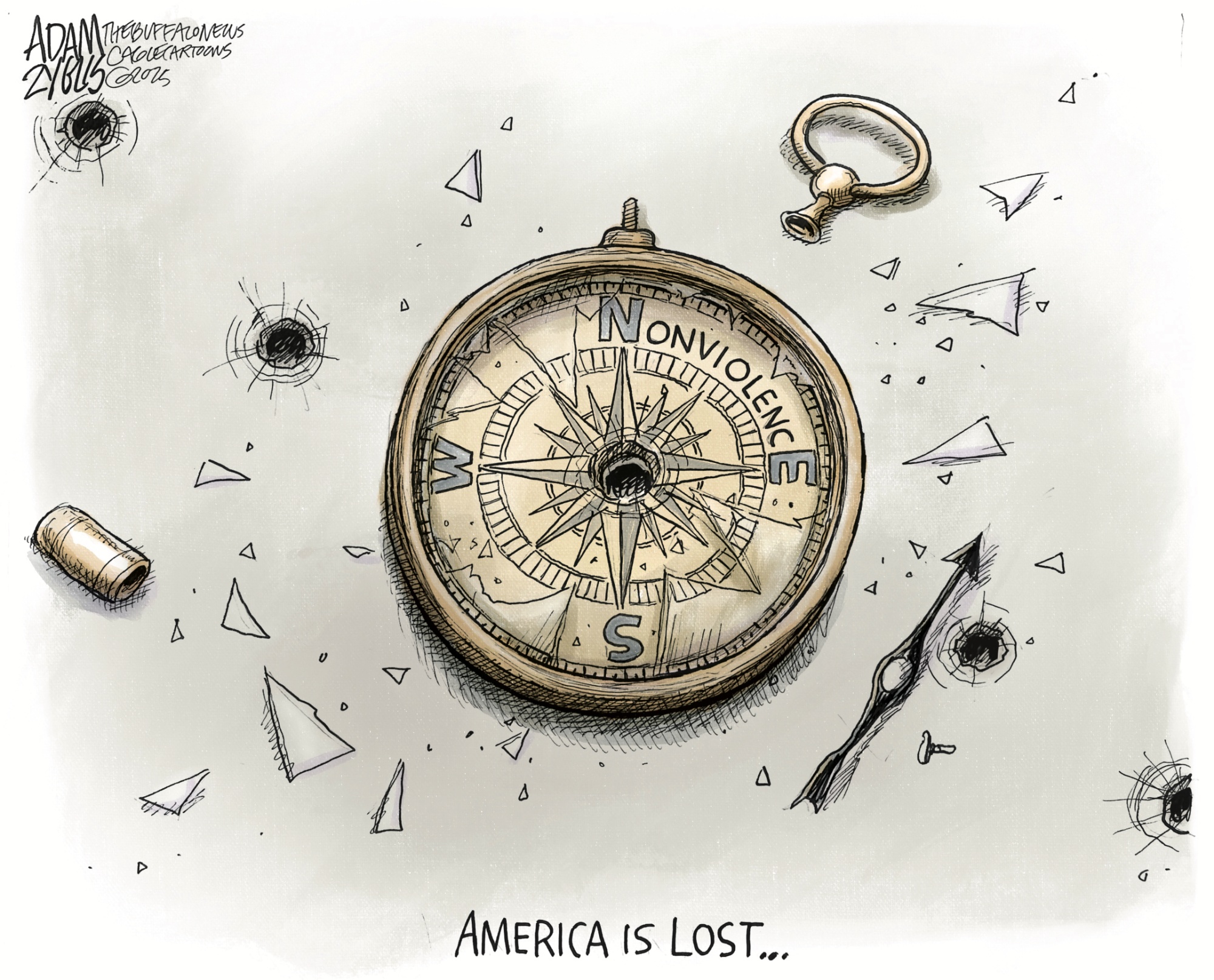


Unless we’re happy with the nastiness of our politics and the ugly contrast between that and the noble sentiments of our founding documents, we need to try harder.
Sep 26, 2025 2:39 PM
We need to remember how to be civil, how to honor each other’s sincerity, how to talk respectfully when we disagree, and how to hear each other when we listen.
We should mourn Charlie Kirk’s death regardless of what we think of his politics. However, as much as we may disagree with his ideas, he was one of us, a fellow American. The shooter who killed him targeted all of us by preferring violence over the open-ended and often uncomfortable dialogue that makes civil society possible.
When we stop listening to each other, we lose the most important means of holding our community together, and it becomes easier for us to think bullets can resolve our disagreements, especially when we all live under the shadow of America’s pervasive gun culture.
No less troubling than the summary execution of Charlie Kirk by a guy with a gun is the way observers from left to right have all appropriated him as the poster boy for their personal political agendas. In his introduction to The Federalist Papers, Alexander Hamilton foresaw what has happened here:
A torrent of angry and malignant passions will be let loose. To judge from the conduct of the opposite parties, we shall be led to conclude that they will mutually hope to evince the justness of their opinions, and to increase the number of their converts by the loudness of their declamations and the bitterness of their invectives.
Related stories
In other words, all the shouting to and fro about Charlie Kirk is not about Charlie Kirk. It’s about the shouting itself and the shouters. It tells us a lot about them, but nothing about Charlie Kirk himself. Hamilton spelled out where he saw the major fault line forming:
An enlightened zeal for the energy and efficiency of government will be stigmatized as the offspring of a temper fond of despotic power and hostile to the principles of liberty. An over-scrupulous jealousy of danger to the rights of the people, which is more commonly the fault of the head than of the heart, will be represented as mere pretense and artifice, the stale bait for popularity at the expense of the public good.
As Hamilton sees it, some will regard supporters of effective government as hostile to freedom — supporters of tyranny, in effect — while others will accuse advocates of freedom of posturing cynically for popular favor in order to clear the way for the establishment of tyranny. In the writings of Charlie Kirk, and of those who share his views, “tyrranical government” is a favored phrase, practically an oxymoron, and they warn of it just as Hamilton said they would:
It will be forgotten, on the one hand...that the noble enthusiasm of liberty is apt to be infected with a spirit of narrow and illiberal distrust. On the other hand, it will be equally forgotten that the vigor of government is essential to the security of liberty...that their interest can never be separated; and that a dangerous ambition more often lurks behind the specious mask of zeal for the rights of the people than under the forbidden appearance of zeal for the firmness and efficiency of government.... the former has been found a much more certain road to the introduction of despotism than the latter....
Recent events in the United States have borne out Hamilton’s judgements with disturbing fidelity. We demonize each othder gleefully, as we demonize each other’s parties, each other’s values and loyalties, each other’s character and integrity. We accuse each other of conspiring to impose a tyranny in the name of freedom.
And we use a stalking horse like Charlie Kirk so that we don’t have to look each other in the eye and speak our thoughts honestly. We might wonder, has it come to this? Is this who we are? Has the American political conversation finally degenerated into nothing more than an angry and vituperative shouting match?
It might seem that the hostility, the hatefulness of political rhetoric across the entire spectrum in the last few decades is without precedent, or that American politics has never been this nasty. It seems that politicians on both the left and the right have brought American politics to a new low, a nadir from which we may never again rise.
Alas, this is who we are. Recent political campaigns may seem more vituperative than ever, but that’s how it’s been from the start.
Our second president, John Adams, the 1796 candidate of the Federalist Party founded by Hamilton, rose to victory in a campaign of character assassination against his opponent, Thomas Jefferson. In 1800, running on the Democratic-Republican ticket, Jefferson defeated Aaron Burr after an equally mean-spirited campaign and an election that ended in a tie that had to be resolved by the Congress.
Then, as if personally fulfilling the warnings he had outlined in his Federalist essays, Hamilton died in a duel with Burr, the outcome of a long-running rivalry between them that came to a head over Hamilton’s role in Jefferson’s victory.
Subsequent presidential contests tended to continue the pattern of vicious accusations against both persons and parties. Andrew Jackson, the first candidate on the new Democratic Party ticket in 1828, won his own campaign with dirty tricks, and when Abraham Lincoln presided over the creation of the Republican Party in 1854 the stakes in the debate over slavery brought out the very worst in nearly everyone involved. “With malice toward none, with charity for all,” Lincoln promised, just six weeks before John Wilkes Booth shot him, shouting “Thus always to tyrants!”
Clearly, Charlie Kirk’s fear of tyrannical government and the kind of nasty name-calling across party lines that has followed his death both have deep roots in American political culture. These days, there’s plenty of malice for everyone, but charity is in short supply.
Though the names and agendas of the parties have changed with time, their election tactics have not. Those who have contended for the White House since Adams and Jefferson have consistently been happy to hit below the belt, to strike from behind, to campaign against each other rather than for themselves. But they have not taken American politics to new lows, as we may imagine. They have lowered themselves to the level established at the very beginning and maintained ever since.
Unless we’re happy with the nastiness of our political process, and the ugly contrast between that and the noble sentiments of our founding documents, we need to try harder. The Federalist authors warned repeatecly of the dangers of parties and factions, and our own history has shown us, relentlessly, that loyalty to party too often overwhelms loyalty to country, to principle.
Nor does it help that with only two parties, in a winner-take-all arrangement determined finally by an archaic institution designed for a population of scarcely more than one person for every hundred of us, the will of the people as expressed in the popular vote frequently proves meaningless.
We can keep doing what we’ve always done and expecting different results. Or we can start over. We don’t need a new Constitution. We need to do a better job of living by the one we have. And we need to remember how to be civil, how to honor each other’s sincerity, how to talk respectfully when we disagree, and how to hear each other when we listen.
We have the wit and the wisdom to find a better way. We just need to find the will.
Comments

Powered by RoundtableAn AI/DeFi-powered Enterprise Media Operating System. Learn more at Roundtable.io.© Roundtable 2026. By using this site you agree to the Terms of Use and Privacy Policy