


Jun 30, 2026 4:23 PM
Behind the insults, threats, vanity and manufactured outrage lies a governing strategy: keep the public watching the performance while wealth rises, institutions collapse and fear becomes an instrument of power.
Imagine a battered leather tool case lying open on the floor of a collapsing carnival.
It is not a physician's bag, though it contains its own peculiar instruments. It is not a carpenter's toolbox, though much of what it touches eventually comes apart. It is not a statesman's portfolio, though its contents increasingly pass for the machinery of government.
It belongs to the court jester.
Inside are the implements of imperial spectacle.
Related stories
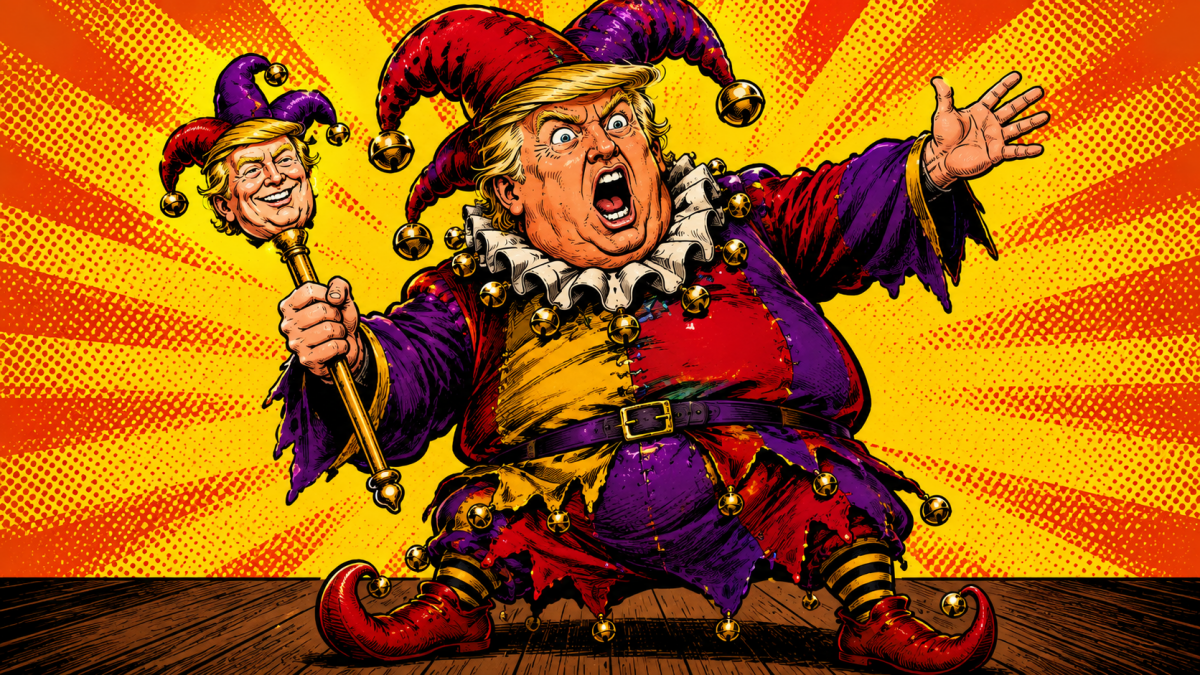
There is the marotte, the fool's scepter, polished by constant use. At its top sits a grotesque puppet head, grinning with obscene loyalty. Its painted eyes stare back at the fool as if offering counsel, though it merely repeats whatever has already been said. It is not wisdom. It is echo. It is the chorus of financiers, propagandists, media courtiers, loyal flatterers, and frightened officials who have learned that repetition can impersonate truth.
Beside it lie the bells.
Small, bright, metallic, almost innocent. But their purpose is not innocence. Their purpose is distraction. Each bell is a provocation, an insult, a threat, a scandal, a staged outrage, a flash of cruelty tossed into the crowd so that no one looks behind the curtain. The bells ring whenever public wealth is transferred into private hands. They ring whenever war is sold as peace. They ring whenever oligarchy dresses itself in the costume of liberty.
Then there is the bladder.
Inflated, ridiculous, hollow—and dangerous. Medieval fools once swung it as a comic weapon, a joke against pomp and authority. But in the hands of the modern jester, the bladder becomes the politics of threat. It is waved across oceans, deserts, borders, and ancient civilizations. It rattles sabers. It redraws maps. It mistakes domination for leadership and force for wisdom. It is filled not with knowledge but with bluster, and yet whole nations are made to tremble before its shadow.
And there is the cage.
Its bars are cold and rusted. At first glance it appears too small to matter, merely another prop among the fool's collection of curiosities. But the closer one looks, the larger it becomes. The cage expands until it occupies entire neighborhoods, schoolyards, workplaces, courtrooms, and city streets.
The fool rarely enters the cage himself. Instead, he points toward it.
And others do the work.
Masked agents emerge from the shadows. Families learn to fear the knock at the door. Children learn to distinguish the sound of ordinary footsteps from the sound of pursuit. Entire communities begin to move cautiously through their own neighborhoods as though crossing occupied territory. Fear settles over the republic like a second atmosphere.
The cage has many names.
Some names are bureaucratic. Some are theatrical. Some sound like policy. Others sound like jokes invented by men who have forgotten the difference between cruelty and humor. One day it appears as a detention camp erected in a swamp and celebrated as though human confinement were a tourist attraction. Another day it appears as a raid, a convoy, a holding cell, a surveillance program, or a frightened family disappearing into administrative darkness.
The genius of the cage is that relatively few people need to occupy it.
Millions need only glimpse it.
The sight alone teaches obedience.
The possibility alone alters behavior.
The rumor alone spreads faster than any law.
People lower their voices. Neighbors become suspicious of neighbors. Teachers hesitate. Clergy hesitate. Journalists hesitate. Citizens learn to calculate risk before speaking. Fear becomes self-administering. The bars no longer surround bodies alone; they begin to surround the imagination itself.
The fool presents all this as security.
The empire presents all this as order.
But beneath the language of protection lies something older and darker: the ancient desire of power to make itself visible through the vulnerability of others. The cage is not merely a structure. It is a performance. It is a warning staged before the crowd.
Folded beneath these instruments is the coxcomb hat.
Its bells are stitched into the fabric like small metallic prayers to vanity. The hat does not signify intelligence. It announces performance. It says: watch me. It says: do not look away. It says: the crisis is whatever I declare it to be. The jester wears it not to govern but to command attention, for attention has become the empire's most reliable form of obedience.
And beneath the hat, carefully hidden, lies the deeper costume of decay.
The preserved arrangement of hair. The painted face. The artificial glow. The visible signs of frailty concealed beneath bluster. The desperate effort to appear untouched by time.
The jester must appear invincible.
Yet the more obsessively the image is maintained, the more visible the decline becomes.
Now imagine the case closing.
The fool lifts it.
The calliope begins.
Somewhere beyond the fog, beyond the ruins of abandoned factories, shuttered schools, poisoned rivers, indebted households, and exhausted workers, a rusted carnival organ groans into life. Its pipes wheeze out a melody that once belonged to parades and festivals but now sounds like a funeral march. Carousel horses circle endlessly without destination. Lights flicker above the midway. Bells jingle from unseen towers. Laughter rises from the crowd, uneasy at first, then louder, then obedient.
At the center of the spectacle stands the fool.
He opens the case before the nation.
First comes the marotte.
He raises the puppet head before the crowd, and it grins back at him with perfect submission. Around it gather the donors, the television priests, the legal conjurers, the market evangelists, the courtiers of cruelty, and the clerks of empire. They repeat his words until repetition becomes atmosphere. They turn lies into slogans, slogans into commands, commands into policy. Narcissus no longer gazes into a pool. He gazes into a puppet head mounted upon a stick, and the puppet tells him he is beloved.
Then come the bells.
They ring and ring and ring.
Every insult is a chime. Every accusation is a cymbal crash. Every cruelty becomes entertainment. The crowd is trained to follow the sound, to chase each metallic flash from one outrage to the next. While the bells ring, laws are rewritten. While the bells ring, public institutions are hollowed out. While the bells ring, democracy is transformed from a public trust into a private marketplace where wealth purchases influence and impunity masquerades as freedom.
Then the bladder swings.
It arcs through the air like a comic weapon, absurd in appearance but imperial in consequence. It threatens distant peoples. It promises annihilation. It mistakes geography for ownership and history for a board game. It tells the world that fear is diplomacy, that humiliation is strategy, that violence is strength. Hollow though it is, the bladder becomes dangerous because fear itself has become a currency of rule.
Then the cage appears.
The agents emerge.
The raids begin.
The warnings spread.
The crowd watches as fear leaves the television screen and enters the streets. Communities learn new forms of silence. Neighbors become cautious. Workers disappear. Families wait for headlights in the darkness. The spectacle no longer lives solely on the stage. It walks among the people.
Then the coxcomb rises.
The fool places it upon his head, and the bells stitched into it begin their private music. Every boast becomes a fanfare. Every grievance becomes a liturgy. Every crisis becomes an opportunity to occupy the center of the stage. The fool need not govern so long as he can perform. He need not solve anything so long as he can dominate the hour.
This is the genius of the spectacle.
The empire does not require the fool to be wise. It requires him to be absorbing. His task is not to lead the people but to hold their gaze while the machinery behind him continues its work.
Behind the curtain, the real business proceeds.
Wealth ascends. Labor is disciplined. The poor are blamed for their abandonment. Migrants are turned into offerings. Schools are starved. Hospitals become markets. War becomes permanent. Surveillance becomes ordinary. The language of freedom is emptied of solidarity and refilled with domination. The common good recedes while private power expands.
And still the crowd watches the hat.
Still it laughs at the bells.
Still it follows the puppet's grin.
Still it mistakes the swinging bladder for strength.
Still it accepts the cage as necessity.
Here lies the deepest tragedy. The fool is not an interruption in the life of the empire. He is its revelation. He merely gives voice to what the empire whispers to itself in the dark: that power alone confers legitimacy; that truth is whatever can be repeated often enough; that history can be bent by force; that entire peoples may be sacrificed to preserve the privileges of the few.
Nor is the crowd innocent.
The fool performs because the crowd has been trained to desire performance. The bells ring because millions have learned to mistake noise for meaning. The puppet grins because obedience has learned to call itself loyalty. The bladder swings because fear remains profitable. The cage expands because fear eventually learns to police itself.
The empire's greatest achievement is not the creation of the fool but the transformation of citizens into spectators who applaud while their inheritance is auctioned away before their eyes.
Once, the marotte mocked the royal scepter.
Once, the fool's wand reminded kings that they were mortal and accountable to laughter.
But in the Empire of Rust and Reason, satire has collapsed into reality.
The fool's wand has become indistinguishable from the sovereign's scepter.
Folly no longer mocks power.
Folly has become one of its preferred languages.
This is not governance.
This is spectacle wearing the mask of authority.
This is not democracy.
This is oligarchy with bells on.
The calliope continues to wheeze.
The puppet continues to grin.
The bells continue to ring.
The bladder continues to swing.
The cage continues to expand.
The crowd continues to laugh.
And behind the laughter, behind the lights, behind the carnival tent and the painted face of power, the empire slowly devours itself.
Comments

Powered by RoundtableAn AI/DeFi-powered Enterprise Media Operating System. Learn more at Roundtable.io.© Roundtable 2026. By using this site you agree to the Terms of Use and Privacy Policy