


The Gospel of the Sociopath
Apr 5, 2025 1:35 PM
From Ayn Rand’s Objectivism to Trump’s ego made flesh
In the cold and clumsy architecture of today’s political landscape, empathy—once the cornerstone of democratic conscience—has been reduced to a weakness, a “bug” in the moral code of civilization, exploited, scorned, and systematically erased. As Thom Hartmann astutely observes the Republican war on empathy is not a recent skirmish resulting from malignant stupidity, but a long, deliberate campaign—decades in the making—to harden the nation’s heart and recast cruelty as strength. This ideological scorched earth has turned America into what he chillingly describes as a playground for sociopaths. Henry Giroux has referred to this as America’s culture of cruelty.
Hartmann invokes the haunting insight of Captain Gustave Gilbert, the U.S. Army psychologist who studied the Nazi leadership at Nuremberg. Gilbert’s conclusion, drawn from staring into the abyss of human depravity, was stark:
“A lack of empathy… It’s the one characteristic that connects all the defendants.”
This same thread of emotional vacancy runs through modern conservatism, stitched tightly into its economic policies, social positions, and moral reasoning. From stripping away healthcare and food assistance to demonizing immigrants and minorities, the GOP’s guiding philosophy reveals itself not as an ideological difference, but as a deliberate repudiation of empathy itself.
Related stories
Even tech titans have joined the chorus. Elon Musk, in a moment of raw candor on Joe Rogan’s podcast, called empathy a “fundamental weakness of Western civilization.” In Musk’s view, the human impulse to care has been hijacked, exploited, and must be resisted, not indulged. He said:
“They’re exploiting a bug in Western civilization which is the empathy response.”
To Musk and those who share his worldview, compassion is a design flaw—a vulnerability to be patched out, not a virtue to be preserved. But as Hartmann reminds us, the people Musk accuses of “exploiting” empathy are not criminals or con artists. They are Democrats, progressives, and everyday citizens who believe that the purpose of government is, at its core, to ensure life, liberty, and the pursuit of happiness for all.
In this era of algorithmic power and political cruelty, Hartmann’s words echo with urgency: the war on empathy is not metaphorical—it is real, raging, and deeply entrenched. And if empathy is, as Gilbert suggested, the line between humanity and evil, then we are teetering dangerously close to the edge.
Hartmann notes that the modern Republican romance with cruelty—its courtship of apathy, antipathy, and the polished mask of sociopathy—did not erupt overnight. It began as a whisper in the twilight of the American soul, taking shape in the waning light of the 1970s and erupting into full-throated gospel in the dawn of the Reagan era. What emerged then was not merely a political movement, but a fevered theology—an exultation of the self, baptized in the ink of Ayn Rand’s pen and sanctified in the temples of deregulation and disdain.
Rand, high priestess of cold virtue and architect of the ego’s dominion, became the hidden hand behind the velvet curtain. Her novels—once the fever dreams of alienated minds—were recast as scripture by the apostles of the new right. Among them stood Paul Ryan, a libertarian acolyte and future Speaker of the House, who would anoint his interns not with civic texts or constitutional reverence, but with the gospel of Atlas Shrugged. To step into his office was to walk into a shrine where empathy went to die.
As Paul Crider observes in The Bulwark, the spell did not end with lawmakers. It infected the titans of Silicon Valley, who began to see themselves as Randian demigods—Prometheans shackled by the ungrateful masses. Elon Musk and Marc Andreessen crow as if they were characters loosed from Rand’s pages, daring the world to collapse without them. Peter Thiel, philosopher-king of plutocracy, has paid homage beneath the chandeliers of the Atlas Society’s annual rites.
Their names echo through the marble halls of tech and power, wrapped in a narrative forged not by history, but by fantasy: a tale in which the strong must suffer the existence of the weak, and mercy is a chain to be broken. The press now speaks of these men with the hushed awe once reserved for emperors and monsters, always with the same grim refrain—"as if out of an Ayn Rand novel."
And so, the poison spreads—not with violence, but with vision. A vision of the world as a market, the citizen as a commodity, and compassion as a failing of the weak.
Hartmann reminds us that nobody knows for certain what dark alchemy strips the soul of empathy, what unseen forge tempers personalities such as Ayn Rand, and the political wolves of today’s GOP into creatures that sneer at compassion as though it were a weakness. Is it carved into their bones by nature, a relic of some ancient survival mechanism—the same ruthless instinct that drove our ancestors to extinguish the Neanderthals? Or is it the slow erosion of the human heart by nurture, a long, methodical chiseling away of kindness until nothing remains but the cold, gleaming steel of self-interest?
But Hartmann draws a direct connection to Ayn Rand, who, like Trump, moved through life like a winter wind—bitter, barren, and joyless. She devoured those in her orbit, bending them to her will with the precision of a puppeteer. Her husband, her followers, even Alan Greenspan—who, in a final grotesque tribute, left a dollar-sign-shaped floral arrangement at her grave—were little more than props in her personal theater of power. And like Trump, she demanded unwavering loyalty, exiling any who so much as hesitated in their devotion.
To her, as to Musk, to Johnson, to the billionaires who bankroll today’s cult of greed, the world is divided into two kinds of people: the anointed few who create, and the unworthy masses who take. In their eyes, a government that dares lift a hand to aid the struggling is a traitor to its best and brightest, a betrayer of its kings in favor of its serfs. They worship the altar of wealth, blind to the suffering left in its wake, convinced that the weight of their gold justifies the bones it crushes beneath it.
And so, like a great machine powered by the fuel of human misery, their ideology churns forward, devouring everything in its path—until, at last, there is nothing left to consume but themselves.
Ayn Rand arrived in America like a thundercloud over a cracked horizon — lightning-eyed, clutching the burnt scrolls of her past. Born Alisa Zinovyevna Rosenbaum, she left Soviet Russia in January 1926, at the age of 21. She arrived in the United States on a visa to visit relatives in Chicago but had no intention of returning to the USSR. Her departure came several years after the Russian Revolution of 1917 and during the early years of the Soviet regime, when the full force of collectivist policies was being imposed under Lenin and, soon after, Stalin. Though the revolution itself had technically ended by the early 1920s, Rand lived through the Bolsheviks' rise to power, the Russian Civil War, and the nationalization of private property—events that deeply shaped her worldview and later fueled the themes of her work. Scarred by the fires of revolution and the ashes of her father’s lost fortune, she forged a creed in steel: the self is sacred, and obligation is sin. From this molten iron she cast her statues — towering figures of individual will, impervious to the winds of need and the cries of the crowd.
Robert Reich notes that for Rand, the “common good” was not a shared flame but a funeral pyre — where the strong are burned to warm the weak. She saw compassion as a con, and duty as a leash. In her market-temple, every man was an island, every handshake a transaction, and every law a theft in disguise.
But this vision, for all its glitter, is ice. Cold, gleaming, and brittle. It seduces the alienated ego and crowns it emperor — yet leaves society hollowed like a tree rotted from within. Her gospel of the self found an echo in fellow libertarian Robert Nozick’s cool abstractions — a galaxy of isolated stars, each burning in solitude, connected only by the invisible lines of contract and currency.
Yet even stars collapse without gravity.
Reich reminds us: there is no market without scaffolding, no liberty without law, no truth without trust. A society is not a stock exchange of self-interests; it is a living organism, its breath shared, its heartbeat common. The myth of the sovereign self, unbound by duty or kinship, is a fable told by those who mistake freedom for detachment — who forget that even wolves run in packs.
Imagine a world of Trumps, where every promise is a pawn, every truth auctioned to the highest bidder. A place where ethics are costumes and law is a mirror maze — always shifting, always self-serving. In such a world, the very oxygen of democracy — trust — is poisoned. And when trust dies, freedom follows.
The common good is not a slogan. It is the invisible bridge we walk on without seeing. It is the green light we stop for. The queue we don’t cut. The tax we pay without rage. The stranger we don’t exploit because we remember they are us.
Ours is a nation of many minds, many hearts — a cacophony of dreams. But democracy doesn’t ask for unison; only harmony. It demands that we honor the rhythm of the whole, even when the melody offends us. That we disagree like kin, not like enemies.
For when we forget that, we are no longer a society. We are a battlefield disguised as a nation — a collection of disconnected selves, shouting into a void.
The common good is the thread. Cut it, and the tapestry unravels. Hold it, and the flame endures.
Donald Trump’s admiration for Ayn Rand might offer a clue to his profound lack of empathy and apparent psychopathy. Rand’s philosophy, a stark celebration of ruthless individualism, exalts the powerful and dismisses the vulnerable as parasites—an ideology tailor-made for a man like Trump, who thrives on dominance, scorns compassion, and views cooperation as weakness.
In 2016, Kirsten Powers wrote this in USA Today:
Trump described himself as an Ayn Rand fan. He said of her novel The Fountainhead, “It relates to business (and) beauty (and) life and inner emotions. That book relates to ... everything.” He identified with Howard Roark, the novel's idealistic protagonist who designs skyscrapers and rages against the establishment.
When I pointed out that The Fountainhead is in a way about the tyranny of groupthink, Trump sat up and said, “That’s what is happening here.” He then recounted a call he received from a liberal journalist: “How does it feel to have done what you have done? I said what have I done. He said nobody ever in the history of this country has done what you have done. And I said, well, if I lose, then no big deal. And he said no, no, if you lose, it doesn’t matter because this will be talked about forever.
"And I said it will be talked about more if I win.”
I suspect there was some political foreshadowing in Trump’s remarks.
Trump’s worldview mirrors Rand’s exaltation of the “great man” standing above the crowd, beholden to no one but himself. Her protagonists, like Howard Roark and John Galt, are painted as titans of industry and intellect, morally justified in their disdain for those who fail to measure up. Likewise, Trump revels in the mythology of the self-made winner, despite a life propped up by privilege, bailouts, and deception.
Rand’s rejection of collective responsibility aligns seamlessly with Trump’s policies and persona. From stripping healthcare access to vilifying the poor, his administration reflects Rand’s belief that society owes nothing to those who struggle. Empathy, in their world, is a liability; compassion is a con. Reich’s observation cuts to the heart of the matter—Trump’s infatuation with Rand isn’t just literary preference. It’s a philosophy of selfishness, weaponized for political power.
Ayn Rand is one of the most hallowed apostles of capital, her legacy towering like a monolith over the wreckage of those whom she deemed less worthy. Her spirit wanders across US campuses not in penitence, but in triumph, her spectral laughter echoing through the most hallowed halls of academia, where even in death, she remains undefeated.
The bronze specter of Ayn Rand that looms along the verdant pathways of Chapman University, where I taught for a decade, would seem to be an unholy relic of a philosophy that festers like a malignant growth in the soul of academia. But there are many still who admire her, academics among her most loyal followers. Her effigy—cold, unblinking, unrepentant—stands as a monument to the triumph of avarice over empathy, a testament to the academy’s surrender to the bile-black gospel of self-interest.
Chapman University’s campus is a theater of ideological ghosts, its walkways lined with frozen titans of opposing creeds, each casting their long and silent judgments upon the passersby. On one side, the bronze visages of Ayn Rand, Milton Friedman, Ronald Reagan, and Margaret Thatcher stand like an iron pantheon of unfettered capitalism—monuments to the high priests of the free market, their lips forever curled in the unspoken sermon that prosperity is a prize for the ruthless and a shackle for the weak. Their presence looms over the campus like sentinels of ambition, whispering of trickle-down dreams and the sacred dominion of the self-made.
Yet, across the campus, standing like a quiet counterspell to this unyielding chorus, are the figures of Martin Luther King Jr. and Paulo Freire, the patron of Brazilian education and the prime architect of critical pedagogy. Their statues do not command; they call. They are not sculpted in the image of conquest, but of struggle and solidarity. They speak not of markets, but of justice; not of dominion, but of dignity. Their words, if one listens, do not drip with the steel-cold certainty of the invisible hand, but with the fire of liberation, the trembling urgency of the oppressed demanding their due.
Between these statues, between these opposing altars, the students walk—a living battleground of ideas, caught between the shadow of power and the promise of resistance.
Like a gnarled oracle of greed, Rand’s presence is a cruel jest upon those who shuffle past, her words entombed in pulp and ink once peddled from dimly lit subway kiosks, reaching the very hands of those she scorned most—the struggling, the desperate, the expendable masses. How fitting, then, that her bust stands unwavering as the sons and daughters of comfort stroll past, unheeding, on their way to lecture halls where ambition is cultivated like a crop meant only for the worthy. To them, her words whisper a poisoned promise: that they, too, may ascend—if only they learn to despise the weight of those beneath them
Her spectral voice slithers into the ears of the young, dripping with the acrid wisdom of conquest? "Climb," she hisses. "Ascend over the carcasses of the weak. Crush the idle beggars beneath the march of progress, for they are the rust corroding the great machinery of empire." The students pass, unnoticing, but her shadow lingers—an eternal, insidious murmur in the corridors of power.
Busts are more than metal and stone; they are the frozen echoes of ideology, standing long after the voices that shaped them have faded. Ayn Rand’s bust remains on the grounds of Chapman University not because bronze has an inherent right to endure, but because the forces she championed—unbridled capitalism, the sanctification of self-interest, the ruthless stratification of society—still hold sway in the corridors of power. Her image lingers as a quiet reminder that wealth does not simply accumulate; it justifies itself, adorns itself in art and academia, and insists upon its own permanence.
Chapman University, an elite private institution with excellent faculty and copious resources, is not immune to this reality. Its very nature—a haven for the privileged, a gateway to influence—makes it fertile ground for Rand’s ethos. The presence of her bust is no accident; it is a declaration, a subtle but unflinching endorsement of the idea that individual success is the highest moral calling, and that those who falter in the struggle for prosperity have only themselves to blame. To remove her would be to disrupt a carefully curated balance—one that allows both the revered Paulo Freire Democratic Project, housed in the education school, and the bronze effigy of Objectivism to exist in uneasy tension, as if academic inquiry can hold all ideas in equal esteem, even when they seek to devour one another.
But statues and busts, for all their supposed permanence, are not immune to the tides of history. They remain only so long as the ideology they embody holds dominion over the hearts and minds of those who walk beneath them. The true question is not how Rand’s busg has endured, but how long it will stand before its presence becomes untenable—before students and scholars alike refuse to let the past’s cold grip of fascist thought dictate the moral compass of the future.
Rand’s gospel of self-interest, bound in the brittle pages of The Virtue of Selfishness (1964), seeks no sanctuary beneath the vaulted authority of religious scripture—no divine sanction shields its ruthless decrees. She, an avowed atheist, did not seek legitimacy in the heavens, nor cloak her philosophy in the vestments of faith. Yet, like a specter of unchecked ambition, her ideology has found another cathedral: the ivory towers of academia, where her words are enshrined not as dogma but as doctrine, shielded by those who mistake her pitiless calculus for intellectual rigor.
Her legacy—an altar built upon the suffering of the weak, an iron edict against the bonds of solidarity—is sustained not by the fervor of the masses, but by the patronage of the academy’s crowned elite who unwittingly become the architects of human diminishment, offering shelter to an ideology that kneels before the golden idol of the market and casts the impoverished into the depths as necessary casualties of progress.
And so, the halls of learning, which should resound with the clamor of justice, too often echo with Rand’s cold exhortation: that suffering is deserved, that wealth is virtue, that mercy is weakness. It is a cruel irony—that the same institutions that praise the liberatory pedagogy of Freire also give quarter to the philosophy that would see his teachings buried beneath the rubble of privatized utopias. The academy stands at an uneasy crossroads, its soul torn between the pursuit of knowledge and the preservation of power. Will it continue to shelter the tyrants of thought, or will it finally recognize that some ideas are not merely debatable but dangerous, not merely provocative but poisonous?
Ayn Rand did not simply scorn the weak—she forged an entire catechism in which the marketplace was God, the wealthy were its anointed, and the suffering of the poor was nothing more than a necessary ritual sacrifice to the divine order of capitalism. Her philosophy, stripped to its marrow, was not about human flourishing but about the enthronement of profit, anointing the free market as the only moral arbiter, its invisible hand a merciless executioner of the undeserving. For humanists, the worth of her work is less than nil—unless one wishes to study, in lurid detail, the anatomy of unchecked avarice, a capitalist id so grotesque that it rivals the gilded ego of our very own President Trump. No small feat indeed.
Rand, ever the priestess of her own creed, stood atop her pulpit to denounce socialism with the fervor of a zealot, shrieking against the tyranny of the welfare state. And yet—oh, the irony!—when the market gods failed her, when the fragility of flesh overcame the arrogance of ideology, she extended a trembling hand toward the very government assistance she had spent a lifetime decrying. Social Security, Medicare—filthy, collectivist constructs—became, for her, a quiet salvation, tucked under the legal camouflage of her husband’s name. Damn the state! But do not, under any circumstances, let me perish in the gutter alongside the moochers and parasites I so despise.
Ayn Rand loathed taxation with the kind of visceral fury that only the truly entitled can muster. To her, the idea that wealth—the sacred spoils of the victorious capitalist—might be siphoned from capital to labor was not just economic folly but a moral abomination. In her worldview, to struggle and fail was not merely unfortunate; it was a sentence of worthlessness. Those who could not sustain themselves in old age were not victims of systemic failure, not casualties of an exploitative economy, but parasites, unfit to draw breath in the world she envisioned.
Her disciples remain, fanatical and feverish, cloaked in the banners of right-wing libertarianism, rallying under the tattered flag of the so-called free market. Among them, the infernal dunderheads of the MAGA movement march in lockstep, regurgitating her every word as gospel, waging holy war against taxation, social welfare, and any trace of collective responsibility. They stand as her true legacy—not in the dusty pages of her novels, not in the cold bronze of her statues, but in the living, breathing machinery of modern governance. The specter of Rand is no longer just a relic; it is a force reborn, its shadow stretching ever wider across the land.
Her influence did not remain confined to the pages of her novels. One of her most ardent disciples, Alan Greenspan, carried her unregulated capitalist vision into the highest corridors of power, shaping the U.S. economy as chairman of the Federal Reserve. Greenspan’s dogmatic belief in Rand’s ideology led him to champion deregulation at every turn, convinced that the “greed” of businessmen would act as an invisible moral safeguard. The consequences of this blind faith were disastrous: unchecked financial speculation, corporate recklessness, and ultimately, the economic collapse that devastated the middle class in 2008. The “superlatively moral system” he once championed revealed itself, over time, to be less a beacon of justice than a gleaming apparatus of quiet predation—an engine finely tuned to siphon wealth upward, where the powerful fattened like ticks upon the labor of the unseen and unheard. What was sold as virtue became veneer, polished to dazzle, hollow at its core.
And now, as Trump’s new tariffs loom on the horizon like storm clouds coiling with unseen consequence, we are left to wonder: will they shield the nation like armor, or tighten like a noose around the neck of the everyday citizen? Will they be the trumpet of revival—or the quiet toll of an economic reckoning yet to come? To any astute observer of Trump’s failed business ventures, his tariffs are forged in the furnace of nationalism, wielded with the bravado of strength—but blind to the delicate, fraying thread by which the common citizen hangs.
Tump’s policies do not stoop to listen at factory gates or weather-beaten farms; they do not pause at the checkout lines where rising prices bite into thinning wallets. Instead, they move with the cold logic of power, indifferent to the laborer whose wages shrink, to the mother choosing between groceries and rent, to the small-town merchant watching shelves gather dust.
Rand’s ideas, far from fading into the past, continue to echo in the policies of contemporary right-wing libertarians and corporate elites who wield her philosophy as a justification for unfettered greed. Her influence is a reminder that ideologies, no matter how extreme or insidious, do not die quietly—they persist, often masquerading as common sense, until the weight of their own contradictions forces a reckoning.
Even now, her presence lingers, an insidious murmur curling through lecture halls and dormitory corridors, coiling around the eager minds of the young. "March forward," she hisses, "trample the weak, worship the strong—this is the path to your dominion. For they are not merely your burdens; they are the fetters upon America itself!"
This dogma—this unyielding, invisible creed—elevates capitalism from mere economic structure to a sacred ideology, an immutable force that must not be questioned. For those who uphold it, capitalism is not a choice or a system, but an existential imperative, an almost divine law etched into the fabric of reality. In this world, alternative ideologies—especially socialism—are not mere ideas to be debated but abominations, long banished and exorcised as relics of naive dreams and failed utopias. To suggest that the economy could be democratized, that power could be redistributed, is to utter blasphemy, a dangerous flirtation with the chaos that lurks beyond the walls of their gilded temple.
And so, the structure remains unshaken, its foundation cast in the unyielding stone of accepted orthodoxy. The temple of capitalism stands untouched, its high priests—the scholars, the economists, the policymakers—standing guard, defending its sanctity from any who would dare approach with new ideas. They bow in reverence to an altar that promises prosperity for all, yet serves only to deepen the chasm between the powerful and the powerless. To them, capitalism is not a man-made construct, but a natural, unassailable force—one that, like the air we breathe, cannot be altered, only accepted. In this way, the illusion of its permanence persists, a mirage that distorts our vision and prevents us from seeing the possibility of another world—one that might be more just, more equitable, and more humane.
But history is not kind to monoliths. What is presumed unshakable often crumbles beneath the weight of its own contradictions. The question is not whether capitalism can be shifted—it is whether those who cling to its inevitability will recognize the fissures before the ground gives way beneath them.
Joshua Holland’s reflection on Ayn Rand’s enduring influence on the modern conservative movement is a chilling reminder of how deeply her toxic philosophy has permeated today’s political economy. Rand, a self-styled sexual libertine, is hardly the icon of moral clarity she’s often portrayed to be. As Mark Ames astutely points out, Rand’s heroes weren’t just the towering, noble individuals she claimed to champion—they were, in fact, modeled after one of the most despicable sociopaths of her time, whose gruesome actions shockingly resonated with Rand’s vision of the “Superman.”
Mark Ames notes that the superhero of Atlas Shrugged, John Galt, was based on a real-life American serial killer, William Edward Hickman, who butchered and dismembered a twelve-year-old girl named Marion Parker. Ames describes the nineteen-year-old Hickman as the son of a paranoid-schizophrenic mother and grandmother. According to his classmates, he enjoyed strangling cats and snapping the necks of chickens. A college dropout, he engaged in a wild crime spree, robbing gas stations and drug stores across the Midwest and west to California. He was accused of “strangling a girl in Milwaukee and killed his crime partner’s grandfather in Pasadena, tossing his body over a bridge after taking his money”. Hickman was a narcissist, and considered himself a cunning crook, signing his letters “The Fox”.
On December 15, 1927, Hickman walked into Mount Vernon Junior High School in Los Angeles with a chilling plan. Disguising himself as an employee of the bank where Perry Parker, Marion Parker’s father, worked, Hickman approached the school office and requested to see the twelve-year-old girl. He told school officials that Marion’s father had been in a terrible accident and that she needed to come with him immediately.
Concerned for her father’s well-being but unsuspecting of the danger, Marion was led away by Hickman, who then vanished with her into the city. It was a cruel deception, one that played on the trust of a child and the authority of adults who believed they were ensuring her safety. Within hours, a ransom note arrived at the Parker home, demanding money in exchange for Marion’s return. However, the horror that awaited the family was far worse than they could have ever imagined.
After securing a ransom demand, Hickman carried out a horrific and calculated murder, mutilating Marion’s body in an attempt to make her appear alive when he presented her to her father for the ransom exchange. His gruesome actions shocked the nation, leading to a swift manhunt and eventual execution. The brutality of the crime and Hickman’s chilling lack of remorse cemented his place as one of the most infamous criminals of the early 20th century.
The father wrote to Hickman that he suspected Hickman might deceive him, and after butchering Marion, Hickman wrote a letter back to Marion’s father feigning being hurt at the father’s suggestion that Hickman might be lying.
At this point I want to share a description of Hickman’s murder of Marion Parker, which Ames retrieved from several newspaper reports from 1927. And as you read it, please remember that this is the man that Ayn Rand lionized as her “superman”:
It was while I was fixing the blindfold that the urge to murder came upon me,”he continued, “and I just couldn’t help myself. I got a towel and stepped up behind Marion. Then before she could move, I put it around her neck and twisted it tightly. I held on and she made no outcry except to gurgle. I held on for about two minutes, I guess, and then I let go. When I cut loose the fastenings, she fell to the floor. I knew she was dead. Well, after she was dead I carried her body into the bathroom and undressed her, all but the underwear, and cut a hole in her throat with a pocket knife to let the blood out” .
Another newspaper account explained what Hickman did next:
Then he took a pocket knife and cut a hole in her throat. Then he cut off each arm to the elbow. Then he cut her legs off at the knees. He put the limbs in a cabinet. He cut up the body in his room at the Bellevue Arms Apartments. Then he removed the clothing and cut the body through at the waist.
He put it on a shelf in the dressing room. He placed a towel in the body to drain the blood. He wrapped up the exposed ends of the arms and waist with paper. He combed back her hair, powdered her face and then with a needle fixed her eyelids.
He did this because he realized that he would lose the reward if he did not have the body to produce to her father.
Hickman was no ordinary criminal. His act was not only violent but chillingly theatrical. This was not just murder—it was a calculated performance of inhumanity, an unfeeling assertion of dominance and detachment from all human norms.
The connection between Ayn Rand’s philosophy and the brutal case of William Edward Hickman is a deeply disturbing and often overlooked chapter in the origin story of Objectivism.
It is in this context that a young Ayn Rand, then in her early twenties and still forming the roots of her philosophical vision, encountered the name Hickman. In her personal journals, she described him not as a monster, but as a kind of prototype—a man whose refusal to be bound by others’ morality, whose complete disregard for the feelings or rights of others, marked him as, in her eyes, a "real man." She was not admiring the crime per se, but rather the psychology behind it: the radical egoism, the total rejection of society’s moral codes. She called Hickman a “wonderful, free, light, consciousness,” because he acted with a kind of cold, brutal purity that she believed exemplified the ideal individual, free from the chains of altruism.
This chilling admiration would later manifest in her fiction, most notably in the characters of Howard Roark (The Fountainhead) and John Galt (Atlas Shrugged): men who are defined by their disdain for the collective, who act according to their own will, and who do not compromise, no matter the cost. While Roark doesn’t kill anyone, he does blow up a public housing project because it was altered against his vision—an act of violence justified in the narrative as artistic integrity. In Rand’s universe, the hero is one who never bows, who owes the world nothing, and who sees empathy as a trap.
So the connection between Rand and Hickman is not merely a footnote—it is a crack in the foundation. It exposes the darker impulses behind Objectivism’s polished rhetoric of “rational self-interest.” If Hickman’s sociopathy could be read as a kind of purity in Rand’s early musings, then the ideal she would go on to preach—a world without obligation, without shared responsibility, without compassion—may have grown from the same soil.
The true horror, then, is not only what Hickman did. It’s that someone watched it unfold and whispered, yes… that’s the shape of freedom!
Ames notes that Rand’s early notebooks contain “worshipful praise” of Hickman. Rand intensely admired Hickman’s sociopathic qualities.
As she wrote in her notes: “Other people do not exist for him, and he does not see why they should” She also described Hickman as having “no regard whatsoever for all that society holds sacred, and with a consciousness all his own. He has the true, innate psychology of a Superman. He can never realize and feel ‘other people’. Was it Hickman’s example that made Rand loathe altruism and worship greed and selfishness? Or was Hickman the culmination of her philosophy that she laughably called Objectivism?
The image of Marion’s lifeless head, eyes open but dead, held aloft as a grotesque mockery of life, is a vision that forever stains the soul. This is the man that Ayn Rand admired, the man she saw as a reflection of the "superman" ideal—someone who, in her eyes, embodied the absolute detachment from societal norms, a person who existed outside the bounds of morality, unconstrained by the needs or rights of others.
Rand's own words reveal the chilling embrace she had for this vision: "A man with no regard whatsoever for all that a society holds sacred," she wrote. She admired his "consciousness all his own," his ability to stand “alone in action and in soul," completely indifferent to the well-being of others. For Rand, Hickman was the perfect example of the kind of individual who could transcend societal constraints, someone who “really stands alone.” And in this grotesque admiration, we see the dark heart of her philosophy—an exaltation of individualism so extreme that it disregards the inherent dignity and worth of others, a philosophy that elevates the self above all else, no matter the cost.
In her chilling admiration for Hickman’s savagery, Rand did not breathe life into a philosophy of strength, but exhaled a frostbitten hymn to cruelty—a doctrine not of empowerment, but of predation. Objectivism, beneath its gleaming mask of reason, reveals the gaunt face of sociopathy, where the worth of a human soul is measured only by its will to dominate. Here, mercy is weakness, empathy a defect, and the powerless are mere silhouettes—ghosts on the periphery of a world ruled by the cold fire of self-interest.
This same dark cadence still echoes through the marble halls of power, where gilded tongues speak of freedom while crafting chains. The marketplace becomes a coliseum, where the strong feast and the weak are sport. And in the shadow of these towering ideologies, the sanctity of life is not revered, but auctioned—drowned in the din of profit, bartered for ambition, and buried beneath the golden idol of the self.
Rand’s own words are like frost on a windowpane—beautiful in form, but concealing a terrible coldness beneath. She spoke of a man with “no regard whatsoever for all that a society holds sacred,” and in those words, we glimpse the monstrous silhouette she mistook for a hero. To Rand, Hickman was no madman—he was a monument. She lauded his “consciousness all his own,” his ability to stand “alone in action and in soul,” as though detachment from the human condition were not a void but a virtue. In her eyes, he was not depraved, but pure—purified by his isolation from empathy, his immunity to the pull of compassion. Here stood, in her mind, the exemplar of the transcendent individual: unbound, unfeeling, and unrepentant.
And in that grotesque admiration, we find not the heartbeat of a liberating creed, but the drumbeat of a darker march—a philosophy that mistakes callousness for clarity, and cruelty for courage. Objectivism, far from a banner of self-realization, becomes a sleek mask for sociopathy. It sanctifies domination, rebrands detachment as discipline, and hollows out the idea of human worth until only power remains as measure.
The vulnerable are cast as burdens, the common good dismissed as sentimental folly. And through it all, the sanctity of life is trampled beneath the iron heels of gain—sacrificed on an altar where the self is god, and no sacrifice is too great so long as it is someone else who bleeds.
The protagonist of the book that Rand was writing around that time was a boy named Danny Renahan. In her notes for the book, she wrote, “The model for the boy [Renahan] is Hickman.” He would be her ideal man, and the archetype for a philosophical movement that would transform a nation.
“He is born with the spirit of Argon and the nature of a medieval feudal lord,” Rand wrote in her notes describing Renahan. “Imperious. Impatient. Uncompromising. Untamable. Intolerant. Unadaptable. Passionate. Intensely proud. Superior to the mob… an extreme ‘extremist.’ … No respect for anything or anyone.”
According to Hartmann,
Rand wanted capitalism in its most raw form, unchecked by any government that could control the rules of the market or promote the benefits of society. Such good intentions had, after all, caused the hell she’d experienced in the Bolshevik Revolution.
Ayn Rand, like Hickman, found peace and justification in the extremes of her economic, political, and moral philosophy. Forget about democratic institutions, forget about regulating markets, and forget about pursuing any policies that benefit the majority at the expense of the very rich — the petty political rule-makers and rule-enforcers could never, ever do anything well or good.
If true, that Ayn Rand once cast worshipful eyes upon the shadow of William Edward Hickman, then the roots of her philosophy do not grow in reasoned soil—but in a garden of ash and bone. Mark Ames’ chilling revelation—that she saw in Hickman not a monster, but a muse—repaints her gleaming temple of Objectivism in hues of dusk and blood.
This was no casual fascination. In Hickman’s icy detachment, his void of empathy, Rand glimpsed what she would later deify: the unshackled self, untethered by mercy, divorced from all moral gravity. He, a man who snatched innocence and left ruin in his wake, became—at least in the pages of her early musings—an ember of the “ideal man.” Not because of his cruelty, but because he did not see others, did not need them, did not care. In his sociopathic stillness, she saw what she would later call virtue: a soul that moves like a god through a world of insects, untouched, unbound.
And so we are left to ask: Was this man a template, or a confirmation? Did he plant the seed of her loathing for altruism, or was he simply the dark bloom of a creed already ripening in her mind? Either way, the conclusion is haunting: that the scaffolding of Rand’s “freedom” may have been forged not in the fires of justice, but in the cold furnace of indifference.
What masquerades as a philosophy of liberty may, at its most distilled, be a hymn to isolation, a gospel of the void. In her gleaming halls of ego, there is no room for the disabled, the weeping, the hungry. There is no choir for the weak. Only mirrors. Only the Self, gazing back.
Libertarians and titans of capital may drape this ideology in suits and silicon, but the skeleton remains the same. Beneath its sleek rhetoric of autonomy lies a trembling truth: that this is not merely a theory of economics, but a eulogy for empathy—a polished, polished shrine to the predator dressed as prophet.
To revere the man who feels nothing is to declare war on what makes us human. And in that war, what falls first is not the state, nor the market, but the fragile thread that binds us to one another.
Rand, in seeking to crown the individual, may have enthroned the abyss.
If Ayn Rand could gaze upon a killer and see, not horror, but a kind of twisted beauty—if she could strip away the blood and grief and find, in that void, a glimmer of her ideal man—then we must ask: what does it mean when others still lift her words like scripture?
What kind of hunger does it speak to, this reverence for the ruthless? What void are we trying to fill with her gospel of self above all?
Worse still: what does it reveal about a society that not only tolerates these ideas, but builds its scaffolding with them—its laws, its markets, its sense of justice? Have we drifted so far from the shoreline of natural law, from the quiet dignity of shared humanity, that we now treat greed not as a sin but as a sacrament?
Ernst Bloch famously dreamed of a world guided by hope—a future stitched together by solidarity, justice, the stubborn flame of empathy. But Rand offered a different vision: not a garden, but a coliseum. Not a common good, but a throne built for one.
And now her ghost, gaunt and eloquent, still whispers in boardrooms and on ballots. Her fingerprints stain deregulation, austerity, the elevation of profit over people. Her disciples are no longer fringe—they walk the corridors of power, crafting a world where the vulnerable are taught to admire their oppressors, and cruelty wears the mask of merit. They eagerly kiss the whip that flays them. History will remember them as moral cowards.
These are not philosophical riddles. They are alarms.
For if we do not confront the dark heart of what Rand revered—if we do not reclaim the moral compass she tried to shatter—then we risk becoming citizens of a world where compassion is weakness, justice is a joke, and the strong feast while the rest are left to cheer for their own devouring.
The question is no longer what Rand believed. The question is: how long will we allow her to keep winning?
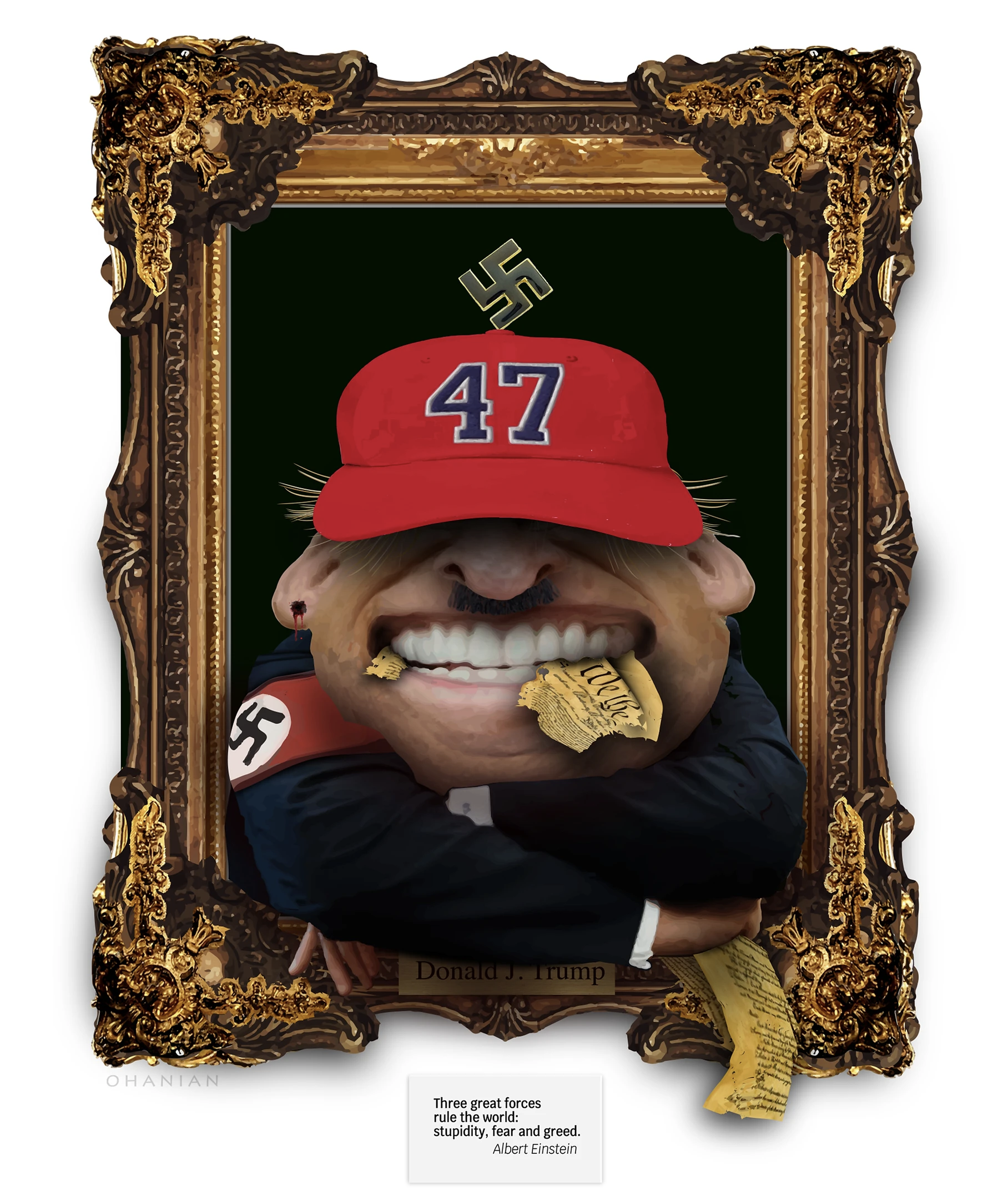
Indeed, we must ask—how much of Ayn Rand’s cruelty do we see in Donald Trump? Is he merely a student of her ideology, or its inevitable offspring?
This is not a rhetorical question. It is a serious reckoning with a living figure whose shadow looms large over contemporary history. In Donald Trump, many see the raw embodiment of Randian Objectivism made flesh—unapologetic egoism, disdain for empathy, and a belief that success alone justifies all means. He venerates the “winners” and sneers at the weak. He brands compassion as weakness and altruism as a fool’s errand. And in this way, he mirrors the cold gleam of Rand’s so-called “heroes,” who stride through life unshackled by conscience, driven only by desire and domination.
Rand’s John Galt was a fictional titan who withdrew from society to punish the world for demanding morality. Trump, in contrast, storms the center of society, not to punish but to possess—to rule. Yet their impulses are kindred: both reject the premise that we owe anything to anyone. Both treat empathy as a parasite on greatness. And both enthrone the self—its appetites, its ego, its will—as the only compass worth following.
Donald Trump’s selfishness—his almost mythic aversion to solemn duty—was once again etched into the fabric of national shame when news broke that he would not stand vigil for the fallen. It has been reported that as the bodies of American soldiers, young lives claimed by a training accident in Lithuania, made their final journey home to Dover Air Force Base, the president would not be there to meet them with bowed head and steady silence. Instead, he would be several hundred miles away in Florida, watching a Saudi-funded LIV golf tournament at his own course and afterwards enjoying a dinner reception there, basking beneath the golden chandeliers of his Miami White House, clinking glasses with his guests.
The choice was not logistical. It was symbolic. Where others might have chosen reverence, Trump chose revelry. Where there should have been the echo of taps, there was the clatter of silverware and applause for ego. The contrast could not have been more stark—flag-draped coffins met with solemn salute on one coast, while on another, the sun dipped below palm trees as the former commander-in-chief toasted himself in a room full of men who play games for millions.
This was not simply absence. It was abdication. A moral eclipse.
Critics responded not just with dismay, but with something older, more primal—outrage. For in that moment, the illusion shattered. The man who once claimed he alone could fix the nation could not be troubled to bear witness to its grief. He who wraps himself in the stars and stripes would not pause even briefly to honor those who died beneath it.
In this, Trump becomes not merely a man indifferent to loss, but a symbol of a broader decay—a rot in the roots of national character, where spectacle takes precedence over sacrifice, and the cult of self obliterates the duty of care. He did not just skip a ceremony. He delivered a sermon of selfishness, written in absence and gilded with golf.
And America watched. But Trump’s diehard base still remains reluctant to react, because they cannot reason empathetically, for they have been carved from the same cold granite as their dear leader.
Trump’s alignment with Rand is no accident. Trump has surrounded himself with devotees of Rand: Paul Ryan, who claimed Atlas Shrugged inspired him to enter politics; Rex Tillerson, who cited her influence; even Mike Pompeo and other figures in his cabinet carried the torch of her economic and moral vision. And so, the spirit of Rand moved not only in rhetoric but in policy—cuts to social programs, deregulation in favor of the wealthy, the stripping of protections for the vulnerable, and a geopolitical ethos of domination over diplomacy. These are not merely political actions. They are philosophical gestures, rooted in a worldview where only power and profit matter.
But the danger Trump poses is not just his resemblance to Rand’s cruel vision. It is that he has converted that vision into spectacle—turned it into a movement. He has transformed egoism into political theater, cruelty into charisma, and indifference into identity. He invites the world to cheer not in spite of callousness, but because of it. That is where Rand's legacy mutates into something far more dangerous than economic theory—it becomes a cult of personality, where the strong have no need for morality and the weak are expendable.
The real challenge before us, then, is historical. Not merely to expose the philosophical undercurrents of Trumpism, but to recognize the moral erosion it represents. To ask whether, in our reverence for individual freedom, we have forgotten the duties that freedom entails. Whether, in our fear of weakness, we have handed power to those who equate compassion with failure.
History will judge this moment. And it will not only judge Donald Trump—it will judge what we tolerated, what we normalized, and what we allowed ourselves to forget: that greatness without goodness is a myth, and freedom without empathy is tyranny in disguise.
.
Comments

Powered by RoundtableAn AI/DeFi-powered Enterprise Media Operating System. Learn more at Roundtable.io.© Roundtable 2026. By using this site you agree to the Terms of Use and Privacy Policy