
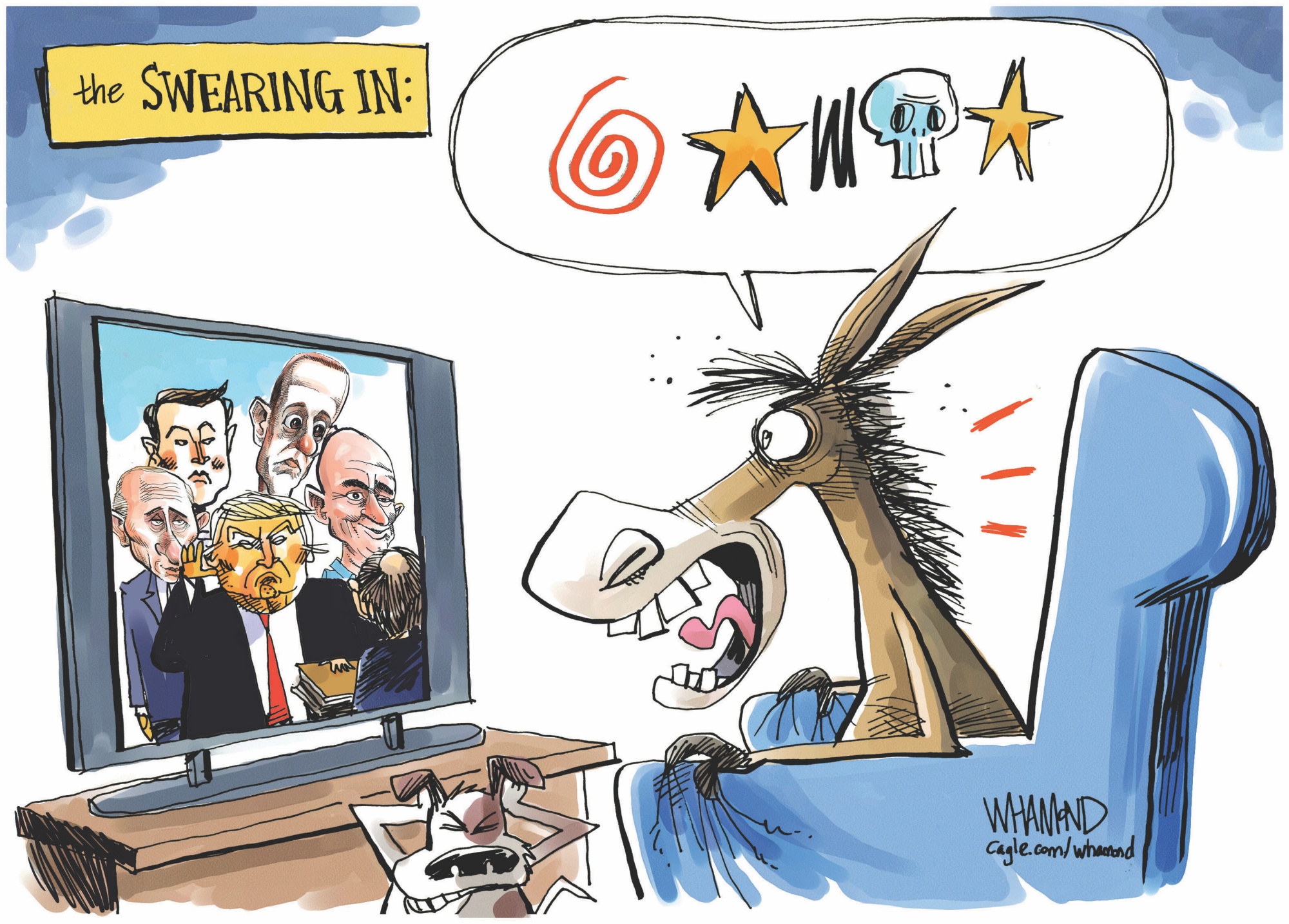
Illustration by Dave Whamond on Cagle Cartoons.


In this essay I also exhort readers to interpret their history correctly, not to fall for false myths - such as Trump possessing a dream similar to MLK’s.
Jan 22, 2025 2:14 PM
Updated Jan 23, 2025 9:01 PM
In this essay I also exhort readers to interpret their history correctly, not to fall for false myths - such as Trump possessing a dream similar to MLK’s.
In futurist Tom Lombardo’s Future Consciousness: The Path to Purposeful Evolution he writes, “Memory of the past . . . is the knowledge foundation for both present and future consciousness, as well as wisdom.” He is correct, and I was reminded of this as I was reading Peter Laarman’s excellent “Rejecting the ‘Lost Cause’ Resurgence” on this LA Progressive site.
In his insightful essay, Laarman amply quotes from historian Richard Slotkin’s A Great Disorder: National Myth and the Battle for America (2024). Being primarily a historian of Russia, I am not especially insightful about U. S. history.
I therefore especially appreciate the analysis that Laarman offers regarding Slotkin’s newest book. And I have even supplemented Laarman’s quotes by unearthing some of my own.
One I took special note of was this of Slotkin’s : “Each side in our [ongoing] culture war appeals to American history to explain and justify its beliefs about who we are and the purposes for which our political community exists.”
Related stories
As the subtitle of Slotkin’s book indicates, our present “great disorder” and the “battle for America” are related to “national myth.” He states: “Four myths have historically been the most crucial to Americans’ understanding of what their nation is, where it came from, and what it stands for.” He identifies these myths as:
- dealing with our frontier
- our founding
- our Civil War
- our “Good War” (WW2)
He also insists that “No modern nation is more indebted to, or dependent on, its myths than the United States of America.”
Regarding our frontier, Slotkin writes that winning it required “‘savage wars’ to dispossess and subjugate the Indigenous peoples, which made racial distinction and exclusion part of our original concept of nationality. In the Myth of the Frontier, these wars transform individual frontiersmen into heroes, and the American people into members of a heroic nationality.”
Five years ago in "The Pioneers: Heroic Settlers or Indian Killers?"--a review of David McCullough’s The Pioneers: The Heroic Story of the Settlers Who Brought the American Ideal West--I criticized that “heroic” myth and approvingly quoted historian Joyce Chaplin. She wrote, “McCullough plays down the violence that displaced the Indians, including the actual Ohio people. He adopts settlers’ prejudiced language about ‘savages’ and ‘wilderness,’ words that denied Indians’ humanity and active use of their land.”
Besides our frontier myth glorifying or ignoring the decimation of Native Americans, it contributed to overemphasizing masculinity. Slotkin writes about a “hard and merciless masculinism rooted in this country’s settler colonial legacy. James Fenimore Cooper’s fictional Hawkeye character (modeled in part on Kentucky’s Daniel Boone) is the primary exemplar of masculine ‘pioneer’ violence—a violence that always gets transmuted into heroism in the settler colonial mindset.” The machoness contained within the frontier myth appeals to Trump and many of his supporters and was amply demonstrated in the January 6, 2021 capitol riot.
Laarman notes this machoness when he writes of the Trumpsters’ affinity for “restoring traditional male authority in the household” and that “raw misogyny masquerades as gallantry . . . the proper way to love women is to control them. Yale-educated JD Vance is proving himself especially adept at suggesting that independent, educated women (and trans youth) need to be put in their place for their own good. Trump, of course, is a bit clumsier, vowing to protect women ‘whether the women like it or not.’”
In a 2017 article entitled “Who Are We?” conservative New York Times columnist Ross Douthat recognized the Trumpsters’ liking of the frontier myth when he wrote that many of them “see themselves more as settlers than as immigrants, identifying with the Pilgrims and the Founders, with Lewis and Clark and Davy Crockett. . . . They still embrace the Iliadic mythos that grew up around the Civil War, prefer the melting pot to multiculturalism, assume a Judeo-Christian civil religion.
Regarding our founding myth Slotkin writes that it “centers on the creation of our political state, which is seen as the work of an extraordinarily intelligent and virtuous set of men of European descent, the Founding Fathers.” And in both the frontier myth, and founding one “American nationality is defined as White, Christian, and largely northern European.”
With the Civil War we have not one myth but, according to Slotkin, three, two from the Union side and one from the South. The first two are the Liberation Myth and the White Reunion one. The first produced what “Lincoln called a ‘new birth of freedom’ that included formerly enslaved Black people.”
The second myth saw “the war as a conflict between brothers who were divided by politics but reunited through respectful recognition of each other’s courage and devotion to their cause—a reconciliation that minimizes the importance of slavery and rejects Black claims to civic equality.” But, Slotkin adds, “opposed to both of these Unionist myths is the Southern Myth of the Lost Cause.”
He characterizes that “Southern Myth” this way:
It “celebrates the virtues of the Old South and justifies the struggle to restore its traditional culture and the structures of White supremacy. . . . [It] would overthrow Reconstruction [a post Civil-War period lasting until 1877, when federal troops left the south] and establish the violent and oppressive regime of Jim Crow, an outcome tacitly ratified by Northerners who embraced White Reunion. As the North and West began to experience mass immigration and labor-capital conflicts between 1875 and 1930, Lost Cause ideology would shape the formulation of a new, ethnonationalist concept of American citizenship in which White Protestant identity was fundamental.”
The Southern Lost-Cause myth was aided by Northerners such as Nation publisher E.L. Godkin. Laarman writes that although he was “once a stalwart Abolitionist,” by 1877 he was echoing Southern “politicians condemnation of Blackness.” And Godkin also began sounding like a nativist. Fearing the “immigrant threat” he wrote, “Vast additions have been made to our population . . . to whom American political and social ideals appeal but faintly, if at all, and who carry in their very blood traditions which give universal suffrage an air of menace to many of the things which civilized men hold most dear.”
Laarman adds that “Harvard president A. Lawrence Lowell also compared immigrants from Southern and Eastern Europe to Black people and Indians, stating that the newcomers were “from beaten races, representing the worst failures in the struggle for existence.” He added that “Real Americans of Anglo-Saxon stock cannot expect to live freely alongside such inferior breeds. The un-American elements must therefore be barred from entering the country or else barred from participating in politics: precisely the ‘solution’ that the Jim Crow states had by then put into practice in relation to the supposed menace of African American enfranchisement.”
Summing up the myths considered so far Slotkin writes, “In the Frontier Myth, the Myth of the Founding, and the Civil War Myths, American nationality is defined as White, Christian, and largely northern European.” But already in the immediate aftermath of the Civil War, a different approach was being put forth. It came from abolitionist Frederick Douglass, and I described it in my 2019 essay “Do We Want the America of Frederick Douglass or Donald Trump?”
In an 1867 speech the famous abolitionist advocated a “composite nation,” a concept that historian Jill Lepore calls “a strikingly original and generative idea, about a citizenry made better, and stronger, not in spite of its many elements, but because of them.” In his speech Douglass not only recalled the U. S. mistreatment of both Native Americans and African Americans, but also praised the contributions of the latter, as well as various immigrant nationalities like the Irish and the German.
Amid great fears regarding Chinese immigrants, he also thought that they could enrich our nation. “Do you ask, if I favor such immigration, I answer I would. Would you have them naturalized, and have them invested with all the rights of American citizenship? I would. Would you allow them to vote? I would. Would you allow them to hold office? I would.” He also believed that “we should welcome all men of every shade of religious opinion, as among the best means of checking the arrogance and intolerance which are the almost inevitable concomitants of general conformity. Religious liberty always flourishes best amid the clash and competition of rival religious creeds.”
But it was not until after two world wars and a Great Depression sandwiched in between that, according to Slotkin, “the nation’s political and cultural elites” broadened “the concept of American nationality . . . to embrace on terms of equality racial and ethnic minorities that had hitherto been marginalized or excluded from the body politic. The result was the creation of a new national myth, the Myth of the Good War, which. . . . created the basis for public acceptance of the civil rights movement and the overthrow of Jim Crow.”
Extending his analysis into the twenty-first century Slotkin adds,
“The postwar civil rights movement challenged the racialist presumptions that were so fundamental to our national myths. It would cue a series of cultural transformations, including a wave of ‘liberation’ movements affecting race, gender, and sexuality, which coincided with radical changes in popular culture and music, and in ‘manners’ generally. It would also produce a major movement in universities calling for the wholesale revision of our ways of reading and understanding national history. With hindsight, we can see these developments as the formation of what might be called a ‘Myth of the Movement,’ in which the nonviolent victory of civil rights provided a script for transformations that blue America has generally seen as progressive, and red America as the cause of national degeneracy.”
Now with Trump once again president we shall soon see whether most of our nation regards the “Myth of the Movement” as being progressive or “the cause of national degeneracy,” as Trump suggested in his second inaugural address. In that address, which occurred on Martin Luther King Day, Trump declared that “in his honor we will strive together to make his dream a reality. We will make his dream come true.”
In a 2020 essay, "The American Dream: Trump’s vs the MLK\ John Lewis Version," I indicated that Trump’s dream was very different from that of MLK - and Lewis. The latter two men sought “not divisiveness, but inclusiveness. Not just “material well-being” for its people . . . but also, in King’s words, “culture and education for their minds, and freedom for their spirits.”
Not a “thing-oriented society,” where “machines and computers, profit motives and property rights, are considered more important than people,” but a “person-oriented society.” And not a society that takes “our air, waters and land for granted” and displays “a simple lack of respect for nature and our environment,” but one that realizes that “humanity is the most important endangered species under threat from climate change.” Today, almost five years after that essay, the contrasting dreams of Trump and the two civil-rights champions seem more different than ever.
In Laarman’s LA Progressive essay he urges “Rejecting the ‘Lost Cause’ Resurgence” and the White supremacy it advocated. In this present essay I also exhort readers to interpret their history correctly, not to fall for false myths - such as Trump possessing a dream similar to MLK’s. And, as important as national reconciliation is, not to sacrifice progressive principles by embracing a history that would ignore or downplay all the injustices, sacrifices, and contributions of Native Americans, Blacks, and other minorities.
Comments

Powered by RoundtableAn AI/DeFi-powered Enterprise Media Operating System. Learn more at Roundtable.io.© Roundtable 2026. By using this site you agree to the Terms of Use and Privacy Policy