
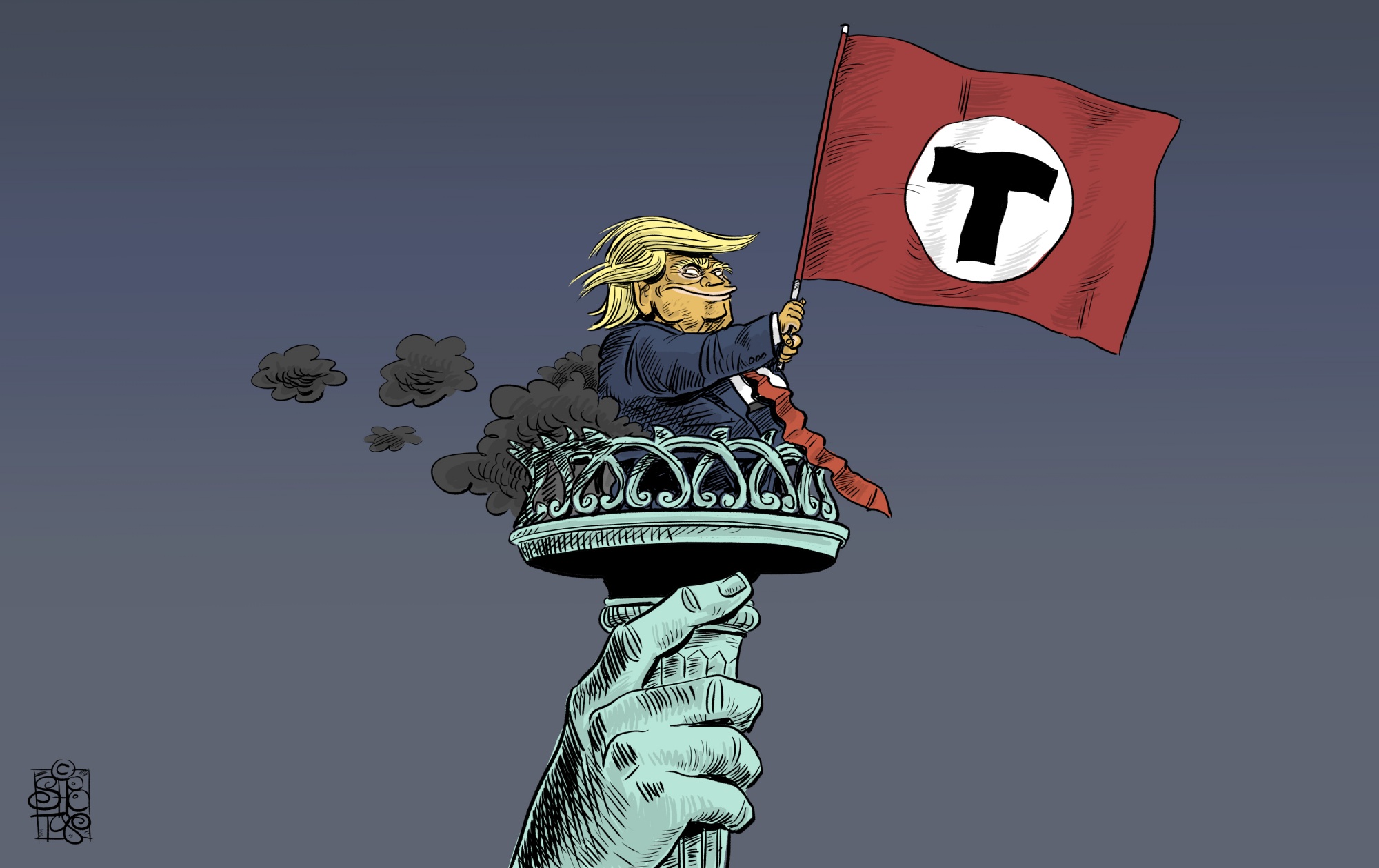
Illustration by Martin Sutovec on Cagle Cartoons


If politicians see Trump's way will win power and keep it, that is how politics will be. We need to rethink how our politics work and the role institutions play.
Jan 22, 2025 1:44 AM
If politicians see Trump's way will win power and keep it, that is how politics will be. We need to rethink how our politics work and the role institutions play.
A Conversation with Presidential Historian Rick Shenkman
November 5, 2024 will be remembered by many Americans as a date of infamy for our democratic institutions. Voters narrowly re-elected President Donald Trump, a race-baiting, mendacious, populist demagogue they knew over Vice President Kamala Harris, an eminently qualified and skilled politician who spoke of policies to lift all Americans while preserving democratic values and the rule of law. And, as David Smith of the Guardian observed, voters narrowly chose fear over hope by re-electing Trump.
Trump’s 2016 election was a shock, but by 2024 he was well known to voters as a force of chaos and calamity during his first term in office that concluded with his treacherous lie that the 2020 presidential election was stolen and his January 6, 2021 incitement of a deadly riot at the US Capitol to overturn that election.
In 2024, Trump ran a bellicose campaign of daily lies, hate mongering in the vein of Hitler, and self-aggrandizement. He threatened his perceived enemies—including ordinary citizens— with a vindictive campaign of revenge (“a bloodbath”), and promised to establish “a dictatorship on day one.”
Since their election loss, Democrats have been consumed by a messy post mortem as they exchange recriminations for the narrow but painful election defeat. This in-fighting, however, avoids larger questions about the underlying causes of the re-installation of a demagogue who brags about plans to upend American institutions.
Related stories
To better understand how we got to this point, I contacted acclaimed presidential historian Rick Shenkman. He graciously responded to questions about today’s political situation by telephone from his home in Seattle.
Mr. Shenkman has a gift for focusing on the big picture of our politics in historical context. His extensive research into voter behavior over time is based on historical analysis as well as research grounded in social psychology and neuroscience.
In assessing voter behavior, Mr. Shenkman’s research revealed that human instinct and emotion usually triumph over reason in making political decisions. As he explained in our interview, the primal reaction of voters in 2024 and the growth of “stupid politics” in recent decades culminated in the re-election of Trump, an unabashedly aspiring autocrat.
Mr. Shenkman has a distinguished career as the founder of the revered History News Network and as an award-winning political journalist and author. His books on history and politics include: Political Animals: How Our Stone-Age Brain Gets in the Way of Smart Politics; Just How Stupid Are We? Facing the Truth About the American Voter; and Presidential Ambition: How the Presidents Gained Power, Kept Power and Got Things Done. In 2008 he was elected a Fellow of the Society of American Historians.
Robin Lindley: How could voters again fall for Trump after his failed term in office—especially with his mishandling of a pandemic and deaths of more than 400,000 citizens on his watch?
Rick Shenkman: Voters gave Trump a pass when it came to the effect of COVID on life in the United States while he was president. But they held Biden responsible for the inflation, which was also by and large a worldwide phenomenon in response to COVID. So, there were two standards by which these presidents were judged. And I don't think it's a result of the media misreporting or underreporting the story. It's just a feature of how the human brain works that people blamed Biden because he was the incumbent. That is one of the iron rules of politics.
The American people are not ideological or terribly knowledgeable about politics, but they go with their feelings and they look for a scapegoat when things go wrong. And Joe Biden, like incumbents around the world, was the obvious scapegoat coming out of this horrible period of COVID and then the resulting inflation. So that made the politics of the 2024 election very difficult for the Democrats.
Even though the Republicans walked away with the House, the Senate, and the presidency, this was not a landslide election. But it was a change election. And Kamala Harris as the Vice President under Joe Biden could not be the agent of change. So that just put her at an enormous disadvantage.
Lindley: In your 2008 book on American politics and voters you asked how stupid are we? Are we too stupid to sustain a democracy?
Shenkman: It's a mistake to say that the American people are stupid or, as some politician and pundits say, that the American people are smart. We’re 330 million people, and it's hard to generalize.
But our politics are stupid. And under Donald Trump's administration, and basically for the last ten years since he entered politics, our politics have become even more stupid and certainly more deplorable. Remember when Trump stood on the debate stage with Kamala Harris and ranted, “They're eating the dogs.”
So, politics are dumber now than they were before. Thank you, Donald Trump.
Lindley: Democrats seem fixated on dissecting and analyzing the purported failures of Harris’s admittedly brief but enthusiastic campaign to save democracy and the rule of law.
Shenkman: These are good questions about Democrats’ failure, but I am more interested as a historian and as a journalist in stepping back and trying to figure out the big picture here.
To me, the big picture is that human beings reacted exactly as we expect human brings to react, given the circumstances. There's nothing that was surprising in the way voters were reacting to the set of events that they have lived through. I'm not shocked by Trump's recent victory. And that’s a saving grace because I was shocked by his victory in 2016.
And after everything, as Brett Stevens wrote recently in the New York Times, the voters showed that they didn't care about Trump’s incitement of the deadly January Sixth attack on the Capitol, an attempt to overturn the 2020 election. But Democrats believed that democracy was on the line, and the voters didn't seem to care about that. They cared more about grocery prices.
I’m not shocked by what has happened, but I then turned to the social sciences and history to try to make sense of this attitude. I wish we would focus on the uncomfortable but vital conversation about voters not caring much about policy and not knowing very much, and succumbing to Donald Trump's demagoguery.
Lindley: How do you see this election and voter attitudes in the larger context of history and your other research?
Shenkman: The Democrats were right during the campaign to focus on democracy. The conundrum that the Democrats face is that they are concerned with preserving democracy, but the voters in whose name they are acting seem indifferent to the cause.
To be sure it was the Republicans that nominated Trump, not the Democrats, but it’s a problem the Democrats need to address because the GOP is unwilling at present to do so. Somebody needs to draw attention to this roaring deficiency in the party system and if the Republicans won’t the Democrats must. The bottom line for me is that for our system to work, strong guardrails must be in place, and you can't have guardrails without guardians. And the way the system is designed now, the guardians cannot do their job. And this starts with the weakness of the party system in its modern iteration,
The old party system would have saved us from a Donald Trump as it saved us from demagogues through most of our history. And the reason it saved us is because party bosses were in charge, and they wouldn't allow a Donald Trump to have access to the levers of power. It's really that direct.
The party system has saved us from ourselves over and over since its creation in the 1820s and 1830s. And, because it's repeatedly saved us in the past, we may, in the back of our minds think that we can rest easy and think, if the Republicans today get out of line, the Democrats will come save us, and we'll go back and forth between them as theory of thermostatic politics suggests.
Lindley: How did the political party system develop?
Shenkman: The idea of the party system arose largely in the brain of Martin Van Buren, a one-term president. He had the radical idea that you need parties to implement programs, and you need the opposition to thrive as well, because without opposition, your own party will split asunder. And he demonstrated how this system worked and then everybody fell in line. And behold, we have the modern two-party system. I should add that it evolved, and there were upwards of half a dozen different party systems in our history.
Van Buren gave us the keen insight that, if you run a political party, you need an opposition. So the saving grace of the situation we're now in is that Republicans need the Democrats to thrive, up to a point, because otherwise the badly divided Republicans will splinter. With this understanding, Republicans can't get rid of the Democratic Party, and the Democrats can’t get rid of Republicans, so we won’t become a one-party state as you found in Germany under the Nazis. But if a demagogue bent on sabotaging our institutions emerges, Van Buren’s equation may fail. The old math may not hold up any more.
Lindley: Hasn’t that old party boss system become extinct for good reason? I think of old men in smoke-filled rooms picking our political candidates.
Shenkman: I don't want to go back to a period where the party bosses are wholly in charge, but the primary system that has evolved since the 1970s, in response to the 1968 disastrous Democratic convention in Chicago, has failed us. It does not work. And if we only have a conversation about how to win the next election, and we don't have a conversation about the largest systemic failures, then we have not lived up to the moment.
Lindley: You’re suggesting that the party system has failed. What happened?
Shenkman: Television has been the first and biggest nail in the coffin of the party system since the 1950s. In the fifties, Estes Kefauver, a senator from Tennessee, chaired a committee that went around the country holding hearings about crime and mobsters and the mafia. He became famous as a result because the hearings were televised, and he decided to self-select in a run for president.
This was an astonishing turn of events. It's the first time in American political history when a high public official self-selected, and it was because of Kefauver’s celebrity from his appearance on television. The party bosses weren’t the ones doing the selecting. Kefauver was, and he didn't have to curry the favor of the party bosses to get himself on the ballot or to be taken seriously as a candidate for president. As it happened, the party boss system was still in place, so Kefauver ultimately did not win the nomination. It went instead to Adlai Stevenson.
But by 1960, it was clear to politicians what impact television was having on our politics. And John Kennedy self-selected himself. He just decided he wanted to run even though he was a 42-year-old senator who would not normally have been considered presidential material at that point. But he was telegenic and he used television to his advantage and he became a credible candidate. And, in the debates with Richard Nixon, Kennedy outshined Nixon on television, and he was elected.
From a historian's perspective, the party system had to change because of television. And then in 1968 we had this horrible, chaotic televised convention in Chicago. And the big complaint of the people out on the street was that Hubert Humphrey had not won the primaries or even run in the primaries. But because the party bosses backed him, he was anointed as the replacement candidate for Lyndon Johnson, the incumbent. And this seemed wrong, and was why people were out on the street demonstrating.
Lindley: How did the Democratic Party react to the 1968 Chicago catastrophe and Humphrey’s ensuing loss to Nixon?
Shenkman: In reaction to the violence in Chicago, George McGovern chaired a commission that went way overboard. It basically exiled the party bosses, leaving the selection of presidential candidates in the Democratic Party up to primary voters. That sounds great, but primary elections call out the activist wing of the party and not the voters who show up in November, and you have two different constituencies. The first constituency gets appealed to with red meat thrown at them by politicians who want to win the nomination and are then saddled with positions that in the general election can be trouble. This happens in both parties. Richard Nixon famously observed that, in the Republican Party, you run to the right during the primaries, and you move back to the center during the general election. That happened with Trump on abortion during his campaign, certainly.
So, we have a problem with the party system. I don't have a solution. I'm not an activist saying, here's how to fix things. As a historian and a journalist, I'm looking at the situation and saying we have a problem and this needs to be addressed and needs to be openly talked about.
Lindley: Is it fair to say that democracy failed us in 2024?
Shenkman: Al Smith, the governor of New York back in the 1920s who also won the presidential nomination of the Democratic Party in 1928, made the observation that all the ills of democracy can be cured by more democracy. That is not the situation right now.
We created a system that's more democratic and it's not working. It is not to the advantage of either the Democratic party or the Republican Party that candidates like Donald Trump can now self-select and, because of their celebrity, win a nomination and then get into office and not be beholden to anybody.
If a Donald Trump can get elected, that means our guardrails are too weak. And the voters need cues from people that they trust before making their decision. The way the system is set up now, there's nobody in these institutions who they trust. Trust was a major factor in American politics until the 1960s. John Kennedy's poll approval ratings were 60, 65, 70 percent. That’s far different from today as a result of things that happened in history.
Lindley: It seems there’s been a shift from voter acceptance of government programs and policies from the FDR era and even in the early years of the Cold War and then, but with the fiery issues of the sixties, mistrust began to grow.
Shenkman: The very first reason why Americans stopped trusting their leaders was Vietnam, and then came Watergate, then came the terrible inflation of the later 1970s, then came Iran Contra. It's obvious why Americans no longer trust their politicians and the system given everything that's happened.
But the voters themselves can't be trusted if left to themselves to figure out who should be in office. They need the help of institutions. They used to have help. The parties were trusted. Voters could turn to the party leaders and ask who should I vote for? Who will help me? Who will keep this country strong?
Lindley: In your 2015 book Political Animals you looked at voter behavior through the lenses of neuroscience and psychology as well as history. You envisioned—before Trump was on the political scene—how voters might choose a populist demagogue for president, noting the strong pull of emotions in voting. What does your research tell us about voter attitudes now?
Shenkman: When I lecture around the country, I assert that we have been conducting a grand experiment since the 1970s concerning whether a democracy can survive and thrive if a majority of the people no longer have faith in their leaders. We've been guinea pigs in a social experiment and are now finding out what the results of this experiment are, and it looks terrible.
We have a systemic problem. Social science teaches us that human beings naturally possess a superpower that leads to the correction of error so when we see with our own eyes things going awry and events not playing out in the world as we expected, that gives rise to profound feelings of ill ease and anxiety. A surveillance system in the brain then triggers a reevaluation of our commitments. This is the central finding of the theory of affective intelligence.
But the way the system is designed today it is sabotaging our superpower. We need people to help us reevaluate our commitments, and help us understand what's actually happening. But the way the system works now, there's nobody who has the authority to help a majority of Americans reach a conclusion that is rational and in their own interests, thus allowing a demagogue like Donald Trump to dominate.
Lindley: Doesn’t the last election demonstrate the decline of history and civics education in our schools? And isn’t that part of the problem?
Shenkman: I don't think that facts or education alone will save us. That’s one of the main points I've made in my book. Political Animals. I should hasten to add that I love facts. As a journalist, I'm constantly trying to accumulate as many facts as I can about what's happening in the world so that I can make good decisions. But the way the human brain is designed, we don't care so much about facts and the truth. What we care about is not the truth, as the Harvard psychologist Steven Pinker says, but our version of the truth. It’s our ability to sell our version help us win that helps us win an argument, and that’s what we care about, as social scientists have shown. But that means our only saving grace has to be institutions that help us stay on the right track. We formerly had these institutions: political parties, churches, and labor unions. They were the three main pillars of our politics that helped American voters reach good, solid conclusions.
Lindley: But don’t we have a history of voters not always making the best decisions?
Shenkman: Of course, voters make mistakes. As we look back through history, we can see all the mistakes that we as a country have made and that voters have made. Even people armed with good information make mistakes. Vietnam was the product of the best and the brightest, as David Halberstam labeled government officials in his famous book, and the Vietnam War ended in disaster.
The reason we make mistakes is that, as my friend George Marcus, a political scientist at Williams College, now retired, likes to say, citing Hobbes, we do not have the gift of prophesy. Because we can’t see into the future, we make mistakes. That is just part of the human condition.
Lindley: You said you don’t have solutions but you seem to suggest some critical reforms.
Shenkman: I am an institutionalist, and I believe that we can establish institutions that help us at least get past some of the biases that prevent us from making good decisions. In the social science literature, hundreds of biases have been identified that warp our view of how world works. And, because of cognitive dissonance, we are good at convincing ourselves that what we believe about the world is true even as we are face with facts that suggest we are full of it. That is just a reality. But with strong institutions, we can overcome these biases to a certain extent. This is the genius of the Constitution.
As James Madison wrote back in the 18th century, if everybody in a large country weighs in on events, they will each balance against the other, giving the truth a chance to emerge as long as no one side in the debate unfairly puts their thumb on the scale. But the Madisonian system, which served us so well for two centuries, is not serving us well now. And that's because our institutions have failed us.
One of the institutions that's failed us has been the media and journalism with people now living in their own silos, in their own bubbles. They're not being exposed to the arguments of the other side, which means that wild opinions can flourish.
And people are not being given the opportunity to test their ideas in the open market. We don't have an open market anymore. The three major television broadcast networks combined only reach a relatively small number of American voters now.
A few decades ago, as bad an effect as television has had on our politics, you had three networks each night reporting on the big stories. They would go around and stick microphones under Democrats, Republicans, and independents, and you would get a good selection of views. Never the best selection, of course. You can criticize the old network system, but it was a better situation than we have now.
Again, I urge my fellow Americans to lift their sights from winning the next election to thinking about how we can reform the system we've got because the system we've got right now is leading to a demagogue in the White House.
If politicians see that Donald Trump's way is how to win power and keep it, then that is how our politics will be going forward and we can't afford that. And so, we need a big rethink about how our politics work and the role that institutions should play in them.
Comments

Powered by RoundtableAn AI/DeFi-powered Enterprise Media Operating System. Learn more at Roundtable.io.© Roundtable 2026. By using this site you agree to the Terms of Use and Privacy Policy