


Aug 16, 2025 4:28 PM
Updated Sep 29, 2025 8:34 PM
We tell stories—we narratize—to explain and to rationalize both to others and to ourselves the random and sometimes violent events that unfold around us.
Part 1: Going Deep: Beyond Belief—They
Part 3: Going Deep: Beyond Belief—Faith
Related stories
Part 6: Beyond Belief—Divide and Conquer
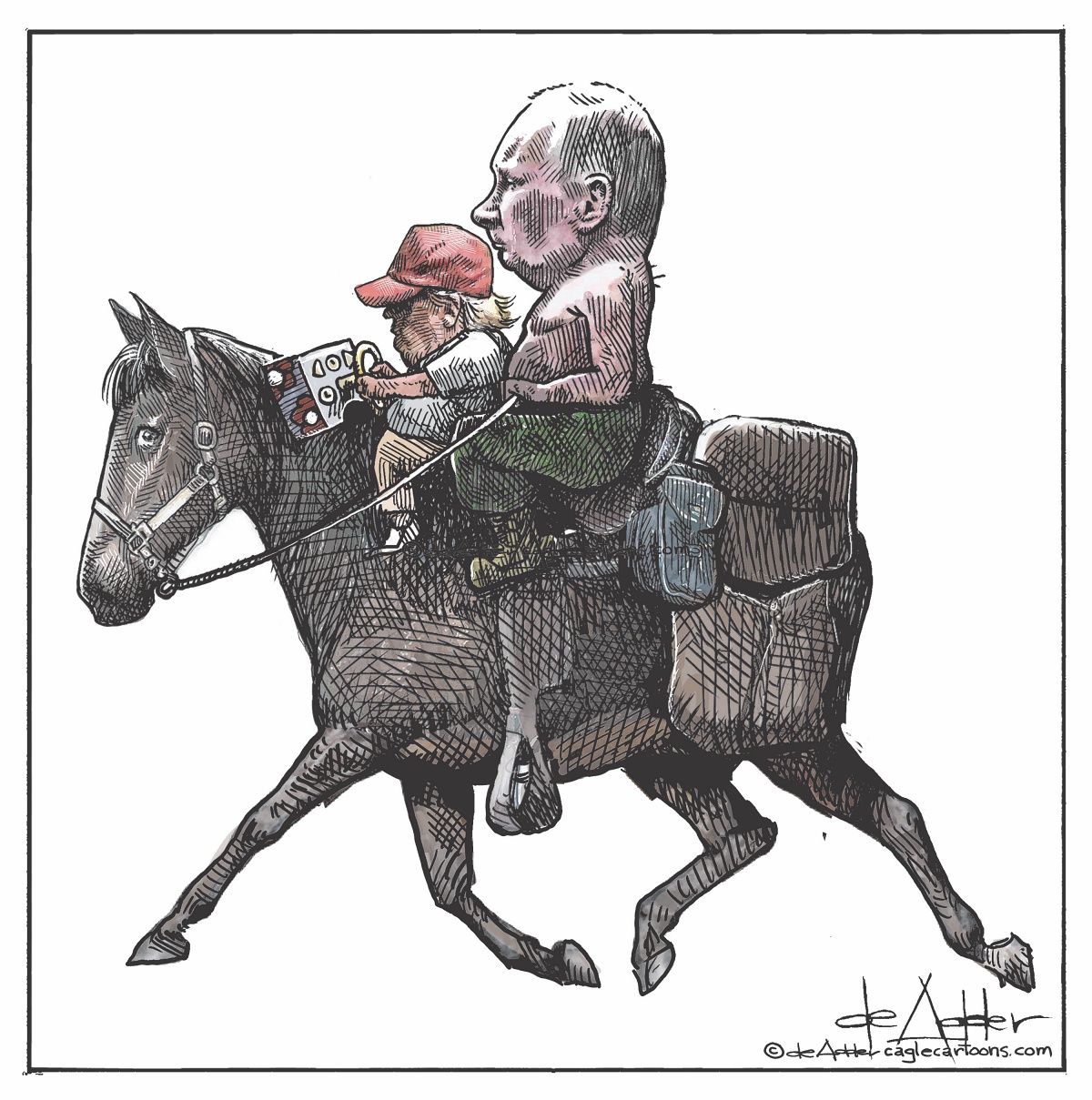
After recent gains, an emboldened, less-constrained, and vast(er) right-wing conspiracy (VRWC) is incrementally going public. In the U.S., a more-assertive Conspirator-in-Chief—Make L’etat Moi Again—is nearly out of the covert closet. (Buffoonery is part of the act; it is a major blunder to underestimate a man in whose madness there is much method.) He has, using a fictitious deep-state as an excuse, fashioned an actual deep state out of his cultists’ paranoia. While persecuting and prosecuting his/moi’s opposition, he is less-than-subtly signaling his Proud Boy shock troops to be ready for a mid-term dress rehearsal in 2026 and the real thing in 2028. MAGA loyalists—Pete Hegseth (Secretary of Defense), Pam Bondi (Attorney General), Tulsi Gabbard (Director of National Intelligence) and many others—have assumed powerful governmental positions. Phasers set on stun, they and a motivated force of far-too-credulous MAGA cultists are boldly going where no American has gone before.
Both around the globe and here THEY have deftly managed to keep liberal democracies in a steady state of stun. In the process THEY have left what’s left of the global left defensive, addled, and gibbering. To see how THEY have done all this, we must go back. We could go back as far as Adam and Eve—that’s actually where THEY want us—but lacking world enough and time, let’s begin with Samuel Taylor Coleridge (1732-1834):
From his The Rime of the Ancient Mariner:
Tariffs, tariffs, every where,
Economies did shrink.
Tariffs, tariffs, every where,
Recession on the brink.
And from his uncompleted Kubla Khan:
In Mar-a-Lag did Donald Trump
A stately pleasure-dome decree:
Where Musk, the addled addict, ran
With hubris measureless to man
Down to a sunless sea.
Besides his eerily prescient poetry, Coleridge (1772-1834) coined the phrase willing suspension of disbelief. Now a lit-crit commonplace, the phrase asserts that audiences consort with writers and narratives by voluntarily exchanging caution for credulity. Coleridge’s exact quote is … that willing suspension of disbelief for the moment, which constitutes poetic faith. Writing more than 200 years ago, Coleridge meant willing in the sense of voluntary; suspension in the sense of disarming; disbelief in the sense of vigilance, circumspection, caution; moment in the sense of occasion (as opposed to a measure of time); poetic in the sense of fiction (i.e., not only poetry); and faith—the most dire—in the sense of implicit trust, of allowing one’s world view to be momentarily supplanted by another(‘s).
You’re thinking Literary theory? Seriously? But please unroll your eyes and suspend your disbelief for a moment. Coleridge’s coinage, though elitist—poetic faith presumes educated readers with leisure to curl up with a good poem and the refined intellect to savor it—has fateful implications for liberal democracies globally.
Despite its focus on fiction and the gentry, Coleridge’s phrase enfolds all brows (high, middle, and low) and narrative forms. Whether a journalist’s This is what I saw, an op-ed writer’s This is what I think, a documentarian’s This is what I choose to show, or a charismatic politician’s This is how things could be, every narrative refracts reality and requires us to suspend our disbelief if we and it are to couple. Regardless of the genre in which narrators are working, they all proposition us with intimate, cerebral ménages-a-trois, blatantly or subtly signaling the boundaries of the unreal estate—journalism, poetry, biography, sci-fi, fantasy, mystery, history, politics, philosophy—they intend to occupy. Every narrator is a creator, every narrative a fabrication. With every willing suspension of disbelief we become accomplices, and our complicity renders narrative a team sport.
Narrators proffer portals to another(‘s) world (or world view; they are the same); posing as Insiders, they tout tickets to three-hour tours. We Outsiders can’t resist being invisibly present at cabals, cabinet meetings, or board sessions. We can’t resist boarding the S.S. Minnow and being stranded with Gilligan. We snatch tickets eagerly, willing to pay a price that often includes cash but always demands collusion.
Having accepted a narrator’s proposition, we orient ourselves—usually subconsciously—to the expected genre. If a narrative is tendered as true—i.e., journalism—we take one position relative to it. If it tacks toward adventure or romance, we take another. If actors burst into song while strolling a stage, we shift to a different whereabouts or whenabouts. If characters speak in iambic pentameter or terza rima, we lodge in a place or time wholly foreign from our own. If an alien bursts from a human thorax, we beam to yet another space.
Collaboration allows us to defy gravity and common sense, to transcend time, space, and the laws of physics, to transport our selves. Whether it’s Steven Spielberg’s Jurassic Park or JD Vance’s Hillbilly Elegy—both evoking a dinosaur-riddled past—we must for a moment adopt another(‘s) world, another’s reality. Or not. Sometimes audiences don’t/can’t/won’t suspend disbelief. Once upon a time, in a movie theater long ago and far away, I watched as Batman and Robin scaled the side of a building in tandem. As the Dynamic Duo pulled themselves hand-over-hand up the batrope, a fellow a few seats to my left said, out loud and to no one in particular, There’s no way. It’s bullshit!
If we don’t/can’t/won’t suspend disbelief, we remain earthbound. We can come aboard The Love Boat—they’re expecting us—but we cannot leave dry land. To grok narratives in whatever form—to sail other(s’) seas—we lower emotional bollards and open intellectual floodgates. Whether the refraction takes the form of myth, movie, theme-park ride, or sermon, grokking it requires us to log in, to let go. For a Coleridgean moment we cede our selves to a narrator’s Just suppose … or Once upon a time ….
This has been the case since ... well … since narrative: Odysseus blinds a one-eyed cyclops. Queen Jocasta weds Oedipus, a young man who has killed King Laius (her husband and his father), then births him four children before realizing he’s her son! Daedalus and Icarus cobble feathers and wax into two sets of working (mostly) wings. Gutenberg prints bibles in which Eve talks to a snake and Moses talks to a burning bush, then parts the Red Sea. For several nights Hamlet chats with his dead dad, and for 1001 nights Scheherazade escapes death via flying carpets. Adam Smith invests in The Wealth of Nations, and Karl Marx claps back a century later with Das Kapital. A horse walks into a bar just ahead of a man from Nantucket. Superman soars. The Von Trapps skip across green, alpine fields one harmony ahead of the Nazis. Adolf Hitler’s whingeing Mein Kampf opens a passage for Donald Trump’s billionaire’s lament. Without an audience’s willing suspension of disbelief There’s no way. It’s bullshit.
We tell stories—we narratize—to explain and to rationalize both to others and to ourselves the random and sometimes violent events that unfold around us. We cling to these explanations and rationalizations because the alternative—that there are none—is intolerable.
As societies became more complex and inter-dependent, stories that made sense of the chaos were collected, evolving into belief, then myth, then faith whether religious, secular, political, or Coleridge’s poetic. Faith, constantly whispering in our inner ears, provides the illusion—frequently the delusion—of order and control. A stream-of-consciousness pilot assuaging our anxieties about what lies beneath, faith frames and tames the often predacious world we encounter, day by day, in both real time and our imaginations. Despite our urge to romanticize and exalt it, faith is less a collection of hallowed principles and tenets than a process that not only calms our fears, but also shapes what we see as and conclude to be real and true.
This process of curation is essential to our existing as human. It individualizes us, makes us us. But so fundamental, ubiquitous, and complex are interactions between faith and perception that few grasp their implications and consequences. Or that there are implications and consequences to grasp. Some of us sense that there is much more going on below than above, but we only inkle them, glimpsing shadows of shadows. Our inability to grok the subtle, pervasive influences faith-colored glasses exert over our perceptions, conclusions, and decisions is the human condition. And curse.
Like Coleridge, Karl Marx coined a pithy phrase that touches on the convergence of narrative and faith. Often translated as religion is the opiate of the masses, Marx’s phrase posits religion as a metaphysical balm for the real suffering in the universe and in society. Like Coleridge’s, Marx’s maxim is reductive, conflating religion and faith when religion is a type of faith and faith, in turn, is a type of narrative. Like Coleridge, Marx misconstrues: The opiate of the masses, since the first human explained thunder as the anger of a god, has been narrative.
And to be opiated by it, we must momentarily suspend our disbelief. For the VRWC’s purposes, whether that suspension is voluntarily or involuntarily matters little.
Part 1 can be found here.
Comments

Powered by RoundtableAn AI/DeFi-powered Enterprise Media Operating System. Learn more at Roundtable.io.© Roundtable 2026. By using this site you agree to the Terms of Use and Privacy Policy