


Aug 29, 2025 7:07 PM
Can anyone honestly believe that what Trump is doing in his second term is benefiting the “common good”? Especially if we include immigrants, minorities, LBGQ people, and the highly educated among the public.
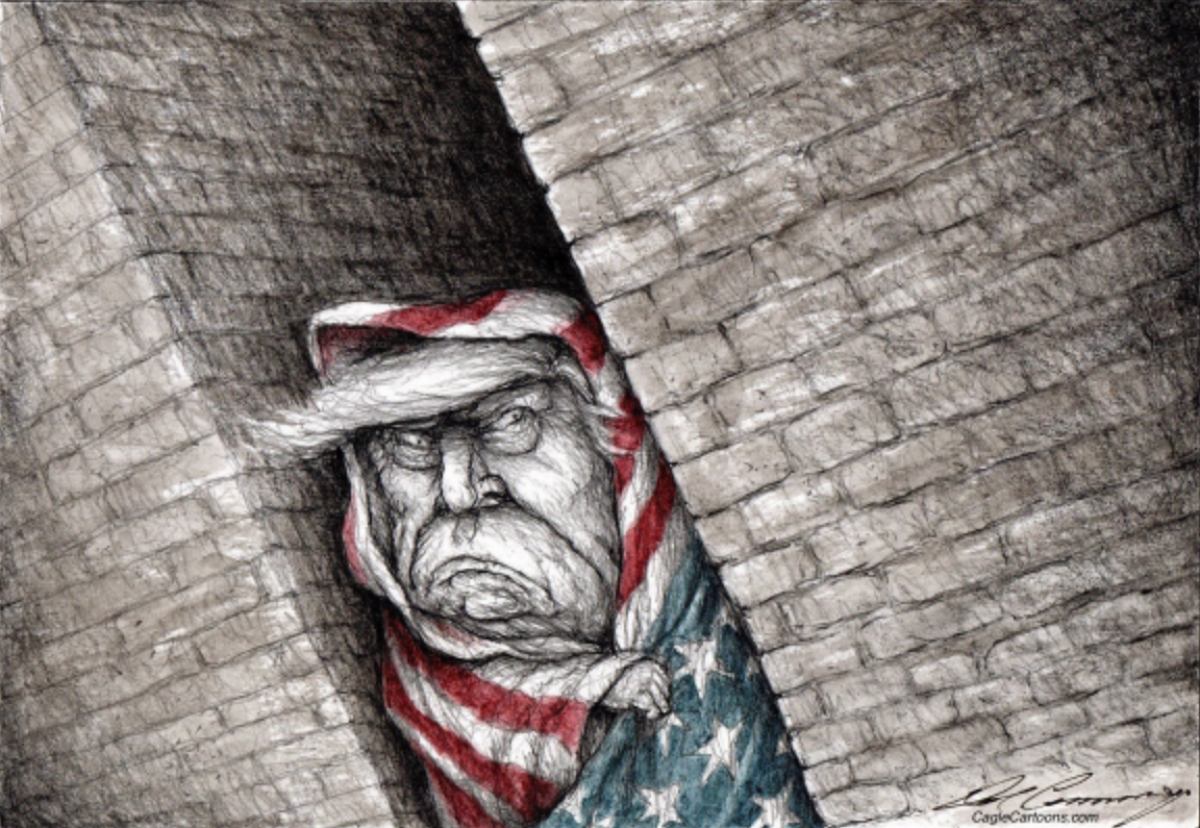
Seven years ago I wrote “The Crassness and Anti-Intellectualism of President Donald Trump.” Now that we’re more than half a year into his second term, it needs updating. Especially the anti-intellectualism part, now that he has stepped up his fault finding with education, museums, and the teaching of history.
Since Trump’s second-term inauguration, our country has spiraled down into a swampy quagmire—almost 200 executive orders (some constitution defying), an enabling Congress, sweeping arrests by U.S. Immigration and Customs Enforcement (ICE) agents, increased tariffs imposed on goods from numerous countries, taking over police powers in D. C. and threatening to do so in some other cities, etc., etc. Often such actions are opposed and brought to courts, with the Trump administration sometimes appealing decisions that go against it.
Much of this is new. But it should be noted that in 2016 Trump benefited “from a deep strain in the American character”—anti-intellectualism. “It was influenced by our frontier experience and contempt for the ‘tenderfoot,’ by the spread of Jacksonian democracy and populism, by the free-wheeling capitalism of the Gilded Age, by our respect for practical men like Thomas Edison, Henry Ford, and Charles Lindbergh, and for common sense and ‘the school of hard knocks’ as opposed to book-learning and being ‘overly educated.’” Growing up in a blue-collar family, I remember well the broader disdain in the 1950s that many Americans felt for “the egghead” Adlai Stevenson—one who “never got his hands dirty”—as opposed to the more down-to-earth Dwight Eisenhower.
In 2025, Trump’s stepped-up anti-intellectualism has been revealed in many new ways—e.g., the picks of his cabinet and other officials; his adherence to Project 2025; his many postings on his own web site, Truth Social; his various executive orders; and most blatantly, his attacks on higher education, museums, and the teaching of history.
Related stories
Taking one prominent example, consider his recent (8/19/2025) posting on Truth Social:
The Museums throughout Washington, but all over the Country are, essentially, the last remaining segment of "WOKE.” The Smithsonian is OUT OF CONTROL, where everything discussed is how horrible our Country is, how bad Slavery was, and how unaccomplished the downtrodden have been—Nothing about Success, nothing about Brightness, nothing about the Future. We are not going to allow this to happen, and I have instructed my attorneys to go through the Museums, and start the exact same process that has been done with Colleges and Universities where tremendous progress has been made. This Country cannot be WOKE, because WOKE IS BROKE. We have the "HOTTEST" Country in the World, and we want people to talk about it, including in our Museums."
Or consider his earlier executive order of March 2025:
Over the past decade, Americans have witnessed a concerted and widespread effort to rewrite our Nation’s history, replacing objective facts with a distorted narrative driven by ideology rather than truth. This revisionist movement seeks to undermine the remarkable achievements of the United States by casting its founding principles and historical milestones in a negative light. Under this historical revision, our Nation’s unparalleled legacy of advancing liberty, individual rights, and human happiness is reconstructed as inherently racist, sexist, oppressive, or otherwise irredeemably flawed. Rather than fostering unity and a deeper understanding of our shared past, the widespread effort to rewrite history deepens societal divides and fosters a sense of national shame, disregarding the progress America has made and the ideals that continue to inspire millions around the globe.
In an LA Progressive piece about Trump’s “pseudo history” I asked, “Were not slavery and segregation racist? Was not denying women the vote in national elections until 1920 sexist?” And I quoted historian David Blight’s words, “It is not the job of professional historians . . . to fashion an openly patriotic history. Our job is to search everywhere and anywhere for the truth and then to convert it into narrative.”
These cautionary words about Trump’s anti-intellectualism and the long phenomenon of it in the USA are important. Important because without being cognizant of it, we risk misunderstanding Trump’s appeal (in 2016 and 2024) to a majority of the electoral college. His words might not be as bad as those of the Nazi Herman Goering—“When anyone talks to me of intelligence, I take out my revolver”—but they’re still pretty deplorable.
Six years ago, Adam Waters and E. J. Dionne also recognized Trump’s anti-intellectualism. They wrote, “Donald Trump campaigned for the presidency and continues to govern as a man who is anti-intellectual, as well as anti-fact and anti-truth...But Trump belongs to a long U.S. tradition of skepticism about the role and motivations of intellectuals in political life.”
Yet the two authors did not believe that intellectuals were always right. “There are times when intellectuals are elitist in their disdain for those outside their class, and when the intellectual style can be mobilized in opposition to genuine expressions of democratic values.” They also quote Christopher Lasch, a Hofstadter student, who criticized the “anti-intellectualism of the intellectuals” and on occasion “saw intellectuals as rationalizing abhorrent policies.”
Such criticism reminds us that intellectuals are not always correct—or wise, or manifest political wisdom. Wisdom scholar Robert Sternberg has written that “smart and well-educated people” are often unwise because of four fallacies, which he labels the egocentrism, omniscience, omnipotence, and invulnerability fallacies. All four are tied up with too big an ego and with overestimating one’s own importance and powers.
Like other social groups, intellectuals can be guilty of “group-think” and living in a bubble. To avoid this, Waters and Dionne suggest that academic intellectuals “do more to bridge the divide between academia and the wider world.”
Yet, the above caveats do not negate Waters and Dionne’s words that Trump is “anti-fact and anti-truth,” as well as “anti-intellectual.” Trump’s assault on facts and truth has long been observed and cataloged. Nor do the words above negate the fact that Trump’s election successes owe much to the less educated. Education does not necessarily mean that the better educated make better voter choices because how one is “educated” is also vitally important. But generally when it comes to such matters as racism and climate change, better educated voters make wiser choices.
Sternberg’s additional words on wisdom are also important. He believes that “people are wise to the extent that they use their intelligence to seek a common good. They do so by balancing, in their courses of action, their own interests with those of others and those of larger entities, like their school, their community, their country, even God.”
Can anyone honestly believe that what Trump is doing in his second term is benefiting the “common good”? Especially if we include immigrants, minorities, LBGQ people, and the highly educated among the public. As conservative columnist David Brooks recently stated, “He lies, cheats, steals, betrays, and behaves cruelly and corruptly.” And “he treats even the presidency itself as a piece of personal property he can use to get what he wants.”
Comments

Powered by RoundtableAn AI/DeFi-powered Enterprise Media Operating System. Learn more at Roundtable.io.© Roundtable 2026. By using this site you agree to the Terms of Use and Privacy Policy