
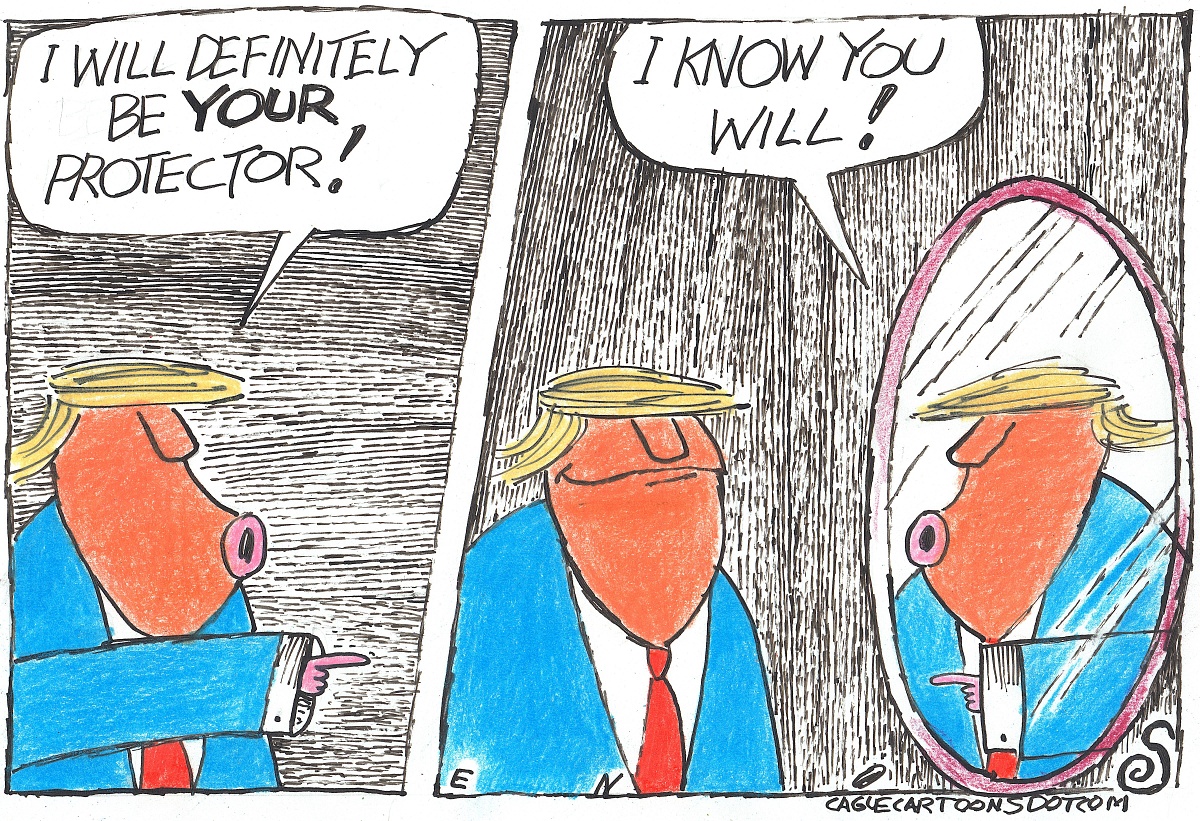
Cagle Cartoons: Randall Enos


Stealth Fascism
Dec 6, 2024 5:52 PM
Domestically, the legacy of anti-socialist paranoia has created fertile ground for the rise of far-right populism, where the rhetoric of "freedom" often masks illiberal, exclusionary agendas.
The United States has long treated fascism as a lesser evil compared to socialism, a strategic calculus that has defined much of its foreign policy since the end of World War II. This uneasy truth is etched into the history of Cold War interventions, where the specter of socialism inspired Washington to forge alliances with right-wing regimes, even those with authoritarian or outright fascist tendencies. The coups and covert operations that punctuated the second half of the 20th century serve as a grim testament to this priority.
In Chile, the 1973 U.S.-backed overthrow of Salvador Allende—a democratically elected socialist—ushered in the brutal dictatorship of Augusto Pinochet. Under Pinochet’s regime, political opponents were tortured and disappeared, while neoliberal economic policies were implemented with ruthless efficiency. This intervention, championed by figures like Henry Kissinger, reflected the prevailing belief that socialism, even in its democratic forms, posed a greater existential threat to American interests than the authoritarianism of an anti-communist strongman.
Chile was no anomaly. Across Latin America, Southeast Asia, and the Middle East, the U.S. repeatedly backed coups and propped up dictatorships in the name of combating socialism. From Suharto’s bloody purge of communists in Indonesia to the support of right-wing paramilitaries in El Salvador and Guatemala, the U.S. showed a willingness to look past human rights abuses so long as the regimes in question were aligned against socialism.
Even in Europe, America turned a blind eye to fascist remnants in countries like Francoist Spain and Greece as part of its broader strategy to contain the Soviet Union.
Related stories
This logic was not confined to foreign policy. Domestically, the Red Scare of the McCarthy era conflated socialism with communism and communism with treason, while far-right actors often escaped similar scrutiny. The rise of corporate-friendly neoliberal policies in the late 20th century, paired with the decimation of union power, further entrenched the idea that market capitalism, no matter how inequitable, was preferable to any alternative that hinted at redistribution or collective governance.
The enduring consequences of this prioritization are deeply felt today. The willingness to tolerate authoritarian tendencies abroad has eroded America's credibility as a global champion of democracy. Domestically, the legacy of anti-socialist paranoia has created fertile ground for the rise of far-right populism, where the rhetoric of "freedom" often masks illiberal, exclusionary agendas.
By treating socialism as an existential threat and fascism as a regrettable but manageable ally, the U.S. helped shape a global order in which the defense of capital took precedence over the defense of democracy. In doing so, it has left behind a trail of shattered democracies, disillusioned movements, and authoritarian regimes that haunt the world to this day.
William E. Connolly reminds us that neoliberalism is not fascism. But the unsettling history of neoliberal figures supporting fascism to shield regimes from social democracy or socialism casts a long and troubling shadow. Friedrich Hayek, Milton Friedman, and Ludwig von Mises—luminaries of the neoliberal tradition—found themselves, under pressure, aligning with authoritarian regimes. Their threshold for what they considered a “socialist” threat was strikingly broad, a reflex that raises disquieting questions about the ideological elasticity of neoliberalism under duress.
At its core, neoliberalism operates as a suite of practices designed to privilege entrepreneurs and corporations. It thrives on a paradox: publicly decrying the state while quietly demanding its largesse in the form of subsidies, legal shields, and deregulation. Labor, in this worldview, is not a community or a voice but an abstract commodity—a mere factor in the calculus of production. Neoliberalism marginalizes collective social movements, erodes the institutions of democracy, undermines unions, and, when the chance arises, dismantles social protections such as public education, social security, and universal voting rights. Its jurisprudence ensures courts lean toward corporate interests, its imperialist instincts sustain global inequalities, and its vision of democracy is stripped bare—minimal, managerial, and antiseptic.
Fascism, as Connolly points out, is a capitalism of cruelty. It dismantles democracy with overt aggression, stokes nationalism, inflames racism, and systematically peddles big lies. It energizes its base through attacks on vulnerable minorities, corrupts courts, captures media, militarizes police, and cultivates shadow armies of vigilantes. Under fascism, the cultural ruthlessness that neoliberalism tempers with technocratic rationality is unleashed in full force, its veneer of reason giving way to raw emotional fervor.
Yet Connolly maintains that the distinction between the two is not always as clear as theory might suggest. The affinities between neoliberalism and fascism—particularly in moments of social or economic stress—are striking. Neoliberalism's relentless market practices, its hollowing out of democratic institutions, and its atomizing individualism create fertile ground for authoritarian backlash. When social unrest brews, when inequalities reach intolerable extremes, or when the neoliberal project teeters under the weight of its contradictions, it often sows the seeds of its own extremity. In these moments, the drift from neoliberal technocracy to fascist fervor can be alarmingly swift.
Recent American history bears this out. Connolly points out that as Trumpism emerged, a cohort of noble neoliberals—on prominent display during Nicole Wallace's MSNBC segments—stood firm against the tide of authoritarian populism. But for every principled dissenter, many others slid easily into complicity. Neoliberal Republicans in Congress who once espoused free-market orthodoxy and minimalist governance now tolerate—or outright support—the belligerence, mendacity, and anti-democratic ethos of Trumpism.
In Connolly’s words: “A whole bunch of neoliberal Republicans in the American Congress, after all, now support or tolerate policies and belligerent practices they did not before the era of Trump. Many do not merely do so because they are cowed by the danger of threats to them in Republican primaries--they could, for instance, quit politics, or join the Democratic Party to stop aspirational fascism, or staunchly support the principles they embrace in those very Republican primaries and elections.”
The lesson is as sobering as it is urgent: neoliberalism’s veneer of civility is no safeguard against authoritarianism. When its logic of privatization, deregulation, and market discipline falters, the door it opens is not toward democracy's renewal but toward its undoing. And in that undoing, the shift from invisible hand to iron fist becomes all too easy to miss until it is too late.
“It is a paradox of democracy,” writes historian Jill Lepore “that the best way to defend democracy is to attack it, to ask more of it, by way of criticism, protest, and dissent.”
In the aftermath of the Cold War, liberal democracy stood as a victorious model, its advocates convinced of its universal applicability. But this narrative of inevitability, this post-Cold War ‘end of history’ moment, dismissed the complexities and particularities of other cultures. Instead of inspiring a global embrace of democratic values, it often bred resentment, alienation, and defiance, particularly in regions where the promises of democracy were accompanied by the upheaval of globalization and the scars of Western intervention.
In their provocative New York Times essay, “Of Course They Gave Up On Democracy,” Ivan Krastev and Stephen Holmes invoke Bernard Shaw’s Pygmalion to illuminate the hubris that has plagued the global project of liberal democracy.
The analogy to Pygmalion is both apt and haunting. Like Eliza Doolittle, who grows to resent her transformation under Higgins’ guidance, nations and peoples molded by the liberal project have rebelled against the perceived condescension and control of their supposed benefactors. The result is not merely a rejection of liberal ideals but a reshaping of the global political
landscape, where democracy itself stands on trial—not for its principles, but for the hubris of those who claimed to wield it as a universal cure.
This disillusionment with liberal democracy and the so-called “administrative state” has given rise to a new wave of populist authoritarians—figures like Donald Trump, whose ascent Krastev and Holmes see as part of a larger revolt against a liberal order perceived as arrogant and detached. These leaders, exploiting the failures and hypocrisies of liberal democracies, have positioned themselves as champions of sovereignty and tradition against a global elite they portray as out of touch and dismissive of local identities.
It is worth remembering that Donald Trump’s battle with the administrative state is less a policy dispute and more a siege—an ongoing war against the unseen machinery of governance that underpins the American republic. To him, the so-called "deep state" is a hydra, a multi-headed beast of career officials, civil servants, and legal guardrails, all conspiring (in his telling) to thwart his will. His crusade isn’t just about dismantling bureaucratic systems; it’s about reimagining power itself, shifting it away from institutional norms toward a singular authority: his own. In this war, every indictment becomes a badge of martyrdom, every loyalist appointed a soldier, and every democratic safeguard a wall to be breached.
An aversion to American ‘wokeism’ has birthed figures like Tulsi Gabbard—political chameleons whose rhetoric often seems plucked straight from the hymnbook of RT. It’s a phenomenon that also explains the curious magnetism pulling some Americans toward the incense-laden aisles of the Russian Orthodox Church, not necessarily out of faith, but as a symbolic embrace of Putin’s crusade against Western liberal democracies and LGBTQ rights. Like moths to a flame, they are drawn to Putin’s authoritarian certainties, mistaking them for moral clarity in a world they fear has become too fluid, too unmoored.
Orthodoxy has become a new weapon in the war for America’s youth who are seeking solace amidst a politically fractious world and who are able to find communities of like-minded racists in the Orthodox world of Putin-loving militant nationalism and medieval traditionalism. Bring on the Paraclete as long as it’s adorned in Confederate grey and has a beard as white as Robert E. Lee! Katherine Kelaidis writes that
[w]hile the Neo-Nazis and Neo-Confederates may be relatively few in number, there is increasing evidence that Orthodoxy has become an integral part of the ideological and recruitment apparatus within some segments of the white supremacist movement. Importantly, these ideas and the converts to them are being tolerated, and frequently exploited, by much more powerful voices. This growing attachment to Eastern Orthodox Christianity among a segment of white nationalists has serious implications for more mainstream currents in contemporary Orthodox life.
When describing how Orthodox Christianity has become the spiritual home of white nationalism here in the United States, critics usually begin with the story of a vile, not-too-bright Neo-Nazi organizer and creepy hate monger, Matthew Heimbach, who, in 2016, was formally received into the Antiochian Orthodox Christian Archdiocese of North America on Lazarus Saturday. A few days later, on Bright Monday, Heimbach and his goosestepping cohorts from the Traditionalist Youth Network (a white supremacist group affiliating itself with Orthodoxy) beat up a University of Indiana at Bloomington SlutWalk participant with an Orthodox wooden cross (a weapon of choice, I assume, because of its high symbolic resonance). Only after immense pressure following the online circulation of photographs in which Heimbach is shown beating the student was Heimbach excommunicated by the Antiochian bishop. Heimbach’s actions led to an outcry with people asking if racism and white supremacy were integral to Orthodoxy. Comments by Heimbach didn’t help:
As an Orthodox Christian, I believe in the separation of races into ethnically based churches. That is why, even in Orthodoxy, there is, for instance, a Greek, Russian, Romanian, Serbian, etc. Orthodox Church. Regional and racial identity is a fundamental principle of Christianity, much to the dismay of Leftists. I believe black Christians should be in their black churches, with black priests, having black kids, going to black Christian schools, etc.
To understand why so many right-wing fascists and neo-Nazis in America are ideologically and emotionally drawn to the Eastern Orthodox Church, which includes the Russian Orthodox Church Outside of Russia (ROCOR), we need only examine the shocking behavior of Patriarch Kirill, leader of Russia’s dominant religious group. According to Peter Smith, Kirill has had no compunctions justifying his country’s invasion of Ukraine, ‘describing the conflict as part of a struggle against sin and pressure from liberal foreigners to hold “gay parades” as the price of admission to their ranks.’ As missiles reign down on Ukrainian hospitals and schools, it doesn’t help matters that Patriarch Kirill has called Putin’s rule a ‘miracle of God,’ and ‘holds the hope that future generations will pick up the spiritual baton from past generations and save the Fatherland from internal and external enemies’. ‘You, Vladimir Vladimirovich, personally played a massive role in correcting this crooked twist of our history,’ Kirill said, using the President’s patronymic. Can’t you see Tulsi Gabbard nodding her head and smiling?
The great deception of fascism is its ability to drape itself in the garments of democracy even as it guts its core. The façade remains—the flags, the oaths, the ceremonies—but peel away that thin veneer, and you’ll find a single man standing at the center of it all, every branch of government bent to his will, every decision serving his power. A nation once built on the ideal of We the People reduced to the singular, suffocating shadow of Him.
Thom Hartmann illustrates how the architecture of fascism rests upon a singular, immovable pillar: the strongman leader, a figure whose shadow looms over every institution, every decision, every aspiration. Surrounding him is a carefully curated chorus of sycophants—handpicked for their unwavering loyalty rather than their competence—who serve as the scaffolding for his unyielding grip on power. This dynamic is not just a feature of fascism; it is its beating heart, pumping fear and servitude through the veins of a society in retreat from democracy.
When a nation staggers from democracy to oligarchy and finally collapses into fascism, this Leader becomes the sun around which all life orbits. For the average citizen, survival and success depend not on talent, innovation, or integrity but on a willingness to bask in that sun’s light—or, more aptly, to grovel in its glow. The formula is as simple as it is corrosive: align yourself with the Leader, or find yourself exiled into the cold, perilous wilderness of irrelevance.
Advancement—whether economic, personal, or political—becomes a test of allegiance. You prove your loyalty not just to the Leader himself but to the layers of enablers, the faceless functionaries and obsequious operatives who execute his will. Through these intermediaries, power flows downward, like poisoned water trickling through a system designed to drown dissent. To rise in such a system is to master the dark art of sycophancy, pledging fealty to a pyramid of oppression whose apex is one man’s unassailable throne.
In such a world, notes Hartmann, merit is a liability, and moral courage an act of self-destruction. Those unwilling to swear their allegiance—to toe the line, parrot the propaganda, and carry out the directives, no matter how cruel or absurd—are cast aside. The penalties for independence are stark: careers ruined, reputations obliterated, families imperiled. Fascism brooks no dissent, and its enforcers, however banal, will ensure that resistance is not only futile but fatal to one's future.
Thus, notes Hartmann, the citizen becomes not a participant in governance but a supplicant to power. The dream of democracy—the promise that each voice matters, that the system serves the many—dissolves into a nightmare where the only voice that counts belongs to the man at the top. It is not just a betrayal of ideals but a reprogramming of the soul, where ambition is reduced to servitude and survival becomes synonymous with submission.
This is how fascism thrives according to Hartmann: by stripping society of its moral anchors, by replacing principles with the promise of protection, and by making the Leader not just a figure of authority but a god to be worshiped—or feared. In the end, every act of loyalty, no matter how small, feeds the machine, and every act of resistance, no matter how brave, is crushed beneath its gears.
In the suffocating embrace of a fascist state, loyalty to the Dear Leader becomes more than just a political currency—it is the key to survival itself. The boundary between the political and the personal dissolves, leaving a society where economic advancement hinges not on skill or merit but on unwavering fealty to the man who commands it all.
In such a system, employers, too, become extensions of the Leader’s will, bending their policies and practices to align with his whims. Corporations seeking favor—state contracts, tax breaks, or the coveted nod of an endorsement—eagerly purge those deemed insufficiently loyal. A whispered criticism of the Leader or a failure to display the requisite fervor at the latest rally can mark an employee for demotion, dismissal, or even blacklisting.
Careers are no longer built on expertise but on proximity to power, transforming workplaces into arenas of ideological conformity.
Economic security becomes a fragile illusion. Workers find themselves treading on eggshells, careful to signal their devotion in word, action, and even silence. A wrong word, a perceived disloyalty, and the consequences can be swift and brutal: a lost job, an ended career, a taint that follows them wherever they go. Employers, vying for the Leader’s approval, enforce this loyalty with the precision of a well-oiled machine, their own ambitions tied to the ever-present need to remain in his good graces.
The marketplace, once a space of competition and innovation, becomes another domain of control, notes Hartmann. Products succeed or fail not on their quality or utility but on their alignment with the Leader’s vision. A company that secures his endorsement flourishes, while its rivals wither in the shadow of disfavor. The Leader’s power becomes omnipresent, reshaping not just the political landscape but the economic one, transforming the pursuit of prosperity into a dangerous game of loyalty.
This is the Faustian bargain of fascism: a society that trades its freedoms for the fleeting comfort of conformity, where economic stability is purchased at the price of individuality. And all the while, the Leader’s shadow stretches further, blotting out the possibilities of dissent, innovation, and independence. For in his realm, success is not earned—it is bestowed, conditional on the unrelenting worship of the one man who holds the keys to everything.
The specter of Donald Trump’s potential second term looms over the United States like the shadow of Bentham’s panopticon—a nation watched, monitored, and disciplined by unseen but omnipresent eyes. As Trump retakes the White House, critics fear the pillars of democracy could erode beneath the weight of an authoritarian state, with security agencies weaponized against dissent and the mechanisms of power turned into tools of retribution. The political situation could become so perilous, Trump will feel at home ruling by decree. Hartmann writes:
Whatever Dear Leader says becomes the law. This is called “rule by decree” and it’s where every fascist in history has ended up. The power to rule by decree goes back to the days of kings and is also embedded in our laws about the president’s emergency powers. Trump came close to invoking it with an “emergency declaration” when he lost the election. General Flynn begged him to do it and “temporarily suspend the Constitution.”
Next year he won’t be so restrained and he will have surrounded himself in advance with people like Flynn who will make it happen.
Reports swirl that Trump’s preferred pick for the FBI, Kash Patel, carries with him not just ambition but an alleged “enemies list”—a chilling relic of the McCarthy era reborn in a new guise. The Federal Bureau of Investigation, under such leadership, could become less an institution of justice and more a sword wielded against critics. The specter of politicized law enforcement recalls not the atrocities of a Josef Mengele or Josef Blösche, but the insidious rise of extremism that seeds authoritarian consolidation.
As David Frum ominously noted, Trump’s envisioned Federal Communications Commission could strip licenses from media platforms deemed unfavorable, muting criticism and amplifying loyalist voices. The Trump administration’s past interference in mergers and acquisitions to punish critics was but a prelude to what some warn could be a full-scale assault on corporate and media independence—a throttling of voices that refuse to echo MAGA orthodoxy.
We only need to hear from one Russian media host — Vladimir Solovyov — to know what Trump’s cabinet picks portend for America:
“What an excellent team is coming along with Trump!"…. "Not with respect to Ukraine, but as far as everything else goes. If they are allowed to get in, they will quickly dismantle America, brick by brick. They are so great!” Ja’han Jones reports that Trump “appears to be constructing a kakistocracy — a government filled with incompetent or otherwise unsuitable characters”—and I couldn’t agree more.
The warning signs are impossible to ignore. Trumpism, metastasized and emboldened, threatens to entwine itself with the apparatus of national security, suffocating opposition under the guise of “protection.” While America may not find itself producing the next infamous war criminal, the creeping extremism of a second Trump term risks reshaping the nation’s identity. The land of the free edges closer to a society where fear, control, and power converge—a state surveilling its people not for safety, but for submission. Brad Reed quotes David Frum:
So when I say it's bigger than Watergate, what Trump wants to do is to take control of, especially the FBI, but also other security agencies and use them as arms of his personal power," he said. "Nixon failed. Trump is on the way to succeeding. Nixon did it secretly, Trump is doing it publicly. Nixon was opposed by his own party, Trump is supported by his own party."
Frum then said that America is in "the same predicament" that it was in with Nixon back in the early 1970s, but is "bigger and more dangerous and more likely to succeed.
One hallmark of fascism is its uncanny ability to cultivate what Timothy Snyder calls ‘anticipatory obedience’—a form of submission that blooms not under duress but in the shadow of what might come. People internalize the leader’s desires, bending their actions to align with unspoken commands, often before those commands are even issued. It’s a preemptive surrender of autonomy, born from fear, opportunism, or the belief that conformity offers safety.
In this climate, bureaucracy becomes complicit, institutions hollow out, and individuals transform into cogs in a machine that requires no explicit orders to crush dissent. It is a chilling efficiency, where the leader’s power is magnified by the silent choreography of those who choose to collapse on their knees in a twisted obeisance. Anticipatory obedience acts as both a lubricant and a mask for tyranny, smoothing the path for a leader’s unchecked ambitions while cloaking their extremism in a veneer of normalcy. By aligning with the leader’s perceived desires, people not only legitimize the tyrant’s actions but also sane-wash them—transforming the outrageous into the acceptable, the unthinkable into the inevitable. Each small act of preemptive compliance chips away at collective resistance, creating a society where the tyrant's will feels less like an imposition and more like the natural order of things. In this way, anticipatory obedience doesn’t just follow authoritarianism; it builds the scaffolding for its ascent. For those individuals prone to kissing the whip after a vicious beating, Timothy Snyder has some terse advice: Do not obey in advance! He writes:
Most of the power of authoritarianism is freely given. In times like these, individuals think ahead about what a more repressive government will want, and then offer themselves without being asked. A citizen who adapts in this way is teaching power what it can do.
Anticipatory obedience is a political tragedy. Perhaps rulers did not initially know that citizens were willing to compromise this value or that principle. Perhaps a new regime did not at first have the direct means of influencing citizens one way or another. After the German elections of 1932, which brought Nazis into government, or the Czechoslovak elections of 1946, where communists were victorious, the next crucial step was anticipatory obedience. Because enough people in both cases voluntarily extended their services to the new leaders, Nazis and communists alike realized that they could move quickly toward a full regime change. The first heedless acts of conformity could not then be reversed.
In early 1938, Adolf Hitler, by then securely in power in Germany, was threatening to annex neighboring Austria. After the Austrian chancellor conceded, it was the Austrians’ anticipatory obedience that decided the fate of Austrian Jews. Local Austrian Nazis captured Jews and forced them to scrub the streets to remove symbols of independent Austria. Crucially, people who were not Nazis looked on with interest and amusement. Nazis who had kept lists of Jewish property stole what they could. Crucially, others who were not Nazis joined in the theft. As the political theorist Hannah Arendt remembered, “when German troops invaded the country and Gentile neighbors started riots at Jewish homes, Austrian Jews began to commit suicide.”
The best way of systematically resisting fascism is through education—to adopt critical pedagogy in our educational institutions, a problem-posing approach that operates at the intersection of the pedagogical and the political. It defies the grain of conventional teaching, empowering students to think critically and draw from their lived experiences. The goal, as Henry Giroux might frame it, is to help learners embark on lifelong projects of service to others while fostering accountability within entrenched systems of power. It’s education as transformation—of the student, the community, and the broader world.
Critical pedagogy offers a powerful framework for resisting fascism by nurturing critical consciousness, empowering individuals to question systems of power, fighting historical amnesia, confronting uncomfortable truths such as colonialism, systemic racism, and imperialism, and inoculating learners against fascist appeals to nostalgia. At its core, it seeks to transform education from a tool of domination into a practice of liberation—a way to unlearn the passive obedience and ideological distortions that allow fascism to thrive. Fascism silences dissent and erases the marginalized. Critical pedagogy reverses this by amplifying voices from the margins, whether through literature, oral histories, or direct engagement with activist communities. These perspectives disrupt fascist narratives and humanize those targeted by its rhetoric.
Through critical pedagogy, education becomes a site of resistance—a way to unmask fascism’s seductions, empower individuals to challenge oppression, and collectively build a society rooted in justice, equity, and freedom.
For Freire, critical pedagogy was not merely a theoretical framework but a practice of hope—a belief in the capacity of humanity to collectively confront injustice and forge a more equitable world. It is this enduring faith in human potential that keeps the dust from ever settling on critical pedagogy, ensuring its relevance as a force for liberation in an ever-changing world.
We need to remember that MAGA is not merely a political slogan; it is a movement with the ambition to rewrite America’s democratic architecture. Through voter suppression laws, gerrymandering, judicial appointments, and attacks on the legitimacy of elections, Trumpism has already begun laying the groundwork for a lasting rule. The GOP under MAGA has shown its willingness to bend democratic norms to breaking points, turning courts, intelligence agencies, and even the military into instruments of partisan power.
This is why relegating MAGA to the dustbin of history is not simply a matter of winning elections. It requires an unwavering commitment to defending and renewing the institutions and ideals that MAGA seeks to corrupt. It means safeguarding the right to vote, ensuring the independence of the judiciary, and holding those who subvert democracy accountable. It means countering the politics of fear with the politics of hope, standing against the scapegoating of minorities, and rejecting the allure of authoritarian simplicity.
In this regard, Thom Hartmann offers an ominous warning:
Next year and in 2026 many of us will no longer be able to know if our voices, our attempts to vote, will actually decide who leads our nation.
Many of us will show up at the polls in two years to discover we are no longer registered to vote. Many of our mail-in ballots will be “challenged” by Republican vote observers and we won’t learn about it until after the election is long over. Five Republicans on the Supreme Court ruled in 2018 that you can be purged from the voting rolls on a whim. In the majority of US states Republicans can take over electoral precincts, install their people (as we just learned they are doing right now) and run them under whatever rules they want. Already in some states when the GOP inflicts 10-hour lines to vote on their people, for example, you go to jail if you bring them water. If you make a mistake on your voting registration or ballot, or help another person register to vote, they can send you to prison for five years or more.
Somehow, of the many people from both parties who are busted for this, it seems only the Democrats end up going to jail. Particularly Black Democrats.
Francisco Franco's iron grip on Spain lasted 36 years, a reign defined by authoritarianism, repression, and the systematic dismantling of democratic institutions. Francoist Spain left a dark legacy, silencing dissent, rewriting history, and embedding a nationalist ideology that lingered long after his death in 1975. While Donald Trump may not have the years left to reign over the United States in a similar manner, his potential return to power could serve as a springboard for something equally enduring and dangerous: the entrenchment of MAGA as a generational political force.
Let the history of Franco’s Spain serve as a cautionary tale. Authoritarian movements often outlive their architects, embedding themselves into the fabric of society through fear, propaganda, and structural manipulation. Trump may not reign for decades, but the infrastructure of MAGA—its ethos of grievance, its disdain for pluralism, and its contempt for democratic norms—could endure, shaping the American landscape for generations to come.
To prevent this, we must not only resist MAGA but also offer a compelling alternative vision—one rooted in justice, equity, and an unwavering commitment to democracy. This time around we need to take Bernie Sanders ideas about socialism more seriously. The stakes are generational, and the lesson is clear: democracy is never a finished project; it must be continuously defended, nurtured, and renewed. The battle against MAGA is not just about today’s America but about the future we leave for those who come after us.
Comments

Powered by RoundtableAn AI/DeFi-powered Enterprise Media Operating System. Learn more at Roundtable.io.© Roundtable 2026. By using this site you agree to the Terms of Use and Privacy Policy