
Lander.pauwels2006 • Creative Commons Attribution-Share Alike 4.0 • Wikimedia Commons


star spangled banner
Jan 19, 2025 6:18 PM
How should Black musicians reinterpret the “Star Spangled Banner” after the Trump inauguration?
To Black Americans, the inauguration of Donald Trump—and with it an extremist agenda—will raise concerns over what it means to be a citizen of color. To many in LA, grappling with the wildfire catastrophe, the inauguration may create special anxiety over his potential to withhold emergency aid to spite Mayor Bass and Gov. Newsom? To immigrants of color, the reality of a convicted felon commanding the roundup of undocumented residents must be galling.
Surely, January is a month of contradictory transition in our national politics, symbolized by the funeral of Jimmy Carter, the departure of Joe Biden, and the inauguration of Trump, which occurs on the same day as the federal holiday honoring Dr. Martin Luther King Jr. Moreover, the overlapping events take place in the context of the upcoming 250th anniversary of the American Revolution.
So, it is appropriate to consider what the transition means for Black America—the most historically abused of the citizens of color—and how its musicians have reinterpreted the “Star Spangled Banner” during times of uncertainty. No doubt, within the cluster of LA cultural creators, some will be summoned to perform the anthem at public events.
As such, it may be appropriate to review the history of how Black musicians have performed the anthem to remind the nation of its democratic and egalitarian commitments. Over the generations, Black musicians have performed “The Star Spangled Banner” to express discontent with conditions of racial injustice. They have done so by rearranging elements such as phrasing, dynamics, tempo, and instrumentation.
Related stories
Through the incorporation of their own distinct musical traditions, the performers have highlighted America's hypocrisy in fulfilling the promise of democracy and equality.
The national anthem is connected to the history of Maryland and its ambiguous status as a former slave state on the border of the North and the South. “The Star-Spangled Banner” was composed by Francis Scott Key, a Maryland attorney, wealthy slaveholder and poet. He was inspired by watching soldiers raise the flag over Baltimore’s Fort McHenry after a bombardment by British naval forces during the War of 1812. The song was composed in 1814 and enacted as the national anthem in 1931 during the depths of tensions over race and class in the Great Depression.
These days, Maryland is arguably the new political capital of Black America. Since 2022, the state’s 30 percent Black population has propelled the historic elections of Gov. Wes Moore, Attorney General Anthony Brown and, last November, Angela Alsobrooks to the Senate. It is the only state where three of the major executive and legislative offices are held by politicians loyal to the Black community.
As well, there is fair representation in the state legislature and the city and county governments. The Maryland political class will oversee the rebuilding of the Francis Scott Key Bridge, demolished in a cargo ship collision last year. It symbolizes the progress in our racial politics since the formation of the song.
One of the first musicians to interpret the “Star Spangled Banner” in a way that displayed a Black consciousness was the piano prodigy known as “Blind Tom.” Born into slavery in Georgia in 1849, Tom was the property of Col. James Bethune, who rented the youth to perform at Confederate social events. He is believed to be the first Black musician to perform at the White House, for President James Buchanan in 1860.
After the Civil War, Blind Tom toured the country as a concert performer until his death in 1904. He used dissonance to subtly highlight the hypocrisy of freedom under Jim Crow, most notably in the composition “Battle of Manassas,” a musical reflection on the Confederate victory in Virginia. It is an aural telling of the 1861 battle through a medley of slave state favorites like “Dixie” and the sound of bugles and cannon fire on piano. Towards the end of the song, rather than glorify the Old South, Tom quoted the “Star Spangled Banner” in an ambiguous manner and ended by shouting as loud as possible, “Retreat! Retreat! Retreat!”
Concert singer Marian Anderson used the anthem to evoke a political conscience in the midst of World War II.
Concert singer Marian Anderson used the anthem to evoke a political conscience in the midst of World War II. Five years earlier, in 1939, the Daughters of the American Revolution, an all-white organization of descendants of Revolutionary War soldiers, prevented Anderson from performing at the segregated and opulent Constitution Hall in Washington, D.C., sparking a national controversy. In response, the NAACP arranged for Anderson to perform on the steps of the Lincoln Memorial on Easter Sunday. An integrated crowd of 75,000 people attended to hear the contralto sing the patriotic ballad, “My Country, ‘Tis of Thee.”
In 1943, the DAR was presented with yet another request to allow Anderson to perform at Constitution Hall for a war benefit concert. Anderson demanded that the DAR permit Blacks to attend the show and the organization relented. Blacks comprised half of the sold-out audience, and Anderson closed the historic event by singing the “Star Spangled Banner” in a manner that evoked a statement of Black resilience.
In 1969, in the midst of the Vietnam War and urban rebellions, Jimi Hendrix composed a dissonant version of the “Star Spangled Banner.” The rendition is considered a powerful example of using the anthem as a platform for protest. He explored the piercing dynamics of the electric guitar to implant a radical interpretation of the song at the close of the Woodstock festival, incorporating complex messages about the Vietnam War and racial tension. It defined the spirit of the Black Power and counterculture movements.
In 1983, when Congress passed the federal holiday honoring Martin Luther King Jr., soul singer Marvin Gaye performed a rendition that stands out in my memory. The occasion was the NBA All-Star Game at the Forum in California, and was viewed by millions. Gaye rearranged the song into a multi-syllabic slow jam that expressed Black urban sensuality and captured the imagination of the audience. It was seen as a way to express a more nuanced understanding of American patriotism. By the end, the crowd shouted affirmations and clapped in time like a revival meeting—but, of course, the unique interpretation was criticized as unpatriotic by some conservatives.
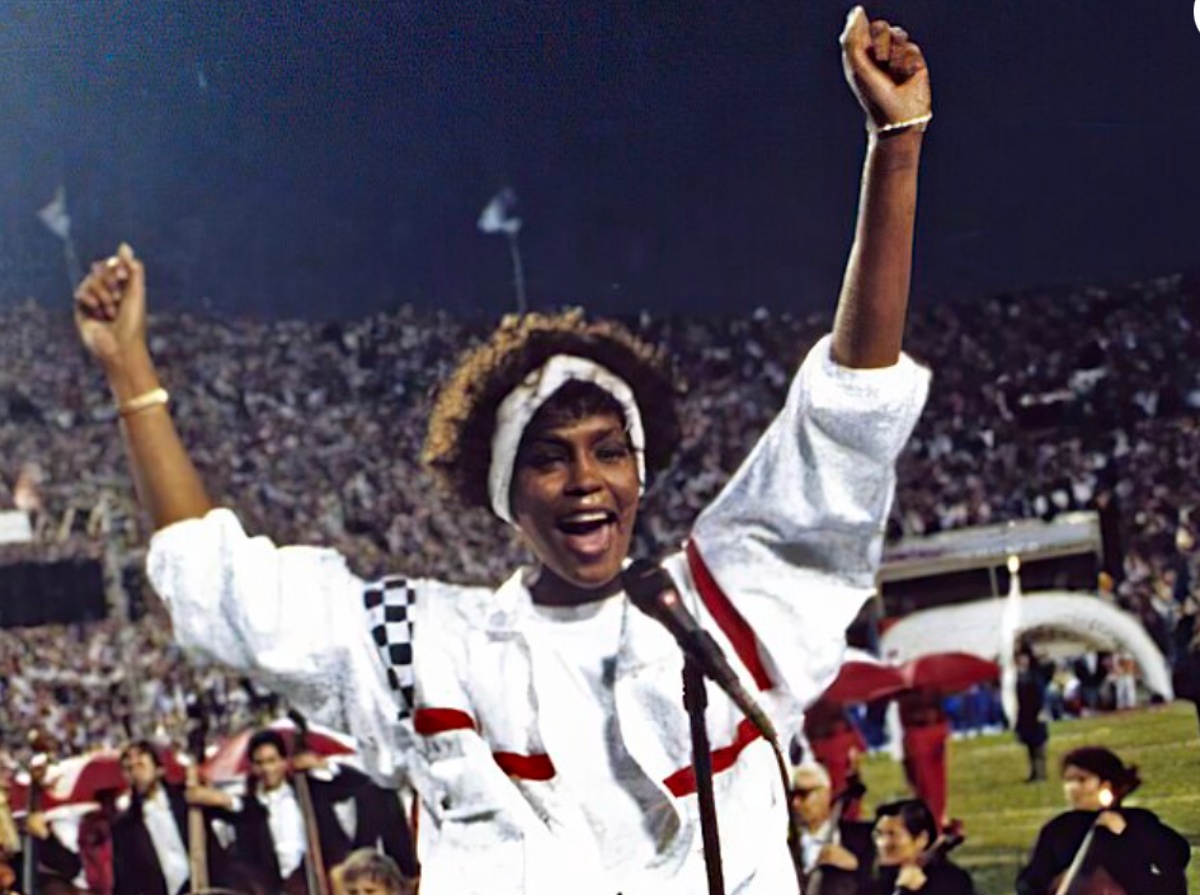
In 1991, as the country went to war against Iraq, Whitney Houston gave one of the more memorable anthem performances at Super Bowl XXV in Florida. Because of the war, Houston needed to be cautious to avoid offending an audience with a heightened sense of patriotism—and she was backed by a military band that controlled the music. While not overtly political, Houston's rendition is often cited as a moving performance that resonated with a racially and politically integrated audience. She managed to evoke a distinct Black style through a virtuoso delivery as dramatic as the jets that soared overhead in a visual coda.
In the years since, Black musicians have built on the creative political interpretations of the early pioneers. Jazz musicians like Louis Armstrong, for example, have used improvisational elements to add personal expression to the traditional rendition. After the tragedy of 9/11, Mariah Carey performed a majestic rendition backed by the Boston Pops Orchestra at Super Bowl XXXVI in New Orleans in 2002.
Stevie Wonder performed the anthem at the Palace of Auburn Hills in Michigan before game three of the 2005 NBA finals. He decided to eschew the lyrics in favor of playing his signature harmonica to inject a Black sensibility into the anthem. At the end, he quoted a line from James Weldon Johnson’s song "Lift Every Voice and"Sing"—often considered the Black national anthem—to express a unique perspective on American patriotism. And, after Barack Obama took office in 2009, Jennifer Hudson gave a crescendo performance at Super Bowl XLIII in Florida.
No doubt people can think of other outstanding renditions beyond this cursory survey, and some MAGA critics may argue for only one way to interpret the national song...their way? All of which is to say that as the country embarks on the Trump era of political transition, Black cultural creators may once again be called upon to infuse a racial consciousness in the symbols of America.
Comments

Powered by RoundtableAn AI/DeFi-powered Enterprise Media Operating System. Learn more at Roundtable.io.© Roundtable 2026. By using this site you agree to the Terms of Use and Privacy Policy