
Attribution-NonCommercial-NoDerivs (CC BY-NC-ND 2.0)


May 21, 2023 5:56 PM
Among my professors at Georgetown I had only one role model, and that was Hisham Sharabi (1927-2005).
We need role models for both intellectual and emotional reasons. To do what the “better angels of our nature” (to use Lincoln’s phrase) tell us we should. To avoid the human failing that St, Paul wrote about in Romans 7:19): “For the good which I have a mind to do, I do not: but the evil which I have no mind to do, that I do.”
How often do our egos or our emotions, as Paul suggests, lead us to do things we really shouldn’t? “Too often”—at least, that’s my guess. Our decision making is often a complex process. To make the best decision usually requires good values and wise prioritizing of them. But strong self-control also helps.
The great Russian writer Leo Tolstoy thought a lot about morality and when older often wrote about it, but he was also someone with a strong sexual drive that continued into old age. One of his short stories, “Father Sergius,” written when the author was about 70, illustrates well the importance of self-control.
Sergius had once been a brilliant young officer and had planned to marry, but then discovered that his fiancé had earlier been a mistress to Tsar Nicholas I. After his discovery he resigned his commission and entered a monastery, eventually becoming a hermit.
Related stories
He was experiencing his sixth year as a recluse when a “divorcée, beautiful, rich, and eccentric” came to his cell and tried to seduce him. Tolstoy tells us that even earlier the hermit had been troubled by sexual thoughts, but they were minor compared to the temptation offered to him by this divorcée who begged entrance to his isolated shelter because she said she had lost her way and was frozen.
After reluctantly allowing her in, he retreated to a partioned-off part of his single-room. From the main part of it, she told him she had gotten all wet and had to undress herself. She added that she was sick, groaned, “unfastened her dress, exposing her breast,” and asked for his help. On the other side of the partition, he “heard everything,” including “how the silk rustled when she took off her dress.” He “felt his own weakness, and that he might be lost at any moment.” Rather than go to her and succumb to sexual temptation, he seized an axe and chopped off part of his finger.
After he then went to her and she saw what he had done, she was so shocked, horrified, and guilt-stricken that not much later she entered a convent as a novice.
Almost all young Catholic men of my generation, when we were taught that premarital sex was a mortal sin that it could send us to Hell, could empathize with the great sexual temptation experienced by Father Sergius—very few of us (maybe none), however, in trying to overcome it would have resorted to chopping off any body part.
Yet, the story illustrates well, how overcoming temptations, exercising self-control, is so important if one wishes to remain true to one’s core values.
Although the fictional Father Sergius never became a role model for me. In the paragraphs that follow, I will indicate how some others have and in what ways. Often by demonstrating not only good values and prioritizing them properly, but also by demonstrating the self-control needed so that those values could become embodied and flourish.
For some boys, their father is one of their role-models. Not so much for me. Dad was a blue-collar worker who wanted me to go to a trade high school, like he had, rather than a regular four-year one that would prepare me for college. When he discovered that I was going to major in English at my hometown Catholic university (Xavier in Cincinnati), he was dumbfounded. “What good is that?” he asked me. Yet dad had his good points, and I’m sure some of them influenced me in a positive way. I always thought, for example, that he was incredibly brave when in the hospital, for example for a broken leg or severed finger (cut up, however, not by self-mutilation like Sergius, but in a printing press).
In my last year of high school I did discover a role model, though I probably didn’t think of him as such back then.
In my last year of high school I did, however, discover a role model, though I probably didn’t think of him as such back then. His name was Elmer (Tony) Strobl, and he was the co-owner of Deno’s Pharmacy in Cincinnati, where I worked part-time for five years. He was a pharmacist, a bachelor, and he had served four years in the Navy during WWII and fought in the battle of Midway. But he didn’t talk much about those years. Instead, besides waiting on customers and occasionally playing chess, we talked a lot about books. He loved to read and enjoyed reading philosophy.
During most of my years working at Deno’s I was a student at Xavier, where almost all students had to take numerous philosophy courses, mainly based on the thinking of St. Thomas Aquinas. Tony liked to read Aquinas, as well as Aristotle, upon whose thinking Aquinas based many of his ideas. He also enjoyed reading good fiction like Dostoevsky’s The Brothers Karamazov. I can remember long discussions with Tony about the novel, as well as about various philosophers like Aristotle. Tony often bought books, and sometimes surprised me with a gift of one, for example a book containing the poetry of Keats and Shelly.
Thus, probably inadvertently, Tony encouraged my love of books and thinkers. But he also reinforced another idea I had then, and have maintained ever since, and that is that it is good to balance that love with being active in sports. In addition to being a weight-lifter (he was once “Mister Cincinnati” because of that), he also enjoyed golf and tennis, and we occasionally played those two sports together.
At Xavier my professors were a mix of Jesuits and laymen—no female profs. back then. None of them influenced me as much as Tony, but I can remember admiring the love of learning of some of them who taught literature, history, or philosophy.
I graduated from Xavier in 1960, the same year that John Kennedy (JFK) was elected president. His being young, apparently idealistic, intelligent, appreciating culture but also playing sports like tag football, and Catholic, of course, he appealed to me. Other sides of his personality—like continually cheating on his wife, Jackie—were generally unknown then. He was not exactly a role model, but I admired him, and after his death, Bobby and Ted.
The military draft still in effect in 1960, I had decided to take two more years of ROTC (the first two years were for most students at Xavier compulsory) so that I could spend two years as an officer rather than an enlisted man. But I never intended to serve more than two years, and no military man was ever a role model.
After my two year stint, I began working for a Ph.D in Russian Area Studies at Georgetown U. Not only did it offer an area of study that appealed to me, but with JFK in the White House it was an exciting place to live.
Among my professors at Georgetown I had only one role model, and that was Hisham Sharabi (1927-2005). He was born in Palestine, was a Middle East expert, but also taught 19th Century European Intellectual History, which I took from him for two semesters. He was young (only about a decade older than I) and most encouraging towards those of us enthusiastic about his course. But what really drew me toward him was his absolute passion for ideas.
We met once a week and were supposed to read a healthy amount before coming to class—one week the assignment was to read Darwin’s Origin of Species. I don’t know if he really thought we would read the whole book in a week, but most of us (I surmise) read as much as we could and came (somewhat) prepared to discuss it.
It was clear that he preferred some thinkers to others, but he tried to be objective toward all whom we read, for example, Hegel, Marx, and Mill, as well as Darwin. His Socratic method of asking us questions, then seriously considering our answers, before continuing on to enlighten us was very effective. We had to write a major paper for each class I took from him, and his critique was both encouraging but instructive.
I later discovered that he had received a B.A. (American University in Beirut) and a M.A. (University of Chicago) in philosophy. His Ph.D. (also from Chicago) was in the history of culture. Largely due to his influence, I decided that within the Russian Area Studies, I was going to concentrate on “Intellectual History”—I had also taken a course on 19th Century Russian Intellectual History. Majoring in English and minoring in history and philosophy as an undergraduate seemed to fit in well with this choice. When it came time to select a dissertation topic I chose to write on “Vladimir Soloviev [Russia’s most famous 19th c. philosopher] and the Russophiles.” (In Soloviev’s criticism of nationalism and racism—in his case, especially Russian antisemitism—I perceived similarities to my own feelings about U. S. nationalism and racism.) Subsequently, in my university-teaching career, it was Sharabi who served as my principle role model.
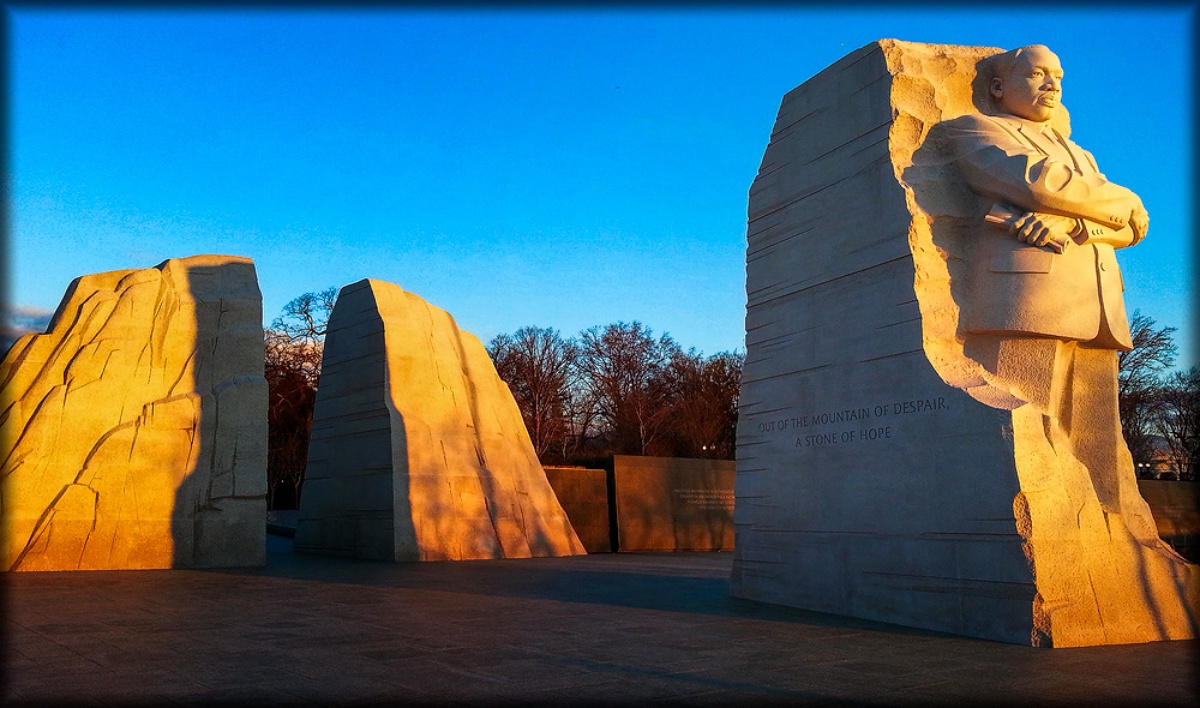
While in graduate school, one other role model was Martin Luther King, Jr. I missed his famous “I Have a Dream Speech” of August 1963 because I was serving a two-week reserve officer assignment in Kentucky and it was less than two weeks before my marriage to Nancy.
As an undergraduate I had not paid much attention to civil rights or racial issues, but while at Georgetown and later at my first teaching job (1967-70) at Wheeling College I became more involved. Upon King’s death in April 1968, some of us in Wheeling, including Nancy and I, formed a human rights council.
Some of the qualities I admired most in King were his quest for racial and social justice and his opposition to the war in Vietnam, but also his insistence that “love is mankind's most potent weapon for personal and social transformation.” His single-minded determination, to create a better America, and thereby a better world was also appealing, as was the consistent courage that he demonstrated. Toward the end of a 2019 MLK-day essay on him, I acknowledged his “flaws and failings,” but then asked, “Who among us humans does not have [such defects], including others that we honor like Washington and Lincoln?”
The loss of MLK and, a few months later, Robert Kennedy, plus our continued expanding of the Vietnam War made 1968 a sad year not only for me, but for our country.
The loss of MLK and, a few months later, Robert Kennedy, plus our continued expanding of the Vietnam War made 1968 a sad year not only for me, but for our country.
In 1970 I moved on to Eastern Michigan U., where I taught history for four decades, Within a few years there I met another role model who, like Tony and Sharabi, I actually knew and admired. He was Howard McClusky (1900-1982), and he became a consultant to a National Endowment for the Humanities project that I directed in the years 1973-1975 on Gerontology and the Humanities.
Biographical information at Syracuse University, where many of his papers are stored, says this about him:
McClusky was generous with his ideas and enthusiasm: in addition to his courses at the University of Michigan he was a visiting professor at ten universities, served on more than a hundred doctoral committees, published in more than fifty different journals and periodicals, served in an advisory capacity to dozens of organizations, and gave more than 430 presentations in 30 states and three countries. He helped found the Adult Education Association (serving as its first president). . . . Over the course of his career he made substantial contributions to many fields including mental health, public health, community education, community development, psychology, youth work, educational psychology, gerontology, and educational gerontology.
McClusky received numerous accolades over his career. . . . In 2002 he was inducted into the International Adult Education Hall of Fame. . . .
As our project’s consultant, Howard was available to me for many talks and chats. What I wrote about him in an essay of about 15 years ago, is still true: “From that time [the mid-1970s] until the present he has remained my chief role model for how to live in old age. I was particularly struck by his humility, generosity, and positive outlook on life, all characteristics associated with wisdom. He was as easy-going and at ease with himself as anyone I ever met. His humility impressed me almost immediately partly because it contrasted so sharply with his many accomplishments.”
Among the considerable pieces of wisdom he conveyed to me was this quote that he was fond of from Robert Peck regarding how one should live in old age: “To live so generously and unselfishly that the prospect of personal death—the night of the ego, it might be called—looks and feels less important than the secure knowledge that one has built for a broader, longer future than any one ego ever could encompass. Through children, through contributions to the culture, through friendships— these are ways in which human beings can achieve enduring significance for their actions which goes beyond the limit of their own skins and their own lives.”
I was still in my thirties then, but I never forgot Howard and his example, and after I retired (in my early 70s), he was my main role model for how to live in retirement. No longer a practicing Catholic, my main goal was to become as wise as I could, and in 2009 I began writing for the website The Wisdom Page.
I began with five long biographical essays about significant world figures—and in the case of poet and Lincoln biographer Carl Sandburg also his wife Paula—all lumped together under the heading “Profiles of Wisdom.” Besides the Sandburgs, the other four were two Russians (Anton Chekhov and Andrei Sakharov), plus the economist/environmentalist E. F. Schumacher and that great helper of the poor, Dorothy Day.
Subsequently, I wrote (on the Wisdom Page and for other sites) about others I considered wise. They included the poet W. H. Auden, the Catholic monk Thomas Merton, Benjamin Franklin, Samuel Johnson, Johann Wolfgang von Goethe, Ralph Waldo Emerson, and Wendell Berry. I also considered the extent to which Barack Obama displayed political wisdom. [2366]
Some of those I considered wise also became role models for me in my old age, especially the Sandburgs (Carl was 89 when he died in 1967), Chekhov, Schumacher, Day, Merton, and Wendell Berry (still living at age 88).
Part of my Wisdom-Page conclusion about the Sandburgs indicates why I liked them so much. “The wisdom of Carl and Paula Sandburg was manifested in their personal, family, social, and political activities, and it matured as they aged. In their youth they emphasized learning and personal growth and were passionate and compassionate seekers of truth, beauty, and justice who appreciated the mysteries of nature and the universe. Without losing these traits, Carl became more humble, pragmatic, and tolerant of political differences as he got older. By temperament, Paula was always more patient and humble.”
In a 2010 essay on Chekhov I wrote that he was relevant for us today because of “his character and values, chiefly his humility, tolerance, pragmatism, compassion, and empathy.” The mere title of another essay on him, “Anton Chekhov: Environmental Prophet for Our Planet,” indicates another reason why he became one of my role models.
With Schumacher it was his criticisms of our lack of wisdom regarding our economy, education, technology, and the environment that especially appealed to me and led me to write numerous essays on him, especially the longest one, which appeared on the Wisdom Page.
I discovered Day’s wisdom just when I needed it most. In 2013-2014 I learned that my wife of fifty years, Nancy, was in the early-to-mid stages of Alzheimer’s. I knew that challenging days lie ahead not only for her, but also for me as her chief caregiver. Day provided the key needed: “If we could only learn that the only important thing is love, and that we will be judged on love—to keep on loving, and showing that love, and expressing that love, over and over, whether we feel it or not, seventy times seven, to mothers-in-law, to husbands, to children—and to be oblivious of insult, or hurt, or injury—not to see them, not to hear them....not judge, not do anything, but love, love, love.”
About the same time as discovering Day’s wisdom I discovered that of Wendell Berry.
He also had wise words to say about love: “Young lovers see a vision of the world redeemed by love. That is the truest thing they ever see, for without it life is death.” “We must take love to the limit of time, because time cannot limit it. A life cannot limit it.” “The room of love is love that holds us all.”
A little over a decade ago when I read about Day’s correspondence with the monk Thomas Merton, I rediscovered a man who had influenced me in the 1960s.
A little over a decade ago when I read about Day’s correspondence with the monk Thomas Merton, I rediscovered a man who had influenced me in the 1960s. His opposition to racism and the war in Vietnam, plus his strong, but liberal, Catholicism, appealed to me. But now, a half century later I learned that both he and Day greatly appreciated some of the same Russian thinkers I valued, especially Vladimir Soloviev and Boris Pasternak, the author of Doctor Zhivago.
More recently, about a year after Nancy’s death, in "The Romantic Agonies of Monk Thomas Merton," I found some consolation in Merton’s separation from a nurse (like my wife, Nancy) named Margie Smith, whom he loved, his struggle over prioritizing his values, and his appreciation for Divine Wisdom (or Sophia).
Thus, from my late teen years until the present, as I stumbled along trying to live my life as best I could, I benefited greatly from role models, some I knew and others I just read about—especially pharmacist Tony Strobl, professor Hisham Sharabi, Martin Luther King, Jr., Howard McClusky, Carl Sandburg and his wife Paula, Anton Chekhov, E. F. Schumacher, Dorothy Day, and Wendell Berry. Other individuals I have admired for their courage, will continue doing so, and hope it will be present for me if I ever need it—for example, Nelson Mandela for enduring great suffering (27 years in prison, separated from his wife and family) and coming out with love in his heart; Michael Fox and the courage he has displayed in battling Parkinson’s; and humorist Art Buchwald and the courage and humor that emanated from him as he faced death.
One final person I should mention is Nancy, my now deceased wife of 58 years. While she was alive, I wouldn't have thought of her as one of my role models. But now I often try to emulate her patience and non-judgemental love, virtues I'm sorry to admit I didn't appreciate enough while she was living.
Role models like Nancy and the others I have mentioned help us to hold good values, but more importantly to act as we should, to follow the promptings of the “better angels of our nature.” None of them were faultless. Nevertheless, they often acted nobly, providing us with living examples and the psychological support we all need if are going to act likewise.
Comments

Powered by RoundtableAn AI/DeFi-powered Enterprise Media Operating System. Learn more at Roundtable.io.© Roundtable 2026. By using this site you agree to the Terms of Use and Privacy Policy