
Photograph Source: Vice President – Public Domain


Feb 5, 2025 5:39 PM
Updated Feb 8, 2025 5:21 PM
Drunk on the bloodlust of empire, Trump wraps himself in the degrading fantasies of conquest.
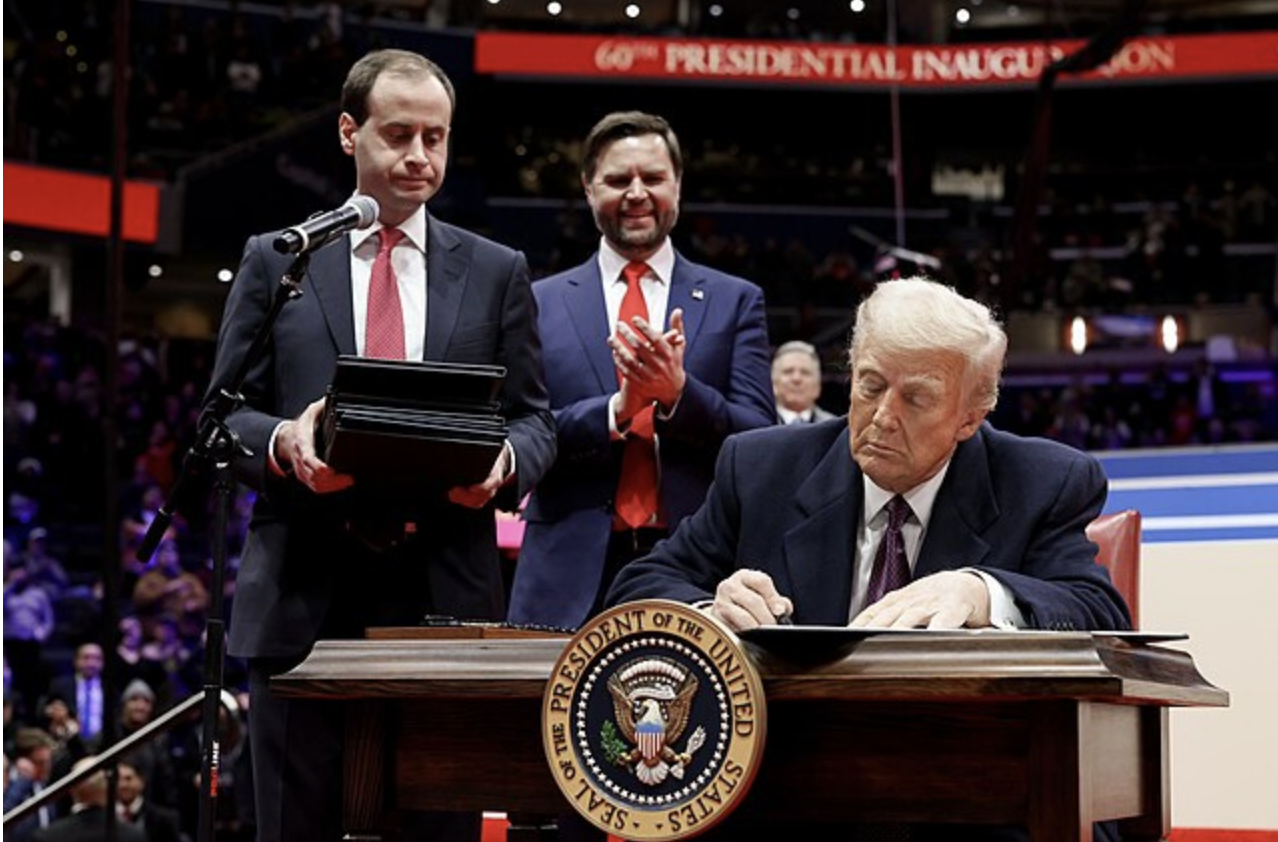
Donald Trump’s re-election marks not just a political turning point but the ascendance of a corpse-like order, a nation stiffening under the weight of its own decay. His second coming is less a victory than a death march, a spectral procession of hollow men in red ties and stiff gaits—zombies with ice in their veins. Videos of Trump dancing evoke images of him moving in a style that is jerky, lifeless, as if his body resents rhythm itself. A wooden plank with a painted sneer, twitching to the anthem of reaction, soulless and mean. No body on fire here. no slow bend toward desire, no trace of the supple grace that lives in a world still capable of love. Instead, the image signals the aesthetic of a new order of cruelty celebrated as the manosphere—puffed-up bodies, drunk on steroids and grievance, exuding the acrid scent of sweat and power.
This is the culture that Trumpism has wrought: stripped of tenderness, of improvisation, of joy. Gone is the world I knew as a working-class kid, where music spilled into the streets, where voices—aching, defiant, untamed—set bodies in motion. Etta James wailing, Billie Holiday lingering on the edge of heartbreak, Nina Simone playing the piano like she was conjuring a storm. Little Anthony and the Imperials harmonizing into the night. This was a world of movement, of bodies ignited by something more than rage—by love, longing, the exquisite pain of feeling too much.
But in the America of Trump 2025, the only bodies that matter are those that march in unison, rigid and obedient. His regime, unbound by law or morality, has reconfigured the machinery of the state into an instrument of vengeance. The January 6th insurrectionists walk free, hailed as patriots. Federal agencies are gutted, purged of dissent. Civil rights protections are erased with the stroke of a pen. Universities, once imperfect sanctuaries of critical thought, are being remade into white Christian indoctrination centers. And in an act of breathtaking cruelty, thousands of immigrants await detention in Guantánamo Bay, that purgatorial space of empire where justice goes to die.
Embracing a long legacy of colonialism with its fantasies of displacement, dispossession, and extermination, Trump has proposed a policy that amounts to the ethnic cleansing of Palestinians from northern Gaza. Drunk on the bloodlust of empire, Trump wraps himself in the degrading fantasies of conquest. Too power-mad to comprehend his own moral vacuity, cruelty, and stupidity, Trump stated that “the United States take over Gaza and that all Palestinians there … leave?" as if occupation were salvation, as if two million lives could be erased with the stroke of a pen. This is a familiar madness, an ancient horror. Under Trump, colonialism’s echo is now a roar. This is not policy—it is lunacy draped in empire, a death wish spoken aloud, a nightmare clawing its way into daylight.
Related stories
This is not simply the return of authoritarianism; it is its evolution—leaner, more technologically adept, more deeply enmeshed in the fabric of corporate and digital power. Trump does not rule alone. He is merely the frontman for a brutalizing oligarchy that has abandoned even the pretense of democracy. The billionaire class—those slick architects of social media monopolies, the digital overlords of surveillance capitalism—have found their perfect vehicle in his shamelessness. Spoiled boys in men’s bodies giving Nazi salutes, orgasmic over their new found power. This is the oligarchy of fools now kissing the ring of the grifter immune for his past and future crimes. Unfettered capitalism has reached its final stage, where wealth no longer hides its contempt for the masses but wears it like a badge.
The spectacle of political theater has become the defining element of Trump’s aesthetic. It has morphed into what Susan Sontag called “fascinating fascism” a form of power that “thrives on gestures of provocation [and] proto-Nazi sentiments. It glamorizes unbridled authority, indulges in the pleasure of humiliation, and expresses outright contempt for “all that is reflective, critical, and pluralistic.” This is not mere political performance—it is the spectacle of domination, staged as both entertainment and ideology whose purpose is to provoke a range of dishonest emotions that filter out matters of reason, ethics, and social responsibility. In this fascist aesthetic, power is not simply wielded but flaunted, paraded in grotesque excess—an orchestrated display of cruelty, intoxicated by its own illusions of national rebirth. This revival is not new. It is a return to the primal politics of racial supremacy, a resurrection of the Confederacy’s racist dreamscape and Hitler’s exterminationist fantasies—wrapped in the cheap spectacle of modern media, adorned with symbols of fear and irrationality, repurposed for an era of digital despotism. It is a fascism that has learned to entertain, to seduce through spectacle, to smuggle its violence beneath the skin of amusement. A spectacle that does not merely wield power but flaunts it—parades it in bloated excess, giddy with its own sadism, its own manufactured illusions of destiny. And yet, the legacy press, bound by its own cowardice, registers the horror but rarely dares to name it, let alone confront it. But this is more than the pornography of power; it is an excremental spectacle, a ritual of degradation where cruelty is both currency and communion, where the logic of reason, ethics, and social responsibility is not merely abandoned but gutted, set ablaze, and paraded through the streets as triumphant wreckage. It is not just the politics of fear—it is the politics of death itself, an orgy of annihilation masquerading as renewal.
Former President Biden, in his farewell speech, warned of the creeping shadow of oligarchy, yet he dared not name the truth: that his own party, with its bloodless embrace of neoliberalism, helped forge the conditions for Trump’s resurrection. This is not simply the triumph of reactionary forces but the consequence of a culture that has surrendered to its own worst instincts—one that has forsaken solidarity for spectacle, justice for cruelty, hope for managed decline.
And so we are left with this: staggering inequality, a militarized state, the slow and methodical unmaking of democracy. The new oligarchs scorn the very notion of the public good. They mock reason, erase history, and demand that the government sever itself from any lingering obligation to care. They speak the language of the market, where everything—including life itself—is merely another commodity to be traded, exploited, discarded. Trump and his sycophants are the walking dead. They have blood in their mouths and anti-freeze in their bodies. The rhythm they embrace is one of stiff soldiers playing in military parades.
But I remember another rhythm, another cadence, one that refuses to die—symptomatic of another time when politics seemed possible as a force for justice, equality, and hope. As a shoeshine boy working Black clubs in Providence, RI.in the fifties, I remember Etta James, her voice raw and thunderous, shattering the quiet. I remember the bodies in motion, defiant and free. In her music, in her story, in the way she broke down racial and musical barriers, there was a fire that no amount of repression could smother. Etta James never bought into the whitewashing of history. She was a border-crosser, refusing to be contained, her music too powerful to be tamed by an industry that sought to erase the rough edges of Black artistry. She carried with her the weight of struggle and the possibility of something beyond survival—of love, of dignity, of a world where music could still touch the soul rather than serve as corporate wallpaper.
Even in her later years, when she sang Fool That I Am at the Newport Jazz Festival or in Toronto when I saw her a few years before she died, her voice carried the same intensity, the same unapologetic passion. But the world she sang into had changed. When Barack Obama was elected, it was not Etta but Beyoncé who sang At Last at his inauguration. It was a gesture that wounded Etta deeply—a reminder that the world she had shaped had turned away from her, preferring a polished version of history over the raw, defiant reality she represented. The same forces that had once feared her power now erased her legacy in favor of something more palatable, more marketable.
This is the fate of all radical voices in a society bent on forgetting. Whether in politics, education, or culture, the forces of erasure work tirelessly to neutralize history, to sand down the edges of struggle, to replace resistance with spectacle. Trumpism is only the most grotesque expression of this impulse, but it is not the only one. The neoliberal university, the corporate music industry, the political establishment—they all participate in the politics of forgetting.
And yet, something lingers. A voice that will not be silenced, a rhythm that refuses to be stilled. In this age of zombie politics, where bodies are reduced to instruments of control and obedience, there is still a memory of movement, of improvisation, of freedom. And as long as we remember—through music, through writing, through acts of defiance—the fire cannot be extinguished. Memory rescues and that is why is has become so dangerous in the age of Trump.
I first heard Etta James in a cramped basement apartment at a party with my Black high school teammates. It was unlike anything I had ever experienced. At the Catholic Youth Organization dances I had attended, white-washed music reigned—Pat Boone instead of Little Richard, the Beach Boys instead of Little Anthony. Nuns patrolled the floor, ensuring that no one got too close, warning us to leave room for the Blessed Virgin Mary. Desire was something to be policed. Bodies were to be contained.
But in that smoke-filled apartment, everything was different. Bodies pressed together, laughing, flirting, moving with a kind of freedom I had never known. And in the background was Etta James, her husky voice breaking through the noise, filling the room with something raw and undeniable. She transformed the body from an object of discipline into a site of joy, creativity, and resistance. I danced without moving my feet, unlearning the rigid postures imposed on me and stepping into a different kind of world—one where solidarity and social justice were stitched into the fabric of music, movement, and feeling. A moment not of nostalgia, but one that reminds me of the power of passion, the body in flight, anger transformed into a collective song of struggle. A moment that fueled a culture of resistance. A moment filled with the passion of youth willing to fight against fascism and build a more just, equal, and democratic future. A moment to come, hopefully sooner than later.
Yet, even in this theater of cruelty—where power struts with impunity and the weight of history is erased by the machinery of forgetting—there remains a force that refuses to be stilled. If memory is dangerous in an age of erasure, then youth are its most powerful custodians. They are not the passive inheritors of a dying world but insurgents of a future yet to be written. Across university campuses, in the streets, in digital spaces that escape state control, young people are breaking through the spectacle of authoritarianism with demands for justice, for history to be remembered, and for the possibility of democracy to be reimagined.
In an era where repression masquerades as stability and cynicism is weaponized against hope, it is the youth and workers who continue to remind us that resistance is not futile but necessary. Their defiance, whether in the form of student movements against police violence, mobilizations for climate justice, or acts of solidarity with the oppressed, signals that another rhythm—one that is fluid, improvisational, and collective—has not been lost. The bodies they put on the line, the risks they take, and the courage they summon speak to the urgency of reclaiming public space, public memory, and a world unchained from the death march of fascist aesthetics.
If Trump’s theater of cruelty is a necropolitical order that thrives on despair and domination, youth resistance is its counter-aesthetic—an assertion of life, movement, and the refusal to submit. It is here, in this unfinished struggle, that hope remains. Not the naïve hope of passive optimism, but the radical hope that insists that history is not over, that democracy can be more than a fading ideal, and that the dead weight of cruelty can be lifted by those who still dare to dance, to defy, and to dream.
Comments

Powered by RoundtableAn AI/DeFi-powered Enterprise Media Operating System. Learn more at Roundtable.io.© Roundtable 2026. By using this site you agree to the Terms of Use and Privacy Policy