
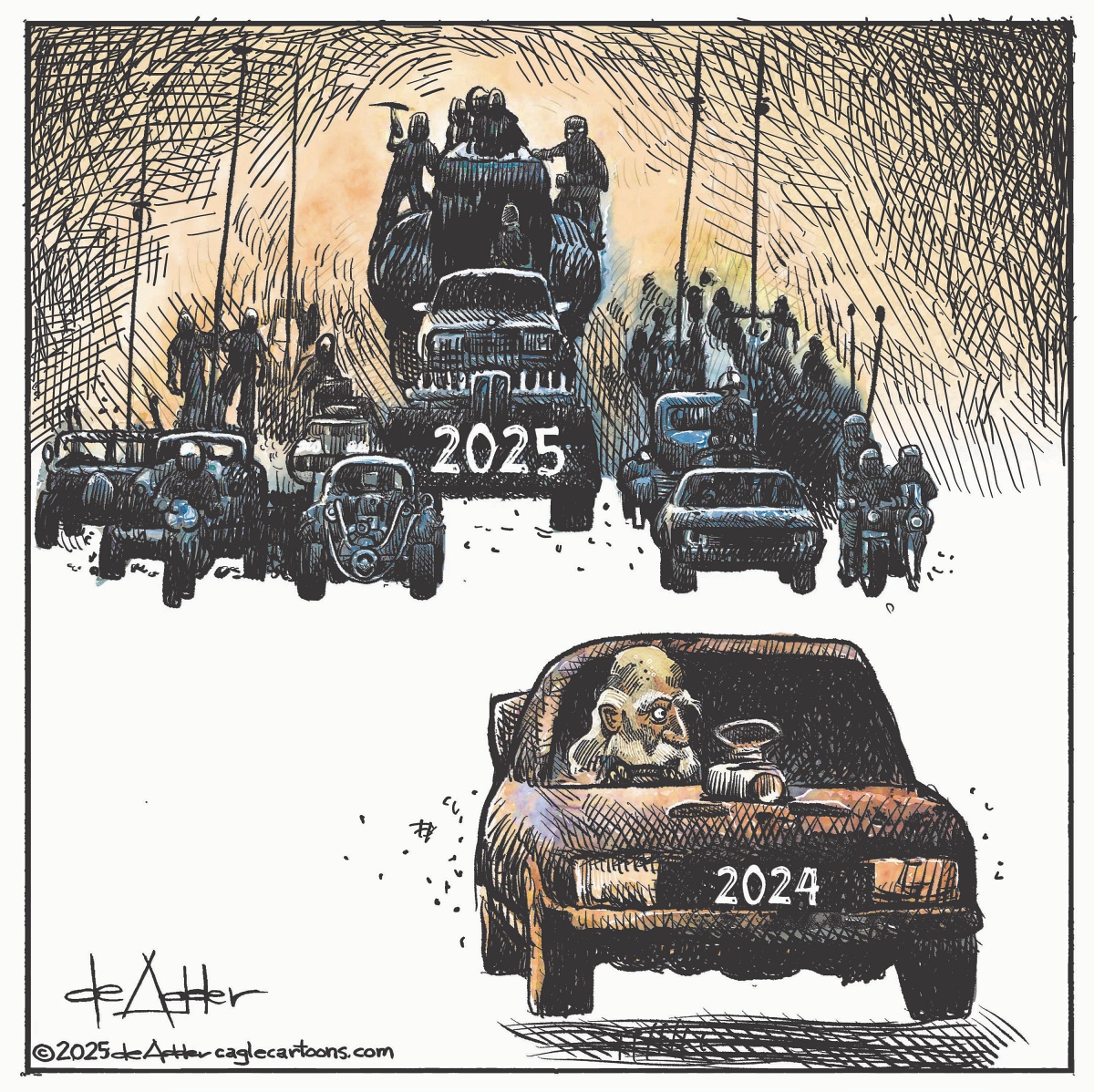
Cagle Cartoons: Michael de Adder


Rewriting American History
Jan 9, 2025 5:43 PM
Trump’s narrative victory—the rewriting of January 6—is a chilling reminder of the power of stories to override the evidence of our own eyes.
Narratives are the primary means of embedding meaning in our relationships with the surrounding social universe. They offer not just explanations but frameworks for belonging, legitimating particular ways of being while erasing others. Ultimately, narratives are not neutral; they are sites of struggle over meaning, identity, and power. But narratives are never merely reflections of reality; they are the scaffolds of thought, the architecture of our inner worlds. They structure not just how we remember, but how we imagine, theorize, and act. Narratives form a cultural contract between individuals, groups, and their surroundings.
Narratives are the very grammar of human life, rendering actions intelligible and binding disparate moments into the continuity we call history. They are cultural toolkits, accumulating over time into shared archives of meaning that define who we are, what we believe and who we want to be. Yet these archives are fraught; they can just as easily serve as prisons as pathways. The danger lies in monumentalizing them, in sanctifying stories simply because they are familiar, until they calcify into totalizing myths that obscure more than they reveal.
The claim that every selfhood implies a narrative underscores how identities are fundamentally storied. Our sense of who we are is bound to the temporal unfolding of events in our lives, imbued with ethical and political significance. In this way, identity is not static but dynamic, shaped by a "succession of events" that we interpret and reinterpret over time. These narratives are not merely personal but are interwoven with larger cultural, historical, and social contexts.
This question highlights the tension between agency and structure in narrative formation. On one hand, narratives can feel as though they “speak us,” scripting our actions and identities through social, cultural, and ideological frameworks. On the other hand, we also actively "speak" narratives, shaping them to reflect our values, beliefs, and desires. However, the narratives we choose to tell—and those we choose to silence—are often influenced by larger systems of power. This duality reflects the complex interplay between individual agency and societal forces.
Related stories
Trump’s narrative victory—the rewriting of January 6—is a chilling reminder of the power of stories to override the evidence of our own eyes. Trump’s words transform insurrection into patriotism, erasing accountability with each utterance. Yet, this is not merely his triumph; it is a reflection of our collective failure to confront the narratives that bind us. To resist, we must dismantle the structures that grant such tales their hegemony and imagine new frameworks of coherence—ones that do not smother difference but nurture it, enabling us to write history before it writes us.
Trump’s grand narrative that recasts the January 6 attack on the Capitol as an act of civic valor—an eruption of patriotism rather than treason—has not merely crept into the national consciousness; it has thundered in, overtaking the terrain of collective memory like a storm that rewrites the landscape. How, then, has such a profound inversion taken root? How has the tale of a brazen insurrection transformed into a hymn of courage? Trump, ever the master of the artifice, has woven a story so potent and pervasive that it remakes reality itself. By convincing a vast swath of Americans that the 2020 election was stolen—a claim utterly devoid of proof—he has retroactively reframed the insurrectionists as heroes, their violence justified as a noble stand against imagined tyranny.
Narratives, like rivers swollen with rain, carve channels deep into the bedrock of our minds through endless repetition. Trump understands this truth instinctively: that a story told often enough begins to live independently of facts, gaining a gravity that pulls the unmoored into its orbit. His January 6 narrative operates not as a reflection of what was, but as a creation of what could have been—a speculative fiction, with Trump masquerading as historical truth.
Trump’s narrative thrives on this process. It is stitched together from the fabric of cultural myths and historical distortions, suturing its fractures with the illusion of coherence. It invites people to inhabit a fictive relationship to the real conditions of their existence, one that makes the insurrection appear not as chaos but as order restored, not as treason but as duty fulfilled. In this way, Trump’s revisionism inscribes itself upon those who embrace it, shaping their subjectivities within the contours of its false logic. They do not merely live the narrative; they are lived by it, their actions encoded in ways that align with the larger scripts of capitalism, power, and historical erasure.
Trump’s supporters do not merely live the narrative; they are lived by it, their very actions encoded as footnotes to the larger scripts of capitalism, power, and historical erasure. In Trump’s tale, they are not simply actors but inscriptions, their choices etched into the mythic arc he has conjured—a story where reality bows before rhetoric, and history becomes a pliable canvas.
Trump emerges in this drama as more than a man; he is cast as a savior, a bloodied martyr who bleeds not just for his followers but because of them. The imagery is potent: the man who survived an assassination attempt, his wound transfigured into a grotesque stigmata that sanctifies his mission. For evangelical believers, he is the "Chosen One," a messianic figure ordained to fulfill a divine reckoning. His sword is aimed at the "administrative state," the faceless machinery of governance he vows to dismantle. His fury is directed at the immigrant "vermin," a grotesque scapegoat made to bear the weight of the nation's fears and failures.
In this narrative, Trump is no mere politician; he is the redeemer, the warrior-king who will save a crumbling America from the clutches of “evil Democrats,” whose policies and principles are cast as nothing short of existential threats. It is a tale of apocalyptic stakes, where compromise is betrayal, and opposition is treason. Through the alchemy of repetition and belief, his story has become a gospel, and its adherents, its apostles, ready to sacrifice truth, reason, and even their own agency at the altar of its telling.
This is the peril of such grand narratives: they do not ask for allegiance; they demand absorption. Those who inhabit this story are not just participants; they are instruments, their actions bent to the will of a fiction so pervasive it becomes their reality. In Trump’s world, the lines between savior and destroyer blur, and the nation teeters on the edge of its own unraveling—its people caught in the grip of a narrative that consumes them as much as it defines them.
Narratives like Trump’s succeed because they anchor themselves in the sediment of our collective past, co-opting the symbols and structures of legitimacy.
Trump’s January 6 narrative is a stark reminder of this struggle. It reveals how stories can erase accountability, reshape memory, and silence dissent. But it also reminds us of the power of narrative accrual—the slow, deliberate process of building new stories together, stories that resist domination and nurture difference. Narratives, for all their capacity to imprison, can also liberate. They can carve new channels through the sedimented landscapes of meaning, letting suppressed truths flow free. The question is whether we will wield this power to build a more just and truthful archive—or let it be wielded against us, again and again.
Regarding January 6, D.V. Date warns: “You can believe your own eyes or Donald Trump's words—and many Americans are choosing to believe him."
Date offers a chilling comparison between Trump’s rewriting of January 6 and the decades of insidious mythmaking it took for the defenders of the Confederacy to alchemize treason into heroism, rebranding a violent insurrection against the United States as an act of chivalry and courage. He describes how Donald Trump, in an era where information flows as swiftly as it can be distorted, has accomplished a parallel feat in the blink of an eye. In just four years, Trump has recast the deadly assault on the Capitol on January 6, 2021—a day when the citadel of American democracy was violated at his incitement—as a tale of patriotic valor and peaceful protest, MAGA’s Lost Cause.
What once stood as irrefutable—a coup attempt fueled by baseless lies and raw ambition—is now, for many, a rewritten script. The insurrectionists, once clearly seen as agents of chaos and violence, have been transformed in Trump’s narrative into martyrs, victims persecuted by their enemies for daring to defend an imaginary stolen election. This audacious rewrite echoes the strategy of Lost Cause propagandists but compresses decades of historical distortion into mere moments.
Date cites Gabriel Reich, a scholar of historical memory, who observes that both the Confederacy’s defenders and Trump’s apostles rely on a seductive narrative: one that absolves its audience of complicity in moral and legal transgressions. These stories soothe the conscience, offering a balm to those who see themselves, or their communities, implicated in acts that betray both the law and foundational principles of justice. “Liberal democracies,” Reich notes, “struggle profoundly with bad-faith actors who manipulate the very norms designed to protect democracy, bending them toward self-interest and power.”
Date quotes Tom Joscelyn, who served on the Jan. 6 committee, and who marvels at the dissonance between what was plainly visible on that day and what millions have since chosen to believe. Unlike the Civil War, whose distorted retelling spanned generations, Jan. 6 unfolded in real-time, broadcast to a world that watched with horror. “All you need is the images and the videos from that day, his own words, and what you saw with your own eyes, and it was clear that he had crossed some bright lines,” he said. “All of that should have been disqualifying, and it wasn’t.”
Trump’s audacity lies in his ability to weaponize immediacy. Where the Confederacy relied on the slow erosion of truth through decades of schooling, public monuments, and cultural reinforcement, Trump’s narrative machine operates at warp speed. His revisionism does not merely reinterpret history; it bulldozes it, replacing memory with myth almost as quickly as events unfold. Those prosecuted for their roles in the Capitol attack are recast as political prisoners, their suffering a cause célèbre in Trump’s ever-expanding mythology of grievance and victimhood. “These people have been treated really, really badly,” Trump declared, deflecting attention from the gravity of their crimes with a characteristic sleight of hand.
Trump has vowed not only to pardon those who stormed the Capitol on January 6 but to turn the machinery of justice against those who dared to hold him and his followers accountable. It is a promise steeped in the logic of retribution, a pledge to invert the moral order and enshrine impunity as principle. In this twisted narrative, the insurrectionists are no longer criminals but martyrs, and those who pursued justice become the persecutors. It is a chilling vision, one that threatens to unravel the fragile fabric of accountability upon which democracy rests, replacing it with a spectacle of vengeance that sanctifies violence and criminalizes dissent.
Date also quotes Mac Stipanovich, who recalls growing up surrounded by Confederate memorials that rewrote Southern defeat into noble sacrifice. Stipanovich describes Trump’s rapid reimagining of Jan. 6 as a staggering achievement. “It’s a tribute to Trump and his posse’s ability to convince half the country,” he said, his tone weighted with a mixture of disbelief and lament. “And it’s a telling indictment of the intelligence of that half of the country.”
This is the power of narrative: to transform the unacceptable into the heroic, to smooth the jagged edges of fact until they fit neatly into a preferred fiction. Trump’s rewriting of January 6 is not just a challenge to the truth of that day but to the very structures of democracy itself, which depend on a shared reality to endure. Without vigilance, history may once again surrender to the hands of those who wield lies as weapons, reshaping the past to control the future.
Date points out that by late 2021, the machinery of Trump’s narrative revisionism reached a new, insidious milestone. With the release of Tucker Carlson’s conspiracy-laden “documentary,” which grotesquely recast the January 6 insurrection as a “false flag” operation orchestrated by the FBI, Trump seized upon this warped storyline to further entrench his mythmaking. It was no longer enough to frame the rioters as patriots; they were now transformed into “hostages” and “political prisoners,” martyrs of a righteous cause persecuted by a corrupt regime. Put on your red caps and raise your fist and you are miraculously transformed into George Washington.
Even those convicted of assaulting police officers—the very agents of law and order that Trump’s base once claimed to revere—were folded into this fabricated martyrdom. In Trump’s retelling, their actions were not violent transgressions but noble sacrifices, their prosecutions not justice but tyranny. It was a masterstroke of rhetorical alchemy, turning perpetrators into victims, rebellion into heroism, and lawlessness and political outlawry into an act of divine providence.
This reframing was not incidental; it was strategic. By invoking the imagery of "political prisoners," Trump sought to evoke comparisons to freedom fighters and dissidents, further inflaming his supporters’ sense of grievance and victimhood. The narrative, like all effective propaganda, required no evidence—only relentless repetition, amplified by loyal megaphones like Carlson, until it drowned out reality itself. In this alternate history, January 6 ceased to be a day of shame; it became the cornerstone of a dangerous, authoritarian mythos of good crushing evil, where truth is not just obscured but obliterated.
Trump, with his characteristic audacity, has recast January 6 as a "day of love," a gathering of patriots bound by devotion to their country and, more pointedly, to him. The shattered glass, the bloodied officers, the noose prepared for Mike Pence ominously displayed outside the Capitol—these are reframed in his narrative as mere props in a theater of misunderstood affection. The mob that chanted for violence now becomes, in his retelling, a congregation of the faithful, their actions motivated not by insurrection but by an almost sacred duty to defend a stolen dream—an epiphanic dream of Trump as the overlord of the downtrodden, the sacred vehicle for their retribution.
By invoking the language of love, Trump cloaks chaos in intimacy, turning a day of democratic rupture into a parable of loyalty and righteous passion. It’s a masterstroke of narrative manipulation, where the grotesque is rendered noble, and the architects of violence are painted as guardians of virtue. In his hands, the riot is no longer an assault on the nation but an act of tender devotion—a perverse transformation that seeks to absolve the guilty and indict those who witnessed the truth.
Date cites Mac Stipanovich, who severed ties with the Republican Party when it capitulated to Trump’s cult of personality in 2016. Stipanovich draws a chilling parallel between Trump’s rewriting of January 6 and Adolf Hitler’s reframing of the 1923 Beer Hall Putsch. What began as an abortive coup, one that landed Hitler and his co-conspirators in prison, was later transformed into a cornerstone of Nazi mythology—a tale of valor and patriotic sacrifice. “When it failed,” Stipanovich observes, “the heroes of the failure became the hope of the future.”
This analogy is not mere hyperbole. Just as Hitler’s propaganda machine turned a humiliating defeat into a rallying cry for nationalistic fervor, Trump has recast the chaos and treachery of January 6 into a story of courage and resistance. The insurrectionists, far from being perpetrators of violence, have been immortalized in his narrative as righteous warriors fighting against an imagined injustice. And just as Hitler leveraged his version of the past to ascend to unchecked power, Trump appears poised to use his mythologized January 6 as a springboard for his political resurgence and enduring legacy.
Date also quotes Larry Sabato, a political scientist at the University of Virginia, who finds the historical echoes of January 6 deeply troubling. Growing up in Virginia, where the Civil War was taught as the “War of Northern Aggression,” Sabato knows firsthand how narratives can be manipulated to sustain political and cultural power. The Confederacy’s defenders reframed treason as honor, a reinterpretation that calcified over decades. But Trump has accelerated this process, warping reality with astonishing speed. Clearly, Trump envisions Jan 6 as becoming a stock narrative in America’s political history, underwriting the meaning of American freedom.
“The Lost Cause was a ‘big lie,’ but I’m not so sure Trump’s ‘big lie’ will ever be a lost cause,” Sabato warns.
This raises the harrowing question: How do we safeguard democracy when its myths can be remade into tools of its undoing?
It is time to rise to the challenge of creating narratives that possess the power to unfix and unsettle, counternarratives that can fracture totalizing systems of domination built on falsehoods and disinformation. Such narratives are not merely stories; they are acts of defiance, capable of dismantling epistemic violence and the dominative systems of knowledge and structures of intelligibility that craft and constrain our social lives.
To engage in this work is to undertake a reading of personal narratives—our own and those of our family, friends, relatives, students—against the grain of society’s imperial and magisterial archives. These "treasured" stock narratives, with their claims to universality, often function as ideological scaffolds that support systems of power and exclusion. Yet alongside them exist the devalued narratives, buried within the rifts and margins of society, cast out but never extinguished. These marginalized stories offer a counterweight, a critical lens through which the cracks in dominant structures can be made visible. Trump recognizes these marginalized voices and patronizes them. Rather than offering ways of empowering them, he offers himself as a vehicle for their tribalized hatred and revenge against so-called ‘woke’ democrats.
By reading the world against these hegemonic texts, we open a space where suppressed voices can emerge, where silenced histories can resonate, and where the seemingly monolithic edifice of societal truths can crumble. It is in this space of resistance and reconstruction that we find the potential to challenge dominative knowledge systems, to dismantle their grip on meaning, and to imagine a world where difference is not erased but celebrated—a world where the infinity of narratives becomes the ground for liberation rather than oppression.
The appointment of Linda McMahon as Secretary of Education signals Trump’s intent to mold the narratives of January 6—and his broader vision of America—at the roots of society: its classrooms. Education reform under Trump becomes a battleground where history is not only taught but rewritten, where students are invited to inhabit his version of patriotism, a narrative that glorifies division, erases accountability, and exalts a singular, authoritarian vision of greatness steeped in a hatred of the ‘other’.
In this rewriting, January 6 ceases to be an insurrection; it is transformed into a mythic defense of liberty, a cornerstone of the "greatness" Trump claims to restore. The power of this narrative does not rest in its truth but in its repetition, codified in textbooks, woven into lessons, and spoken with the authority of institutions designed to shape young minds. If unchallenged, this reimagining of America will teach a generation to see domination as strength, to conflate dissent with treason, and to accept a version of history that sanitizes violence in the name of nationalism.
We must fight for the right to challenge these narratives—not only to protect the integrity of education but to preserve the soul of democracy itself. This is a fight for intellectual freedom, for the power to interrogate the narratives that threaten to suffocate critical thinking. It is a fight to ensure that education remains a space of possibility, where imperial and totalizing narratives are met with resistance, subversion, and the courage to imagine a more inclusive, honest account of what makes America great—not its fabricated myths, but the unrelenting struggle for freedom and justice among its citizens, the fight against oligarchy and plutocracy and fascism that has been documented by historians such as Howard Zinn.
The fight against Trump's deceptive narrative of January 6 is not just about correcting historical facts but also about challenging the cultural contract it seeks to impose—a contract that undermines democracy and ethical accountability.
Trump's retelling of January 6 is a carefully crafted narrative that redefines violence as patriotism, lawlessness as righteousness, and dissent as betrayal. By sanctioning this narrative and discounting opposing ones, he and his supporters erect boundaries around acceptable identities—those of the "true Americans" who align with his vision—and delegitimize others as threats to the nation. This form of narrative containment limits the space for alternative stories and suppresses critical engagement with history.
Trump's narrative surrounding January 6 doesn't exist in isolation; it drives social action, often accompanied by discriminatory rhetoric, and violent expressions of power. Consequently, it has never been more urgent that we learn to critically "read the narratives of January 6 that are already reading us. "
Trump’s tale operates like a magician’s trick, drawing audiences into an imaginary relationship with the real conditions of their existence. It conjures an illusory coherence that masks the fractured, grinding machinery of social formations to which individuals are precariously indentured.
Trump’s story wields this power with ruthless precision. Its structural, rhetorical, and discursive solvency rests on its ability to root itself in the sediment of our shared histories, no matter how distorted or selectively remembered. It thrives because it stitches together signifiers of belonging and exclusion, suturing the ruptures in its own contradictions to constrain competing narratives of January 6.
At the heart of this deception is a fiction of stasis—Trump wants to plant an image in the brainpans of Americans, a still frame, of MAGA patriots retaking America from a stolen election, to create an effect similar to the iconic photograph of six United States Marines raising the US flag atop Mount Suribachi during the Battle of Iwo Jima. Trump’s narrative does not simply reflect events; it manufactures them. The event of January 6 is not simply the attack on the Capitol building by Trump supporters. The event is the story that follows—the retelling, the mythmaking, the reordering of reality around his singular orbit. Narratives, like containers, hold our socially embedded subjectivity. They inscribe our actions within boundaries that conform to the larger tales of capitalism, culture, and history. And in this inscription, they either discipline us into submission or give us the tools to rebel. It is here that the footage available of the January 6 insurrection plays an important role in determining what actually happened.
But in the age of rightwing media, can we rewrite the script, or does it rewrite us? This is the battle of narrative accrual—the slow, sedimentary process through which stories interlock, enabling collective action or immobilizing it.
Narratives like Trump’s succeed because they anchor themselves in the sediment of our collective past, co-opting the symbols and structures of legitimacy. But it’s important to remember that narratives are not inert; they are battlegrounds. They organize relationships of difference, distributing privilege and marginalization, sanctioning some ways of being while obliterating others. They constrain possibilities, suturing meaning so tightly that alternative readings of the world struggle to breathe.
And yet, narratives are not immutable. They can be resisted, rewritten, fractured. To do so requires a critical interrogation of the stories we inherit and the ones we create. It requires us to refuse the easy coherence of totalizing myths and instead embrace the polyvalent assemblage of meanings that more truthfully reflects the complexity of our world. To rewrite history before it rewrites us, we must confront not only the narratives themselves but the systems of power that give them their strength.
In a world in which the dominant political narrative is arcing towards fascism, draconian austerity methods, fake masculinity, and necrophilous personhood as evidenced by the rise of Bukele, and Milei, Musk and Trump, we need more than ever narratives that inspire a protagonistic agency that reaches towards freedom, equality and social justice.
Comments

Powered by RoundtableAn AI/DeFi-powered Enterprise Media Operating System. Learn more at Roundtable.io.© Roundtable 2026. By using this site you agree to the Terms of Use and Privacy Policy