
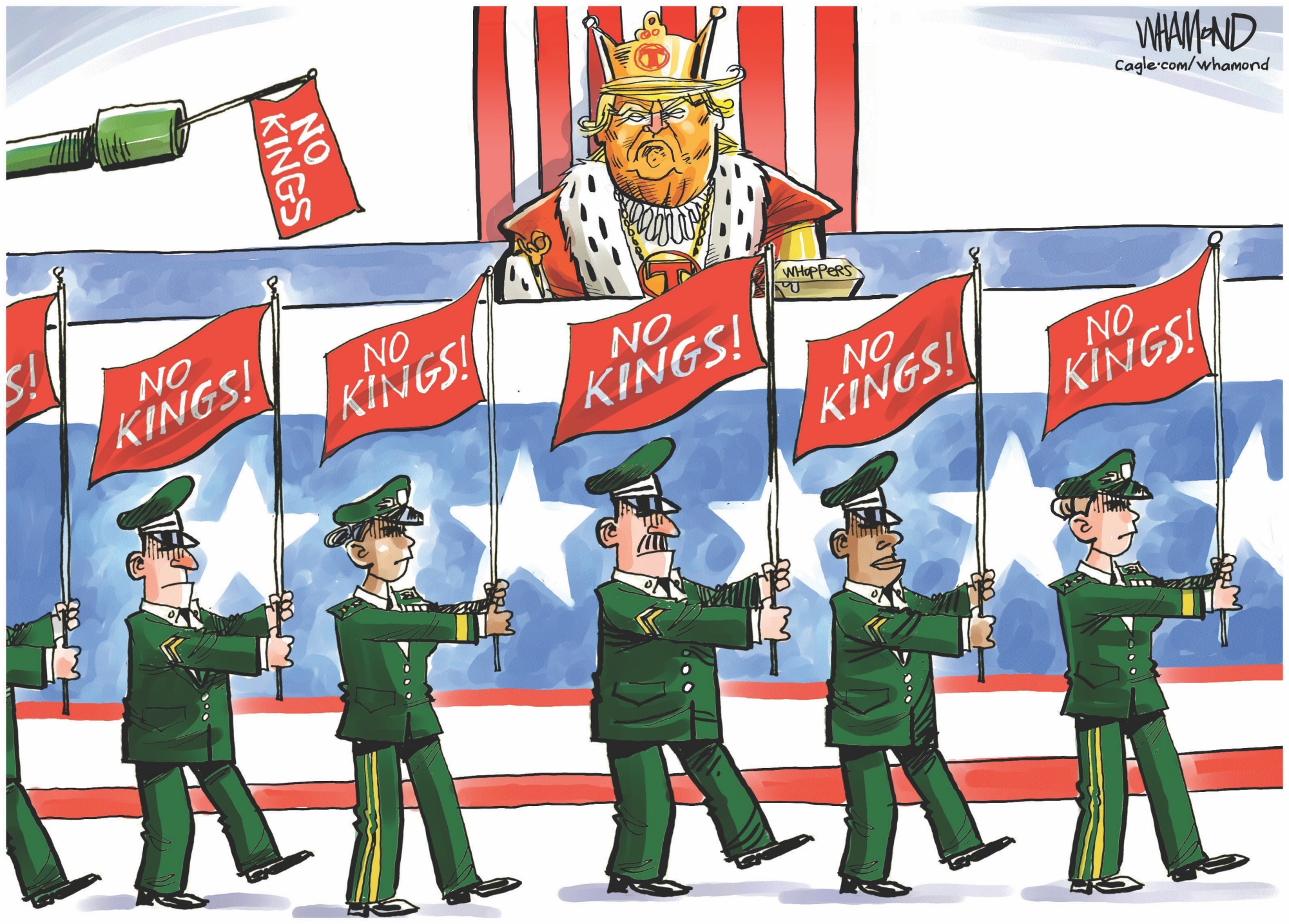
Illustration by Dave Whamond on CageCartoons.com


This is the stuff of Orwell. The Dark Enlightenment is a blueprint for a post-democratic regime where truth is declared and the public serves the sovereign.
Jun 3, 2025 9:51 PM
Updated Jun 3, 2025 9:53 PM
This is the stuff of Orwell. The Dark Enlightenment is a blueprint for a post-democratic regime where truth is declared and the public serves the sovereign.
It might, at first glance, seem that the phrase Dark Enlightenment refers simply to the murky theater of Donald Trump’s digital ravings — a twilight echo of reason in which the shadows stretch longer than the light. As when Trump denies that his “Great Big Beautiful Bill” would cut Medicaid, even though a simple Google search turns up the Congressional Budget Office’s nonpartisan analysis, projecting that cuts to Medicaid and the Affordable Care Act would leave roughly 13.7 million people without health insurance by 2034.
But such denials are merely the crude stagecraft of a familiar liar, a man who governs not by truth but by bluster, repetition, and the hypnotic spell of grievance. To stop there, though, would be to mistake symptom for cause.
The true Dark Enlightenment — capitalized not for drama but for ideological precision — is not just the gloom of Trump’s misinformation, but the intellectual current beneath it, a current that runs deeper and darker than the usual partisan theater.
Coined by British theorist Nick Land, the term describes a movement of reactionary thought that views democracy as a mistake, egalitarianism as decay, and the Enlightenment itself as a wrong turn in human history.
Related stories
Its adherents do not merely oppose liberal institutions; they dream of their destruction. They seek, in Land’s techno-nihilist vision and its American adaptations, a return to hierarchy, an embrace of inequality, and a reengineering of society according to the dictates of capital, algorithm, or blood.
Trump may not read Nick Land, but the operating system of Trumpism runs on similar code that all echoes the Dark Enlightenment’s deeper logic:
- The contempt for the weak
- the glorification of domination
- the gutting of the commons in the name of efficiency
When Trump waves away the loss of 13.7 million people's health coverage as if it were a rounding error, he is not just lying. He is enacting a principle: that the vulnerable are expendable, and the truth, like the state, is whatever the strong say it is.
So no, the Dark Enlightenment is not just a poetic term for a bad Twitter feed. It is a doctrine — a cold philosophy clothed in memes and power suits — that seeks to reverse the moral arc of history. Where the Enlightenment offered reason against tyranny, the Dark Enlightenment offers tyranny against reason. And in men like Trump, its shadow becomes flesh.
The most recent conjuration: from the altar of Truth Social, the former president has, with a flourish of spectral fingers, summoned into view a litany of deranged proclamations. In recent weeks alone, he has:
- elevated the cry for a military tribunal against Barack Obama
- accused federal judges of crimes “tantamount to treason and sedition”
- entertained the blasphemous notion that he, Trump, ought to be installed as pope — as though the papal tiara were but a gaudy crown for his carnival of grievance
Repellent though these hallucinations may be, my concern lies not only with their grotesque content, but with the sorcerer behind the veil: Curtis Yarvin, the shadowy philosopher-king of the far-right underworld. Here, in the ink-black marrow of political thought, dwells a darker alchemy — the true Dark Enlightenment, born not of delusion, but of deliberate design.
Yet for those who treat politics as a pageant of monsters and masks, a new favorite has emerged.
On a recent Saturday eve, Trump lent his cursed megaphone to a message so unhinged it throbbed with apocalyptic lunacy. The post claimed that Joe Biden had been “secretly executed in 2020,” and that since then, America has been ruled by a parade of hollow simulacra — clones, doubles, robotic engineered soulless mindless entities, marionettes in the likeness of the man from Delaware.
Trump did not pen these words himself. No, like a medieval duke nodding from the battlements while mad prophets preach in the courtyard, he merely shared them — beckoning his millions to drink from this poisoned chalice.
And why, we ask, would he do such a thing? The New York Times reported that the White House offered no comment on this latest descent into madness — unsurprising, for how does one answer a specter? How does one respond when the pageantry of democracy is replaced with a haunted opera, and the man who once bore the seal of the presidency now plays the role of sorcerer, clown, and prophet of the abyss?
This is no mere confusion of truth and fiction. This is the theater of a kingdom slipping into night, and Trump as its harlequin herald, laughing as the curtain falls. This is true Dark Enlightenment stuff.
The Dark Enlightenment — known in some digital catacombs as NRx, short for neo-reactionaryism — has emerged like a subterranean fungus beneath the foundations of liberal democracy, feeding on discontent and blooming into the light with venomous purpose. Conceived in the blog-forges of Curtis Yarvin, a software engineer turned political necromancer who writes under the alchemical pseudonym Mencius Moldbug, and further elaborated by the English philosopher of cybernetic dread, Nick Land, the movement seeks not merely to critique democracy, but to enter the political Thunderdome of American democracy in order to ritually disembowel it.
In his 2012 digital grimoire, Land writes with the icy clarity of a nihilist prophet, denouncing democracy as a virus and summoning the spirits of libertarian titans like Peter Thiel, who famously declared that “freedom and democracy are fundamentally incompatible.” Such are the maxims of the Dark Enlightenment, a creed where liberty becomes the preserve of oligarchs and monarchs, not the many.
But this philosophy does not dwell in isolation. Its shadow snakes into darker lairs, coiling around white supremacist and anti-immigrant factions like the VDARE Foundation. As the Southern Poverty Law Center has observed, VDARE acts as an intellectual cloister for the high priests of exclusion, a place where racism dons the robes of policy analysis. In this subterranean fellowship, exclusion is not shameful — it is sacred.
Enter Curtis Yarvin, a far-right conjuror of post-truth devilry and celebrity. A Republican spellcaster who has aligned himself with the Dark Enlightenment, embracing its tenets with unique fervor. In this bleak landscape of ideological warfare, Yarvin seeks kinship with those who wish to dismantle the pillars of democracy, casting a long, foreboding shadow over the future.
The wandering shaman of Trumpism, the Rasputin of post-truth politics, a master alchemist of media manipulation, far-right spellcaster Yarvin has grafted the tenets of the Dark Enlightenment onto the flesh of the Republican body politic. His project is civilizational regression: a return not to order, but to hierarchy; not to reason, but to myth; not to democracy, but to occupying the throne — the same throne that once symbolized the sovereign reach of power enjoyed by the likes of Henry VIII and Bloody Mary, and just as effectively cushioned their buttocks.
Trump performs monarchy by other means. Not a monarch by divine right, but by algorithmic acclaim, by reality television coronation. His authority, bloated and theatrical, pretends to restore imperial majesty while eroding the democratic substance beneath it. He sits not to rule with wisdom, but to broadcast dominance. His throne is not carved of oak or gold but assembled from retweets, rage clicks, and Fox News segments aired on loop.
And yet, the effect is the same: decrees without deliberation, cruelty without consequence, and pageantry without purpose. The Dark Enlightenment needs no crown when it has a camera. It needs no scepter when it has a smartphone. But it hungers still for the old world’s hierarchies, its aristocratic contempt, its naked belief that some were born to rule and others to serve — or disappear.
In the feverish carnival of the 2024 election, Yarvin’s rejection of Enlightenment ideals proved less a liability than a strategy — a dark star rising over a disillusioned republic.
The movement’s momentum, however, is not just political — it is memetic. The ideological virus propagates not through debates, but through echoes, impressions, and the easily excited neurons of mass psychology. As Włodzisław Duch observes,
“people that subscribe to specific subcultures share many common beliefs and contribute to replication of specific memes... adding new, easily excitable elements strongly associated with already memorized memes.”
The mind, in this schema, is less a deliberative republic than a memeplex — an attractor state into which Trumpism easily — even lasciviously — falls.
In the words of Stephen Albrecht, Maik Fielitz and Nick Thurston, it is becoming alarmingly clear that,
Our technical era is intermedia and digitally driven – one in which old and new interact – and our intermedia tools run software that allows multiple simultaneous user-tool and user-user interactions with ‘glocal scope.'
This connectivity makes the online and offline responsive to one another, and their growing augmentation makes them increasingly interdependent.
For those post-digital far-right actors leading the current resurgence, intermedia systems are not neutral communication tools. Rather, they are a catalyst for highly social processes and forums where political opinions are created, expressed and practiced. These media are mediating politics. They connect larger audiences more quickly and widely, allow for autonomous spreading, circumvent regional and national restrictions, can host parallel channels that range from open access to the encrypted, and use overlapping frames, feeds and windows to keep politics, digital citizenship and users’ personal lives in constant contact.
Here lies the terrible elegance of the neo-reactionary project: it does not argue; it resonates. It calls to deep cultural memory, to resentment dressed in gold leaf, to trauma that seeks a tyrant. In the minds of many, Trump is not a man but a vessel — an attractor for dreams of vengeance and restoration. And as he has readied himself for a second ascension, the old alliance reforms: Yarvin stands at the helm, cloaked in digital mysticism and ideological rage, fusing conspiracy with strategy, casting lots in the ruins of the Enlightenment.
Yarvin is a sorcerer-pseudo philosopher wielding the language of grievance like an obsidian blade, blending the occult and the political with apocalyptic flair. His goal is not mere victory. It is annihilation followed by reconstruction — an empire of moral filth and fury reborn in Trump’s image, with all its stringy algae, gelatinous masses, cyanobacterial growth and pond muck.
Ah, picture it: the Watergate Hotel, that hallowed mausoleum of American scandal, now resurrected not for shame but for pageantry — a new court rising from the ruins of the old Republic. Beneath chandeliers still dripping with the ghosts of Nixon’s fall, a ballroom fills with silk-pocketed schemers and champagne monarchists, all gathered not for a democratic jubilee, but for a Coronation.
Yes, Coronation. Not Inauguration.
This was no mere political fête. It was a rite — a christening of the post-democratic order. And among the courtiers and hedge-fund heralds stood a figure whose pen, more than any sword or slogan, had carved the crown: Curtis Yarvin, the prophet of the Dark Enlightenment, clad not in ermine but in the anonymity of a technocrat-priest.
He came not as a headliner, but as a hidden architect — a guest oracle cloaked in Silicon Valley plainness, quietly basking in the victory of ideas that once dwelled in the catacombs of the internet. For over a decade, Yarvin has written as though he were whispering across time to future kings, scripting a system wherein democracy is a bug, not a feature, and the American state is a bloated, broken mainframe in need of a hard reset.
And so it was on that January night, beneath a gilded ceiling and above the Potomac’s indifferent flow, that the Dark Enlightenment stepped into the ballroom. Not with trumpets, but with toasts. Not with legions, but with LinkedIn résumés. The crown was metaphorical — but make no mistake, it gleamed.
For in that gathering, democracy was not merely doubted. It was deemed finished.
And Curtis Yarvin, the Rasputin of Palo Alto, looked on as his ghost-kingdom began to breathe. Yarvin was smiling. All the ingredients for a massive wet dream were in the making.
His proposal? Abandon the system. Scrap the circuitry of representative government. Reboot the republic not as a parliament but as a platform — with a single administrator, a CEO-dictator, unencumbered by the clamor of the people. In his strange gospel, the Constitution is not sacred scripture but obsolete code, and liberal democracy is little more than legacy bloatware.
This was once laughable. A blogger's fantasy. But now the fantasy has gained ghoulish flesh. Once the oracle’s scrolls were fringe, now they are scripture for a swelling chorus of MAGA political operatives. Remember that the plague once whispered through the sewers before it danced in the courts.
In the final measure, this is not merely a tale of men. It is the ancient drama of power and illusion, replayed on digital stages with actors in hoodies and hedge funds. And we, the audience, must decide whether to rise from our seats wide-eyed and giddily gob smacked — or be swept away by the next act of this spittle-flecked farce.
Chris Lehmann writes that Yarvin’s claim to influence lies in the fact that Blake Masters and J.D. Vance favorably cited a core plank of Yarvin’s blueprint for post-democratic overhaul: the strongman policy to “retire all government employees,” cheerfully branded with the mnemonic “RAGE.” As Yarvin envisions it, RAGE is not just bureaucratic reform—it is the great purge, the ritual deletion of the old operating system, clearing the way for a new aristocracy of technocrats to seize control and reboot society along the lines of algorithmic purity and information-driven self-realization.
The collateral damage in this euphemistic reboot? The nexus of institutions Yarvin derisively calls “the Cathedral” — the universities, the elite press, and any organ of public reason tainted by liberalism, which to this “pseudo-intellectual fascist dreck” and his apostles of digital absolutism, constitutes a corrupt priesthood in need of exorcism.
According to The Guardian’s Jason Wilson, Curtis Yarvin has long played the role of a political sorcerer muttering incantations against democracy. His vision is stark: the republic, as we once knew it, is a corpse in ceremonial dress, hollowed out and governed not by voters or representatives, but by a clandestine priesthood of elites cloistered in universities and media towers.
In Yarvin’s gospel, notes Wilson, the sclerotic machinery of democracy should be dismantled, replaced by a strict hierarchy with a single sovereign — part monarch, part CEO — reigning over the ruins of representative government.
Yarvin believes liberal democracy contains within it the seeds of its own undoing, a slow suicide wrapped in ballots, bullets and bureaucratic processes. JD Vance, now vice president and once a humble supplicant at Yarvin’s philosophical altar, spoke plainly in 2021:
“There’s this guy Curtis Yarvin who’s written about some of these things. One has to basically accept that the whole thing is going to fall in on itself.”
Vance went further:
“The task of conservatives right now is to preserve as much as can be preserved and then when the inevitable collapse comes you build back the country in a way that’s actually better.”
Wilson reports that in 2022, Vox dubbed Yarvin the “person who’s spent the most time gaming out how, exactly, the US government could be toppled and replaced.” His blueprint reads like the libretto of a soft coup: first, a would-be autocrat must win power lawfully — through election. Then, like a magician revealing the final twist, he must wield that power unlawfully, or rather, without constraint.
Yarvin believes that congress can be brought to heel by unleashing the fury of a populist horde against any who resist. As for universities and liberal media — “summarily closed,” as if deleting errant files from a corrupted hard drive.
Wilson describes a podcast conversation between Yarvin and Michael Anton where Yarvin outlines his plan with icy clarity. Anton, like a cautious priest hearing dangerous prophecy, asks:
“You’re essentially advocating for someone to – age-old move – gain power lawfully through an election, and then exercise it unlawfully. What do you think the actual chances of that happening are?”
Yarvin answers with a sovereign’s calm: “It wouldn’t be unlawful. You’d simply declare a state of emergency in your inaugural address. You’d actually have a mandate to do this. Where would that mandate come from? It would come from basically running on it, saying, ‘Hey, this is what we’re going to do.’”
And indeed, notes Wilson, Trump, the would-be Caesar, has done just that. During his 2024 campaign, he pledged retribution with the zeal of an avenging god: naming enemies like Nancy Pelosi and Adam Schiff, vowing to deploy the military against “the enemy within,” and hinting at the invocation of emergency powers to cleanse the nation of its democratic rot.
Later in the same podcast, Yarvin delivers the final blow to the dream of liberal continuity: “You can’t continue to have a Harvard or a New York Times past since perhaps the start of April.” These institutions, he argues, are rival kingdoms in the empire of meaning. “The idea that you’re going to be a Caesar and take power and operate with someone else’s Department of Reality in operation is just manifestly absurd.”
He adds, invoking the old Florentine himself: “Machiavelli could tell you right away that that’s a stupid idea.”
Though Trump has not yet ascended to the totality of Yarvin’s imperial vision, Wilson reports that the tremors are already felt. Lawsuits have begun — against CBS, ABC, even the Des Moines Register — as Trump lays siege to the bastions of the press. ABC, faced with the weight of litigation, settled for $15 million, a sum legal experts believed unnecessary — yet perhaps politically expedient.
The machinery hums. The cathedral trembles. And Yarvin, the court magician of post-democracy, sharpens his quill and smiles.
In this twilight of our democratic republic, clearly a new breed of court astrologer has risen — not to read the stars, but to darken them. There are epochs when a counterfeit sage ascends from the depths, not by merit of truth or wisdom, but because his poisoned tongue pleases the sovereigns of a shadowy, Mafioso-style regime. In our present age, that man is Curtis Yarvin—a necromancer of ideas long thought buried, whose digital scrolls now pass from gauntleted hand to gauntleted hand in the marble halls of would-be emperors.
Steve Bannon — the foul alchemist who brewed a frenetic nationalism with digital sorcery — is but a prelude, a cracked bell rung before the true descent of dusk. Worse still is Yarvin, a Rasputin reborn, not in bear pelts and incense, but in server rooms and Substacks. As Rasputin whispered into the ear of the dying Tsar, as Newt Gingrich wrapped the American mind in a velvet fog of cynicism, so does Yarvin, a man of modest intelligence, now murmuring to the techno-barons and steel-blooded courtiers of our era.
Yarvin, who cloaks himself in the antique moniker Mencius Moldbug, is a programmer by trade but fashions himself a cartographer of a new, crueler political order. With philosopher Nick Land — a mind equally enamored with abyssal thought — Yarvin helped erect the gothic architecture of the Dark Enlightenment, a philosophical mausoleum where democracy is declared dead and hierarchy reigns like a resurrected god-king.
From 2007 to 2014, in the echoing chambers of his blog Unqualified Reservations, Yarvin poured ink like poison into the water of public discourse. He returned in 2020 with Gray Mirror, a newsletter whose very title evokes a dim reflection of modern life: clouded, technocratic, haunted by illusions of freedom.
In these writings, Yarvin proposes that America — this vast, noisy experiment in rule by the people — has failed. Its lights flicker not from overuse, he insists, but from design. The people, he argues, are the problem.
In place of democracy, Yarvin dreams of a digital throne room: a corporate monarchy ruled not by blood but by capital and digital code, where a CEO-king governs with absolute power under the pretense of "accountability." No votes, no deliberation — only a streamlined sovereignty where the citizen becomes a client and history is managed like a spreadsheet.
Indeed — let us not fool ourselves.
This is the stuff of Orwell, not merely in theme but in architecture. The Dark Enlightenment is no academic curiosity; it is a blueprint for a post-democratic regime where truth is no longer negotiated, but declared. Where power no longer serves the public, but the public serves the sovereign. Where institutions — courts, universities, newspapers — are not flawed but illegitimate, and thus expendable. In this vision, the very idea of a shared reality becomes suspect, and the ‘Department of Reality’ — Yarvin’s own phrasing — belongs to the autocrat alone.
When Yarvin says, with chilling composure, that the leader should “declare a state of emergency in your inaugural address,” or that you can’t continue to have “a Harvard or a New York Times” after April, the echoes of 1984 are no longer distant. They are here, thudding like boots on the floor above.
Like Orwell’s Ministry of Truth, Varvin’s neo-reactionary project seeks to erase history and overwrite the present — not just to control behavior, but to command belief. Not to reform government, but to liquidate it. And not to persuade a citizenry, but to program a polity.
We are not dealing with a fringe theory scribbled in the dark. We are confronting a system of thought that has wormed its way into the bloodstream of American power, whispered in the ears of billionaires, senators, and presidential contenders.
This is not prophecy. This is preparation.
So yes — this is Orwellian. And worse: it knows it is, and it doesn’t care.
Yet Yarvin is not merely a theorist of government. In parallel, he constructed Urbit, a computing platform intended to reforge the very architecture of the internet — and with it, perhaps, the architecture of thought itself.
Urbit was envisioned as a new realm for the enlightened few, a digital feudal fief coded from scratch, where sovereign individuals would dwell in cryptographic castles, answerable to no one but their code. In 2013, Yarvin co-founded Tlon to steward this platform, remaining its shadowy architect until 2019.
After his departure, he receded further into the mists, but like a conjurer retreating behind the curtain, the spell he cast continued to ripple outward — through technology, ideology, and the corridors of anti-democratic power.
Yarvin’s vision is not just post-democratic — it is pre-modern, a techno-feudal restoration masquerading as futurism. He paints liberal democracy as a hall of mirrors maintained by priests in bureaucratic robes and scribes in media towers. He longs to smash those mirrors and crown a new sovereign — not chosen by the people, but installed like software.
A few paragraphs from his Wikipedia page should be enough to send thinkers of good will running for their lives:
Yarvin has been described as a "neo-reactionary", "neo-monarchist" and "neo-feudalist" who "sees liberalism as creating a Matrix-like totalitarian system, and who wants to replace American democracy with a sort of techno-monarchy". He has defended the institution of slavery, and has suggested that certain races may be more naturally inclined toward servitude than others. He has argued that whites have higher IQs than black people, and opposes US civil rights programs.
Yarvin has influenced some prominent Silicon Valley investors and Republicanpoliticians, with venture capitalist Peter Thiel described as his "most important connection". Political strategist Steve Bannon has read and admired his work. U.S. Vice President JD Vance "has cited Yarvin as an influence himself". Michael Anton, the State Department Director of Policy Planning during Trump's second presidency, has also discussed Yarvin's ideas. In January 2025, Yarvin attended a Trump inaugural gala in Washington; Politico reported he was "an informal guest of honor" due to his "outsize[d] influence over the Trumpian right".
Yarvin has alleged that whites have higher IQs than blacks for genetic reasons. He has been described as a modern-day supporter of slavery, a description he disputes. He has claimed that some races are more suited to slavery than others.[15] In a post that linked approvingly to Steve Sailer and Jared Taylor, he wrote: "It should be obvious that, although I am not a white nationalist, I am not exactly allergic to the stuff." In 2009, he wrote that since US civil rights programs were "applied to populations with recent hunter-gatherer ancestry and no great reputation for sturdy moral fiber", the result was "absolute human garbage".
Yarvin isn’t just dabbling in edgy contrarianism; he’s laying intellectual landmines beneath the foundations of liberal democracy. Cloaked in the discourse of technocratic efficiency and historical revisionism, his ideas glamorize autocracy and racial hierarchy under the guise of elite competence. It is not subtle. He defends slavery as historically “rational,” traffics in pseudoscientific theories of racial superiority, and dismisses the entire civil rights era as a misguided detour from the “natural order” of hierarchy.
Yet somehow, these positions — once relegated to the paranoid margins by podcasters prone to faux-macho schlock puffery — now circulate among billionaires, venture capitalists, and would-be philosopher-kings. The very absurdity of Yarvin’s proposals — a monarchy run like a startup, civil servants purged like bad code, racial inferiority treated as policy insight — has not diminished their appeal in certain elite circles. Instead, they function like a political narcotic: a heady mix of nostalgia, control, and nihilism, perfectly tuned to the fantasies of powerful men who see in democracy not promise, but inconvenience.
In the cathedral of this dark edgelord’s mind, democracy is a desecrated altar. What he offers in its place is not liberty, but a throne — raised high, wrapped in wires, and lit by the cold glow of post-digital machinery.
In 2007, with a programmer’s precision and a necromancer’s flair, he launched Unqualified Reservations, a name as sly and smirking as its content. There, Yarvin dared to bind together two strange bedfellows: the engineering mind that builds systems from scratch, and the feudal ghosts of history — Augustan grandeur, Victorian hierarchy, and the cold, orderly beauty of pre-democratic order.
The Washington Post, with a mix of awe and unease now calls this arcana “required reading for the extremely online right.” Yarvin has not appreciated the way the Department of Government Efficiency (DOGE) was birthed. In interviews with The Washington Post, Yarvin likened DOGE's approach to that of "a brash but insecure man who repels potential sexual partners," suggesting that the initiative's aggressive tactics are counterproductive and lack strategic depth. He further compared DOGE's execution to "an orchestra of chimpanzees trying to perform Wagner," highlighting his view that the program's implementation was chaotic and misguide.
Yarvin's disapproval underscores a growing rift between his theoretical frameworks and their practical applications within the current administration. Despite being a significant influence on DOGE's formation, Yarvin now distances himself from its execution, criticizing the initiative's alienation of federal experts and its departure from his envisioned reforms.
In other words, he takes no responsibility for destroying the lives of thousands of federal workers and their families.
Yarvin — despite his often cloaked language — proposes ideas fundamentally aligned with anti-democratic, even fascist, principles: elite rule, the rejection of equality, and the glorification of hierarchy and order imposed from above. That mainstream platforms such as The Washington Post, the New York Times and CNN now find such a figure worthy of serious, even reverent, attention reflects a broader cultural crisis — one where liberal democratic norms are no longer treated as sacred or foundational but as optional, outdated, or even laughable.
When the mainstream press provides him a platform, it does more than inform the public; it confers legitimacy, signaling that liberal democracy is now merely one option on a menu that includes autocracy rebranded as innovation. When major news outlets provide a platform to someone like Curtis Yarvin, a man of modest intelligence who advocates for the dismantling of democracy in favor of a CEO-like monarchy, it is not merely an editorial choice; it's a signal that the Overton window has shifted alarmingly far.
In the 1920s and 1930s, many intellectuals and journalists dismissed Hitler as a crank, or worse, treated him as a curiosity — until it was too late. Similarly, treating Yarvin’s ideas as interesting thought experiments, or framing him as a quirky "tech intellectual," is a kind of aestheticization of fascism, rendering it palatable to an elite audience under the illusion of philosophical debate.
The danger lies not in the fact that Yarvin exists — every society will have its odious extremists — but in the decision by institutions of mass influence to elevate and sanitize these voices rather than confront them.
In this light, America’s descent into darkness rings true. It’s not a sudden collapse but a slow dimming, as the guardians of the public square mistake provocation for substance and confusion for complexity.
This searing indictment captures the surreal, terrifying convergence of tech-capital celebrity and far-right politics in our current era. Elon Musk, once portrayed as the visionary entrepreneur of a green, spacefaring future, has now become something closer to a postmodern Berlusconi-meets-Mussolini: erratic, entitled, and increasingly aligned with the forces of authoritarianism, nationalism, and chaos.
Musk’s apparent endorsement of Germany’s far-right Alternative für Deutschland (AfD) — a party with deep ties to Neo-Nazi ideology — is not a glitch but a revelation. It unveils the ideological heart of a man who once cloaked himself in the aesthetics of futurism and progress but who now seems intent on dragging the world backward toward oligarchy, techno-dystopia, and white ethno-nationalism. When someone with Musk’s influence signals approval of fascist currents — however obliquely, however dismissively — the effect is not isolated. It reverberates globally, offering permission and prestige to forces that would otherwise remain on the political fringe.
The attempts to excuse this behavior — whether by citing Musk’s drug use, erratic moods, his infamous Nazi salute or libertarian eccentricities — are not only unserious but dangerous. They frame fascist flirtation as personal pathology rather than political alignment. But it doesn’t matter whether he’s high on ketamine or tripping on mushrooms when he amplifies anti-democratic ideologues, embraces white nationalist rhetoric, or uses his platform to harass journalists and scientists.
The effect is the same: the erosion of truth, the destabilization of civil norms, and the global emboldening of fascist movements. Musk leaves his job with DOGE with his reputation in shambles. Giles Whittell of the The Observer describes it as “a maniacal assault on American foreign aid and public service that has cost tens of thousands of livelihoods in the US and the lives of vulnerable people abroad who had depended on US-funded drugs.”
Whittell continues:
What was going on? The world’s richest man was “killing the world’s poorest children ”, said Bill Gates, the Microsoft founder.
What else? The world’s richest man was manipulating a biddable president into supporting federal funding for a trip to Mars. He was testing to destruction the notion – perennially popular on the American right – that business knows best. And there is now mounting evidence that he was personally unravelling on the world stage from exhaustion, overstimulation and an overdose of hubris.
Former staff tell a story of deep disappointment.
The low points in Musk’s extended dance though geopolitics have pulsed into the ether like distress signals, but mainly for the distress they have caused others.
This is not just about one man’s descent. It’s about how extreme wealth, algorithmic influence, and media complicity have allowed someone with deeply reactionary politics to masquerade as a misunderstood genius while serving as the herald of a new authoritarian age. When the richest man on Earth tweets fascist dog whistles into the digital void—and they echo back in chants from Charlottesville to Chemnitz — we should stop asking what’s wrong with him and start asking what’s wrong with us.
Yarvin’s ideas, like those of Musk, have become the fevered dreamscape of right-libertarians and paleolibertarians — a fantasy where the inefficiencies of democracy are swept aside by the sleek authority of corporate monarchs. His vision of seceding from the United States to build autonomous techno-kingdoms — ruled not by laws but by lines of code and shareholder will — has found eager resonance among Silicon Valley’s elite. Prominent investors like Peter Thiel have not only echoed this ambition but bankrolled it — envisioning a data-driven Game of Thrones future, where nation-states crumble into irrelevance and CEOs wield algorithmic scepters over sovereign digital empires.
Yarvin has tapped into the dark side of The Force — becoming the Lord Vader of the so-called Dark Enlightenment — his lightsaber insight slicing through the fog of democracy with a chilling alacrity. And like Steve Bannon, he bears a macabre ideological gravity, orbiting close to the heart of Trump’s movement. His anti-democratic visions ripple outward through the cocaine- and ketamine-laced corridors of Mar-a-Lago, where imperial delusions and chemical fantasies intermingle in the twilight of the republic.
In the shadowed backrooms of the techno-aristocracy, Curtis Yarvin’s ideological saplings have taken root and blossomed into something far more insidious than a mere political fringe. His doctrines whisper like cobwebbed secrets to the right-libertarian and paleolibertarian currents — an underground river pulling at the foundations of the republic.
Prominent investors such as Peter Thiel have heard this murmur and fashioned it into a clarion call for secession: not of states or provinces, but of a digital fiefdom where CEOs reign as modern monarchs. In their visions, the stars and stripes fade beneath a banner of shareholder supremacy.
Yarvin’s ideas spread through the corridors of wealth and power like spores on an unseen wind — each investor, each strategist, each acolyte breathing life into the notion of a techno-CEO aristocracy. What began as an obscure, far-right whisper has swelled into a chorus of influential voices, all urging the dismantling of democracy’s scaffolding to raise in its place a new citadel: one ruled not by consent, but by code. This is definitely not your city on a hill. More like your dungeon built on a latrine.
In the realm of ideas, Curtis Yarvin poses a subtler, and in some ways more insidious, threat than Trump himself. Not because he’s more intelligent (his writing is often opaque, self-indulgent, and laced with false historical analogies), but because he lends a veneer of intellectual respectability to authoritarianism. He turns fascism into a thought experiment, cloaking tyranny in footnotes, irony, and tech-bro smugness.
Where Trump bulldozes democratic norms with brute force, Yarvin corrodes them from within. He doesn't shout “dictatorship” — he calls it a “patch,” a “CEO government,” or a "formalist restoration." Don’t be fooled: It’s tyranny with branding. His ideas run parallel to Trump’s assault on democracy — delegitimizing elections, glorifying hierarchy, mocking liberal ideals — but they do so in the form of essays instead of rallies, Substack posts instead of Truth Social tirades. He is the dim-witted ideologue of autocracy for the Ivy-educated contrarian class.
Yarvin’s danger lies in his appeal to a particular demographic: disaffected young men in tech, libertarians turned reactionary, Silicon Valley plutocrats who fancy themselves philosopher-kings. His writing gives them a narrative in which democracy is not merely inefficient — it is obsolete. In this vision, the future belongs not to citizens, but to shareholders of civilization.
That’s what makes him so dangerous. Trump is the performance of authoritarianism; Yarvin is its blueprint.
I would cut the Gordian knot. For example, a straightforward way to cut the Gordian knot is to say, “Look, the [Federal Reserve] is clearly under executive authority.” It’s clearly not part of the legislative branch, it’s clearly not part of the judicial branch, so it’s clearly part of the executive branch. And because the Fed actually controls the monetary system, I can order it to mint the trillion-dollar coin, or more to the point, I can basically order the Fed to buy assets. And because I can order the Fed to buy assets, I can order the Fed to buy notes issued by new institutions.
That allows me to basically come face to face with two very clear facts. One is that the U.S. doesn’t really have an executive branch — it has a legislative branch, and it has an administrative branch, which is basically managed not by a monarchical president, but by an oligarchical Congress.
The second fact is that, when I look at any part of the federal government as a start-up guy, and I say, “OK, first, let’s take for granted that this is trying to solve [a real] problem,” for almost anything that you can look at, the right way to fix that organization is just to stand up a new one.
There are some parts of the U.S. government that have a very clear role and are not politicized in any way. If the president had the exclusive executive power over the Coast Guard, would the right choice be to create a new Coast Guard or to reuse the existing Coast Guard? I’m going to [reuse] the Coast Guard. But when I get to something like the State Department, I’m no longer anywhere near assured of that.
Once dismissed as the mutterings of a cloistered madman, Yarvin’s words now echo in the marbled chambers of commerce and in the catacombs beneath Washington.
Most openly, Vice President J.D. Vance — he who once styled himself a chronicler of forgotten men — now serves as an acolyte of Yarvin’s temple. He speaks of “de-wokification” not as reform but as a purge, as a sacred fire meant to strike “the heart of the beast.” But beware: the beast is not the spirit of inclusion or inquiry. The beast is this rising tide of reaction, cloaked in Latin maxims and silicon dreams.
Ah, the hour is late, and yet the architects of the new absolutism do not sleep. Let us speak, then, of Curtis Yarvin — gray cardinal of the server farm, midwife of monarchy reborn in code. Fifty-one winters have passed over his brow, yet his pen still drips with the ink of counterrevolution, each phrase a byte-sized brick in a citadel against democracy. For two decades he has preached not from cathedral steps, but from the glowing tabernacle of his blog, where ancient despotisms are resurrected under the glow of LED light and libertarian zeal.
Yarvin does not tinker at the edges—he swings the hammer of Hephaestus at the very foundations. Democracy was doomed from birth, he declared, with the cheerful nihilism of a techie on a caffeine bender. Governance, in his view, must be refactored. A hard reboot, not a patch. No ballots. No debates. Only sovereign execution — swift, clean, command-line governance.
“Elections?” he scoffs. “Superfluous.” Power does not emanate from the people, he contends, but from systems — rigid, optimized, free of the dross of public opinion. Whether red or blue, the machine runs the same code, the same stale process loops. If the Capitol were to vanish in smoke tomorrow, Washington, he insists, would carry on untroubled, like a zombie mainframe chugging through legacy commands.
Fritz Holtznagel of The Conversation writes:
Democracy was dead and doomed from the beginning, Yarvin argued in his blog, in quippy, Reddit-style prose. Governance should look to other mechanisms (tech) and modes (monarchism) for inspiration. The state needs a “hard reboot,” asserted Yarvin. “Democratic elections are entirely superfluous to the mechanism of government” he argued. “A vote for democratic or republican matters a little bit,” he admitted, but “basically if the whole electoral system disappeared, Washington would go on running in exactly the same ways”.
For Yarvin, then, it is not just the government that must change – a superficial swap of parties and politicians – but something far more fundamental: the form of government. Democracy was beta tested and failed to deliver. The political operating system must be ripped out and replaced.
It is not a matter of electing better stewards, Yarvin insists — it is the stewardship itself that must be reimagined. Democracy, in his cosmology, was a beta release. Glorious in its optimism. Disastrous in execution. Time to scrap the source code and start anew.
And yet, like all dangerous ideas, his once whispered doctrines have found purchase.
Words like “red pill,” once sealed in fringe internet apocrypha, have gone viral. And now Yarvin stands not in shadows, but in full debate at Harvard — the very sanctum of Enlightenment rationality — sparring with democratic theorist Danielle Allen, who, with grace, conceded Yarvin sees the rot, but misreads the root and prescribes poison for the cure. Monarchy and bloodlines, she warns, are not solutions, but sirens leading us back into the abyss.
For Yarvin and his disciples in the glass towers and quiet boardrooms — Thiel, Karp, Musk — the problem is not the state, but the people. The demos, in their eyes, is defective hardware. Too slow, too sentimental, too easily swayed. Why let the mob decide, they wonder, when the founder can found? When the CEO can rule?
In Yarvin’s vision, the republic is not a covenant of citizens, but a malfunctioning app. One to be deleted, reinstalled, and governed by terms and conditions written in private.
Government, says Yarvin, is merely a “corporation that owns a country.” Musk, ever the emperor-in-exile, agrees. The state is inefficient, bloated, a relic. The real sovereigns wear hoodies, not crowns; they build rockets, not roads.
But let us pause, gentle reader. If this be the future, it is not sleek — it is sterile. Not swift, but savage. For what is monarchy with an API but tyranny with uptime? What is the founder-king but a pharaoh with a product roadmap?
Let us not mistake velocity for virtue, nor efficiency for justice. The polis, in all its cacophony, is not a glitch. It is the source code of freedom itself. And though it falters, and though its packets may drop, it must not be overwritten by those who would replace humanity with hierarchy, and the will of the people with the click of a godlike mouse.
Is this the America you wish to claim?
When asked about the looming brain drain — the flight of scholars, researchers, and teachers fleeing a second Trump administration like birds before a storm — Senator JD Vance answered with the kind of reverie that passes for wisdom in our age of curated or motivated amnesia. “American scientists put men on the moon,” he said, drawing up the memory like a polished coin from the bottom of a wishing well. And yes, we did, with some major help. But Vance seemed unaware that the wish came true at a terrible price.
With the solemn pride of a man citing scripture, Vance invoked American ingenuity, with a passing nod to “some German and Jewish scientists who had come over during WWII” who happened to lend a hand. It was a moment meant to uplift, to inspire — though he seemed blissfully unaware, or artfully indifferent, to the origin of those German minds. They did not arrive with laurels and diplomas, but with cow dung clinging to their jack boots.
These were not merely men of science. They were disciples of a darker order — alchemists of atrocity, engineers of empire. Operation Paperclip was their gateway: a quiet, moral smuggling operation that spirited some 1,600 scientists from the wreckage of the Third Reich into the waiting arms of the American military-industrial complex. Wernher von Braun, the golden boy of NASA, had once designed death machines for Hitler and watched slaves perish assembling them. The road to the moon was paved through Mittelbau-Dora and the London ‘blitz’. And the US Vice President seemed oblivious to this fact.
Vance, in his polished Midwestern baritone, seemed to hold this up as proof that we need not worry if our current scholars take flight. Let them go, he seemed to say — America will always find her technocrats, even if she must dig them out of the ruins of collapsed regimes and cleanse them in the baptismal waters of strategic forgetting.
In this strange retelling, the American moonshot is not a hymn to freedom, but a requiem for memory. He sees the stars, but not the camps. The rockets, but not the chains. He offers us a future made of borrowed brilliance and moral anesthesia — and calls it patriotism.
Yes — we are in terrible trouble.
The house is burning, and those who set the fire are laughing in its glow. The Trump regime, with its army of flatterers, enablers, and moral escape artists, will be remembered not for policy or principle, but for its profound betrayal of the American spirit. It is not simply corrupt — it is delusional, a fever dream of grievance and grandeur, wherein lies are worshipped as truth, and cruelty masquerades as strength.
This was not governance; it was a spectacle of self-worship. A conman's cathedral, built not to serve the people but to enthrone a myth. And those who served it — those who lent their names, their offices, their voices — must reckon with what they have done. They were not mere cogs. They were architects. They dismantled norms, strangled institutions, and tried to bend reality itself to the will of one man’s ego.
And yet — they feel no shame.
That, perhaps, is the most chilling part. Not the authoritarian instincts. Not the lies that piled up like bones. But the absence of shame. The blank stare of men and women who traded their integrity for a seat at the banquet table of delusion. The thirst for power has hollowed them out. They have become instruments, not individuals — tools of a machine that grinds justice beneath its gears and calls the sparks "freedom."
They are not just failing the country. They are desecrating the idea of it.
The American Dream, for all its contradictions and failings, was always a promise in motion — a fragile hope that each generation might rise a little higher, breathe a little freer. But these people have slammed it shut. They would rather rule over ashes than lose with dignity. They are unbuilding America with their bare hands — and grinning while they do it.
History will not be kind. But justice — if it still lives — must be swifter.
People the world over will ask, with furrowed brows and haunted eyes, “How?”
How could the republic that once stormed the beaches of Normandy to defy tyranny now kneel before a petty autocrat wrapped in a flag and soaked in grievance?
How could a nation that dreamed in moonlight and civil rights elevate a man who bartered power for gold and truth for applause?
They will ask:
How could Americans elect a man so brazen in his cruelty, so unrepentant in his grift and corruption?
A man who looked upon Ukraine — bleeding and defiant — and saw not a fellow democracy under siege, but an opportunity for extortion.
A man who sold the honor of his office like a prize to the highest bidder, whose admiration for tyrants exceeded any love for allies, whose idea of diplomacy was to kneel to strongmen and sneer at friends.
They will ask:
How could the people of Jefferson and Douglass, of Roosevelt and King, stand idle as he slandered their northern neighbors, those quiet stewards of peace and democracy, and cast them as enemies for the sin of decency?
How could the land of "We the People" turn its back on Canada — the kindred nation that bled beside us in war, that mourned with us in tragedy, that cheered with us in triumph?
And we will have to answer.
We will have to speak of fear and fantasy. Of a people fed on resentment, of algorithms that whispered falsehoods into every ear. Of a media culture that sold outrage as truth and turned politics into bloodsport. Of how dignity became weakness, and cruelty a credential.
How could they — Trump’s sycophants and ideological footmen — look upon scholars with such sneering disdain, as though intellect were a stain and inquiry a threat? How could Charlie Kirk, a man of wafer-thin depth and thunderous conviction, lift his chin in smug triumph as he compiled his Professor Watchlist, as if burning books in the town square had merely become digitized?
With a glint of boyish zealotry, Kirk stands not in the tradition of Jefferson or Franklin, but of the Tudor boy-king Edward VI — a child sovereign cradled by zealots, who, in the shadows of the throne, learned to rule not with wisdom, but with informants — all the machinery of persecution and political calculation available during his rule. Edward, too, reveled in spycraft and whispered heresies; he was delighted by tales of thumbscrews and racks, inquisitorial tools that turned conscience into confession. And like Edward, Kirk fancies himself a guardian of orthodoxy — not divine, but ideological — sniffing out dissent on campuses and fashioning a new age of inquisitors, with Wi-Fi instead of whips.
The Professor Watchlist is not policy — it is performance. A digital scaffold upon which dissenters are hung, not in flesh but in name. It is the revenge of the mediocre upon the brilliant, the assault of dogma upon thought itself. Like some court of youthful fanatics, they delight in naming names, branding scholars as enemies of the state because they dare to complicate the world or contradict the holy writ of capitalist piety and nationalist myth.
What is this but the Inquisition reborn in khakis and clickbait?
They do not seek truth. They seek submission. They demand that professors become parrots, not prophets; that universities cease to be laboratories of democracy and become temples of conformity. For them, education is only useful when it serves power — and dangerous when it questions it.
Kirk is not alone. He is merely the most eager altar boy in a new inquisition, one where the instruments of torture are tweets and algorithms, where public shaming replaces iron chains. The goal is the same as it was in the dungeons of Toledo: obedience, silence, erasure of the self.
But history whispers: the fire consumes more than its intended prey. Let them build their watchlists and quote their boy-kings. The minds they fear are not so easily broken. The scholars they scorn have endured worse. And truth, however long buried, rises — as it always has — from the ashes of tyranny.
But we will also say: not all were silent.
That the dream was not entirely surrendered. That in courthouses, classrooms, churches, and kitchens across the land, voices rose. Protesters marched. Journalists resisted. Teachers kept teaching.
And that even as darkness swept through the institutions, some light remained.
History will judge this age with merciless clarity. But it will also ask:
Who stood up?
Who refused?
Who remembered that patriotism is not obedience to a man, but fidelity to a principle?
The world is watching. The record is being written. Let us not be remembered only for the fall, but for the rising that must follow.
Comments

Powered by RoundtableAn AI/DeFi-powered Enterprise Media Operating System. Learn more at Roundtable.io.© Roundtable 2026. By using this site you agree to the Terms of Use and Privacy Policy