


Aug 14, 2025 6:47 PM
With ICE, the supervising agent becomes an avatar of sovereign force through whom the silent terror of the bureaucracy is made flesh.
It was just past seven, and the sun had begun its slow, golden crawl over the rooftops of Santa Ana, casting long, ecclesiastical shadows across the asphalt lanes. Its palm trees were swaying like parishioners in silent prayer, as if blessing the start of another day. Nestled beside the cities of Orange and Anaheim—close enough to hear the nightly crackle of Disneyland’s fireworks—Santa Ana has long served as a cultural heart for Mexican Americans in Southern California. Murals of Aztec gods and farmworkers adorned stucco walls, and the smell of pan dulce and carne asada drifted from corner bakeries and backyard grills.
On these streets, Spanish mingles with English like a familiar hymn, and storefronts bear names that honored both saints and revolutionaries. It is a place where memory lives not only in history books but in color, scent, rhythm, and faith—a city where the sacred is woven into the ordinary.
The heat had not yet arrived and the silence not yet broken by sirens. And there he stood—the landscaper, Narcisco Barranco, a man of middle years, washed and ready, his damp hair combed with a kind of quiet dignity, as though preparing not for labor but for ceremony. His shirt, clean though sun-faded, clung gently to a frame carved not by indulgence but by decades of toil. The morning air clung to him like incense; the steam of his shower still lingered faintly in his collar. He carefully put on his sunglasses and cap, readying himself for the day.
Little did he anticipate that beneath the shadow of an IHOP’s sterile corporate sign, the earth would betray one of its quiet keepers. Narciso Barranco, a 48-year-old landscaper—a man who had shaped gardens but asked little from the soil himself—was seized by the machinery of empire. He had lived among us since the 1990s, invisible to the state yet known to the land: a man with no record but years of labor etched into his hands.
Related stories
Then came the masked men, faceless as policy, veiled like inquisitors of a distant age. They descended not with summons or speech, but with the fury of impersonal force. Surveillance suddenly became muscle; suspicion became flesh. Barranco was tackled to the pavement as though he were not a man but a fugitive. Pepper spray seared his eyes. Fists punctuated silence where due process should have stood. Video footage caught the moment—a flickering gospel of brutality in the age of endless watching.
In those few seconds, America’s promise staggered. A man whose hands had coaxed beauty from barren soil was met not with gratitude, but with armored doubt. The state did not ask his name before it delivered judgment with its fists.
He was undocumented, yes—though what that meant was never quite clear. A legal fiction, a phantom status, a phrase uttered with the same coldness as an invoice or eviction. But in that moment, he stood not as fugitive but as artisan, wielding his weed whacker like a violinist would a bow, coaxing order from unruly hedgerows and sunburned lawns and drawing from the chaos a low, buzzing aria of precision and purpose. Each sweep was a stroke of improvisational grace, each trimmed edge a measure in a symphony of reclamation, where the overgrowth yielded not to brute force but to the practiced rhythm of a man who made harmony from neglect.
He trimmed with reverence, not haste; he pruned with restraint and care.
He worked not with complaint but with craft, as though the edge of each blade of grass mattered, as though the American Dream might still be coaxed from the clay if one were exact enough.
Passersby did not see him. Or they saw only a blur of brown skin and motion. A service. A utility. But if you looked—really looked—you might have seen a man who bore in his sinews the weight of two nations. A man who had raised three sons with his American wife, all Marines.
Those who watched him from across the street witnessed a lone landscaper—bent over a bed of red clay and sun-bleached sod, his back curved like a question mark that no one ever bothered to answer. Grasping his weed whacker with calloused hands, he would trim the hedges with the solemn devotion of one who believes that order, consistency and following the same daily routine might protect him. He is not a criminal and has never been convicted of a crime.
You might have seen the hot California sun glint off the metal of his shears, his brow gleaming with sweat. And a quiet conversation may have revealed a pair of hands that are sunk deep in the soil of a nation that has never truly wanted him, though it takes everything from him—his strength, his quiet, his time. But not his hope.
Those who may have watched him in shaping the hibiscus bushes into quiet symmetry might have noticed that his shirt clings to his back. His hands are soil-stained and knotted with years of labor—hands that have pulled weeds from boulevards, patched fences, raised three Marines, and built the America that others merely inherit. If you can’t see him as a patriot then I would advise an exercise of your imagination. As Mark Twain would put it, “you can’t depend on your eyes if your imagination is out of focus.”
He works with the silence of ritual, the care of a man who believes that tending to a landscape might, in time, earn him a place somewhere within it. He is no outlaw. No record shadows his name. He takes pride in the fruits of his manual labor, neatly trimmed hedges, lines of mulch like sutures holding together the lawn of a republic that has always used him but never claimed him.
He and his wife raised three sons. All Marines. Sent them off to serve a country that has never saluted him back. He knows the names of battles this nation can’t pronounce. He has kissed helmets goodbye. He has stood in quiet reverence during national anthems, even when no one was watching. His life has been lived in service—in quiet, unmarked service. He has given this country his future.
And now it has come for his body.
And still the landscaper toils, unaware of what force is about to descend upon him. Still he trims the hedges, shaping them into neat geometries as if order might serve as a protective talisman. Still his sweat falls onto the roots of a flowerbed. You can see him still hunched over his work, unbothered, brow glistening, hands deep in the soil of a nation that has never truly welcomed him. He smiles as the sun sharpens the color of the leaves he trims.
You watch him stand in the open, unhidden, unworried, as if honest work might still be a kind of amnesty. As if tending another man’s land might purchase him a sliver of belonging. As if the rhythm of his labor could shield him from the eviction notice that always waits just out of frame. And yet—beneath the weight of the sun, and the silence of a watching nation—he keeps going. Not because he is naïve, but because he still carries hope like a seed beneath his ribs. Hope that grows, even in hostile ground.
Here they come! You see them before it fully registers that they have arrived, figures appearing not dramatically, but incidentally, at the edge of a field, at the mouth of a warehouse, at the shadowed doorway of a home. Or in this case, it was the grass outside of a restaurant specializing in pancakes.
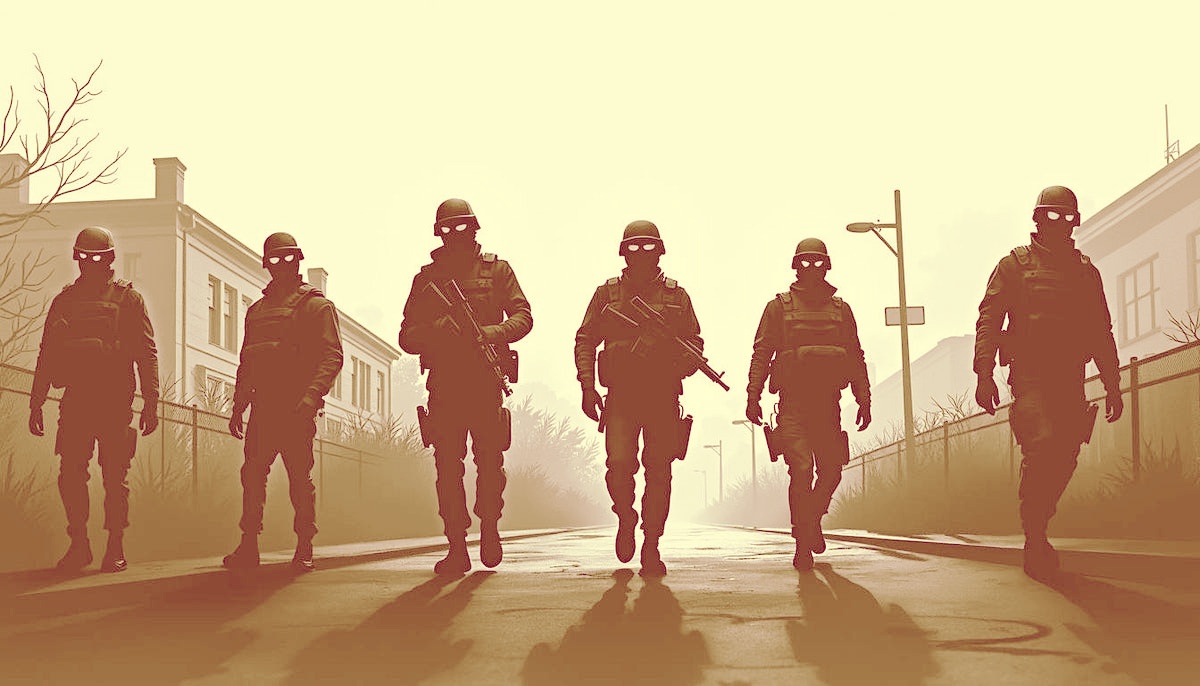
They wear the dull blue of state neutrality, but it is the mask that captures your attention. Not simply the cloth stretched across their faces, but the ancient mask—the one of which anthropologists speak. A mask that doesn’t conceal so much as transfigure. The ICE officer’s face is no longer a face. It is a liminal surface of ritual. Something between human presence and the erasure of that which makes such presence human.
In this suspended space—neither fully man nor pure abstraction—the officer becomes what the state demands: a vessel for its unspoken violence, a specter of control, a ghost in uniform with all identification wiped clean.
Anthropologists have long known the workings of the mask. Claude Lévi-Strauss, in The Way of the Masks, described how masks among Indigenous peoples mediate between the living and the dead, the visible and the invisible. So too with ICE: the supervising agent becomes an avatar of sovereign force through whom the silent terror of the bureaucracy is made flesh. Like a ritual dancer overtaken by ancestral spirits, he no longer acts—he is acted through.
Roger Caillois, in Man and the Sacred, deemed the mask an instrument of sacred terror—worn during initiations to instill obedience and fear So too does the ICE agent arrive—not as a man, not as a name, but as a mask. Next, the choreography of separation begins. The masked agent does not need to explain himself; his presence alone reflects the sentence. He invokes the law not with words, but with fists, handcuffs, and silence.
And the landscaper—brown-skinned, sweat-worn, unarmed—will be led across that veil of sorrow.
He who woke before dawn to shape the edges of another man’s lawn will now vanish into the edges of the state. He who mastered the topiary will now be trimmed from the nation’s image.
This is not an arrest. It is a rite. Not a raid, but a casting-out.
Not enforcement, but exorcism—performed by men whose faces are hidden because the system no longer needs faces to function. Only rituals. Only fear.
John Mack, in Masks: The Art of Expression, shows how identity is erased and remade under the mask. ICE masks do not merely conceal—they redefine. The officer, who once dreamed private dreams and whispered tenderness to his children, refuses to discard his mask and exits his soul. He becomes a functionary. His dreams become captured by the dungeon masters, they are no longer his own. They belong to Orwell’s sadistic bureaucrats, Kafka’s clerks and Foucault’s wardens. They are the unseen jailers born of trauma, who both shape and limit human experience. They have internalized systems of discipline and fear and have themselves become architects of weaponized misinformation and containment.
Erving Goffman, in The Presentation of Self in Everyday Life, describes how all human beings wear masks to perform their identity. But ICE is not just performing—it is performing power, a certain species of power. Its power is reflected as much by what it doesn’t say as much as it does say. It wears the mask of law, of order, of “follow the rules and you have nothing to fear.” Yet behind this militarized pageantry lies the same catastrophe: torn families, vanished bodies, the slow grind of fear turned into paperwork.
But perhaps no one knew the violence of the mask more intimately than Frantz Fanon. In Black Skin, White Masks, he describes how the colonized must wear masks to survive—masks of erasure. The ICE officer wears his mask to dominate. The migrant wears hers to disappear. She lowers her eyes. She moves silently. She learns the posture of deference and invisibility. This is the colonial theater ICE restages daily: the enforcer masked by law, the victim masked by fear. Fanon confronts the deeply entangled psychic formations produced by colonial domination, particularly the construction of Blackness as marked by dependency, negation, and internalized inferiority. Drawing on psychoanalysis, he illuminates how the colonial subject is not only politically subjugated but psychically fractured—alienated from themselves through the imposition of the white gaze. In Black Skin, White Masks, Fanon explores the lived experience of racism as a form of epidermalization, where the Black body becomes trapped in a historically saturated image—a mask that conceals, distorts, and disciplines. He examines how colonized individuals are conditioned to aspire to whiteness, and how this desire leads to a recursive sense of inadequacy and shame. The mask of ICE is the white gaze, the pervasive way that whiteness positions itself as the default, neutral, or objective standpoint, while nonwhite people are rendered visible only in relation to that norm—often as deviant, exotic, threatening, or inferior.
Nowhere is this more vividly illustrated than in the operations of ICE. This agency does not simply “enforce the law”—it manufactures the categories by which law is made meaningful. It decides who belongs and who is alien, who is visible and who is vanished. Through biometric databases, detention centers such as ‘Alligator Alcatraz’ and immigration courts, ICE embodies the productive function of power: it fabricates “illegality” through documentation, embeds fear into entire communities, and disciplines through a digitized machinery of normalization. It is not just a force of repression but a generator of social truths—about danger, borders, and citizenship. Like the carceral institutions Foucault studied in his masterwork, Discipline and Punish, ICE produces subjects: the deportable, the surveilled, the stateless, the dangerous, the insane—those who live under the gaze of a racialized and carceral power that does not need to be spectacular to be absolute.
Kristi Noem, dubbed “ICE Barbie” by detractors, appears cast not for her governance but for her costume: tight tactical gear that blends dominatrix fantasy with Homeland Security chic. She is the algorithmic dream of MAGA masculinity—law, order, and latex, all in one photogenic package. The militarized, hyper-feminized archetypes circulating in right-wing politics captures the appeal of ICE in the formation of libidinal politics. The militarized, hyper-feminized archetypes circulating in right-wing politics—embodied by figures like Kristi Noem—illustrate how state violence is increasingly aestheticized and eroticized. These figures do not merely represent authority; they perform it through a spectacle of control wrapped in sexuality, projecting an image of power that is at once punitive and desirable. In this context, agencies like ICE are not just administrative apparatuses but libidinal fantasies—fantasies of domination, purity, and order—that are consumed and reproduced through political media.
The fusion of tactical gear with gendered allure turns state power into a fetish object, one that invites the spectator not only to obey but to desire the machinery of repression. It is not the uniform alone that seduces, but the performance of sovereign femininity—authoritarianism in mascara and heavily applied fruit pigmented cocoa butter matte foundation lipstick—border control in high heels. Here, the erotic appeal of state violence circulates freely within the affective economies of the far right, turning fascist aesthetics into clickable content and militarized cruelty into culture war pageantry.
Camouflaged in anonymity, ICE agents move like shadows across sunburnt fields and cavernous warehouses. Cloaked in law and armored by silence, they descend with a quiet fervor into brown and black neighborhoods, intoxicated by the choreography of power. They do not knock on houses as men. They do not speak as men. They descend as instruments—impersonal, implacable. Trump has described the deportable as ‘vermin’, again echoing the vocabulary of Adolf Hitler.
And you, agents of chains and iron chambers—yes you!—standing behind the ridge, watching the man who only wanted to work—who only wanted to be left in peace—when will you finally realize what the mask really does?
It does not just hide the violence.
It is the violence.
They descend not in tanks or armored personal carriers, but emerge on foot, sometimes in plainclothes, sometimes in jeans and untucked shirts complimented by tactical gear, and sometimes in shirts and ties. And these ICE agents—unannounced, unmarked—step into the pageant of enforcement carrying M4 carbines and sidearms such as Glocks, having banned the Sig Sauer P320C pistol, which is a semi-automatic pistol chambered in 9mm. They do not say his or her name. They do not ask questions. They arrive like a firestorm, throwing flash bang grenades, suddenly and without explanation. Some prefer pepper spray once the deportable have been taken into custody. And then come the fists.
What follows their activities is neither the tidy efficiency of arrest, nor the sterile violence of handcuffs—but entry into a pride of place where knuckles and steel meet bone. Take our landscaper. He is thrown to the ground like a broken tool. His ribs absorbed the thudding grammar of rage. The ICE officer’s face is not hidden by his mask so much as it has been remade, retooled into something liminal, something that hovers between human and symbol, between the heat of presence and the chill of disappearance. In this suspended state—neither fully person nor pure abstraction—ICE become the perfect vessel for the public’s projected terror. You do not see the man. You witness what he has become: a totem of enforcement, a ghost of the state’s iron will.
The passersby glance, hesitate, then look away.
To become effective instruments of the carceral state, their violence must be sanctified by anonymity.
But this mask—the one worn by the ICE agent—does not connect. It severs.
It does not summon the spiritual realm but is planted firmly in the realm of the flesh. It does not mediate—it obliterates. It severs the landscaper from his dignity, his story from its setting, his body from the shelter of law. It reduces him to a target, to a quota, to a case number—a narrative cut loose from meaning, floating in the cold bureaucracy of exile.
Where the sacred mask once signified transformation, this mask imposes erasure.
Where it once invoked reverence, now it provokes silence and submission.
The masked agent does not transcend the reactive materiality of flesh to commune with spirit, nor does he ascend toward any higher calling; in fact, he descends. He descends not to be at one with the most vulnerable, with the crucified poor, but to bind them further to the machinery of abandonment. His is not the descent of the incarnate God who walks among the dispossessed, but of the imperial functionary who comes bearing neither healing nor solidarity, only the cold logic of discipline and obedience. According to Jenna Prestininzi of the Detroit Free Press,
A key feature of recent immigration raids has been immigration agents wearing masks. The Reuters/Ipsos poll found that 42% of respondents disapproved of the measure, while 38% approved. Among Republicans, 56% support immigration raids at workplaces, while 24% disapprove of the measure, per the poll results. Eighty-two percent of Democrats disapprove of the raids, with 7% approving.
On immigration agents wearing masks during raids, 70% of Republicans approve, while 12% disapprove. Among Democrats, 70% disapprove of the move and 15% approve.
Former Fox News personality Geraldo Rivera said: "I also think that this is the most humiliating, harmful, racist government policy I've ever seen executed."
"The targeting of Latinos is something that is …. absolutely appalling," he said. "They walk around now, the laborers on Long Island, worried that because they are Mexican, they're going to get scooped up and their lives are going to be ruined and they're going to be ... deported to Africa someplace. I think it's really it's really disgusting. It's lowbrow. It's something that I believe is shameful in every regard."
"I mean, it's one thing to have a tough border, stop them at the border and all the rhetoric, I don't care. Build a wall 100 miles high if you want to," he continued. "But if people have been living here for some time and a peaceable way and in a, in a way where they're law-and-order, God-fearing, you know, they love their families and what, and they're working hard ... why are you bothering these people? Why are you going after these people? Why are you targeting these people?"
I'm telling you, places like East LA, you know, very heavily, 10 percent of LA is undocumented, East LA is probably 50 percent — East LA is going to build a wall around itself to keep ... the immigration officers out," Rivera said. "And why in the world are they wearing masks?"….
"Why are they wearing masks?" Rivera repeated. "The cops don't wear masks. The FBI doesn't wear a mask. Nobody wears masks. Nobody. Because they're doing something honorable to protect the people. And yet only immigration officers wear masks. Yeah, it's because they're embarrassed by what they're doing. It's not for fear. It's for embarrassment that they are scooping up Juan and Maria, the meat packer and the poultry processor, or the babysitter or the lawn mower, and they're, they're ruining their lives. I think it's horrible."
Where Christ touched the leper, ICE scans and catalogs and creates algorithms; where prophets stood beside the broken, ICE records and neutralizes. The agent of ICE is the anti-incarnate presence without compassion, power without a face, action without a witness. His purpose is not revelation but erasure. Cloaked in anonymity, he becomes the veiled executor of state decrees, a silent emissary of a faceless regime whose only liturgy is control. He does not speak—he enforces. He does not see—he surveils. His presence is not embodied agency but the abstraction of power made flesh, a cold technician of rupture and repression. In his hands, violence is not passion but policy, not wrath but protocol. He arrives not as a man, but as an instrument—precise, disposable, and deniable—an avatar of the bureaucratic abyss.
And the man before him—the worker, the father, the neighbor—is no longer seen, only processed—what about him?
This is not the way of the mask.
This is its betrayal.
And he—this landscaper, this father of three Marines—is no longer a father. No longer a man with a name, a home, a prayer whispered before dawn. No longer a citizen of anything.
He is a body on the pavement, a shape bent beneath the weight of history, bureaucracy, and boots stomping on an innocent-built face.
He is brown skin pressed against sun-seared asphalt, as if the earth itself were being asked to swallow him. He is not a danger, nor a fugitive, nor a ghost—but he is treated as all three.
And what he offers—his years of labor, his lawful record, his soft voice, his sons in uniform—is not enough.
Because in the eyes behind the mask, there is no reciprocity, no recognition, no redemption.
Not your taxes.
Not your sweat.
Not even your sons, clad in the flag’s camouflage, offering their bodies to foreign soil in the name of a country that won’t acknowledge their father.
He lies there not because he broke a law, but because the law was built to break him.
He is not detained. He is dismissed.
Not judged, but disqualified—from belonging, from memory, from the story we tell ourselves about who we are.
And so he is led away, not like a man but like a warning.
A reminder to others: no offering is sufficient.
Not even your blood, if it runs the wrong shade of brown.
The raid becomes a ritual—a dark liturgy of power enacted not merely to enforce, but to remind. It is a performance not just of state control, but of national forgetting: forgetting the hands that built the garden walls, paved the driveways, cleaned the windows of the state itself. And, I would add, forgetting those that were tortured and killed when they did not do their ‘masters’ bidding. What do you expect, when Florida’s state standards for middle schools stipulated students must be taught that during slavery, the enslaved benefitted from their enslavement because they learned how to do agricultural work, painting, carpentry, tailoring, domestic service, blacksmithing, transportation. You get the idea. This is the shocking and shameful logic of domination.
ICE also sadistically dangles false promises to migrants who are being sent to gulags in El Salvador and Guantanamo Bay, imparting the message that they have forever blown their chances at US residency and citizenship. They manipulate Ernst Bloch’s notion of the “swindle of fulfillment”, (Betrug der Erfüllung) that refers to the ideological illusion propagated by ruling class institutions—such as media, religion, and education—that promises satisfaction, happiness, or redemption within the existing structures of US capitalism. In other words, the subliminal message of ICE is that that these migrants have forever missed their chance at heaven.
But as Roger Caillois wrote in Man and the Sacred, the mask in sacred rites does not only frighten—it initiates. And here, in the flickering fluorescence of a pre-dawn IHOP parking lot, beneath the grinning sign of pancakes and patriotism, a man is being initiated into the caste of the disappeared.
His crime is not violence. His sin is not deception.
His offense is his difference—his accent, his papers, his brownness.
The fists that land on his body are not just blows; they are symbols, rites of passage into statelessness. He is not simply arrested—he is transformed: from father to fugitive, from worker to warning.
His pain becomes a kind of flare, sent skyward for others to see: This land is our land, it is not your land. This land does not remember your labor. It remembers only your difference.
It does not recall the decades in which you showed up before sunrise.
It does not recall the taxes paid, the silence endured, the sons in fatigues.
It remembers only that you do not belong. And so you are cast out—not just from the country, but from its memory.
This is the ritual.
This is the forgetting.
And behind it all, the mask—cold, impersonal, sacred in its terror—remains fixed in place, performing the will of a nation that can no longer recognize its own inhumanity.
Where is his thank you? Where are the folded flags?
You can imagine him at home—quietly placing medals in a drawer, watching the news with a weary reverence, never suspecting that the same state his sons defend would one day press its knuckles into his father’s chest. That the land he landscaped would one day landscape him—remaking him, through violence, into something else: a statistic. A name mispronounced.
The officers vanish as quickly as they came. The bushes remain trimmed. The sidewalk is washed clean. The sun climbs higher.
And yet the ritual lingers.
It lingers in the bruises beneath his shirt, in the stunned silence of witnesses who do not yet know what they saw. It lingers in the soil he tilled, which now bears no fruit. It lingers in the unbearable irony that this nation demands service from those it refuses to see.
And in that moment, standing as a witness to the slow cruelty of empire, you realize:
He gave the state his sons.
The state gave him its fists.
He does not know—cannot know—that he is being watched. Not yet. But the watchers have already arrived. You see them before it registers that they are ICE—shadowy figures emerging at the edge of a field, the mouth of a warehouse, the doorway of a home. They wear the dull blue of state neutrality, but it is the mask that arrests you. Not just the cloth stretched across their faces, but the mask in the fuller, timeless sense: the ancient instrument of transformation.
And then there is Michel Foucault, who pulled the veil back on modern power in Discipline and Punish. He warned us: in the modern state, power is most effective when faceless, when it watches without being seen, when it strikes without leaving fingerprints. Society built as a panopticon. Jeremy Bentham’s Panopticon—unveiled like a dark flower at the dawn of modernity—is not merely a theory. It is a cathedral of dread, a temple built to the quiet tyranny of visibility.
Enshrined centuries later by Michel Foucault in Discipline and Punish: The Birth of the Prison, the Panopticon was more than architecture. It was a metaphysics of control: a circular prison where every cell opened inward toward an all-seeing watchtower. The genius—no, the horror—was that the prisoner could never know if he was being watched. And so, he watched himself.
The guard may not be there.
The eye may not be open.
But the fear is constant. And fear, in time, becomes internalized obedience.
The Panopticon is not enforced through beatings or cages but through sight alone—or rather, the possibility of it. It converts surveillance into theology. It makes the state omnipresent, not through strength but through suggestion. The prisoner becomes his own warden, his own confessor, his own snitch.
It is not the scaffold but the silence that disciplines.
And it did not remain in the prison.
It metastasized—into schools, offices, clinics, border checkpoints, apartment intercoms, algorithmic face scans.
It became the blueprint for a civilization built on observation.
The Panopticon is not gone. It has only become invisible.
Not a tower of stone, but a network of data. Not a guard behind glass, but a badge behind a mask cobbled together by algorithms of hate.
Not a cell, but a sidewalk.
Not a sentence, but a gaze.
A haunting parable for the age when eyes no longer need faces and power no longer needs a voice.
The image Foucault borrowed—and transformed—was originally drawn by the utilitarian hand of Jeremy Bentham in the late 18th century: a circular prison, ringed with cells like the chambers of a hive. At its center, a tall and silent watchtower. No floodlights. No barking guards. Just the possibility that someone might be watching—at any moment, from behind smoked glass.
The genius of this architecture was not in its iron bars but in its ghostliness. The guard may be absent, asleep, or long gone. But the prisoner cannot know. And so, he polices himself, adjusts his posture, disciplines his thoughts, censors his outbursts. The threat of vision becomes more powerful than vision itself.
Bentham designed it as a machine of order. Foucault revealed it as a blueprint of control—not just for prisons, but for schools, hospitals, factories, and eventually, the very soul of the modern citizen.
It is here, in this invisible Trumpian empire of perpetual maybe, that freedom begins to look a lot like obedience. And where the cage no longer needs to close—you simply remain in place, ever aware that you might be seen.
The masked ICE agent is this principle made manifest. He is anonymous, interchangeable, untraceable. He does not threaten you with his name, but with his erasure. His mask is not cloth. It is the bureaucracy behind him. It is the badge without a face, the law without a voice, a court, the system without a soul. And so you watch him—not the man, but the specter he has become. You see him move across the threshold, and you know what he carries beneath the veil. Not just shackles or handcuffs, but a mask that, when worn, transforms the everyday into a ritual of obedience, the law into fear, and the person into a tool of something vast and unseen. And in this moment, standing as a witness, you realize the truth: the mask does not just hide the violence.
The mask is the violence.
Finally, after three weeks in a detention center, the landscaper is released on bond. He still aches in his shoulder and from repeated punches to his head.
The masks worn by ICE agents are not the noble veils of the Lone Ranger or Zorro. They are not the mythic shrouds of Batman, whose anonymity served justice from the shadows. No. These are anti-masks—not donned to protect the innocent or defend the vulnerable, but to erase accountability, to cloak the state’s violence in facelessness.
Zorro wore his mask to strike fear into tyrants. The ICE agent wears his to shield himself from the eyes of the public as Mr. Barranco is dragged into a car to be carted off to a detention center. The Lone Ranger rode masked through the desert to uphold the law beyond the reach of corruption. The modern federal agent wears his mask as a uniform of impunity—a costume not of heroism, but of bureaucratic menace.
These masks are not symbols of rebellion but of enforcement—of a new kind of masked rider, not lone but legion, dispatched not to avenge injustice but to preserve the cold machinery of it. The mask wearers do not emerge from the shadows to rescue. They come at dawn, unannounced, expressionless, armored, as if shame itself had been engineered out of them.
In comic books, the mask conceals the man to amplify the myth. In the real world, the ICE mask erases the man altogether, so that cruelty may pass through our neighborhoods unrecognized, like smoke.
Where once the mask meant defiance against tyranny, it now signals its triumph.
Under the shadow of a gilded flag, the Trump administration has quietly turned the machinery of surveillance into a cattle chute. According to internal White House documents obtained by The Washington Post, the state is now fastening electronic leashes to the limbs of migrants—devices originally designed to track livestock across open plains, now repurposed to mark human beings like beasts of burden.
In a June 9 directive, Immigration and Customs Enforcement ordered its agents to bind every migrant in its so-called "Alternatives to Detention" program with GPS ankle monitors “whenever possible”—a phrase that clinks like chain metal through bureaucratic corridors. This single command could subject up to 159,000 people to a regime of digital tethering: men, women, children—all fitted with bracelets that buzz, track, and accuse, long before any courtroom verdict.
Their homes become transformed into perimeterless prisons, their skin blistering beneath the eye of machines first designed to track cattle.
This is not policy. This is branding the body.
And as the state expands its reach, so too does its chosen emissary: BI Inc., a corporate appendage of the private prison giant Geo Group, a firm whose genesis lay in monitoring livestock, and whose loyalty lies not with liberty but dividends. “We are very well positioned,” their CEO told investors—as though millions of human lives were mere entries in a growth forecast.
The ankle monitors, heavy as an iPhone, dig into skin. They chafe, bruise, and hum with the quiet menace of ownership. Some are wrapped around wrists—on pregnant women, as if motherhood itself were a conditional privilege.
The policy has blindsided immigrants like Paola, a 29-year-old Honduran mother who fled an abusive husband four years ago. Despite attending every court hearing and complying with check-ins while awaiting her asylum case, she was suddenly ordered to wear an ankle monitor due to ‘new laws’. "Maybe they've taken these drastic steps because many people don't show up to court," Paola told The Post. "But some of us do everything right and still get treated the same."
To the machine, compliance is irrelevant. What matters is the spectacle of control. The wristband is not about risk. It is about ritual—the visible marking of a class of people as less-than, as watched, as potentially disposable.
It has been called an alternative to detention.
But it is not freedom. It is freedom with an asterisk, freedom with a leash.
It is the transformation of freedom into conditional space, of dignity into a data point pulsing through satellite signals.
A country that once mythologized liberty now scripts its migration policy in the language of monitoring and control.
And so, the land of the free becomes a pasture of the surveilled—where your path is charted not by your choices, but by the silent hum of algorithms meant to keep you in a digital corral.
The terror is not of the mask itself, but of the day it ceases to be a mask—when cloth becomes cartilage, thread becomes sinew, and the pretense of restraint hardens into the very bone of the state. When Trump stretches out his hand, granting police departments in mostly Black cities a king’s writ to rule the streets as they please, the stage is set for the old pageant of power to stride out of the shadows and take the daylight. And in Washington, the police union stands like a choir awaiting its cue from a grinning Trump, ready to sing in the key of iron and asphalt—patrolling not as guardians but as lords, their power no longer borrowed but enthroned, each baton a scepter in the theatre of control.
Comments

Powered by RoundtableAn AI/DeFi-powered Enterprise Media Operating System. Learn more at Roundtable.io.© Roundtable 2026. By using this site you agree to the Terms of Use and Privacy Policy