
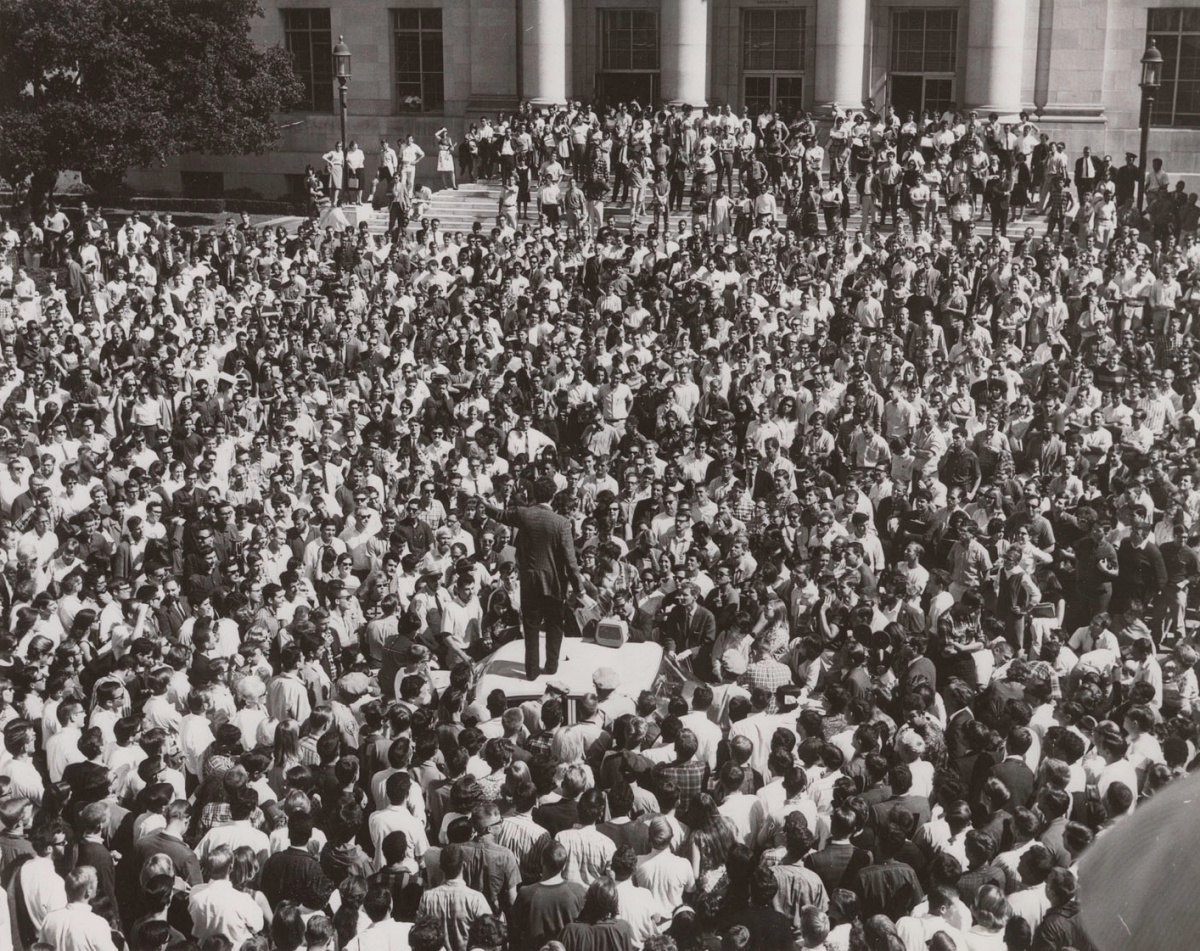
View of students in Sproul Plaza surrounding police car, October 1, 1964. Mario Savio speaking from roof of car. Wilson, Lon. Oct. 1, 1964. UC Berkeley, University Archives.


Oct 30, 2023 4:29 PM
Criticizing a government’s policies isn’t the same as hating its people. The world is tired of being force-fed this conflation.
Berkeley’s free speech activist Mario Savio once implored 1,000 students sitting in at Sproul Plaza to throw their bodies against the gears of the machine to demand a reversal of the university’s prohibition against political organizing on campus.
“There's a time when the operation of the machine becomes so odious, makes you so sick at heart that you can’t take part! You can’t even passively take part! And you’ve got to put your bodies upon the gears and upon the wheels, upon the levers, upon all the apparatus—and you’ve got to make it stop!"
Savio’s words still echo in the hallowed halls of UC Berkeley, where the steps in front of Sproul Hall, the Savio steps, are named after him and used as a platform for student speeches, performances and rallies.
But in a recent Wall Street Journal Op-Ed, “Don’t Hire My Anti-Semitic Law Students,” Steven Davidoff Solomon, a corporate law professor at UC Berkeley, grinds those gears to a halt denouncing the actions of Berkeley’s Law Students for Justice in Palestine and other similar groups that adopted organizational bylaws prohibiting supporters of what they term “apartheid Israel” from speaking at law school events. Davidoff, who serves as an advisor to the Jewish Law Students Association, rightfully expressed concern about this exclusionary stance.
Related stories
Meanwhile, I believe that cross-cultural competency is not only vital in the legal field, but also indispensable in the broader business environment. And the American Bar Association, which is the accrediting body of American law schools, requires ABA Standard 303(c), indicating that law schools “shall provide education to law students on bias, cross-cultural competency, and racism.” Notice the standard says “shall” and not “may.”
As an educator, I teach courses in Business Organizations, Property, and Environmental Law. I updated my syllabi and course preparation to be in compliance with these standards. At elite institutions, like UC Berkeley, these rules are selectively applied and enforced. Colleges and universities are sites of elite self-dealing.
For example, I observed that Berkeley Law’s administration has remained rather tepid on free speech issues. Dean Erwin Chemerinksy may be viewed as “a liberal,” but at the end of the day he is still the dean in a position of power, who benefits off the same racket I do of complaining of the demise of the U.S. Supreme Court. Dean Chemerinsky is lukewarm on issues of solidarity with Muslims and Palestinians. Furthermore, the UC Berkeley Law faculty leans conservative with figures like John Yoo, the author of the infamous torture memos, among its ranks. While the faculty boasts experts in fields such as national security, terrorism, human rights, and racial justice, many of them have built their careers commenting on, and even advocating for or against, topics like the War on Terror and the civil rights of Muslims and Arabs. Yet, there remains a stark underrepresentation of Muslim and Arab faculty within the institution.
The age-old defense mechanisms that shielded settler colonialism and apartheid are rusting, and the winds of change are relentless.
So let’s get one more thing straight: Criticizing a government’s policies isn’t the same as hating its people. The world is tired of being force-fed this conflation. The main headline from the Wall Street Journal on the same day as Professor Davidoff’s oped states, “Israel-Hamas War Is Tilting Global Power Balance.” Indeed, the world is tilting, shifting, awakening. The age-old defense mechanisms that shielded settler colonialism and apartheid are rusting, and the winds of change are relentless. In organizational theory, we call this system dynamics, which helps “people understand complex and dynamic systems and help them make better decisions” by “provid[ing] tools to investigate current decision making and to help decision makers learn.” The world around us has changed and become more connected, but we have insisted on sanctions, trade embargos and war, because we cannot accept the Majority World as equals. As such, we have fallen behind in trade and global economic competitiveness.
Berkeley with its proud history of dissent is once again in the eye of the storm. The curmudgeons of the academy, comfortably ensconced in their ivory towers, may scoff at the winds of change, but the rest of us feel it. We are the tempest. While some law professors are engrossed in the old ways, the Wall Street Journal’s front page doesn’t even support this position. Professor Soloman seems oblivious to the paradigm shift taking place right under his nose.
Then there’s the notorious bylaw, which is raw, audacious, and screams for change. While the law students’ approach may be contentious, their concern underscores a deep-seated frustration. By no means am I endorsing “Jew-free zones” or promoting prejudice, but I am advocating for understanding the root cause of such drastic actions. To dismiss them as mere anti-Semitism is to bury one’s head in the sand. As law professors, we need to be sensitive to our students’ lived experiences instead of being disgusted by their political stances.
Even GOP’s Vivek Ramaswamy warns of cancel culture, and senior editor of Reason Robby Soave supports him and urges consistency.
Just to be clear: This isn't about canceling; it’s about accountability. The law students of Berkeley are not only being prepared to argue cases; they are being forged to challenge systems. And if challenging the system brands them as unemployable, then perhaps the system is the problem.
To the legal employers out there: If you’re looking for a compliant, nodding associate, a Berkeley grad might not be your best bet. But if you want someone who’s unafraid to question, to challenge, to disrupt – Berkeley is where you'll find them.
Remembering the words of Savio, “There’s a time when the operation of the machine becomes so odious—makes you so sick at heart—that you can't take part.” Perhaps it's time to recognize that for many, that time has come. And rather than admonish them, we should applaud their courage.
Comments

Powered by RoundtableAn AI/DeFi-powered Enterprise Media Operating System. Learn more at Roundtable.io.© Roundtable 2026. By using this site you agree to the Terms of Use and Privacy Policy