


Sep 19, 2025 2:31 PM
I didn’t know anything about Kirk until someone shot him, but the four-wall media blitz that has followed the shooting has left me feeling both astonished and fascinated.
I’ve been reading Charlie Kirk. I wasn’t eager to hang out with someone so controversial, but as John Stuart Mill warned, “He who knows only his own side of the case knows little of that. His reasons may be good, and no one may have been able to refute them. But if he is equally unable to refute the reasons on the opposite side, if he does not so much as know what they are, he has no ground for preferring either opinion... Nor is it enough that he should hear the opinions of adversaries from his own teachers.... He must be able to hear them from persons who actually believe them...he must know them in their most plausible and persuasive form.” If I intend to challenge the views of conservatives, I have an obligation both to them and to myself to understand them on their terms. I’ve been reading their words for over a decade, and I think I’ve come to know them fairly well. Reading Charlie Kirk is just a continuation of that enterprise.
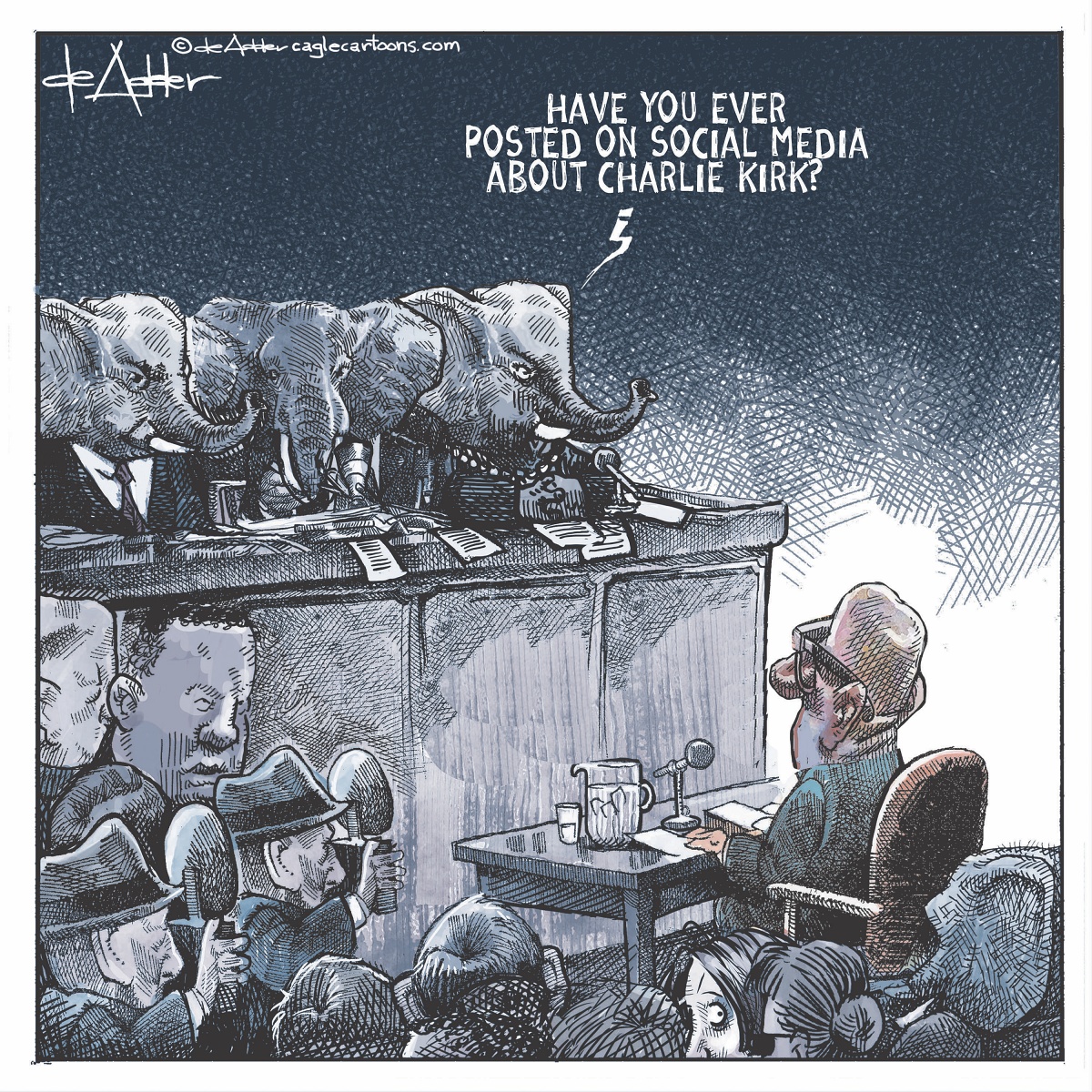
I didn’t know anything about Kirk until someone shot him, but the four-wall media blitz that has followed the shooting has left me feeling both astonished and fascinated. The adulation lavished on him from the right is matched only by the opprobrium flowing from the left. Who was this guy? Founder of Turning Point USA, Kirk was one of President Trump’s favorite MAGA ideologues, and when he died he was doing what he did best: recruiting college students to his cause.
“Charlie was the best of America,” Trump said. “An assassin tried to silence him with a bullet, but he failed because together we will ensure that his voice, his message and his legacy will live on for countless generations to come.” Trump was unequivocal about the cause of the shooting, saying “For years, those on the radical left have compared wonderful Americans like Charlie to Nazis and the world's worst mass murderers and criminals. This kind of rhetoric is directly responsible for the terrorism that we’re seeing in our country today....” He promised to find each and every one of those who contributed to this atrocity.”
So I needed to find out what made Charlie Kirk tick—I needed to learn what all the fuss was about.
Related stories
In his 2016 memoir, Time for a Turning Point, Kirk tells us, “I wanted to create the MoveOn.org of the right. MoveOn...was an incredibly powerful force for anti- American propaganda...” In contrast, he explains ,Turning Point USA, is “strictly an educational organization dedicated to teaching the values of free markets, the Constitution, and American exceptionalism.” No anti-American propaganda here, then, even if the idea of exceptionalism carries with it a self-assured belief in Manifest Destiny.
And in his 2020 book The MAGA Doctrine, Kirk writes, “‘Americans don’t like to be told what to do....Protecting individual liberty from the tyrannical forces of government is the idea our nation was built upon....” Is this what pro-American propaganda sounds like? Do we make America great again by decrying the tyrannical forcers of government? The Declaration of Independence offers an estensive list of specific indictments against the tyranny of George III. Here we see only the accusation. Kirk adds, “For anyone who has been waiting for a sunny day in America, maybe this book will show you a break in the clouds.”
For anyone paying attention, that break had opened memorably 1849, when Henry David Thoreau wrote, “I heartily accept the motto, ‘That government is best which governs least’....Carried out, it finally amounts to this, which I also believe, ‘That government is best which governs not at all’....The objections which have been brought against a standing army...may also at last be brought against a standing government....The government itself, which is only the mode which the people have chosen to execute their will, is equally liable to be abused and perverted before the people can act through it.”
Before Thoreau, in 1776, Thomas Paine wrote, “Government even in its best state is but a necessary evil; in its worst state an intolerable one,” and James Madison wrote,
“If men were angels, no government would be necessary.” John Adams called for a “wise and frugal Government, which shall restrain men from injuring one another, shall leave them otherwise free to regulate their own pursuits of industry and improvement.” More darkly, and with disturbing prescience, Alexander Hamilton declared,“Of those men who have overturned the liberties of republics, the greatest number have begun their career by paying an obsequious court to the people; commencing demagogues, and ending tyrants.”
Government is bad, autonomy is good. The theme is unmistakable. And with antecedents such as these, we might wonder what’s new, what Kirk thinks is different about his organization and his vision for America.
Some may have heard a faint echo of Ronald Reagan in Kirk’s remark about a sunny day in America; Reagan’s “morning in America” was not explicitly sunny, but it’s unlikely that Reagan himself visualized a cloudy morning. And Reagan also famously said, “Government is not the solution to our problem, government is the problem.” Kirk seems to echo this when he tells us that according to the MAGA doctrine, “Bigger is not always better. The role of government should be so small that it is barely noticeable.” Backstage we can hear Grover Norquist whispering, “I don't want to abolish government. I simply want to reduce it to the size where I can drag it into the bathroom and drown it in the bathtub.”
George Will, easily the most eloquent conservative writer of our time, seems to share this fundamental suspicion of government. In his 2019 meditation, The Conservative Sensibility, he writes, “By pruning the state’s pretensions and functions, conservatism prevents the emergence of an enveloping state....In a political setting that insists upon the reality of individual autonomy and the morality of self-reliance, some find solace in an omnipresent and omniprovident state....Conservatism’s great gift is preservation of the social space for personal pursuit of higher aspirations....”
Establishing these themes in the 1950s, Russell Kirk, the intellectual founder of Movement Conservatism, writes, “A state in which an individual or a small group are able to dominate the wills of their fellows without check is a despotism.” If nothing else, Charlie Kirk’s distaste for government has a formidable ancestry, both in the early days of our country and in our own times. And if it’s true, as he asserts, that Americans don’t like to be told what to do, then it’s likely that any government that seems to be doing that will appear despotic and oppressive, even if what that government is doing is trying to protect the environment, guarantee safety in the workplace, or assure that all Americans actually do enjoy equality of opportunity.
I certainly didn’t like it when my parents told me what to do. I may even have called them tyrants. In hindsight, though, I can see that they actually did know better, and they actually were doing their best to protect me and my interests from harm.
Perhaps that’s the key. Perhaps Charlie Kirk is only the most recent voice in a long line of conservative ideologues whose first concern has been to make their own unhindered choices, to protect their own interests, and to warn against the ambitions of government. Perhaps Charlie Kirk’s MAGA doctrine is nothing more than Movement Conservatism on steroids. He speaks and we hear the voices of Robert Welch, Phyllis Schlafly, William F. Buckley, Jr., Barry Goldwater, Ronald Reagan, and many others, all espousing the values articulated by Russell Kirk while claiming to be reaffirming the world view first elaborated by Edmund Burke.
In a meticulously argued critique of conservatism, published the year Reagan was elected to his first term and reissued with revisions twenty five years later, the British philosopher Ted Honderich declares, “The conclusion to which we come is not that conservatives are selfish. It is that they are nothing else. Their organized selfishness is the rationale of their politics, and they have no other rationale.” Organized selfishness? We might think Honderich has misunderstood the conservative preoccupation with the primacy of individual liberty and autonomy against the interests of the state, had not Russell Kirk himself written in 1982, “Conservatism has its vice, and that vice is selfishness.”
If Honderich and Kirk agree that conservatives are fundamentally selfish, does that mean that the Beatles also had it figured out when they sang, “All through the day, I me mine, I me mine, I me mine. All through the night, I me mine, I me mine, I me mine.” Surely there’s more to the politics of Charlie Kirk and others who share his views tthan just organized selfishness. If so, I haven’t found it yet, so I guess I’ll just have to keep reading.
Comments

Powered by RoundtableAn AI/DeFi-powered Enterprise Media Operating System. Learn more at Roundtable.io.© Roundtable 2026. By using this site you agree to the Terms of Use and Privacy Policy