


Jun 3, 2023 1:00 PM
I would argue that we progressives should not have an ideology. Values? Yes. But ideology? No.
On LA Progressive, political compromise is often criticized for failing to meet the test of ideological correctness, of being faithful to true progressivism. Such, I presume, was the basis of Jack Rasmus’s recent “Biden-McCarthy Deal: Neoliberal Fiscal Policy Continues.” I have admitted that it is difficult “for us progressives to get right the proper combination of passion, tolerance, and compromise” but that I admired Ted Kennedy as a politician who seemed to have struck a good balance.
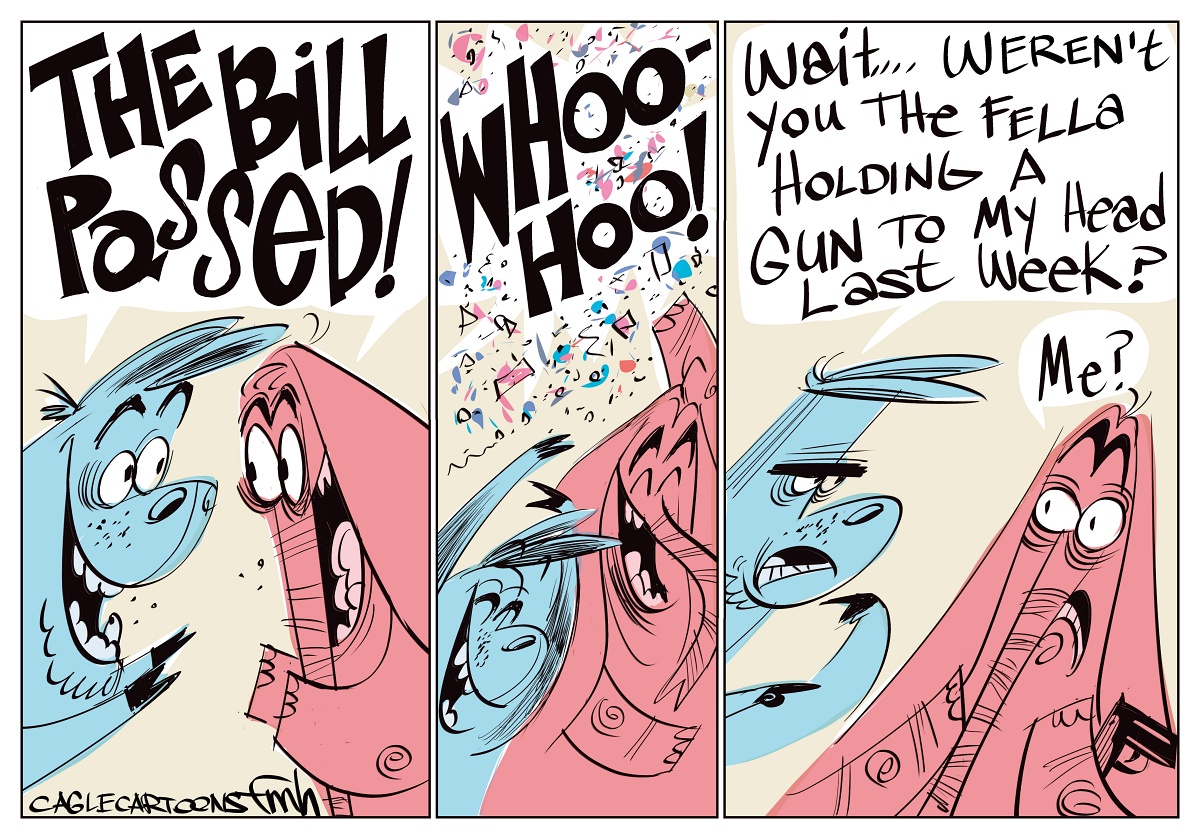
Likewise, I now think President Biden did about as well as he could have in getting Congress to approve the Fiscal Responsibility Act (the raising of the debt ceiling, etc.). Certainly the measure passed by Congress is far short of what progressives would prefer. And admittedly there are stipulations in it that progressives find distasteful. But to expect Biden to have achieved much more is unrealistic. Politics often necessitates compromise, and so it did in regard to the raising of the debt ceiling.
Rasmus’s criticism of Biden is based on two unproven statements:
- Both sides to the compromise “hide behind a claim that the economic sky would have fallen in had they not agreed. A dubious claim at best.”
- And“Biden clearly gave in far more than he needed to. One would have to conclude McCarthy and the Republicans came out ahead in the negotiations.”
Related stories
Dubious at best? I disagee. Biden gave in “more than he needed to?” Where’s the proof?
What irks many progressives—and I suspect Rasmus—is that the agreed-upon legislation compromises progressive ideology. No doubt it does. But I would argue that we progressives should not have an ideology. Values? Yes. But ideology? No.
In a 2012 LA Progressive article on “Ideology and Pragmatism: The Republicans and Obama,” I mentioned that Obama was more of a pragmatist in the tradition of philosopher William James, who eschewed ideologies believing them hindrances to realism. I also quoted former President Bill Clinton:
“This is a practical country. We have ideals. We have philosophies. But the problem with any ideology is that it gives the answer before you look at the evidence. So you have to mold the evidence to get the answer that you've already decided you've got to have. It doesn't work that way. Building an economy; rebuilding an economy is hard, practical nuts and bolts work.”
That essay also cited someone from the Right, Russell Kirk (1918-1994), sometimes labeled “the Father of American Traditionalist Conservatism.” In his essay “The Errors of Ideology” he wrote, “Ideology makes political compromise impossible: the ideologue will accept no deviation from the Absolute Truth of his secular revelation...Ideologues vie one with another in fancied fidelity to their Absolute Truth; and they are quick to denounce deviationists or defectors from their party orthodoxy...The evidence of ideological ruin lies all about us.”
When Kirk wrote that piece, he thought ideologues were mainly on the Left, but by 2012, and still today in the USA, they are mainly on the Right (thanks in part to the Tea Party movement). But they can be on either side.
In 2015, in his address to the U. S. Congress, Pope Francis used the word dialogue a dozen times. He stated that “a good political leader is one who, with the interests of all in mind, seizes the moment in a spirit of openness and pragmatism.” He eschews rigid dogmatism and intolerance and believes that people should reason together to advance the common good, which he added should be “the chief aim of all politics.”
Two years earlier, in a sermon, he warned Christians against making their religion into an ideology: “When a Christian becomes a disciple of the ideology, he has lost the faith...But it is a serious illness, this of ideological Christians...His attitude is: be rigid, moralistic, ethical, but without kindness.” He urged Christians “to remain humble, and so not to become closed.”
The reminders about avoiding intolerance, embracing humility, and seeking the common good are all pertinent, and speak to maintaining good values. In a 2010 LA Progressive essay on “Health Care Reform and Liberal Values,” I stated that “the chief values I associate with liberalism are compassion (or empathy), tolerance, pluralism, and rationality.” Although progressivism and liberalism are not the same, those values are also ones progressives should embrace.
As the pope said, the aim of congresspeople should be to achieve the common good. Not what lobbyists want, not what constituents who will help us get elected want, not even what we think might be good for us individually—like paying minimal taxes if we are rich—but the common good. And we need humility to realize that what we want may not always be synonymous with the common good. And we need empathy, as Barack Obama once wrote, ”to stand in somebody else's shoes and see through their eyes.”
In negotiating with House Republicans, Biden deserves credit for appointing as one of his two chief negotiators Shalanda Young, director of the Office of Management and Budget, the first Black woman to hold that prestigious top budget job. For more than a decade she had worked for the House Appropriations Committee, helping to negotiate compromises.
After the director’s job became available, The Washington Post reported that “top House Democrats and the Congressional Black Caucus immediately called on Biden to elevate Young to the position.” After Biden appointed her as one of his top two negotiators to reach a deal with Republicans, an NPR correspondent noted that her approach was “pragmatic” and that “finding compromise even in the most toxic of environments...earned Young the trust of both Republicans and Democrats.” NPR also reported that House leader Kevin McCarthy said, “Everybody in this place knows her, respects her greatly.” And the Post quoted Rep. Patrick T. McHenry (N.C.), who was a key GOP debt-ceiling negotiator, referring to Young and her Democratic colleague (Biden adviser Steve Ricchetti): “They’re a highly credible team, they’re a tough negotiating team; these are tough discussions that we’re having...But they’re honest. We’re honest with each other.”
In negotiating with Republicans Young says, “I want to know their value statements and they need to know mine. And we have to find a middle ground.” In addition to her honesty, I think what Republicans value about her is that she displays respect toward them. Maybe we could all learn something from her.
Comments

Powered by RoundtableAn AI/DeFi-powered Enterprise Media Operating System. Learn more at Roundtable.io.© Roundtable 2026. By using this site you agree to the Terms of Use and Privacy Policy