
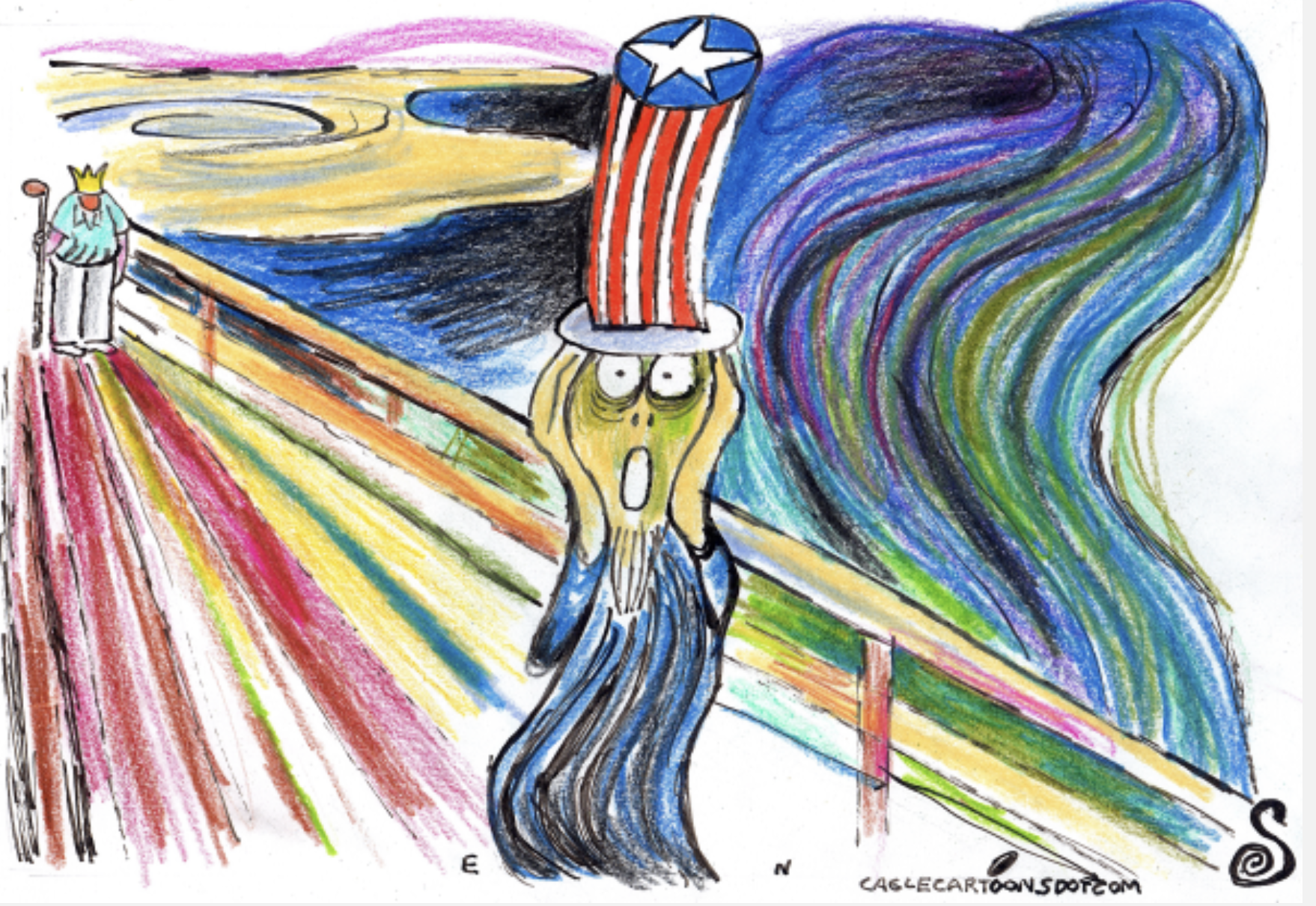


Quiet Courage of Dissent
Apr 20, 2025 2:23 PM
Foreign gulags, constitutional amendments and the casual menace of state terror.
Twice in a week, and with the casual menace of a man who believes himself above history, the Trump regime has uttered the unspeakable—not in the shadows, not behind closed doors, but before the full light of the press: the intent to disappear American citizens, to exile them to foreign gulags, outside the reach of due process, beyond the Constitution’s fading grasp. What was once floated as a dangerous fantasy has now been spoken again, and this time, it bears the chilling repetition of a plan being tested in the public square, waiting for its moment to become lawless decree.
President Trump confirmed it himself: he has asked Attorney General Pam Bondi to explore the legality of exiling Americans, of rendering them unto prisons beyond our borders, beyond the reach of their rights, as if citizenship were a cruel cosplay costume to be torn away at will.
Experts say it is illegal but in the language of authoritarianism, the law is not a boundary—it is a wall to be bulldozed, reshaped by those who see justice as an obstacle, not an ideal.
Twice in a week. This is not a slip of the tongue. It is a test. A signal. A crack in the dam.
Related stories
Trump welcomed into the White House a man who proudly calls himself “the world’s coolest dictator”—a man who reveled in receiving Trump’s undocumented deportees, funneling them into prison torture centers with sadistic glee. And worse still, he delighted in the possibility—spoken aloud by Trump—of sending American citizens into those very same Salvadorean dungeons, should they be deemed undesirable.
It was not just an alliance of convenience, but a shared fantasy of repression, a mutual admiration rooted in the gleeful abuse of power.
Once, such acts were whispered behind the iron curtain or scribbled in the margins of dictatorships. Now, in the twilight of American democracy, they are spoken aloud, with a straight face, by a president of the United States.
Let us be clear: this is not politics as usual. This is terror by decree.
And the rights of prisoners—American prisoners—are already dissolving faster than memory. According to recent reporting, the incarcerated migrants today, under Trump’s warped idea of justice, enjoy fewer protections than those held in the Japanese internment camps of World War II—those dark pages of our past we once swore never to turn again. At least in those days, the state acknowledged its captives. Today, Trump dreams of disappearing them altogether. Let that truth settle in one’s bones: we have crossed a moral threshold we once vowed never to approach again.
What was once unthinkable is now policy in waiting.
History does not repeat, but it rhymes in blood and silence. We have seen this before—in regimes where truth was criminal, where dissent was a deportable offense, where fear walked the streets in uniforms of law.
Now, the question is not what Trump will do.
The question is what we will allow.
The Trump administration has floated an idea so chilling it should stop the heart of the republic itself: the forcible disappearance of American citizens into foreign gulags, without trial, without charges, without the constitutional protections that are the birthright of every person under the flag.
We, as American citizens, are on a journey that leads not merely beyond the rule of law, but into the abyss where tyrants thrive. It is not a whisper behind closed doors. It is policy spoken aloud, normalized by repetition, daring us to look away.
And this is not an idle threat. This is the machinery of state terror, beginning to turn.
We fail to recognize—at our peril—that legality holds no weight in the theater of the strongman. In this grim play, the law is not a boundary but a prop, a costume to be worn or discarded depending on the scene. Power defines its own permission, and the louder the crowd roars, the more absolute that permission becomes.
The Constitution—once held sacred, passed reverently from hand to hand like a living scripture of freedom—is now treated like parchment soaked in gasoline, its ink running, its promises trembling at the edge of a matchstick. The oath to uphold it has been reduced to a formality, recited with all the sincerity of a snake oil prayer. And somewhere in the background, the torches are lit.
If you listen closely you can hear the guttural cheers rising from the crowds in their red hats, their eyes glazed not with patriotism but with a hunger for vengeance, a craving for spectacle. To them, the rule of law is not a safeguard but a suggestion, a quaint relic of a softer age, when restraint was mistaken for weakness, when decency was scorned as the posture of the timid, when virtue dared to restrain power.
And now, in this blasphemous theater, the Constitution is interpreted by court jesters in robes, men and women in MAGA hats, who twist its clauses like scripture in the mouths of false prophets. Deception is no longer cloaked—it is paraded in daylight, dressed in Sunday best, and preached with the practiced cadence of a sermon from the pulpit of hypocrisy.
We were told to watch for boots and banners, for uniformed salutes and shattered glass. But we forgot how fascist tyranny often arrives—not with jackboots, but with judges, not with gunfire, but with legalese and raucous applause.
This is no longer a question of policy. It is a question of whether we still recognize the difference between law and lawlessness, between the voice of a free people and the chant of a mob begging to be ruled by its basest desires.
We are not drifting toward the abyss. We are marching.
And still we ask: can this happen here?
It is happening.
Trump does not speak in metaphor. When he speaks of disappearing Americans, he means it.
And what awaits in those foreign prisons, if this darkness takes hold? What awaits those who fall out of favor with the regime, or speak too loudly, or refuse to kneel? What justice? What defense?
Already, we know: less than what was offered in the darkest days of our own past.
Trump dreams of something more sinister: a vanishing. No charges. No hearings. No names on record. Just citizens, disappeared.
This is not hypothetical. It is not theater. It is the slow, deliberate erosion of the rule of law—scraped away, inch by inch, clause by clause—replaced by the whims of a narcissist president intoxicated with vengeance, a man for whom loyalty is the only virtue and punishment the only justice. He is cheered not in spite of his cruelty, but because of it, by a following that mistakes brutality for bravery, and domination for leadership.
And history is not silent. It is never neutral. It does not pass by as a spectator in the stands. It screams in righteous fury. It records, indicts, and condemns, long after tyrants are dust and empires are rubble. It does not forget.
Walter Benjamin’s Angel of History hovers still, its wings caught in the storm of progress, its back forced forward by winds it cannot escape, yet its eyes cast eternally backward—beholding the wreckage of what we once called civilization. The angel sees the Constitution set alight in the town square, hears the cries of the disappeared echoing through foreign cells, watches the red-capped mob raise their fists to the sky while justice lies bound and gagged beneath the flag.
That angel sees us now.
And what will we offer in return? Silence? Shrugs? A third news cycle and a forgetting?
Or will we answer?
Because this moment is not merely one of political crisis. It is a test of national character. And history has no sympathy for those who failed it by pleading ignorance or indifference.
It is watching. It is judging. And it is waiting.
The Constitution groans under the weight of those who waited too long. Who thought the line would hold. Who believed no leader would dare. But tyranny always dares—and it begins just like this: with a test. Then another. Then a silence that seals the fate of a nation.
This is the test. And this—this—is the sound of the silence being broken.
Donald Trump stands before a sprawling map of the world, his gaze fixed, his Sharpie at the ready, tracing the invisible borders of his ambitions. His lips pucker into a half-smile, smug and self-assured, the kind that only a man who believes himself to be the puppet master of fate can wear. He sees not a world of nations, but a chessboard, and in his hand, he holds a piece of strategy meant to thrill the feral hunger of his base.
It is a plan perfectly forged in the fires of their fears and resentments, designed to tantalize their darker appetites—an offering of schadenfreude that dances just out of reach, but never quite slips away.
He speaks of migrants as though they were nothing more than pieces in a game, pawns to be swept off the board and cast beyond the reach of the American justice system, where they might fall into the shadows of foreign lands. With each word, he promises deliverance to the souls who have longed for the spectacle of others' suffering, believing that in this cruel gesture, he will cement their loyalty. But in his eyes, there is something more—an icy calculation to exorcise the demons of law and order from those who dare to challenge his vision. And so, in his fevered quest, he casts away not just bodies, but justice itself, scattering it across the globe like refuse, convinced it will never return to haunt him.
Kilmar Armando Abrego Garcia is not a name that should echo through the halls of injustice — and yet, here we are.
He is 29 years old, a husband to a U.S. citizen, a father of three young children who once ran barefoot through the green backyards of Maryland. He has resided in the United States for fourteen years. A man who woke each day and went to work beneath the promise that America makes to those who follow its rules: play by them, and you may stay.
But on March 15, 2025, that promise was shattered like glass beneath the boots of a regime that no longer bothers with masks. He was deported back to El Salvador, to the infamous incarceration complex. The Trump administration called it an "administrative error." A clerical shrug. A paperwork hiccup.
But it was no mistake. It was a message written in deportation ink.
Years ago, in 2019, a judge examined Abrego Garcia’s case — weighed the evidence, heard the arguments, and granted him withholding of removal — a rare and sacred designation under American law. It meant that, even if not a full citizen, he had earned a place. He had, legally, the right to remain. The Department of Homeland Security issued him a work permit. And with it, Abrego Garcia built a life. Paid taxes. Raised children. Lived quietly in Maryland.
But none of that mattered when the machinery turned.
In the crude theater of Trumpist politics, Abrego Garcia’s was cast as the villain before the script had been written. The administration accused him — without charge, without trial — of being a member of MS-13, a gang he has never belonged to, and which no court has ever found him connected to. Not a single conviction. Not a single charge. Only the whisper of suspicion, amplified by a regime that feeds on fear the way wolves feed on blood.
He was ripped from his home, flung from the country by agents who ignored court orders and due process. The gears turned, the plane lifted, and Abrego Garcia’s — a man who had followed the rules — was deposited not just into exile, but into a prison cell in one of El Salvador’s notorious incarceration centers. Not because of who he is, but because of what he symbolized: a brown man with roots in American soil, thriving quietly.
To the regime, that was threat enough.
So they called it a mistake. As if due process could be deleted with a keystroke. As if the cries of his children, now sleeping fatherless, were just background noise in a bureaucratic opera.
Kilmar Armando Abrego Garcia did not disappear.
He was disappeared.
Erased not by law, but by a lie dressed in the language of national security. And now, behind bars in a homeland he fled, he waits — not just for justice, but for the country that betrayed him to remember the meaning of its own laws.
In open defiance of the Constitution, in full contempt of court, beneath the unflinching gaze of Attorney General Pam Bondi, the Trump-controlled Department of Justice moved like a shadow across the threshold. There was no hesitation, no reverence for the law — only the ruthless rhythm of an administration that had ceased to recognize limits.
They did not knock.
They did not pause.
They vanished him.
Lifted Abrego Garcia from the soil he had tilled with hope, from the life he had woven in Maryland — a home, a name, a place in the American story — and cast him into the bureaucratic abyss, where paperwork becomes a shroud and exile is delivered by stealth.
This was not deportation. This was abduction under the flag of unchecked power. This was a message: the law is no longer the line that guides us — it is the line we dare you to cross.
And Abrego Garcia? He became a ghost not of crime, but of compliance — a man sentenced not by court, but by cruelty masquerading as governance. Recently they plucked him from the iron jaws of a Salvadoran prison—a place where shadows threatened and time forgot its name—and placed him in a cleaner cage, dressed in the illusion of mercy. But the setting was a theater, the script penned by the state, and the visiting American cast as an unwitting actor in a pantomime of reform, staged to give the world the scent of retreat without surrendering the war.
Trump has learned that the further one exiles a body, the fainter its cry becomes. He now supposes that if a deported Salvadoran falls in the forests of Soyapango or vanishes in the night of San Miguel, the Constitution does not hear it. The Supreme Court, to him, is a local ordinance, a town crier whose voice does not echo beyond the walls of Washington. And so, he casts people away, not just across borders but into legal oblivion—beyond the reach of judges, beyond the hands of habeas corpus, into the hush of sovereign silence.
El Salvador, to him, is not a country—it is a silence, a void, a place into which problems can be exiled and stories can be erased. It is, in this architecture of cruelty, a juridical oubliette. And into this oubliette, he casts human beings like unwanted stones, with the full knowledge—or perhaps the monstrous indifference—that the law cannot chase them there.
This is not deportation. It is disappearance dressed in bureaucracy. It is the same logic the Nazis used when they pushed their atrocities eastward. When they built Treblinka, Sobibor, Majdanek—not in Berlin or Munich or Frankfurt, where German judges might one day recall the idea of conscience—but in the dark corners of occupied Poland, where legality was already a corpse and the dead would have no one left to testify for them.
What Trump has rediscovered, perhaps intuitively, is what tyrants have always known: that geography can be a weapon. That you do not need to erase a law if you can simply outflank it. That if you push human suffering far enough away, you can pretend it is no longer your concern.
But sovereignty is not a magician’s trick, and justice is not blindfolded so she can look away.
To deport a person to danger and then slam the door shut against their return is not merely neglect. It is collusion with death. It is the creation of zones of moral impunity, where American power still casts a long shadow but refuses to bear the weight of its consequences.
And make no mistake: these are camps, if not by architecture then by purpose. Camps of abandonment. Camps of expulsion. Camps that prove the experiment of humanity can be paused, reversed, and suspended at will, as long as you build them just beyond the border, where the Constitution holds its breath and the cameras forget to look.
We have seen this story before, and it does not end with deniability. It ends with testimony, with reckoning, with the slow march of ghosts returning to say: you knew.
Trump thinks geography is absolution. That if you deliver a body to a distant graveyard, you have not killed it. That if you deport someone into violence, but shut the door behind them and throw away the key, then you are clean. This is not deportation—it is banishment, a sentence etched in the invisible ink of cruelty, its meaning known only to those who dare look close enough to see the lines of despair it outlines. It is a quiet, sinister shrug at the face of fate, a gesture that pretends to be nothing more than a logistical necessity, when in fact it is a death sentence, delivered without a voice, and signed in the dark. This is not the act of a government enforcing its laws; it is the procedural drowning of humanity, a flood of bodies swept away in the current of bureaucracy, leaving no trace but the scent of erasure.
And here, in this hollowed-out theater, Donald Trump plays his part with the same cold detachment that history has witnessed before. He maneuvers the chess pieces with the same logic that once sent Hitler’s concentration camps to Poland, Czechoslovakia, Belgium, Estonia, Italy, Latvia, Lithuania, Holland, Yugoslavia, Norway and France. It is the same ambition, the same hollow thirst for power, dressed in the garments of security and order, a mask to hide the monstrous face beneath. A world of shadows waits, and in the darkness, Trump's steps echo with the quiet certainty that once the game begins, the world will tremble in its wake.
The Nazis understood this heresy all too well. They built their most terrible machinery not in the heart of the Fatherland but at its trembling periphery. They did not burn the bodies in Berlin; they burned them in the forests of occupied Poland. Chelmno. Sobibor. Belzec. These were not random locations. They were chosen like oubliettes—dungeons of denial, places where the law was already weak and the witnesses fewer. Jurisdiction, like conscience, was treated as a matter of convenience. As long as the camps were somewhere else, the Reich could claim ignorance or innocence, even as the ash rained down like blackened snow.
Trump, in his crude way, is attempting the same sleight of hand.
To exile someone to El Salvador and then declare that the courts cannot touch what lies beyond their maps is to carve out a gray zone of impunity. It is a legal Bermuda Triangle, where citizenship, rights, and humanity vanish without official notice. He does not have to build camps—he merely has to identify nations already broken by decades of war and poverty, many of them shaped by America’s own Cold War interventions. He needs only to deport and deny, to shrug and deflect. What happens next is none of his business. The torture is not televised. The screams are in Spanish.
There is a deeper exile than geography. It is the exile from decency. And in that landless place, Trump has made his kingdom. He governs a republic of betrayal, whose borders are drawn not in maps, but in acts of cowardice: deportations into danger, silences amid slaughter, alliances abandoned like corpses on a battlefield. He believes he will not be held to account because the bodies fall far from the cameras, because the smoke does not reach Mar-a-Lago, because the Constitution does not yet speak in the tongues of the dead. But history does. And it will.
A nation cannot deport its guilt. There are no flights out of moral history. You can cast the exiled into the dark, but the ledger remembers. And the ghosts, like water, will find their way back through the cracks. They will haunt the halls of government, drift through the corridors of law, whispering the names of those who knew and did nothing. The distance between the decision and the disappearance will one day collapse. And in that moment, we will not be able to say we did not see it coming. We will only be able to say we looked away.
When we speak of state terrorism, the mind is drawn like iron to a lodestone, to two thunderclaps in the stormy theater of history—the Jacobin Reign of Terror and the Yezhovshchina or Soviet Great Terror. These are the infernal twins that stalk the imagination of every historian and every citizen who has tasted the bitter wine of tyranny cloaked in the garb of justice.
The Reign of Terror in Revolutionary France—that crimson baptism of the Republic—was the moment when Liberty, once a radiant maiden, became a blood-drenched Fury. The guillotine, that mechanical altar, rose not as a symbol of justice but as an idol demanding sacrifice. Robespierre, the high priest of virtue corrupted, proclaimed the union of terror and morality. “Terror is nothing but prompt, severe, inflexible justice,” he said—and thus the state, intoxicated by its own righteousness, devoured its children in the name of salvation. The people were told they were free even as their necks met the blade.
Then, we are swept eastward through time, to the frozen heart of Stalin’s Soviet Union, where the Great Terror was not a public spectacle, but a silent machinery of fear. It moved in shadows and struck at midnight, with boots on the stairs and the whispered knock that meant disappearance. There were no crowds here to cheer or to mourn—only the emptiness of vanished lives, rewritten histories, and confessions chiseled from flesh. In this theatre, the state was not a fiery goddess but a faceless god—a presence that saw all, knew all, and spared none.
Both terrors are monuments to the same dark revelation: that the state, when it seizes the monopoly not only on violence but on meaning, becomes a forge of nightmares. When the sword is wielded not in defense but in purification, it becomes an instrument of divine cruelty, slashing aside not merely bodies, but truth itself.
And of course, there was the Reign of Terror in Nazi Germany.
Not a reign of chaos, but of cold precision, of the bureaucratized destruction of the soul. It did not begin in the camps—it began in the classroom, the newspaper, the whispered joke, the neighbor’s silence. It began with people looking away on Kristallnacht, the “night of broken glass” when German Nazis attacked Jews, smashed their stores and burned their synagogues.
It was the terror of a nation that had been seduced into believing cruelty was a form of strength, that greatness required scapegoats, that purity required sacrifice. The streets were orderly, the trains ran on time, the uniforms gleamed. But beneath the steel and spectacle was a culture soaked in fear and submission. It was not only the Gestapo who enforced it—it was the teachers, the secretaries, the shopkeepers, the sighs of neighbors who said, “What can we do?”
And yet—not all bowed.
There was a whisper in the heart of that darkness. A whisper made of paper and of blood. A whisper that became the White Rose movement.
Sophie Scholl, only twenty-one, stood with protest leaflets in hand, not bombs. Words, not bullets. She and her fellow students at the University of Munich—young, bright, marked for death—did not believe the lie that terror was too strong to be resisted. They scattered truth like seeds in a poisoned field, believing it would grow, even if they would not live to see the harvest.
They stood not because they believed they would win, but because they knew that to remain silent was already to lose. Sophie stood before the shimmering blade of the guillotine and her executioners and said, ““How can we expect righteousness to prevail when there is hardly anyone willing to give himself up individually to a righteous cause? Such a fine, sunny day, and I have to go, but what does my death matter, if through us, thousands of people are awakened and stirred to action?”
She did not weep. She did not beg. She bore witness.
The state may wield terror. But it is the conscience that bears eternity.
We must remember the White Rose—not as a romantic relic of history, but as a mirror. For if cruelty rises again—and it has—it will not be in the same uniform. It will come draped in flags and laws and talk of "efficiency." It will come with a smile, calling itself great again. And when it does, it will ask each of us not for our soul, but for our silence.
And so the call is this: If we are to be great, let it be in the way of the White Rose, not the red capped mob that assaulted the Capitol. Let it be in the refusal to dehumanize, to decry migrants as ‘vermin’, to contemplate sending citizens to torture prisons in other lands. Let greatness be found in the courage to speak freely, in the trembling but steadfast choice to say no when the world is cheering yes.
Because in the end, terror builds nothing. But conscience plants a seed that no tyrant can destroy.
And so, these terrors echo still—not as relics, but as omens. For every era builds its guillotines, some of steel, others of surveillance; some thunderous, others silent as frost. The state that believes it alone defines righteousness will always find the gallows too tempting to resist. And every people must learn, again and again, that justice without mercy, and power without humility, are merely terror in ceremonial dress.
There are moments in a nation’s life when the veil slips, when the mask of civility cracks, and we see—not who we wish to be—but who we have become. The first Trump presidency was such a moment. And if we quiet ourselves long enough to look directly into that mirror, we will see something ancient and more terrifying than a single man or woman. We will see a culture—our culture—built on cruelty, sustained by it, addicted to it.
When we speak of state terror, we often reach backward—toward the bloodied blade of the Reign of Terror, or the steel mechanisms of Stalin’s purges. We comfort ourselves by imagining such horrors as foreign and long ago. But America’s version was televised. It was tweeted. It wore a suit of algorithms. We all saw it.
In 2015 it walked down a golden escalator and grinned for the cameras. Not long after it was tearing children from their mothers’ arms. They called it zero tolerance, but it was never about justice. It was about breaking the bond of blood to send a message.
Under the Trump regime, a policy was born not in silence but in cruelty—a machinery of separation that tore children from their mothers and fathers at the southern border, cast them into cages, and renamed this violence “procedure.” More than 5,000 children were taken. Infants wept in courtrooms, toddlers rocked themselves to sleep on concrete floors, and the government kept no map, no ledger, no plan for reunion. These were not administrative errors. They were calculated omissions—the cost of a strategy that saw children not as human beings but as pawns.
And for a year and a half, they lied.
They lied to Congress, to journalists, to the American people. First, they denied it altogether, as if the cries of children were a myth. Then, when the truth bled through the walls, they said it wasn’t the intention. “Collateral damage,” they shrugged, as if trauma could be excused by a legal footnote. As if prosecuting parents could ever justify the erasure of their children from their arms and memories.
But separation was not a side effect. It was the point. A spectacle of state terror designed to intimidate the desperate. To teach the refugee that in America, the land of liberty, your family is a bargaining chip—and your pain a public deterrent.
This was not policy. It was punishment. It was cruelty, codified.
The legacy of this moment will not be measured in immigration statistics. It will be measured in the scar tissue of children, in the mothers who still do not know where their babies are, in the fathers who stood before judges pleading not for leniency, but simply to see their child’s face one more time.
History, if we are lucky, will one day call it a disgrace.
But until then, we must call it what it is now: a crime against the most vulnerable, authored in the name of a flag that should have known better.
This was not incidental. This was not bureaucratic drift. It was a sadistic policy, born of vengeance and shaped for applause. It was, in its purest form, cruelty as ideology.
And in 2024 we returned to the scene of Trump’s crimes, as if history’s fire has warped the mirrors of memory, bending truth and time until we no longer recognized ourselves. Now we stand isolated—our closest friends and allies cast aside or betrayed, while our most dangerous foes grow bold with impunity. We watched, some in silence, some in complicity, as Russia set out to grind a sovereign nation into dust. And in the face of this brutality, Trump did not stand with the victim—he mocked them. He humiliated Ukraine on the world stage, not as a misstep, but as a deliberate spectacle, a performance of cruelty for political gain.
Donald Trump did not invent cruelty in American politics. But he made it the main event. He transformed it from a hidden vice into a public virtue. In Trump’s America, cruelty is the tie that binds the powerful to the powerless—not through duty, but through domination. He governs like a man settling scores, not stewarding a nation. And his followers do not merely tolerate this—they thrive on it. They feed on the spectacle. They laugh at the pain. They rejoice, not despite the cruelty, but because of it.
This is the deeper terror.
Because behind the narcissism of the man stands the mirror of the culture. A culture that has long taught us that weakness is contemptible, that empathy is naïve, that the highest form of success is the ability to crush your enemy without remorse. A culture built on zero-sum fantasies and reality-show humiliation. A culture of winners and losers, where the worst thing you can be is vulnerable—and the highest moral calling is to never, ever be held accountable.
And Trump, in his theatrical, festering narcissism, is the perfect high priest of this cruel religion. His psyche is a void that demands constant affirmation, and his rage is always turned outward—toward immigrants, women, Black athletes, journalists, the disabled, the dead. To be near him is to live under threat of expulsion, ridicule, or erasure. He governs not by law, but by loyalty test. He punishes not only dissent, but even the failure to applaud.
This is the textbook pathology of the tyrant-as-narcissist: to wield state power not as servant of the people, but as extension of the self. The border became his mirror. The Justice Department, his shield. The flag, his cape. The nation, his reflection.
And while some have buyer’s remorse, many millions still cheer. That is what must haunt us.
The cruelty is never the byproduct. It is the point. It is the offering he makes to his base—a ritual of shared contempt, a promise that someone would suffer more than them. In return, they grant him absolution. They ask for no justice, no wisdom, no compassion—only revenge.
That is why his followers can forgive everything except apology. He could lie, cheat, steal, endanger them, even insult them—but the moment he admits weakness, the spell would break. And so it never comes. Not one apology. Not one true reckoning. Because to be accountable, in the Trumpian code, is to lose.
But what is left of a republic when accountability is seen as weakness? When cruelty becomes the national language, and vengeance the unifying creed?
If the Trump era reveals anything about politics, it is that America is not immune to the temptations of fascism. On the contrary, it reveals that we are especially vulnerable to fascism when it is wrapped in spectacle, bathed in grievance, and soaked in cruelty. And unless we reckon with that—not just with him, but with us—the terror will continue.
We have not escaped. We have only paused. The mirror is still there, waiting. The next man may be quieter, more disciplined, more dangerous.
History does not repeat. But cruelty remembers. And it does not die when we look away. It waits.
State terror does not build the greatness of a nation. It only pleases those who lack empathy, the sadists who enjoy watching the suffering of others.
It builds only the illusion of greatness—a brittle, shining facade strung together with barbed wire and broadcast signals, beneath which the moral structure rots.
It does not inspire the soul—it distorts it. It does not elevate the people—it corrupts them. It trains them not to hope but to fear, not to serve but to dominate, not to build but to punish. And in that haunted hall of mirrors, cruelty becomes the highest currency.
They do not dream of justice. They dream of getting even.
This is the kind of greatness state terror breeds: a greatness of the clenched fist and the iron gate. It is great only to those whose hearts have been scarred into stone, whose compassion has been bled dry by years of bitterness and grievance. It is great in the eyes of the conspiracy-fed, the lie-hardened, the ones who mistook pain for prophecy and cruelty for truth.
It is great only to those who look upon the machinery of human suffering and feel nothing but triumph.
And now, these are the ones rising—those who once seethed in the shadows, now armed with the levers of government. They come with contracts and executive orders, with border agents and private planes, with lawyers ready to twist the Constitution into a weapon. They send the poor to prisons not only in Mississippi but in El Salvador—outsourcing punishment like a business model. They reframe cruelty as efficiency, exile as security, and terror as patriotic duty. They cosplay in their roles, in cowboy hats and flak jackets, on horseback and in limousines. And they watch the richest man in the world mock the memory of Sophie Scholl with his Nazi salutes.
And the crowd cheers.
But hear me now: no nation has ever crucified the stranger, the refugee, the protester, the journalist, the weak—and emerged great in the eyes of history. Not one.
The greatness promised by state terror is not greatness at all—it is the true meaning of inflation, a temporary swelling of might that masks the spiritual emaciation beneath. It ends, always, in collapse—in blood, in silence, in regret carved into marble. And long after the tyrant has vanished from the stage, it is the people who live with the echo of what they cheered for.
So beware the banners that call themselves righteous while trampling the innocent. Beware the voices that sell cruelty dressed as common sense. Beware the siren song of strength without mercy.
For history does not judge the powerful by how many they imprisoned—it judges the people by what they accepted.
Sophie Scholl is remembered—rightly—as a martyr of truth in a time of terror. But her voice does not echo alone. Her spirit walks beside others, across oceans and centuries, among those who in America also chose the bitter, luminous road of truth-telling.
For every tyrant’s reign, there are always those who choose to speak.
In this land, they were once enslaved men who taught themselves to read by candlelight, and then wrote words that shook empires. They were women who stood on street corners and told the truth about lynching while others looked away. They were workers, marchers, whistleblowers, dissidents. They were students with signs, poets with pens, soldiers who refused immoral orders. They were those who refused to lie—especially when lying was easy.
They were Frederick Douglass, who told the nation that its Fourth of July was a sham while still bearing the scars of bondage. They were Ida B. Wells, who dragged the bones of the lynched into daylight and dared America to look. They were James Baldwin, who told white America, "Your history has led you to this moment"—and dared it to become something more.
They were Daniel Ellsberg. They were Chelsea Manning. They are those who leaked the lies and paid with their freedom. Those who sounded the alarm and were cast out as traitors. Those who said: "This is what your country is doing. Look."
They, too, were called enemies of the people.
They, too, were scorned, silenced, shamed.
But history remembers them not as threats—but as prophets. As those who did not mistake loyalty for submission, or patriotism for complicity. As those who knew that love of country means refusing to let it become monstrous.
In Sophie Scholl, we see the glint of all of them—and in them, we see her. The lineage of truth-tellers is not bound by nation or tongue. It is a fellowship of conscience, forged in every age where the powerful demand silence.
That lineage now calls to us.
And so the question is not: What will the tyrants do?
The question is: What will we allow?
The hour is late, the line is drawn, and history does not wait for the hesitant. We must join forces—not under the banner of cruelty masked as greatness, but under the banner of freedom, the only banner that has ever made a nation truly great.
For in every age, the tyrants will rise. But in every age, so will the people.
This is our season. This is our test.
Comments

Powered by RoundtableAn AI/DeFi-powered Enterprise Media Operating System. Learn more at Roundtable.io.© Roundtable 2026. By using this site you agree to the Terms of Use and Privacy Policy