


Oct 30, 2025 1:47 PM
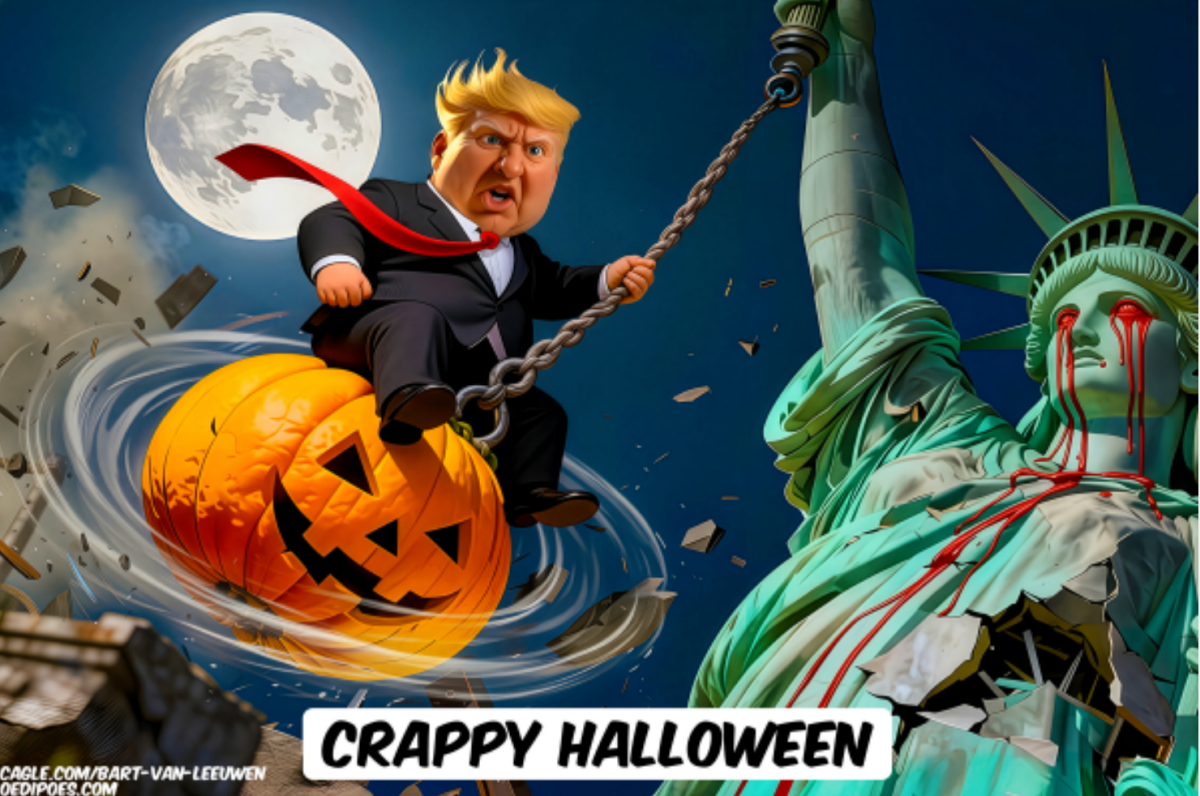
Though the present political polarization is primarily due to extreme policies of Trump, I argue that he himself is not an ideologue but an opportunistic egotist.
In the mid 1930s, when Communist influences were fairly strong in the U. S. and the political Left could be dogmatic. But today, it’s the Right that is more dogmatic and extremely ideological. Yet, it’s a man, Russell Kirk (died 1994), sometimes labeled “the Father of American Traditionalist Conservatism,” who gave us one of our best warnings about ideologies.
In his essay on the “Errors of Ideology,”(1993) he wrote that,
“Ideology makes political compromise impossible: the ideologue will accept no deviation from the Absolute Truth of his secular revelation...Ideologues vie one with another in fancied fidelity to their Absolute Truth; and they are quick to denounce deviationists or defectors from their party orthodoxy...[but] the prudential politician . . . is well aware that the primary purpose of the state is to keep the peace. This can be achieved only by maintaining a tolerable balance among great interests in society. Parties, interests, and social classes and groups must arrive at compromises, if bowie-knives are to be kept from throats. When ideological fanaticism rejects any compromise, the weak go to the wall.”
Now, still in the early days of Donald Trump’s second presidential term and in the midst of a non-compromising, Trump-caused, government shutdown, it is primarily fired and no-longer-working government employees who are suffering. And not only does “ideological fanaticism” prevent compromise - a necessity in democracies - but it’s contrary to toleration, a fundamental value of liberalism.
Related stories
Another trenchant warning about ideologies came from the late Pope Francis. In a 2013 sermon he warned Christians against making their religion into an ideology:
“When a Christian becomes a disciple of the ideology, he has lost the faith...But it is a serious illness, this of ideological Christians...His attitude is: be rigid, moralistic, ethical, but without kindness.”
He urged Christians “to remain humble, and so not to become closed.” In a 2015 address to the U. S. Congress, he added that a “good political leader is one who, with the interests of all in mind, seizes the moment in a spirit of openness and pragmatism.”
One reason we should be humble is that we are all prone to error. The Catholic monk (and poet) Thomas Merton saw this clearly. In writing on the “root of war,” he alluded to a lack of humility and thus tolerance when he observed that,
“we are all at fault, all limited and obstructed by our mixed motives. In our refusal to accept the partially good intentions of others and work with them....we are unconsciously proclaiming our own malice, our own intolerance, our own lack of realism.”
And yet we cannot let doubts, the realization that we could be mistaken, wholly or partially, immobilize us, prevent us from acting. Issues like peace, global warming, and racial justice are too important for us to do nothing. All we can do is learn about issues and act the best we can.
But without demonizing those who disagree with us. When others criticize our views we should open-mindedly consider their criticism. Truth-seeking should be our goal, not protecting our fragile egos or Trumpian revenge.
Although the present political polarization and gridlock in our country is primarily due to the extreme policies of President Trump, I have argued that he himself is not an ideologue but an opportunistic egotist - “Unless it serves his ego, Trump will dismiss any ideology that fails to serve it.” But he has surrounded himself and appointed to important positions many ideologues on the far Right, who damage the conservative cause just as fascists and authoritarians have done elsewhere - many more-enlightened conservatives, however, have opposed numerous Trump’s policies.
A good example of a poor nomination by Trump is Paul Ingrassia, “a far-right lawyer” whose present job is “White House liaison with the Department of Homeland Security.” In October 2025 Trump nominated him to lead the Office of Special Counsel, “a traditionally independent corruption-fighting agency that safeguards federal whistle-blowers and enforces some ethics laws.”
According to Politico, Ingrassia earlier told a “group of fellow Republicans that “he had ‘a Nazi streak’ and that the federal holiday honoring the Rev. Dr. Martin Luther King Jr. should be ‘tossed into the seventh circle of hell.’” Such remarks were even too much for several Republican senators, and after their announcement that they would not support him for the new position, he withdrew his candidacy.
In this present essay I do not wish to belabor the point that the Trumpians, the MAGA people including many Evangelicals, are ideologues as opposed to pragmatists. But I think Pope Francis was correct to see that ideological Christianity was “a serious illness.” And I find it interesting that in 1993 William Bennett, former Secretary of Education under Ronald Reagan, wrote The Book of Virtues, and that among the 10 virtues he treats there is no mention of humility.
Being raised Catholic in the 1940s and 1950s, I was taught that it was an important virtue. And there is plenty of evidence that virtues, including humility, were important to U.S. progressives. Historian Jill Lepore has written that “much that was vital in Progressivism grew out of Protestantism, and especially out of a movement known as the Social Gospel, adopted by almost all theological liberals and by a large number of theological conservatives, too.”
And I recently quoted another historian, Doris Kearns Goodwin, who believed that FDR was at his “formidable best, when guided by a sense of moral purpose.” She also thought the same about President Lyndon Johnson. And the battle for equal rights, led by Martin Luther King, Jr. and others and supported by Johnson, was very much about fundamental values like equality, tolerance, and justice.
But with the founding of the “Moral Majority” in 1979 and the two-term Reagan presidency, supported by many Evangelicals, progressives began to avoid debating conservatives on values and virtues. This was mainly because conservatives were able to frame the moral debate around such issues as abortion, pornography, illegitimacy, infidelity, homosexuality, explicit sex in movies and television, and sex education.
But in 2006, future president Barack Obama’s The Audacity of Hope made a bold declaration - “I think that Democrats are wrong to run away from a debate about values.” And he was right.
When it came to values such as love, tolerance, empathy and humility, progressives had (and have) the advantage. Subsequently, in a July 2018 speech in South Africa,early in the Trump administration, Obama stated that “too much of politics today seems to reject the very concept of objective truth. People just make stuff up. . . . We see it in state-sponsored propaganda. . . . We see it in the promotion of anti-intellectualism and the rejection of science from leaders who find critical thinking and data somehow politically inconvenient.” But, he added, “the denial of facts runs counter to democracy, it could be its undoing, which is why we must zealously protect independent media.” (In late 2025, his words seem even more relevant.)
Almost a decade ago (in 2016) I wrote “Wisdom and Humility.” In it I cited English novelist and philosopher Iris Murdoch, who insisted that we not let our egos interfere and fog up the way we perceive other people or things, that we prioritize truth-seeking and humility.
Yet already in mid 2016 and again in September 2025, LAP articles make clear the centrality of Trump’s egotism - which prevents humility. And for many years his truth trampling has become a fundamental reflection of his character.
What is so ironic is that a majority of Christians in the 2024 presidential election voted for Trump. Their Bible (in Luke 14: 11) says, “For everyone who exalts himself will be humbled, and the one who humbles himself will be exalted.” How and why did so many Christians fail to perceive that the man they voted for was a self-exalter and not a humble Christian?
Comments

Powered by RoundtableAn AI/DeFi-powered Enterprise Media Operating System. Learn more at Roundtable.io.© Roundtable 2026. By using this site you agree to the Terms of Use and Privacy Policy