
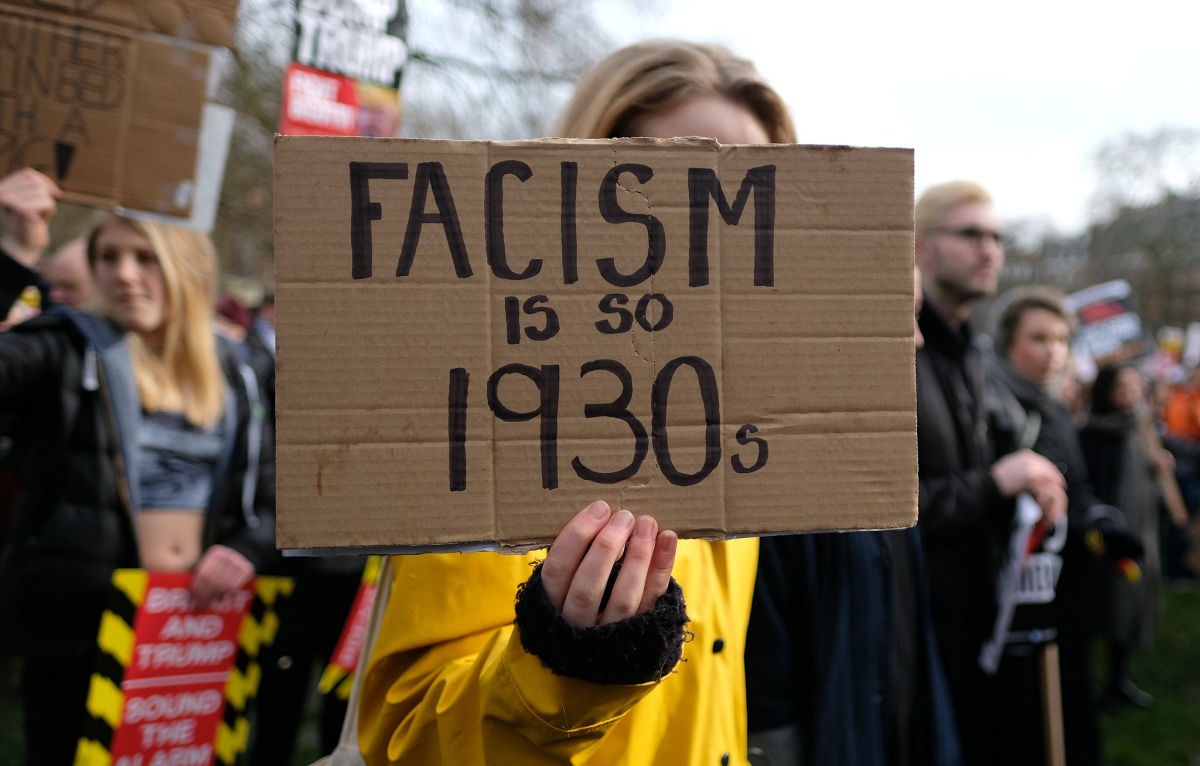
Alisdare Hickson • Attribution-ShareAlike (CC BY-SA 2.0) • Flickr


Facing the Fascist Danger
Apr 3, 2025 5:26 PM
Updated Apr 4, 2025 2:59 PM
What I have called neoliberal fascism operates through economic violence, cultural repression, and the strategic erasure of memory, history, and civic literacy.
We are living in a time of great peril—at historical moment marked by the collapse of democratic institutions, the rise of neoliberal fascism, the poison of racial cleansing, and the transformation of education into white nationalist indoctrination factories. In the United States, and increasingly around the world, we are witnessing a deeply authoritarian project that is as cultural and educational as it is political and economic.
At the heart of this crisis is a new form of fascism—one that doesn’t wear a uniform, but cloaks itself in the language of freedom, markets, and religion. What I have called neoliberal fascism operates through economic violence, cultural repression, and the strategic erasure of memory, history, and civic literacy. This isn’t a revival of yesterday’s authoritarianism—it’s a monstrous evolution of capitalism, turbocharged by predatory finance and weaponized through the all-seeing eye of digital surveillance and the acceleration of state terrorism. As Brecht reminds us, "Those who are against Fascism without being against capitalism, who lament over the barbarism that comes out of barbarism, are like people who wish to eat their veal without slaughtering the calf. They are willing to eat the calf, but they dislike the sight of blood."
Neoliberalism has hollowed out the civic fabric of our societies. As Thomas Piketty has argued, it celebrates unrestrained self-interest, privatization, de-regulation, extreme individualism, and decries anything that gets in the way of markets, free trade, and the commodification of all social relations. It reduces citizenship to consumerism, and public life to market transactions. It erases the idea of the common good and normalizes staggering inequality, systemic racism, militarism, and ecological collapse. And it does all of this while offering the seductive myth that there is no alternative. It thrives on the false assumption that capitalism and democracy are synonymous.
We now live in an era of gangster capitalism. No longer able to legitimize itself through promises of upward mobility or social progress, capitalism has reached a tipping point—one that converges with ultra-nationalism, racism, and state violence. The result is a slow-motion descent into a 21st-century fascism. This is evident not only in Hungary, India, Argentina, and Italy—but most alarmingly in the United States, where Donald Trump has returned to power on a platform of open cruelty, authoritarianism, and racial terror.
Related stories
Trumpism is not merely a political movement—it is an authoritarian project aimed at dismantling public education and all cultural apparatuses that serve as protective spaces for critical thought. Across the United States, we are witnessing an aggressive campaign to erase history and reshape schools and universities into instruments of ideological control. Books are being banned, professors attacked, gender and ethnic studies eliminated, trans-identity attacked, student protests criminalized, and honest historical narratives suppressed. This is not symbolic—it is state-sanctioned policy.
From Florida to Texas, far-right governors are transforming education into a vehicle for repression. Teachers are threatened with criminal charges for acknowledging gender diversity or reproductive rights. At the national level, student activists—particularly those protesting U.S. support for Israel’s genocidal assault on Gaza—are being surveilled, detained, and in some cases, forcibly abducted and held in detention centers without transparency or due process. These actions mark a dangerous escalation in the use of state power to crush dissent and stifle democratic expression.
This is fascism on steroids. It silences dissent, erases the past, and extinguishes the future. It aims not only to control education, but to destroy its emancipatory potential—to eliminate the very idea that education might serve as a democratic public sphere, create an informed public, and imagine a radical democratic future.
Why this obsession with education? Because the far right understands something many liberals forget: that education is dangerous when it teaches people to think, to question, to remember, and to dream. These attacks are not simply about controlling education—they are about eliminating the possibility that education could serve as a democratic public sphere-one that both defends and enables democracy. The far right understands what many liberals forget: critical education is dangerous when it encourages people to think, to question, to remember, and to act.
Educators need a new political and pedagogical language. It is hard to imagine a more urgent moment for making education central to politics. At stake here is the notion of education as a moral and political project rooted in the goal of individual empowerment and social emancipation. This is a view of education that encourages human agency, one that is not content to enable people to be only critical thinkers but also engaged individuals and social agents. This is a pedagogical project that recognizes that there is no democracy without knowledgeable and informed citizens.
Central to this argument is the notion that pedagogy is always political not only because it raises questions about the relationship between power and knowledge but also because it is connected to the acquisition of agency, values, visions of the future, and the ability to speak, write and act from a position of agency and empowerment. Despite the claims by mainstream and managerial educators, pedagogy is neither neutral nor is it simply a methodology, which is a cover for equating education with training. This is why critical pedagogy matters more than ever. It calls students beyond themselves. It affirms the ethical imperative to care for others. It reconnects historical memory to present struggles. It nurtures agency rather than obedience, and solidarity rather than cynicism.
This is a pedagogy that insists education must be dangerous—dangerous to racial cleansing, to militarism, to unbridled capitalism, and to the politics of hate and ignorance. Critical pedagogy both in its symbolic and institutional forms has a vital role to play in fighting the resurgence of false renderings of history, white supremacy, religious fundamentalism, an accelerating state terrorism, and ultra-nationalism. As far-right movements disseminate toxic racist and ultra-nationalist images of the past, it is essential to reclaim critical pedagogy as a project crucial to developing and affirming historical consciousness and moral witnessing as central elements of education. This is a pedagogy that refuses “anticipatory obedience,” to conform to authoritarian demands or expectations even before these demands are officially made.
This is especially true at a time when historical and social amnesia have become a national pastime, further normalizing an authoritarian politics that thrives on ignorance, fear, the suppression of dissent, and hate. The merging of power, social media, and everyday life have not only altered time and space, but they have also expanded the reach of culture as an educational force. A culture of lies, cruelty, and bigotry, coupled with a fear of history and a 24/7 flow of information now wages a war on attention spans, and the conditions necessary to think, contemplate, and arrive at sound judgments.
We need classrooms that are not factories of compliance but sanctuaries of critique, critical literacy, and radical hope. We need educators who teach students not simply how to make a living, but how to make a life committed to justice, equality, and freedom. And we need schools that serve not only the marketplace, but a radical vision of democracy itself.
One of the challenges facing the current generation of educators, students, and others is the need to address the question of what education should accomplish in a society. Or more pointedly, what is the role of education in a democracy? What pedagogical, political, and ethical responsibilities should educators, musicians, artists, journalists, and other cultural workers take on at a time when there is an alarming rise of authoritarian regimes across the globe, especially in formally democratic countries such as Turkey, Hungary, India, and Italy. How can educational and pedagogical practices be connected to the resurrection of historical memory, new modes of solidarity, a resurgence of the radical imagination, and broad-based struggles for an insurrectional democracy? How can education be enlisted to reclaim public memory, to challenge the culture of lies, and to make visible the historical conditions that have brought us to the brink. In a world where the future is being cancelled by climate catastrophe, authoritarian rule, and market fundamentalism, education must help recover the radical imagination, promote new modes of solidary, recover the common good, and refuse a politics of social and political abandonment.
Any viable notion of critical pedagogy needs to create the educational visions and tools to produce a radical shift in individual and mass consciousness; it must be capable of recognizing both the scorched earth policies of a market-based system marked by staggering inequalities and the twisted anti-democratic ideologies that support it. This shift in consciousness cannot occur without pedagogical interventions that speak to people in ways in which they can recognize themselves, identify with the issues being addressed, and place the privatization of their troubles in a broader systemic context. Such a project is both educational, deeply political—and deeply urgent.
In Greece, as in much of Europe, you know these pressures well. Neoliberal austerity, the erosion of public institutions, and the rise of xenophobic nationalism have targeted students, workers, migrants, and educators alike. You know what it means to have your universities surveilled, your protests criminalized, your intellectual spaces hollowed out.
But you, perhaps more than most, know what it means to resist. From the Athens Polytechnic uprising of 1973 to the anti-austerity movements of the past decade, and the powerful, ongoing protests demanding justice for the 57 lives lost in the Tempi train disaster—one of the deadliest tragedies in Greece’s recent history—Greek people have shown the world that education, both inside and beyond the classroom, can become a site of defiance, mourning, and hope. Today, it is more urgent than ever to carry that legacy forward—to reject silence, to turn classrooms into spaces of memory, truth-telling, and collective struggle.
If authoritarianism is to be defeated—whether in the U.S., Greece, or anywhere else—it will require educators, students, artists, journalists, and cultural workers to take a stand. It will require a new language of critique that unmasks power, and a language of possibility that dares to imagine a different future.
As Hannah Arendt warned, fascism does not only live in the past. Its seeds are always present—waiting for the conditions to grow. Our task is to make those conditions inhospitable.
We must fight for an education that defends historical memory, sustains civic imagination, and fosters the capacity to think and act ethically. We must teach students not just how to critique, but also to struggle, fight for the truth, and defend and enable a vibrant radical democracy.
Within this framework, everything is commodified, and what cannot be monetized is devalued as irrelevant or disposable. Freedom of speech is criminalized, and state-sanctioned violence has become the foundational principle of authority. In the face of this, the vibrant protests sweeping across universities and beyond are not merely reactions—they are essential acts of defiance. Educators must rise to this challenge by rejecting the neo-liberal myth of historical inevitability, the normalization of capitalism, and embrace a radical reimagining of political solidarity.
This is not an easy task, but it is the only one that can counter the unrelenting advance of corporate power, fascist politics, and its subjugation of democratic ideals. If we are to reclaim democracy from the clutches of financial markets, authoritarianism, and the Darwinian logic of unbridled capitalism, it will be through collective struggle—led by educators who defend higher education as the bedrock of public life, as a site for nurturing democratic values over profit-driven motives and a culture of indoctrination. Educators must actively preserve the political responsibility of the academy, ensuring that students are equipped not only with knowledge but with the critical capacities needed for engaged, courageous citizenship. The stakes are too high; this is a battle for not only the promise, but the very idea of democracy itself.
(Speech Given in Greece In Celebration of Greek Translation of On Critical Pedagogy)
Comments

Powered by RoundtableAn AI/DeFi-powered Enterprise Media Operating System. Learn more at Roundtable.io.© Roundtable 2026. By using this site you agree to the Terms of Use and Privacy Policy