


Oct 5, 2025 4:04 PM
If having a government means all of its members working together, then the United States hasn’t had a government worthy of the name since the 1980s.
The United States needs a government. We don’t have one right now. Oh, we have government officials, both elected and appointed, placed in office to do the jobs the Constitution spells out in its first three articles. And if you watch closely enough, you might actually see some of them doing their assigned jobs now and then. Mostly, though, you won’t see that.
Instead, what you’ll see is a gaggle of self-absorbed spoiled brats and bullies threatening to hold their breath until they get their way, pouting, posturing, and pontificating about what’s right and what’s wrong, who’s righteous and who’s not. Most of the time, their fondest hope is not to serve or protect the interests of the people who put them where they are. What they want most is to embarrass or impede the people they view as their opponents. There’s very little civility in our civil government these days.
This is not a matter of parties. It’s not a matter of personalities. It’s a matter of performance. Find someone on the right doing nothing but bloviating, blustering, and blocking the way, then turn around and you’ll find someone on the left doing the same thing. As Peter Drucker argued in his 1989 book, The New Realities, people had learned that it’s always possible to keep things from happening, even when they can’t make things happen.
Until the Soviet Union collapsed in 1991, United States policy had been to prevent the spreaed of communism around the world, and to prevent fifth column subversion at home. Labor unions got their way by stopping production and keeping people from working. Political parties filibustered to keep things from happening in the Congress, and gerrymandered to keep their opponents from winning elections. And politicians—”very fine people, on both sides”—sought mainly to keep their opponents across the aisle from accomplishing anything.
Related stories
Of course there were exceptions. Some remarkable civil rights and environmental legislation went into effect during the administrations of Democrat Lyndon Johnson and Republican Richard Nixon. In those days, bipartisanship was the rule, and partisan obstruction was the exception. Of course, the good things Johnson and Nixon did were often overshadowed by the bad things. And as we learned later, they both lied routinely, and did everything they could to keep us from finding out.
But at least they tried to make a good show of it. Like professional wrestlers, they tried to make it look real, and we the people did our best to look like we believed it was real. These days, they’ve mostly stopped pretending, and so have we. Why try to make it look like a real deadlock on principle when you can just shut everything down until your opponents tap out? You can always blame them for the disruptions, and then take the credit when you let it start working again. That’s what our government has become in the years since Johnson and Nixon.
In 1976, the government couldn’t pay its bills. Five Republicans and four Democrats have occupied the White House since Nixon left office in 1974. Three of those Republicans and two of those Democrats have been reelected for second terms. In the half century since Nixon’s resignation, the federal budget has gone into the red twenty times, and ten of those shortfalls have resulted in government shutdowns, ranging in length from a few hours to over a month. In 1980, the attorney general reminded officials that under federal law the government may not spend money without the approval of Congress. However laudable his motives, he gave politicians the perfect tool to thwart their opponents. All they had to do was prevent approval of the budget.
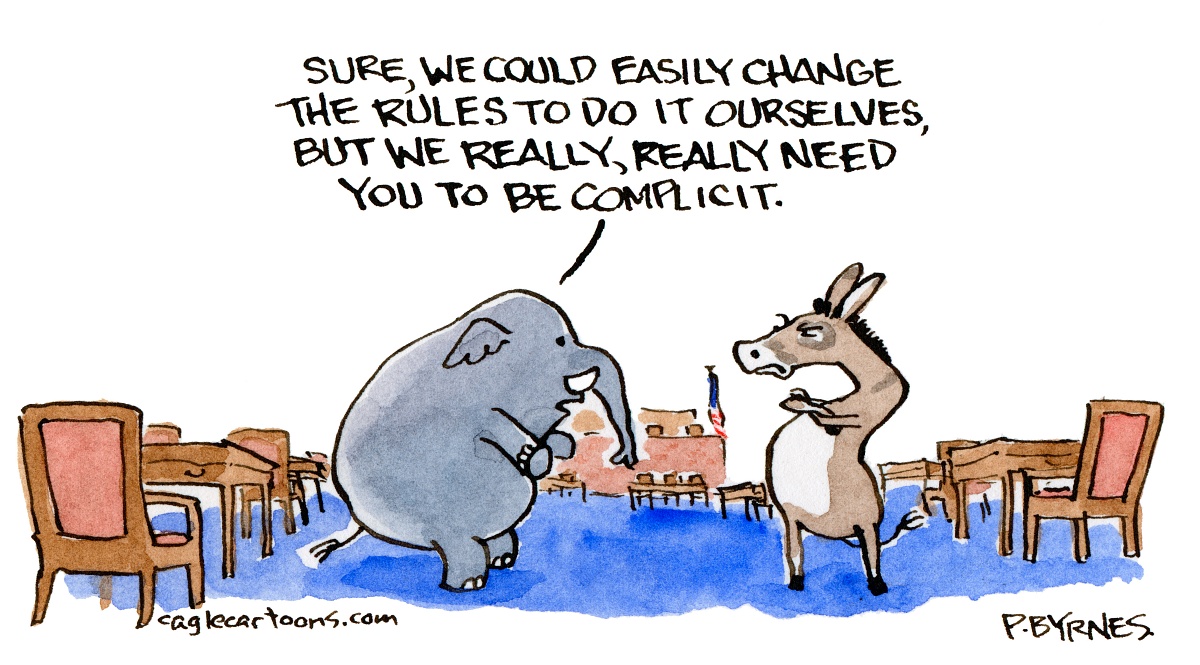
Not everything stops during a shutdown, and the things that do stop can vary from one episode to the next. Typically only non-essential services cease to function, but people depending on government services are not the ones who decide what’s essential and what’s not. That decision lies with the politicians they put in office to represent them, who are more interested in making a good show of obstructing each other than in representing anyone. In the current episode, the president boasted, “We can do things during the shutdown that are irreversible, that are bad for them and irreversible by them. Like cutting vast numbers of people out, cutting things that they like, cutting programs that they like.”
The “we” here is the Republicans, and the “they” is the Democrats, and Trump’s language makes it clear that the goal of the current shutdown is not to abide by laws that regulate federal spending. The goal is simply to keep Democratic members of the government from making things happen, regardless of whatever the consequences may be for people dependent on those things continuing to happen.
If having a government means all of its members working together, despite their differences, to find mutually acceptable ways that serve the will of the voters who put them in office, then the United States hasn’t had a government worthy of the name since the 1980s, and certainly doesn’t have one now. We get the government we choose in the voting booth. If we want a government those members serve us, instead of serving only themselves, we ned to start thinking more carefully about our choices.
Comments

Powered by RoundtableAn AI/DeFi-powered Enterprise Media Operating System. Learn more at Roundtable.io.© Roundtable 2026. By using this site you agree to the Terms of Use and Privacy Policy