
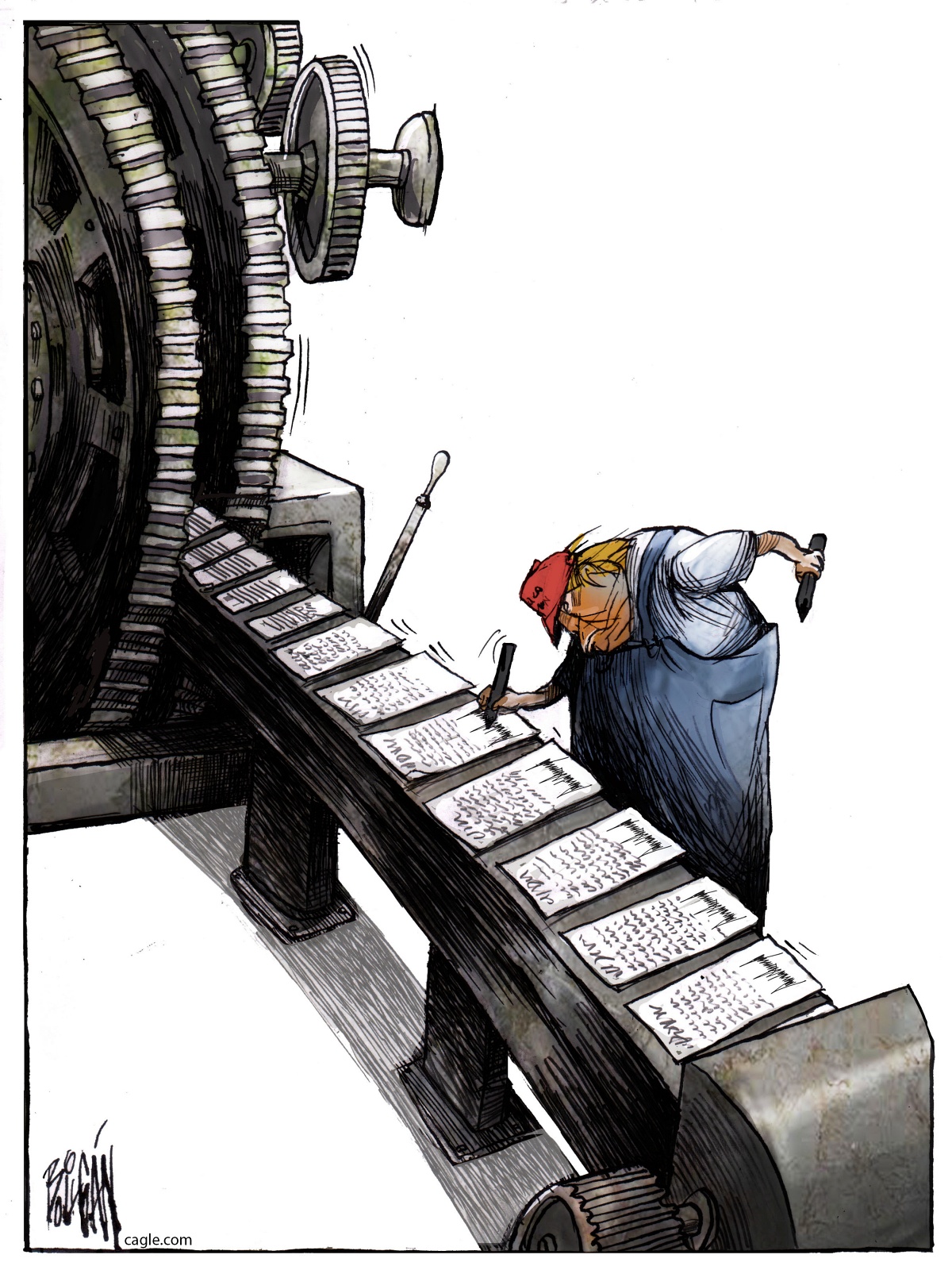
Cagle Cartoons: Angel Boligan


Political Division in the USA
Mar 11, 2025 4:11 PM
One of our central problems at present, one that contributes greatly to our political divisiveness and negativity, is the varying content that citizens rely on for their information.
To what I am about to write, as with many generalizations, there are many exceptions. And I don’t mean to overly simplify a complex situation. Yet, it seems to me that in general our main political division prior to the November 2024 election was between the fearful and the hopeful, the naysayers and the yeasayers, the Trump supporters and the anti-Trumpers.
In 2016 writer George Saunders in The New Yorker’s “Who Are All These Trump Supporters?” summarized the situation well. He wrote that Trump’s followers were united by what he called “ usurpation anxiety syndrome—the feeling that one is, or is about to be, scooped, overrun, or taken advantage of by some Other with questionable intentions. In some cases, this has a racial basis, and usurpation anxiety grades into racial nostalgia, which can grade into outright racism.”
The “Other” which Saunders referred to might include one or more of the following: non-Whites, undocumented immigrants, government bureaucrats, educated elites, big-city residents, so-called “Woke” citizens, and liberals or progressives.
In a 2017 article “Who Are We?” conservative columnist Ross Douthat indicated that Trumpites preferred an “older narrative” of U.S. history, the one that glorified Columbus, the Pilgrims, the Founding Fathers, Lewis and Clark, and Davy Crockett, the one that emphasized the melting pot (not multiculturalism), and the U.S. Christian tradition (not separation of church and state, and certainly not any secularist thinking). The Trumpian phrase “Make America Great Again” indicated a longing for a simpler America. As Saunders pointed out, Trumpites yearned for a less complex time, one where they believed the rights of Others such as ethnic and religious minorities, immigrants, women, and LGBTQ people did not complicate their lives.
Related stories
Since our last November election and the early whirlwind Trumpian actions of his second term, it is more difficult to discern who are the fearful and who are the hopeful. To some extent, there has been a reversal, with the anti-Trumpers now being more fearful and the Trumpsters being more hopeful, at least regarding the chances of Trump’s success in reversing any past “Woke” gains.
Nevertheless, the Trumpsters, especially the main one, the president himself, remain chief symbols of negativity. In Trump’s early-March-2025 speech to Congress he called Joe Biden “the worst president in American history” and criticized international agreements and bodies that he withdrew from—“the unfair Paris Climate Accord,” “the corrupt World Health Organization,” and “the anti-American U.N. Human Rights Council.” He also emphasized that he “ended all of Biden’s environmental restrictions,” which he stated “were making our country far less safe and totally unaffordable.” Putting Hispanics in what he thought was their proper place, he noted that he made “English the official language of the United States of America” and “renamed the Gulf of Mexico the Gulf of America.” He added that “we’ve ended the tyranny of so-called diversity, equity, and inclusion policies all across the entire federal government and, indeed, the private sector and our military. And our country will be woke [“wokeness” being a major subject of Trumpian criticism] no longer.”
In an attack against Affirmative Action policies he added, “We have removed the poison of critical race theory from our public schools. And I signed an order making it the official policy of the United States government that there are only two genders: male and female.”
The negativity drumbeat continued when he talked about the economy he received: “We inherited from the last administration an economic catastrophe and an inflation nightmare. Their policies drove up energy prices, pushed up grocery costs, and drove the necessities of life out of reach for millions and millions of Americans. They’ve never had anything like it.” Under the Biden presidency, he thought it possible that “we suffered the worst inflation in 48 years.” And he ticked off what he called the “appalling waste we have already identified,”and how Elon Musk’s task force (Department of Government Efficiency) was going to end that “flagrant waste.” (The Washington Post fact-checkers stated that Trump’s economic claims were “absurd. Trump inherited an economy with relatively low unemployment, falling inflation and strong growth. The month before the November election, the Economist newspaper published a cover story declaring that the U.S. economy was ‘the envy of the world.’”)
Trump also rattled off many more damning accusations such as “shocking levels of incompetence and probable fraud in the Social Security program for our seniors,” but The Washington Post fact-checkers found this and 25 other Trump-claims to be false or misleading.
One of our central problems at present, one that contributes greatly to our political divisiveness and negativity, is the varying content that citizens rely on for their information. The increasing role of social media has worsened the problem. Although truth-seeking should be prioritized, it often is not. One journalist has written of “technology’s godlike power to infect each of us with a virus of lies, pitting us against one another, igniting, even creating, our fears, anger, and hatred, and accelerating the rise of authoritarians and dictators around the world.”
In his first inaugural address on March 4, 1933, President Franklin D. Roosevelt (FDR) stated that it was “preeminently the time to speak the truth, the whole truth, frankly and boldly,” and “that the only thing we have to fear is fear itself—nameless, unreasoning, unjustified terror which paralyzes needed efforts to convert retreat into advance.”
In her Leadership: In Turbulent Times Doris Kearns Goodwin wrote that FDR’s “infectious optimism restored the hope and earned the trust of the American people through both the Great Depression and World War II.”
In 1961, in President John Kennedy’s Inaugural Address—only 14 minutes compared to Trump’s finger-pointing, self-glorifying one hour-39 minutes-32 seconds 2025 speech to Congress—there was also optimism and no blaming of his predecessor (President Eisenhower). What he said about potential enemies abroad also applied to Republicans at home—“civility is not a sign of weakness,” and “Let both sides explore what problems unite us instead of belaboring those problems which divide us.”
And looking beyond our borders, JFK’s outlook was also optimistic and generous, not blame-casting like Trump’s—freezing “all foreign aid,” and speaking ill of “the unfair Paris Climate Accord,” “the corrupt World Health Organization,” and “the anti-American U.N. Human Rights Council.” Rather, JFK stated that “if a free society cannot help the many who are poor, it cannot save the few who are rich”—contrast Trump’s 83 percent cut in aid from USAID, which previously had been the “largest provider of international food assistance, feeding more than 70 people every year.” And Kennedy added “to that world assembly of sovereign states, the United Nations, our last best hope in an age where the instruments of war have far outpaced the instruments of peace, we renew our pledge of support.”
In his pre-presidential The Audacity of Hope, Barack Obama praised various values and wrote that “these values are rooted in a basic optimism about life and a faith in free will, and that “our system of self-government and our free-market economy depend on the majority of individual Americans adhering to these values.”
In his farewell address to the nation (1796), George Washington warned against “the baneful effects of the spirit of party,” against “the alternate domination of one faction over another, sharpened by the spirit of revenge.” Such a spirit, he stated, “agitates the Community with ill-founded jealousies and false alarms; kindles the animosity of one part against another, foments occasionally riot and insurrection.”
FDR may not have been entirely correct when he said “the only thing we have to fear is fear itself,” but he was more than half right. Bitterness, name-calling, and negativity is not the way for our nation to move forward. What we need to proceed onward is generosity of spirit and optimism, not the fear and damning of anyone different, whether they be ethnic and religious minorities, immigrants, women, LGBTQ people, or unfortunates in other countries. And a little humility would also be helpful. We are all fallible human beings, and that’s one reason why leaders should surround themselves not just with flatterers and toadies (as Trump has done) but also with those who will challenge our views.
Comments

Powered by RoundtableAn AI/DeFi-powered Enterprise Media Operating System. Learn more at Roundtable.io.© Roundtable 2026. By using this site you agree to the Terms of Use and Privacy Policy