


Jun 7, 2026 12:25 AM
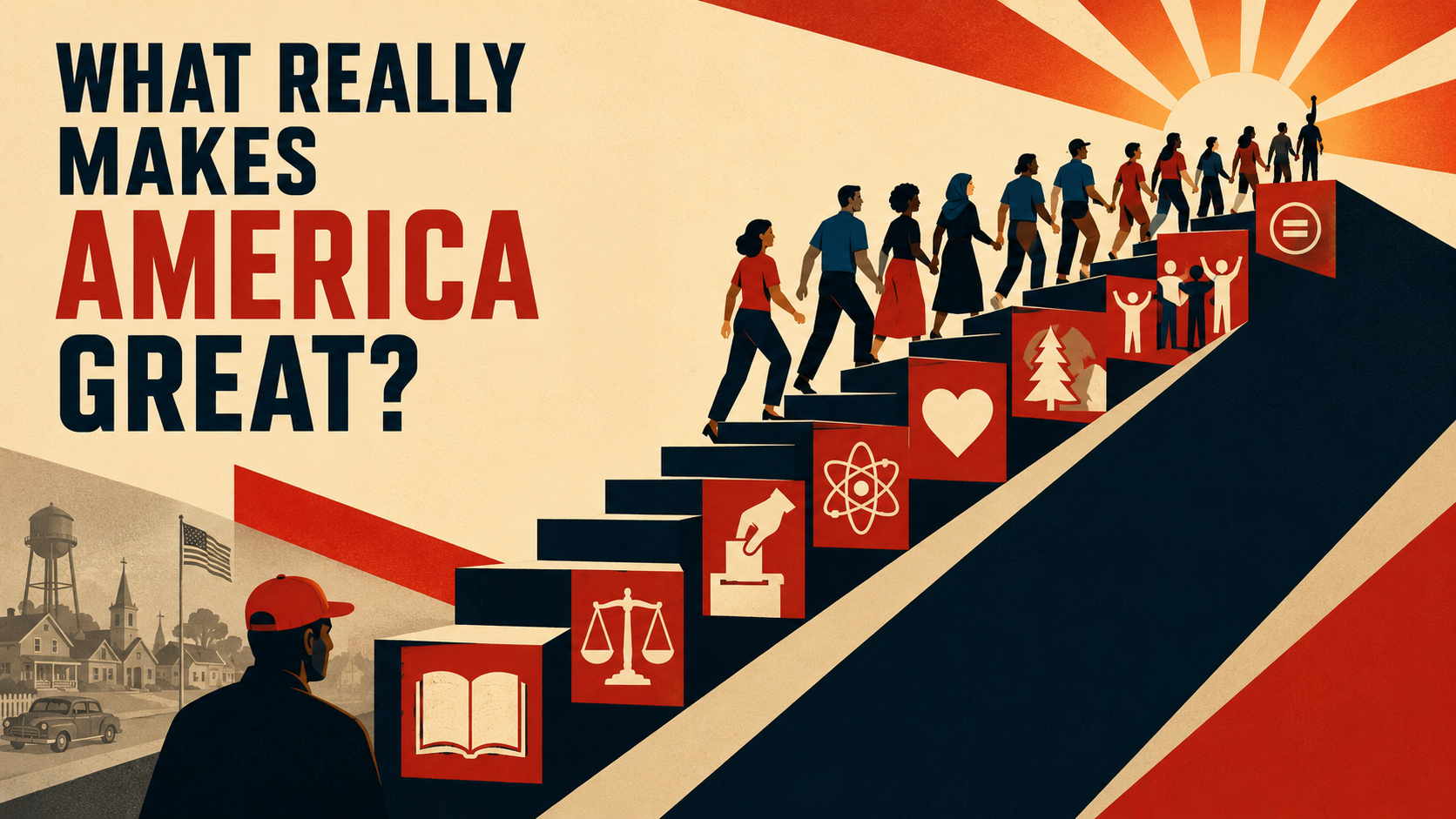
The Enduring Values of Freedom, Justice, Opportunity, and Community That Have Shaped the United States
People argue about what makes America great all the time.
There are those who refer to military might. Then there are those that refer to economic might, technological prowess, or global dominance. But American exceptionalism was never about the world’s loudest nation, richest nation, or most powerful nation.
What has always made America special is something deeper than power.
It’s the ideals the country keeps fighting for — even when it struggles to live up to them.
America has never been perfect. It has made mistakes, contradicted itself, and gone through painful periods of division and injustice. But what makes the country remarkable is that, generation after generation, it keeps pushing forward rather than giving up.
Related stories
That constant effort to become better is part of the American story.
Religious freedom is one of those ideals.
Throughout history, governments controlled religion and punished people for believing the “wrong” things. America helped create a different model — one where people could worship freely, practice no religion at all, or follow their conscience without fear of the state deciding what they were allowed to believe.
That freedom matters because freedom of conscience is one of the most personal freedoms a human being can have.
Here are real historical examples showing how religious freedom helped shape and strengthen the United States over time:
1. The Founding of Rhode Island (1636)
Roger Williams, [who] was cast out of Massachusetts for failing to follow Puritan orthodoxy, established Rhode Island as a colony that welcomed all faiths, thus laying the foundation for the modern principle of separation between church and state and creating a community of tolerance.
2. The First Amendment (1791)
The United States Constitution, especially the First Amendment, established that Congress cannot create a national religion or stop people from practicing their faith. This became the legal foundation of American religious freedom.
3. Jewish Communities Finding Protection in Early America
In 1790, President George Washington sent a letter to the Hebrew Congregation of Newport, assuring them that the United States Government would not allow discrimination. The United States, therefore, became a much safer place for Jewish people to live than most countries in Europe.
4. Catholic Immigration in the 19th Century
Despite facing discrimination, countless Irish and Italian Catholic immigrants have moved here to America, but since coming over, they’ve experienced considerable amounts of religious freedom. That has enabled them to construct churches, schools, and other institutions over time, ultimately making them part of the American community.
5. The Mormon Migration (1840s–1850s)
The Church of Jesus Christ of Latter-day Saints fled persecution in the Eastern United States, ultimately establishing its home in Utah. They found they could openly practice their religion without the threat of persecution, resulting in strong communities across the Western United States.
6. The Rise of Diverse Religious Institutions in Cities
The expansion of cities during the 1800s & 1900s allowed people of all religions - including Muslims, Hindus, Buddhists, Sikhs, Jews, and many denominations within Christianity - the freedom to practice their faith by constructing places of worship all across the nation.
7. The Civil Rights Movement and the Black Church
Within the black community, religious groups had played a major role in orchestrating events during the Civil Rights Movement. Leaders such as Martin Luther King Jr. used their religious beliefs and the right to assembly to assert a right in the eyes of the law.
8. The 1943 Supreme Court Case West Virginia v. Barnette
Students cannot be required to salute the flag or recite the Pledge of Allegiance in an explicit manner when doing so is contrary to their beliefs. The ruling supports the doctrine of separation of church and state, meaning that government is prohibited from forcing anyone to practice a religion or hold a religious belief against their will.
9. The Religious Freedom Restoration Act (1993)
The above law establishes further safeguards regarding one's freedom of religion, placing an onus on the government when it imposes a material burden on an individual’s ability to exercise their religion. Furthermore, it's an attempt to continue balancing the application of the law with one's beliefs in our multi-religious society.
10. Modern Religious Diversity in Public Life
Many individuals today of various faiths hold open positions of authority in all forms, from government, military, and schools to other levels of public office. This is one of the many examples of belief being completely independent of citizenry. This type of inclusion is evidence that democratic systems can accommodate multiple viewpoints while upholding the fundamental principles of equality and freedom. By providing an environment promoting mutual respect and encouraging conversation, this type of connection also reminds us that, similar to one another, we all believe we can share the same core beliefs while also being unique individuals that can contribute to our community as a whole, thus strengthening our society and creating a sense of belonging for all of us.
Big Picture
Religious freedom in America's past has:
- Reduced persecution experienced under state religions
- Allowed for a wider range of ethnic communities to emerge and thrive
- Helped expand civil rights and reform immoral conduct
- Foster 'pluralistic' living in the public sphere
In so doing, it molded America into a republic where different opinions could co-exist peacefully under a single national structure.
Civil disobedience is another reason America has grown stronger over time.
The most significant moments of moral progress in American history have been when ordinary people stood up peacefully against unjust laws and refused to go along with the way things were done. There was no change when everyone stayed quiet and did what they were told; there was a change when people had the guts to not just believe that things were not right, but to take action to express their concerns.
A democracy needs that pressure. Without it, injustice becomes permanent.
Here are real-life historical examples showing how civil disobedience has shaped and strengthened the United States over time:
1. The Boston Tea Party (1773)
Colonial tea was dumped into Boston Harbor due to colonists' reluctance to pay taxes imposed by England, and they also violently rejected English imperial rule without any legal documentation. While the colonists broke the law with this action, their determination to resist injustice motivated them to join an eventual movement toward independence. The Boston Tea Party Crest would rally many in support of the emergence of the Revolution against the injustices caused by the British Empire. As a result of the Boston Tea Party, the American Revolution was founded on the revolutionary ideas that people have a right to resist the abuses perpetrated by their government.
2. Abolitionist Resistance to Slavery (1800s)
Abolitionists were breaking the laws of the land in America by violating the Fugitive Slave Acts and other similar laws when they helped to free enslaved people from slavery through the Underground Railroad. By doing so, they were directly opposing slavery using moral resistance to support the idea that slavery is a violation of the human rights of enslaved individuals. They demonstrated this through their actions, ignoring these laws and revealing contradictions within a system of freedom and oppression. This type of resistance helped create a lot of momentum toward freeing enslaved people from slavery, thus participating in their ultimate emancipation.
3. Women’s Suffrage Protests (late 1800s–early 1900s)
From arrests and protests to hunger strikes and public demonstrations, activists such as Susan B. Anthony and countless others fought hard for the right to vote for women as part of the larger suffrage movement — ultimately achieving this goal with the ratification of the Nineteenth Amendment in 1920, securing women’s right to vote in the United States. The success of this campaign was one of the early successes in the fight for gender equality and inspired future movements for both civil and human rights.
4. Labor Union Strikes (late 19th–20th century)
Workers (legally or not at the time) have used strikes and sit-ins to create conditions for their job safety, provide a fair wage, and limit the use of child labour, as these conditions were major contributors to the development of labour legislation and protection for employees; the resulting creation of minimum wage laws, job safety legislation, and elimination of exploitation over time have demonstrated the effectiveness of worker perseverance in improving the quality of life for workers globally.
5. Gandhi-Inspired Civil Resistance Movements (early–mid 1900s influence in U.S.)
Peaceful law-breaking methods of protest were adopted by American social justice leaders who had been influenced by peaceful resistance to technologies like violence that were used internationally, most of which were modeled after Gandhi’s work through initiatives such as the Salt March, where his followers could peacefully oppose an oppressive regime by violating oppressive laws without actually using violence themselves. Examples of these types of protests can therefore be found in social justice advocacy groups such as the Civil Rights Movement, where participants used seemingly innocuous actions, like eating at “white-only” restaurants or providing service to customers in that section of a business, to demand equality.
6. Civil Rights Sit-Ins (1960s)
Greensboro, North Carolina, is the home of where students (and activists) engaged in sit-ins at segregated lunch counters that defied existing local laws. Through acts of civil disobedience (i.e., sit-ins), protests quickly spread across the Southern US and brought about national awareness regarding the injustices of racial segregation in the Southern U.S. The sit-in exemplified how effective nonviolent methods of protesting oppression can be. As a key historical event during the Civil Rights Movement, the success of the sit-ins continued to inspire activism and/or legal change.
7. The Montgomery Bus Boycott (1955–1956)
Many Black Americans, including Martin Luther King Jr. and many other community leaders, boycotted using the city’s segregated buses as opposition to the publicly funded exclusion of blacks from using public transportation in the city. This boycott lasted over a year and caused significant economic disruption in the city’s bus system, demonstrating the power of collective action. At the end of this period of lawful disobedience, the United States Supreme Court issued a significant ruling that barred any city, state, or local government from segregating public transportation. This ruling marked a significant victory for the Civil Rights Movement and became the catalyst for additional challenges to segregation laws throughout the southern states.
8. Freedom Rides (1961)
As part of the civil rights movement during the 1960s, an interracial group of activists rode buses throughout the South to challenge racial segregation. To challenge these unconstitutional laws, they knowingly violated segregation laws and faced violent opposition in order to have federal laws banning segregation in interstate travel enforced; ultimately, their persistent efforts attracted national attention, thereby putting pressure on federal authorities to enforce civil rights protections, and creating momentum for the civil rights movement as a whole throughout the United States.
9. Vietnam War Draft Resistance (1960s–1970s)
American citizens opposed the Vietnam War for a variety of reasons. Some were against the U.S. military's plan for conscription; others burned their draft cards; both were forms of expression regarding their disapproving views on the war and morally objecting to participating in it. Both actions constituted violations of existing federal law at the time. Although many draft card burners were incarcerated or faced exile from the United States, their actions made visible a growing number of American citizens who opposed the war, and ultimately resulted in an increased amount of public awareness and pressure on the federal government to re-evaluate its policies toward Vietnam. Ultimately, this public pressure affected the U.S. decision to withdraw its military forces from Vietnam.
10. LGBTQ+ Rights and Stonewall (1969)
It all started with a raid on a gay bar in New York City. From this event, a wave of protests erupted. These protests directly challenged laws that criminalized LGBTQ+ individuals and their actions. This was the start of a revolution for LGBTQ+ rights and social inclusion. Activists came together to form organizations such as the Gay Liberation Front, and annual Pride marches continue in honor of the Stonewall uprising. This demonstration highlighted the importance of legal protection and community solidarity. As a result, LGBTQ+ people became more visible, and their rights were strengthened worldwide.
Big Picture
Civil disobedience, throughout American history:
- questioned unfair laws when our justice system was falling behind.
- ignited national dialogues about justice and human rights.
- helped stretch our democracy beyond its original parameters.
- been shown that peaceful resistance can drive reform, just as John F. Kennedy said in his most famous statement on peaceful protest and political change: "Those who make peaceful revolution impossible will make violent revolution inevitable."
In many cases, what was once an illegal protest later became widely recognized as a turning point toward greater justice and inclusion.
Unity matters too.
Not the fake kind of unity where everyone pretends to agree about everything, but real unity — the kind where people with different beliefs, backgrounds, and opinions still recognize each other as fellow Americans.
The United States is a huge, diverse country. It survives because people continue to try, however imperfectly, to hold the country together through disagreement rather than tear it apart.
Here are real historical examples showing how unity has helped strengthen the United States during key moments in its history:
1. The American Revolution (1775–1783)
The Thirteen Colonies came together with unique economic systems, cultures, and leadership styles in pursuit of a common goal: freedom from British oppression. It's probable that it would have been significantly harder or even impossible to achieve independence from Great Britain if not for the common purpose.
2. The Formation of the Constitution (1787)
To remedy the shortcomings we previously discovered in the Articles of Confederation, delegates from each state met in Philadelphia, Pennsylvania, to discuss, compromise, and negotiate over how best to reform and create a more workable form of federal government. They would produce and ratify the United States Constitution, which established a new, significantly improved system of government.
3. The Civil War Union Effort (1861–1865)
In the north, the federal government was united and resilient in its efforts to hold the country together rather than let it break apart. Their shared purpose was to maintain the integrity of their nation and to defeat the southern secessionist rebellion. Using a combination of military, economic, and political warfare, the Union came to the rescue of the Constitution, saving the Union and preventing America from collapsing.
4. Reconstruction After the Civil War (1865–1877)
Although deep disagreements split the nation, these actions and attempts were directed toward reuniting the broken states and reconstructing the South after the Emancipation Proclamation and then the American Civil War, ultimately bringing the nation back together as one.
5. World War I National Mobilization (1917–1918)
From all walks of life, Americans banded together to help win the war. They joined the military, rationed materials, and pushed factories into overdrive to support the war. This also included the development of propaganda to foster nationalism, women entering the workforce in larger numbers to work in factories, and the issuance of war bonds to help finance the military. Americans demonstrated their collective ingenuity and unity during a time of world conflict and economic hardship.
6. The Great Depression Cooperation (1930s)
In an economic crisis, the American people came together across the country in a multitude of federal programs, local charities, and public works to create a more stable and hopeful society, while rebuilding trust within communities. Whether they were enrolled in New Deal programs like the Civilian Conservation Corps (CCC) or Works Progress Administration (WPA), creating public works and employing Americans, or helping their neighbors on a local level, Americans worked together to bring their country back and reinforce the belief that solidarity in hard times will ultimately make the economy stronger and more equitable for all.
7. World War II “Arsenal of Democracy” (1941–1945)
The whole nation united. Regardless of industry, community, or sector, everyone banded together. The public, and companies too, mobilized to meet the demands and created all manner of war materials for the effort.
8. The Civil Rights Movement (1950s–1960s)
The civil rights movement rose above its fractious beginnings and achieved its mission of desegregating American society through an interracial coalition, national unity, and shared constitutional principles. Martin Luther King Jr. and other movement leaders consistently hammered home the point that if we were ever going to achieve racial justice, it would take a collective, national effort.
9. Post-9/11 National Response (2001)
Americans were brought closer together after 9/11 and became more resolute as a result of the attacks. They united in responding to urgent needs, supporting victims and their families, even though they themselves were scared, grieving, and worried.
10. Disaster Recovery Efforts (Hurricane Katrina, wildfires, etc.)
In the face of natural disasters, when the need is greatest, Americans can always count on one another. People from all across America and all walks of life will come together to help with search-and-rescue efforts, transport food and water, and volunteer their time to assist with rebuilding.
Big Picture
You know, the United States has always found strength in its unity:
- Through wars and difficult times, we've pulled together and overcome.
- We've come together to form a government with compromises we could live with.
- Civil rights could never have been fought and won without our collective voice.
- We've bounced back after recessions and natural disasters, thanks to the help of our fellow Americans.
Unity does not erase differences—it helps a diverse nation function despite them, especially in moments when cooperation is essential.
Scientific evidence has also helped move America forward.
Science has been a tool for learning through mistakes, not for being caught up in them. People were curious enough to ask questions, try out ideas, and use evidence to test their assumptions, even when they went against the traditional way of thinking. In this way, medicine, technology, engineering, and space were all discovered and created by mankind.
That willingness to keep learning is one of the country’s greatest strengths.
Here are real-world historical examples of how scientific evidence and research have helped strengthen the United States over time:
1. The Polio Vaccine (1950s)
Notable scientists such as Jonas Salk conducted carefully designed studies, complete with rigorous clinical trials and extensive data-driven experimentation, to determine and develop the polio vaccine. This tremendous accomplishment ultimately contributed to the significant reduction in the number of people in the United States affected by polio each year.
2. The Apollo Moon Landing Program (1969)
By drawing on fundamental physical laws and applying innovative engineering procedures and a robust test program, NASA was able to put man on the Moon for what is undoubtedly one of the most famous and celebrated achievements of the entire history of science-driven national enterprises (Apollo 11).
3. Antibiotics and Modern Medicine (20th century)
These scientifically tested and approved antibiotics are widely used, and this new technology has transformed all aspects of health and medicine. Diseases that were once fatal were brought under control with these new drugs, and death rates were greatly decreased, and life expectancies greatly increased.
4. Vaccination Programs for Childhood Diseases
The introduction of these scientifically tested and accepted effective antibiotics into everyday clinical use has made a massive impact on health care as we know it. Diseases, once potentially fatal, have become treatable, and a drastic reduction in human mortality has been achieved, with an equivalent increase in life expectancy.
5. The Manhattan Project and Nuclear Physics (1940s)
The study of Physics gave rise to nuclear technologies that were later harnessed, with the bomb representing the clearest example of science in application and its complete transformation of power across the globe, but also creating a massive debate about morality and blame.
6. The Human Genome Project (completed 2003)
Scientists from all over the world worked together on mapping the human genome. This has vastly improved our knowledge of genetics and our ability to understand and predict medical developments, disease prevention, and innovations in biotechnology.
7. Air Safety and Aviation Engineering
The American commercial aviation industry today is built on years of detailed research in aerodynamics and crash investigations, as well as ongoing development and enhancement through research and engineering.
8. Environmental Science and Pollution Control Laws
We've seen science inform how policymakers take action to clean up our air and water. We have comprehensive laws like the Clean Air Act and the Clean Water Act to thank for that. Thanks to these laws, our health has been much better protected, and the amount of pollution that industrial facilities dump into our air and water has dropped drastically.
9. Hurricane and Weather Forecasting Systems
With advancements in weather forecasting, satellite technology, and supercomputers, we're better able to anticipate storms much earlier and much more precisely than ever before. That means officials can send out warnings for hurricanes and other extreme weather in advance - potentially saving lives and billions of dollars in damages.
10. Modern Medical Imaging (MRI, CT Scans, X-rays)
Thanks to innovations in physics and engineering, today doctors can use the latest technology for diagnosis. This enables earlier, more accurate identification of disease without painful, messy surgeries.
Big Picture
In case you missed it, throughout America's history, science has:
- saved millions of lives with medical discoveries and vaccines.
- launched rockets and led the world into the technological age.
- protected communities through smart engineering and data.
- informed efforts to safeguard the environment and shape public policy.
In essence, science has translated discovery into reality and turned the impossible into the commonplace.
Equal opportunity is another essential part of the American ideal.
The belief that someone’s future should not be determined entirely by where they were born or what family they came from has inspired millions of people to work, build, create, and dream bigger than their circumstances.
America has not always provided equal opportunity fairly to everyone. But the belief itself — that people deserve a real chance — continues to push the country toward progress.
Here are real-life historical examples showing how equal opportunity has shaped and strengthened the United States over time:
1. The Post–Civil War Reconstruction Amendments (1865–1870)
You probably heard of these amendments, even if you never studied them in detail: The 13th, 14th, and 15th amendments of the US Constitution. What are they about? Well, in 1865, the 13th Amendment outlawed slavery and forced labor, unless as punishment for a crime. Then, in 1868, the 14th Amendment gave citizenship rights to everyone born or naturalized in the US and declared that all individuals are equally protected by the laws. And finally, in 1870, the 15th Amendment granted Black men the right to vote. Together, these amendments paved the way for equal rights and equal opportunities in the United States.
2. The Rise of Public Education (19th century onward)
With free public schools opening up to more kids from all walks of life, many children gained the chance to hone their reading skills and acquire the knowledge and tools needed to thrive, opening up new possibilities beyond their financial means and their parents' lineage.
3. The GI Bill (1944)
When veterans came home from WWII, the government showered them with goodies. They got free college tuition, low-cost home loans, and job training. In the decades following the war, these programs helped millions of veterans (rich and poor) make their way into the middle class.
4. The Civil Rights Act (1964)
Back in 1964, we saw the passing of a historical law called the Civil Rights Act. In a nutshell, this legislation outlawed discrimination in employment, education, and public facilities, regardless of race, religion, sex, or country of origin.
5. The Voting Rights Act (1965)
So we can say this law removed the hurdles that had kept a lot of Americans, especially African Americans in the Southern states, from enjoying their equal right to vote. It also opened the door for them to enter the political arena.
6. Women Entering the Workforce in Large Numbers (20th century)
For generations, most women in many industries were unwelcome and thus had limited access to education and job opportunities. This began to change around World War II and in the years afterward, when women had an expansion of education and work options.
7. Expansion of Higher Education (Post-World War II to present)
Higher education is now much more accessible to students of all income levels, thanks to public universities and community colleges, providing more opportunities to advance your education.
8. Civil Rights Legal Challenges in Courts
But, would you believe it? There's this one landmark Supreme Court case called Brown v. Board of Education that really kickstarted everything that put an end to school segregation. The Supreme Court ruled that racial segregation of children in public schools was unconstitutional, slowly tearing down laws of segregation, and ultimately allowing children of all backgrounds to receive an education. The year was 1954, and in terms of the Civil Rights Movement, this case set a clear precedent. The decision held that "separate but equal" facilities were not equal and set in motion the fight against segregation in public facilities, employment, housing, and more.
9. Immigration-Based Economic Mobility
Throughout history, impoverished immigrants have had the chance to start their own businesses, pursue a higher education, and ascend the socio-economic ladder by participating in the economy and its labor markets. This movement was aided by accessible educational systems, employment opportunities, and the availability of small-business loans. Still, discrimination, insufficient resources, and tight immigration policies can pose obstacles to their efforts. Nevertheless, numerous immigrants have enhanced economic growth and innovation.
10. Entrepreneurship and Small Business Growth
Because of our fairly open and transparent marketplace, there have always been people from all sorts of backgrounds (including blue-collar workers and recent immigrants) who can set up their own businesses and create opportunities for themselves through hard work and invention.
Big Picture
For centuries, the idea of equal opportunity has played a pivotal role in the American story. This includes:
- Increasing access to jobs and schools
- Removing barriers imposed by the law and prejudice
- Enabling millions to climb the socio-economic ladder
- Fostering innovation and economic growth
It has never been perfectly applied, and debates over fairness continue—but the direction of progress has consistently been toward widening access to opportunity.
Immigration is deeply connected to that story.
America has been the place where many people from all over the world have come to find freedom, safety, opportunities for a better life, or simply to create a new life from scratch. They have introduced many new ideas, traditions, crafts, foods, music, cultures, and viewpoints throughout American history, thereby changing the country.
America’s diversity is not a weakness. It is one of the reasons the country constantly renews itself.
Here are clear, real-life examples of immigration’s impact:
1. Early European Settlement (1600s–1700s)
English, Dutch, German, and French colonists brought their farming and trading skills to the fledgling colonies, which, in turn, were critical to the formation of what would later become the United States.
2. Irish Immigration and Infrastructure (1800s)
As you might know, Irish immigrants were the muscle behind the building of American canals, railroads, and infrastructure, especially during the terrible Great Famine. Beyond that, they made a lasting impact on American politics and labor.
3. German Immigration and Industry (19th century)
Not only did our ancestors from Germany shake things up in farming and brewing, but they were also pioneers in science and education, helping improve the economies of our rural communities and urban areas alike.
4. Chinese Labor on the Transcontinental Railroad (1860s)
Chinese immigrant workers did so much, mostly unrecognized, building the western part of the railroad. This railroad linked the coasts and helped remake America's entire economy, spurring growth and settlement.
5. Ellis Island Era (late 1800s–early 1900s)
So, immigrant after immigrant from Southern and Eastern Europe arrived by the boatloads at Ellis Island, seeking nothing more than a chance to live a better life. These immigrants worked in our factories and built our cities. In other words, they fueled our industrial growth and prosperity in the 20th century.
6. Jewish Immigration and Scientific Achievement (1900s)
So you had a wave of Jewish scientists, doctors, artists, writers, and many, many other thinkers and innovators come to the US and really make some fundamental contributions to both research and higher education in this country. They were driving innovation. They were pushing boundaries.
7. Mexican and Latino Labor in Agriculture and Industry (20th century–present)
Without the hard work of immigrants to power food systems, agriculture, construction, and a multitude of other industries in so many states, these industries simply wouldn't be able to run.
8. Refugees from WWII and Cold War Eras
From European immigrants escaping religious and political persecution to the intellectuals who came over from behind the Iron Curtain after WWII, American technology and science were the richer for all the European scientists, engineers, and mathematicians who settled in the United States. Physics, aerospace, and medicine all benefited enormously from the arrival of these skilled minds.
9. Silicon Valley and Modern Tech Industry (late 20th–21st century)
Take a moment to consider all of the companies in Silicon Valley, for example, whose founders come from India, China, Israel, Eastern Europe, and many other parts of the world.
10. Cultural Contributions Across Music, Food, and Arts
Immigrant cultures have given us so much here in America. From the music we listen to, like Latin music, hip hop, jazz, etc., to our literature and movies. While it's an ongoing mix, we can definitely say that immigrants have been a big part of what has become America.
Big Picture
People moving to the US is nothing new. We've relied on them for:
- Providing labor when our economy was young and growing
- Fuelling our innovation and entrepreneurship
- Infusing us with art, culture, and new ways of living
- Boost our population and economy
At the same time, immigration in U.S. history has always been complex and debated, especially regarding law, enforcement, and economic impact. But over the long arc of history, immigrants have been a major force in shaping the country’s development.
Marriage equality reflects another important American principle: expanding dignity and freedom over time.
The ability to marry someone you love and are committed to should also be recognized equally by the legal system (with the potential to have your partner as your spouse). For many Americans, the legalization of same-sex marriage represents the continuing evolution of the country as being more true to its fundamental values of freedom and equality.
Here are real-life historical examples showing how marriage equality has shaped modern American life. Because marriage equality is relatively recent in legal terms, most examples come from the late 20th century through today.
1. Obergefell v. Hodges (2015 Supreme Court Decision)
For the first time in our nation's history, the U.S. Supreme Court recognized same-sex couples as being constitutionally married in all 50 states. Not only was this a significant win that legalized same-sex marriage across the United States, but it also made marriage an equal right.
2. Expansion of Federal Benefits
With the overturning of the Defense of Marriage Act (DOMA), married same-sex couples finally won the right to:
- Claim their spouse's Social Security survivor benefits
- File their taxes jointly
- Access Family and Medical Leave Act protections
- Sponsor a non-citizen spouse or partner in the immigration process
For these couples and their families, these wins meant concrete legal and economic security.
3. Hospital Visitation Rights Reform (2000s–2010s)
When marriage equality wasn't a thing, partners were routinely denied visitation for a hospital admission, which was incredibly painful. Once their marriage was legally recognized, spouses had the right to make life-or-death decisions for their partners, to stand bedside during a crisis, and to make their partner aware of their full backing.
4. Military Service and Spousal Benefits (Post-2013)
After recent policy changes and marriage recognition, the partners of military service members who are in same-sex marriages will receive military benefits, including housing assistance and survivor benefits, if the service member dies.
5. State-Level Legalization (2004–2015)
Before 2015, when the Supreme Court legalized same-sex marriage nationwide through the Obergefell v. Hodges decision, many individual states were paving the way for this milestone - Massachusetts even did it in 2004! But the states that took the plunge weren't only writing same-sex marriage bills; their models paved the way for future nationwide reforms.
6. Economic Stability for Families
When same-sex marriage became legal, LGBTQ+ couples gained many of the benefits heterosexual married couples had already enjoyed, such as:
- The Ability to share health insurance plans.
- Legal ease in passing property to their loved ones after their passing.
- The protections offered by jointly held financial accounts.
7. Adoption and Parenting Rights Expansion
This legalization of same-sex marriage has meant that many LGBTQ+ couples can claim clearer legal rights around adoption, custody, and even their own recognition as parents. This provides kids in LGBTQ+ families with greater legal stability and security.
8. Corporate and Workplace Equality Policies
Now, as marriage equality rolled across the states, employers started tweaking their policies to grant equal benefits to spouses of all genders, and in doing so, raised the bar for gender equality.
9. Public Opinion Shift Toward Greater Acceptance
You see, over the years, there's been a correlation between increased legal acceptance of marriage equality and a corresponding increase in public acceptance and support of LGBTQ+ Americans. This cycle of legal recognition and social attitudes helped drive an ever-increasing equality and acceptance for LGBTQ+ people.
10. Broader Civil Rights Continuum
According to some historians and legal experts, marriage equality can be seen as one aspect of a much larger civil rights movement in the United States, in parallel to rights and freedoms granted to minorities and women throughout history. In this context, it can be thought of as a new step in the ongoing march towards rights and protections for a multitude of previously oppressed people.
Big Picture
Here's how marriage equality has benefited our nation:
- Greater legal security for families: Thanks to the fight for marriage equality, more families now have access to the same legal benefits as traditional nuclear families, including things like hospital visitation rights, joint tax filing, and adoption rights.
- More economic and medical stability: Marriage equality has made it easier for couples to pool their resources and access benefits, leading to greater economic and medical security. This is especially important for couples in long-term relationships.
- Less discrimination in the workplace: When marriage equality was passed, many employers removed their discriminatory policies that barred same-sex couples from receiving spousal benefits. This has been a major win for LGBTQ+ employees.
- An affirmation of equal rights: At its core, marriage equality is about ensuring that all citizens are treated equally under the law. The passage of marriage equality has sent a powerful message that discrimination based on sexual orientation is not acceptable in the United States.
It remains part of a broader, ongoing national conversation about rights, law, and social change.
Love and compassion matter too — more than politics sometimes admits.
A country cannot survive on laws and institutions alone. It survives because people take care of each other. Compassion is what drives people to help neighbors after disasters, feed struggling families, comfort the grieving, volunteer in their communities, and show kindness even during difficult times.
Without love, freedom becomes hollow—and without compassion, it becomes cold, distant, and disconnected from humanity.
Here are real-life historical examples showing how love and compassion have shaped and strengthened the United States over time:
1. The Founding of the American Red Cross (1881)
Founded and spearheaded by Clara Barton, the American Red Cross rallied a nationwide and even global force of volunteers, stepping in to assist people who had suffered disasters, wars, and other emergencies by providing medical aid and general humanitarian relief.
2. The Civil Rights Movement’s Nonviolent Philosophy (1950s–1960s)
For instance, activists such as Martin Luther King Jr. pushed the envelope on nonviolence, love, and moral suasion as a means of bringing about change. These tactics were pivotal in altering this country's laws and creating a new social reality through the power of a moral argument.
3. Volunteer Disaster Relief After Natural Disasters
It's true that when disaster strikes, whether a hurricane is bearing down on the coast or a wildfire is tearing through neighborhoods, the American people are the ones who respond. We mobilize, we set up shelters, we donate food and supplies, we help people rebuild their lives - usually through the sheer generosity of regular folks wanting to help out.
4. The Creation of Major Charitable Organizations
That's where groups like the Salvation Army, Habitat for Humanity, and food banks of all sizes come in. Across the country, these organizations have a massive footprint, helping those most in need, from the homeless to the impoverished.
5. The Great Depression Community Support Networks (1930s)
When the economy took a severe hit, local people joined together to create soup kitchens, mutual aid societies, and other community support groups to help their families get through. These groups distributed vital resources such as food, clothing, and psychological support, strengthening bonds within the community and building its resilience by pooling resources and finding solutions together. All this showed how crucial community-driven responses were in alleviating the impact of such large-scale economic shocks on vulnerable people.
6. WWII Home Front Solidarity (1940s)
During world wars, citizens showed solidarity with their nation and supported soldiers in numerous critical ways. They went to great lengths to ration goods and ration cards, buy war bonds to help fund the war, and worked in factories to provide necessary supplies for the soldiers to protect themselves. Moreover, they supported injured soldiers and their families through community care efforts.
7. Hospice and Modern End-of-Life Care Movement
This growing trend in the United States - hospice care - is proof of a caring attitude toward keeping people alive and well as they near the end of life, by tending to their comfort and emotional needs, while keeping their dignity intact.
8. Expansion of Mental Health Awareness and Care
More recently, as awareness of mental health increased, so did our more humane approaches to caring for the mentally ill, the development of hotlines, and stronger societal networks designed to help.
9. Community Response to the September 11 Attacks (2001)
In the immediate aftermath of the attacks, Americans were incredibly generous and compassionate to one another, giving blood, helping with rescue, donating funds to victims' families, and working tirelessly for hours at Ground Zero to recover and assist the victims of the attacks.
10. Modern Nonprofit and Volunteer Culture
Did you know? Each year, millions of Americans pitch in and volunteer their time to help out schools, hospitals, homeless shelters, churches, community centers, and so much more. Volunteering is truly part of the American way of life.
Big Picture
Love and compassion have been:
- uniting American communities through times of crisis
- propelling powerful social change movements forward
- helping those in need
- forging an enduring legacy of volunteerism and giving
These acts are often quiet and local, but together they form a major part of what holds society together in the United States.
Grace matters for the same reason.
People make mistakes. Nations make mistakes. A society without grace becomes cruel and unforgiving. But a society capable of forgiveness, growth, and second chances remains capable of healing.
Grace does not mean ignoring wrongdoing. It means believing people are more than the worst thing they have ever done.
Here are real-life historical examples showing how grace—understood as forgiveness, second chances, and the willingness to rebuild after failure—has shaped the United States:
1. Reconstruction After the Civil War (1865–1877)
The Civil War was followed by internal strife as the nation attempted to reunify the North and South. However, in the postbellum era, there was a strong desire to reassert the nation's unity, and the government pursued a policy - imperfect as it was - of incorporating the former Confederate states into the Union and rebuilding the country.
2. Abraham Lincoln’s “Reconciliation” Vision (1865)
As the Civil War came to a close and in the years leading up to his death, President Abraham Lincoln called for us to act "with malice toward none; with charity for all" to heal the divided nation, rather than seek everlasting punishment for the losing states.
3. The Post–World War II Marshall Plan (late 1940s)
While this primarily occurred in Europe, the U.S. also lent enormous amounts of aid to those who had been adversaries in the war, as well as their allies, not to seek retribution for the years of global turmoil but to reconstruct and rebuild communities.
4. The GI Bill (1944)
Those who served in WWII often came home from the war with trauma and/or difficult childhood experiences. The government, determined to help them adjust to civilian life, offered many programs and services: job training, housing, and educational resources. It was a nation ready to help its heroes build a better life for themselves and their families.
5. Criminal Justice Reform Movements (20th–21st century)
Over the years, the adoption of mechanisms such as parole systems, probation, rehabilitation programs, and reentry programs has demonstrated a growing conviction in individuals' capacity to reform. Through these reforms, efforts are underway to rehabilitate individuals and help them reintegrate into society after they have served their time for their wrongdoings.
6. The Civil Rights Movement’s Emphasis on Non-Retaliation
Martin Luther King Jr. was the ultimate example of this – even when people he was fighting against were doing things that were downright wrong, he practiced nonviolence and forgiveness to help us avoid chaos as we progressed toward meaningful social change and justice.
7. Presidential Pardons and Clemency Powers
This presidential pardon power has been used for decades, from one administration to the next, not just to clear criminal records but also to lessen sentences or commute existing prison terms. At its heart, the president is extending the law of justice with compassion. Some have called for reforms, given how, more recently, pardons have become a political tool. (Take Donald Trump, for example, and his attempts to pardon the January 6 Rioters)
8. Post–Vietnam War National Healing (1970s)
After the intensely contentious war had passed, the country put the nation before continued infighting, working instead to rehabilitate veterans and foster political accord.
9. Bankruptcy Laws and Economic Second Chances
If you or your business are facing financial difficulty in the United States, the law offers you a way out with the mechanism of bankruptcy to kick-start a financial rebound. Think of bankruptcy as a legal "grace period" that would help you re-enter the economy with a blank check.
10. Community Reintegration of Former Incarcerated Individuals
In today's world, a wide range of states and programs offer rehabilitation and job training opportunities. Many programs also provide assistance for re-entry after an offense. The rationale here is simple. Mistakes from one's past should not forever define one's opportunities for the future. Kind of like in Nitya Prakash’s Quote: “Everyone makes mistakes in life, but that doesn’t mean they have to pay for them for the rest of their life. Sometimes good people make bad choices. It doesn’t mean they are bad people, it just means they are Human...”
Big Picture
In the history of America, grace has taken various forms:
- National unity following a time of war.
- Forgiveness or a second opportunity for people.
- A rehabilitation process (as opposed to lifelong removal or ostracization) that allows for redemption and reform.
- The desire for renewed relationships when things go sour or divide.
It is not always applied evenly or perfectly—but over time, it has been a recurring principle in the country's efforts to heal and move forward.
Education also plays a huge role in what makes America strong.
Education gives people the tools to think critically, solve problems, understand the world, and participate fully in democracy. An educated population is harder to manipulate and better prepared to shape the future responsibly.
But beyond those numbers, it's each teacher igniting curiosity and each student remaining open to new knowledge that truly helps build and shape America's future.
But history doesn't lie - here are some actual, real-world examples of how education has played a role in making the United States into the country it is today:
1. The Founding of Public-School Systems (1800s)
People like Horace Mann fought for public, free education and began the movement to include all people in the educational sphere, regardless of class or social background. This concept is part of our modern systems of public education, in that schools are meant to reduce inequality and provide avenues for self-improvement through education. Public education was the instrument used to develop a well-informed and competent citizenry and to encourage democracy and capitalism by teaching people how to acquire the knowledge and skills needed in the economy.
2. The Morrill Land-Grant Acts (1862 & 1890)
Under these laws, land-grant colleges were founded, which opened up a whole new set of institutions of higher learning - state universities across the country that offered coursework in agricultural studies, engineering, and the sciences.
3. The Expansion of Public High Schools (early 1900s)
More and more high school seats became available, fostering a better-educated and more skilled workforce during the Industrial Revolution. Kids now had more options than to leave after grade school.
4. The GI Bill (1944)
For returning WWII vets, Uncle Sam opened up the checkbook for college and trade school. The result? These GIs flooded college campuses and created the American middle class as we know it.
5. The Growth of Research Universities
Science, medicine, and engineering today are hallmarks of prestigious institutions such as MIT, Stanford University, Harvard University, and numerous public universities. Their groundbreaking work in these fields, along with their high-quality educational programs, is a catalyst for global innovation, knowledge discovery, and economic development.
6. The Civil Rights Movement and School Desegregation
Back in 1954, a major Supreme Court ruling, Brown v. Board of Education, declared school segregation unconstitutional. This would have a big impact on educational opportunities for many, many kids throughout the US.
7. The Rise of Community Colleges (mid–20th century)
So, community colleges gave more people, especially those without much money, a chance to get a degree and learn skills. This helped boost the economy for those communities.
8. Federal Student Aid Programs (1960s onward)
Thanks to programs like Pell Grants and a variety of student loan programs, millions of people who otherwise wouldn't have been able to attend college because of prohibitive costs can do so.
9. STEM Education and Space Race Innovation
It was the Cold War, and the US knew that the way to get ahead in tech and science was to invest resources in mathematics and science education. That effort produced a generation of engineers and scientists who were key to advancements in space and tech for organizations like NASA and others.
10. Modern Digital and Online Learning Expansion
In recent times, access to knowledge has become more open to students than ever before. Online learning systems, public schools' technology programs, and digital learning tools have made it a lot easier than before.
Big Picture
Education has played a role in the American story. It has fostered:
- increased opportunity over the generations
- spurred scientific and economic progress
- fostered informed voters in a democracy
- removed class, race, and gender barriers
Although education has not been practiced as equitably as it could be throughout the American story, it has generally moved toward greater inclusion.
Justice is equally important.
Without justice, freedom can be nothing more than an empty vessel. Individuals require the confidence that law is fair and that their rights can be secure without fear of individual or institutional impunity. In fact, the pursuit of justice has always been as much an American quest as an American predicament.
This is not theoretical. Throughout history, we have examples of how justice has strengthened the United States:
1. The U.S. Constitution and Rule of Law (1787)
The writing of the United States Constitution created a legal system with detailed checks on power by law and by constitutional means, as an ultimate protection against personal rule and tyranny. It provided a basic framework for a government in which all people would be ruled fairly and justly within clear and limited boundaries. (But now those checks on power are failing because of Donald Trump and his MAGA Loyalists in Power)
2. The Bill of Rights (1791)
Back then, the first ten amendments were added to the Constitution as the Bill of Rights. This was the place where free speech rights, the right to a fair trial, and protection against illegal searches and seizures were put down on paper for all time.
3. The Abolition of Slavery (13th Amendment, 1865)
The 13th Amendment freed enslaved people. That in itself was a landmark for justice. It was one of the worst human rights abuses in US history, and at long last, the law officially recognized it as so.
4. Reconstruction Amendments (14th and 15th Amendments)
These amendments guaranteed the right to equal protection under the law and to vote to groups that had previously been denied these rights solely because of their race. The amendments sought to remedy the harms of slavery and discrimination and to include African Americans in the body of the American nation. Yet the amendments faced significant resistance to their implementation, and they were undermined by systemically rooted racial discrimination, such as through the implementation of Jim Crow laws, for nearly a century.
5. Brown v. Board of Education (1954)
Back in 1954, the Supreme Court made a ruling declaring racial segregation in public schools illegal. This was a watershed moment in the fight for educational equity and took a giant leap toward ending segregation!
6. Civil Rights Act (1964)
It was under this landmark bill that discrimination of any kind - color, race, sex, national origin, and religion - was outlawed. This applied across the board - in jobs, in school, and more.
7. Voting Rights Act (1965)
This law removed discriminatory barriers that prevented many citizens—especially African Americans in the South—from exercising their right to vote.
8. Expansion of Civil Liberties Through the Courts
While I acknowledge there are some exceptions (hello First Amendment), U.S. Legal interpretations - with the Supreme Court at the helm - have consistently broadened civil liberties over time, protecting speech, privacy, due process, and equal protection.
9. Exoneration and Wrongful Conviction Reforms
Here are some modern justice reforms that are helping to exonerate wrongfully convicted individuals, such as DNA testing and the rise of "innocence projects. "This reminds us of the critical idea that the justice system has a responsibility to right its own wrongs.
10. Equal Application of Law in Democratic Governance
Rule of law: "Leaders, institutions, and individuals all exist under the same laws and are therefore accountable, which serves as a defense against the consolidation of arbitrary power." (Now those powers are being unchecked because of Trump and his followers in power)
Big Picture
Justice in American history has:
- expanded legal rights over time
- strengthened equality under the law
- corrected historical injustices
- reinforced accountability in government and society
It has never been perfect or complete—but the ongoing effort to make laws fairer and to ensure they are consistently applied is a central part of the American system.
Then there are America’s public lands.
The country contains some of the most breathtaking natural landscapes on Earth: forests, mountains, deserts, rivers, coastlines, and national parks that belong to everyone. These places remind people that not everything of value can be measured by profit or ownership.
These resources are an integral part of America's legacy and the nation's collective public lands heritage.
There is no better way to illustrate this impact than with examples from American history of how public lands have defined, molded, and reinforced the American experiment:
1. Creation of Yellowstone National Park (1872)
In a revolutionary move for conservation of natural sites, Yellowstone was the first place in the world to be declared a national park. This was to ensure that these sites would be conserved for everyone to appreciate and learn from, rather than for commercial profit by individuals.
2. Establishment of the National Park System (1916)
The National Park Service was founded to coordinate efforts to protect and preserve natural, historic, and cultural sites across the United States. It is tasked with preserving these sacred places, intact, for everyone to enjoy.
3. Yosemite’s Protection (1890s onward)
Thanks to conservationists like John Muir, Yosemite's unique lands were saved. The push to conserve was the genesis of America's conservation movement.
4. The Civilian Conservation Corps (1930s)
During the Great Depression, young Americans worked on public lands building trails, planting trees, and restoring parks—helping both the environment and the economy.
5. Creation of National Forests (late 1800s–early 1900s)
When it comes to protecting timber, water, and animal habitats for the long term, the government's protection of our forestlands has been a major factor. Federal laws and conservation practices protect against overuse and protect the animals, plants, and long-term health of forest ecosystems.
6. Conservation Movement Leadership (Theodore Roosevelt era)
President Theodore Roosevelt added massive tracts of land to wilderness protection. His administration was responsible for wildlife refuges and national forests and made a significant contribution to the development of the building blocks of modern-day conservation policy.
7. Wilderness Act (1964)
The goal of this legislation is to protect vast wilderness tracts from industrial activities, keeping our natural ecosystems pristine for recreation, wildlife, and a healthy environment.
8. Establishment of the National Wildlife Refuge System
A few million acres of land were set aside and deliberately conserved to protect critical wildlife habitats. A key focus of this program is to provide for the long-term protection of migratory birds and endangered species.
9. Recreation and Tourism Growth (20th century–present)
For years now, public lands have been driving tourism, outdoor recreation, and economic development in local communities by offering opportunities to hike, camp, ski, fish, and explore.
10. Cultural and Historical Preservation Sites
If that doesn't seem compelling, consider what we lose when these sacred sites are lost. Public lands are a treasure trove of American Indian sacred sites, battlefields, and historical monuments that house our nation's shared history and cultural memory.
Big Picture
Here's a look at what we've accomplished on our public lands in the U.S.
- Protecting the Wild: Our public lands have helped to conserve magnificent landscapes and keep nature's diversity thriving for future generations.
- Global Leadership: We've set a world-leading example for conservation policies and management practices.
- Investing in Our Health and Happiness: Americans are healthier and happier thanks to access to public lands for recreation.
- Fueling our Economy: The tourism and recreation sectors are taking off, providing jobs and bolstering our local and national economies.
- Celebrating Our Heritage: Public lands are the keepers of irreplaceable cultural and historical resources that link us to our past.
They represent a simple but powerful idea: that some of the most valuable parts of a country are shared by everyone and protected for future generations.
And finally, there is community.
At the end of the day, America is not just a government or a flag. It is people. Families. Neighborhoods. Friendships. Local communities. It is in millions of everyday interactions that people decide whether to help one another or turn away.
That human connection is what holds everything else together.
Here are real-life historical examples showing how the community has helped shape and strengthen the United States over time:
1. Colonial Town Meetings (1600s–1700s)
The early settlers in New England held town meetings to make decisions about their communities. That was one of the very first models of grassroots democracy.
2. Mutual Aid Societies (1800s)
Working-class and immigrant communities created these mutual aid societies to meet their immediate needs - like health care, burials, and other financial support - during times when government programs were lacking, nonexistent, or inadequate.
3. The Abolitionist Movement (1800s)
This activism took place among informal activist communities, formal religious institutions such as churches, and clandestine networks such as the Underground Railroad. They worked together closely to end the slave trade and help those enslaved in its grasp find freedom.
4. Civil War Home Front Communities (1860s)
The Union and Confederate neighborhoods didn't just sit and do nothing during the war; they rallied to create supply drives, set up hospitals, and form support groups for the troops. This just goes to show how essential it was for them to work together on a local level for the national war effort.
5. Settlement House Movement (late 1800s–early 1900s)
As places like Hull House in Chicago did, settlements provided programs like education, childcare, and job training that assisted immigrants and families struggling with poverty. These institutions helped to strengthen their communities.
6. Great Depression Community Support (1930s)
In the midst of the economic downturn, neighbors always looked out for one another by volunteering at soup kitchens, trading skills to help one another, and setting up informal assistance for locals in need when established relief systems failed or couldn't cope.
7. World War II Home Front Unity (1940s)
Community initiatives are what locals get to work on. On a local level, volunteers helped organize war bond drives, victory gardens, rationing efforts, factory projects, and more. These projects were essential parts of what the rest of the country was doing at the time.
8. Civil Rights Movement Local Churches and Organizations (1950s–1960s)
Local black churches and other community groups provided much of the leadership, organizing, and safe havens for activism and change throughout the civil rights era. Some of those activities were initiated or led by individuals such as Martin Luther King Jr.
9. Volunteer Disaster Response (Hurricane Katrina, wildfires, etc.)
If there's one thing the modern era has taught us, it's that volunteers are remarkably good at dropping what they're doing to form immediate disaster-response communities. They set up temporary shelters, supply food and other goods, offer rescue services, and assist with rebuilding in the wake of a tragedy.
10. Modern Neighborhood and Civic Organizations
Our communities - our schools, churches, food banks, local clubs, and more - are alive and thriving day by day. They are critical to the daily lives of the people they serve, providing community, access to services such as education and food, and opportunities to work together to solve local challenges. They motivate civic participation and encourage us to work toward lasting changes in our own communities in collective and responsible ways that benefit us all.
Big Picture
American history is packed with stories of how community has…
- stepped in where institutions failed
- pulled people through times of trouble and strife
- launched movements to change the world
- solidified local democracy
At its core, community is what turns a large nation into a place people can actually live together—it is the everyday system of trust, cooperation, and mutual support that holds society together.
How “Make America Great Again” Is Commonly Interpreted—and Why People Disagree About It
Make America Great Again. These are the words Donald Trump and the political movement he inspired used to articulate the view that the US was once a more successful and powerful place and that we should return to that state.
Supporters of the slogan often connect “greatness” to ideas such as:
- a stronger national economy and domestic industry
- stricter immigration enforcement
- a more traditional cultural or national identity
- increased national security and global influence
- skepticism toward some global institutions or policies
In that sense, the slogan is less a detailed policy plan and more a broad political message about restoring strength, confidence, and direction.
Oh, and before you ask, "Yes," Ronald Reagan did use the exact words, "Make America Great Again" (or "Let's make America great again") as a central campaign theme in his triumphant victory over Jimmy Carter in 1980. He repeated the line in stump speeches and convention speeches as part of his call to bring back the American dream. As you can see, it was originally used by Ronald Reagan as a campaign slogan in his 1980 presidential campaign ("Let's Make America Great Again"), was later adopted by Trump in 2015, and was most recently popularized during his presidential campaigns in 2016, 2020, and 2024.
The only difference between the two Presidents is that Ronald Reagan became one of the greatest presidents in American history because he revitalized the American economy, restored national pride, and played a crucial role in ending the Cold War, while Donald Trump is becoming one of the worst presidents in American history because he attempted to overturn the results of the 2020 election after losing, repeatedly undermined public confidence in elections and other democratic institutions, intensified political polarization, became embroiled in numerous ethical and legal controversies, handled major crises such as the COVID-19 pandemic in ways many experts regard as ineffective, oversaw an administration marked by unusually high turnover and internal conflict, was impeached twice, played a role in events surrounding the January 6, 2021 attack on the United States Capitol has led many to believe that those occurrences have done irreparable damage to democratic principles, eroded public confidence in the government, called into question a peaceful transition of power, which was once considered a fundamental pillar of the United States' democratic ideals, and more. And I’ll bet my bottom dollar that if Ronald Reagan were still alive today, he would be a staunch Anti-Trumper because of what Trump is doing to both America and the World today.
But before we get off topic, let’s get back on track by noting that People who’ve criticized the idea behind “Make America Great Again” have made some valid points that are worth thinking about.
They argue that the idea of “returning” to a previous era is complicated because earlier periods in American history also included serious problems, such as inequality, exclusion, and limited rights for many groups. From this perspective, the country’s progress is not about going backward, but about continuing to expand opportunity, justice, and inclusion over time.
Others also point out that “greatness” is not defined in a single way. For many Americans, it includes values like:
- religious freedom
- civil rights and equality
- scientific progress
- immigration and diversity
- education and public institutions
- justice and the rule of law
Because of these differences, the same phrase can carry very different meanings depending on a person’s values and priorities.
The Core Tension
At the core of the argument, however, is this simple question:
Should America focus on restoring what some people believe made it great in the past, or should it focus on continually changing and expanding opportunities, rights, and influence to benefit a broader and more diverse group of people?
It's this dispute that sustains the slogan's effectiveness while ensuring that people continue to find divergent and sometimes contradictory meanings within it.
America’s greatness does not come from pretending the country is flawless.
It comes from continuing to fight for ideals worth believing in — freedom, justice, opportunity, compassion, truth, dignity, and community — even when the country falls short of them.
Maybe that has always been the real meaning of making America great:
Not returning to a perfect past that never truly existed, but continuing the difficult work of building a better future together.
So don’t believe what Donald Trump and his MAGA following are claiming, what Makes America Great, because things like:
- Religious Freedom
- Civil Disobedience
- Unity
- Scientific Evidence
- Equal Opportunity
- Immigration
- Marriage Equality
- Love and Compassion
- Grace
- Education
- Justice
- Our Public Lands
- Community
Are what Really and Truly Makes America Great.
Learn more by reading the Hardcover book called What Really Makes America Great by Creative Action Network (Author) at https://a.co/d/0e4SZ6z2 OR by going to their website at https://creativeaction.network/collections/what-makes-america-great, and Proceeds support DreamCorps, which you can visit by going to the following website at https://www.thedreamcorps.org/team
Comments

Powered by RoundtableAn AI/DeFi-powered Enterprise Media Operating System. Learn more at Roundtable.io.© Roundtable 2026. By using this site you agree to the Terms of Use and Privacy Policy