


Sep 25, 2025 2:52 PM
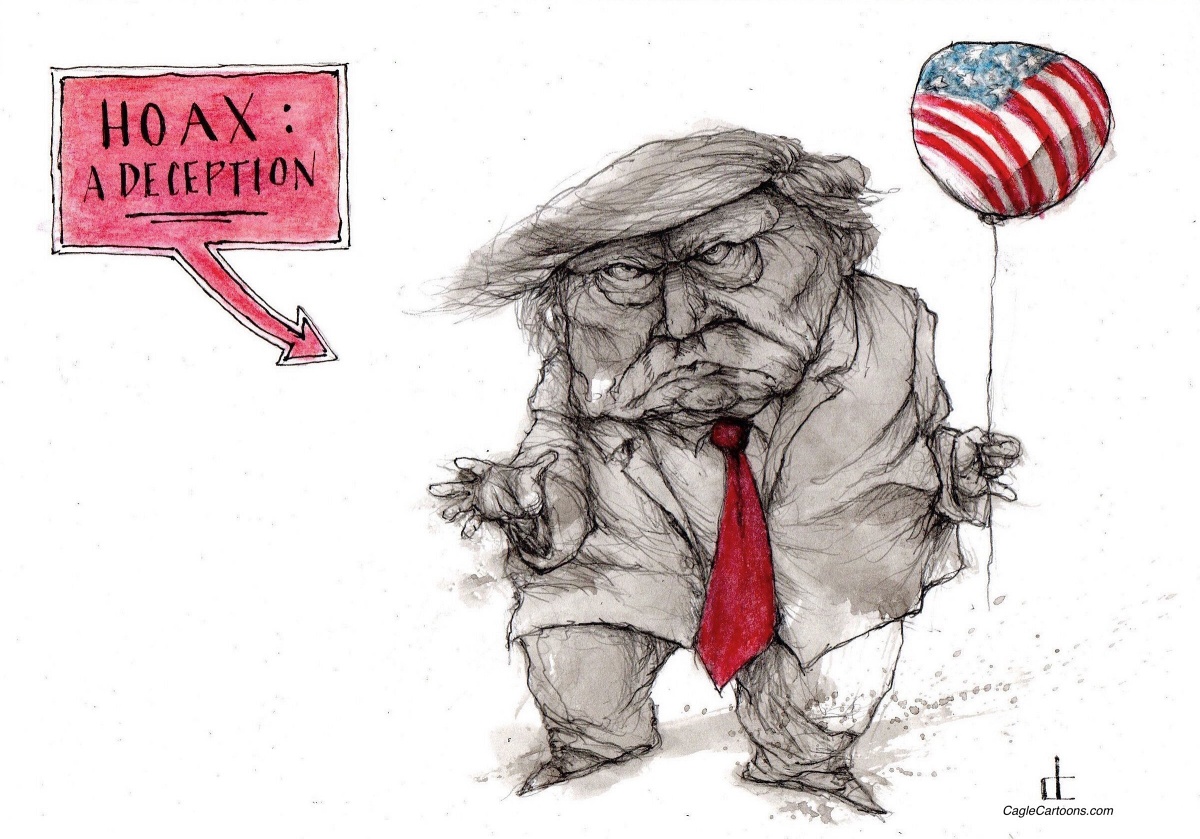
There is a way to report on Trumpy behavior that minimizes his anti-democratic impact. It requires that the limping vestiges of non-partisan, for-profit media take a disciplined approach to golemic coverage
Part 1: Going Deep: Beyond Belief—They
Part 3: Going Deep: Beyond Belief—Faith
Related stories
Part 6: Beyond Belief—Divide and Conquer
The media’s complicity in the undoing of America is complicated. They—the media—constantly proffer, and thus reaffirm, an anxiety-inducing narrative. This narrative, concocted by the VRWC (Vast, Right-Wing Conspiracy) that Hillary Clinton called out, implies irreconcilable differences (the language of divorce) between liberals and conservatives. Prodded by the VRWC, the media take every opportunity to sensationalize Americans’ internecine rancor, reminding us daily that between liberals and conservatives never the twain shall—in fact, never the twain can—meet. It’s hopeless. It was against this media-spread miasma of hopelessness that the Obama-era “Hope” theme and Shepard Fairey’s poster resounded so effectively.
Regularly reiterating lurid reports of an unbridgeable gap—an abyss—between repelling poles of a neatly binary culture war widens and deepens that gap. As with any other narrative refraction, before we fall into that gap we must suspend belief for an indefinite, Coleridgean moment. Meant by the VRWC to be erosive, this unspannable-gap narrative is an anti-faith. Like the incorporeal gap it invokes, it is (only) as real as we believe it to be, neither more nor less substantial than professional wrestling.
Abetted by a much-diminished-but-still-influential media, THEY (the VRWC, who are responsible for that diminishment) have been pushing the unspannable-gap narrative for decades. It is a classic false dilemma. There are differences among us, of course, but when does “difference” become “gap,” and “gap” become “abyss?” Formerly the swaggering flagbearers of democracy, the media find themselves mired in a true dilemma: Driven by an existential need for profit and battered—and bettered—by new forms of competition, they are compelled to report on the VRWC’s—and by extension Trump’s—every anxiety-inducing provocation despite knowing that every mention of him, every item they print or air, is another shovelful of dirt dug from beneath the Enlightenment-derived, liberal foundation of their freedom to publish and/or broadcast what and when they choose.
Fictitious and reductive, the unspannable-gap narrative is a disinformative fable of animus that both stirs and amplifies that animus. This constant media drone has turned the abyss-narrative into a mantra. In a nation built both on optimism (the blind faith that, despite all evidence to the contrary, humans can find a way to get along) and loyal opposition (the patriotism of respectful disagreement), the implication that we can’t all just get along generates cognitive dissonance and significant, subconscious anxiety in all of us. It also sells papers and draws eyeballs. Thus the media profit from simultaneously undermining democracy and making their own position worse. Among journalists, this causes more than a little angst.
Extra! Extra! Read all about it!
To contrive this simultaneously false-true dilemma—what is written on the other side of this note is false/what is written on the other side of this note is true—the VRWC had first to weaken the press’s hold on the American psyche. This effort was aided by the press’s complacency; journalism (and journalists) had long taken for granted how deeply the press was trusted and how tightly its quasi-governmental status was woven into America’s liberal faith. For the VRWC, unstitching that weave required shattering the public’s deeply ingrained, positive opinions of the press and media in general.
This was a challenge: Overwhelmingly positive public opinion of the press was the result of more than two centuries of pro-press propaganda. While much of that propaganda was disseminated by the press itself, it came also from high-school civics classes and popular culture: comics, novels, radio, TV, and movies that featured intrepid journalists bravely righting wrongs, helping little guys, and saving democracy from corrupt government officials. In the opening of the original Superman TV show, we are informed that Superman, disguised as Clark Kent, mild-mannered reporter for a great, metropolitan newspaper, fights a never-ending battle for truth, justice, and the American way. What better guise from within which to protect America and American values than that of a newspaper reporter?
Who is the fairest of them all?
The VRCW, some of whose members own presses and other mass-media outlets, took on the challenge of undermining American’s faith in the press. Among THEIR earliest, most successful, tactics was to imply that the media, which often bruited their commitment to objectivity and fairness, were being unfair to conservatives. Because THEY knew that, absent relatively small numbers of paranoid fringe dwellers, the general public well-and-truly trusted the press’s (and media’s) claims of objectivity, the VRWC initially asked, in polite and reasonable tones, that the media occasionally present a conservative point of view.
These requests made the press defensive (as was VRWC’s intent). Not only did proud journalists react reflexively to being called unfair and unobjective, but also editors had no politically acceptable way to say no. They couldn’t say what they were thinking, which was, Though you are undoubtedly sincere, you are whack-a-doodles, and your craziness is unworthy of being dignified by appearing alongside serious journalism. So, absent an acceptable way to say no, they had no choice but to agree.
THEY insisted that fairness in print meant providing equal space to THEM. (In cities with intense sports rivalries, e.g., Los Angeles, editors tell of rabid fans measuring printed-column inches to ensure their favored teams were getting equal coverage.) But as editors knew it would, providing equal space to niche viewpoints created optical illusions that implied that fringe positions were of equal merit, validity, substance, and popularity with carefully researched, provable, repeatable, defensible, fact-based articles. (You know … journalism.) This in turn implied that those viewpoints deserved sober consideration. Yet as editors also knew, because it lacked journalistic vigor, the coverage they were being strong-armed into providing wasn’t deserving of sober consideration: Rather then being the result of rational, inductive reasoning that began with verifiable facts and led to credible conclusions, this unvetted coverage was an indefensible muddle of irrational, deduction, an agglomeration of faith-based partial truths, cherry-picked “facts” of doubtful provenance, outright fantasies, unsubstantiated opinions, and tinfoil-hat ravings that arose from preconceptions grounded in delusion. And yet there they were being presented side-by-side with articles buttressed by serious, interrogated journalism.
Complacence (and arrogance) left the media, particularly the press, vulnerable, but they had also hoisted themselves by their own petards. They had long pushed their own false narrative, a reductive and distortive pretense that they were objectively and fairly explaining complex issues by presenting two—but only two—sides of a story. In their defense, there is no financially feasible way a for-profit media outlet can present most issues’ multi-dimensional complexity in a format readers or viewers can—or even want to—digest in a reasonable amount of time. Nor can advertising-dependent media afford to publish the many pages or air the many minutes that comprehensive coverage would require. Nor could advertisers be expected to pay for it.
The Fairness Doctrine
The power of broadcast media—its ability to reach and manipulate mass populations—was quickly understood. In 1934, FDR’s New Deal established the Federal Communications Commission (FCC) to replace 1927’s Federal Radio Commission. In 1949, as television was supplanting radio, Democrat Harry S. Truman’s FCC implemented the Fairness Doctrine. This policy required holders of broadcast licenses both to present controversial issues of public importance and to do so in a manner that fairly reflected differing viewpoints.
But presenting alternate views via news broadcasts never had the same impact that providing equal space in newspapers did. Though most TV and radio stations stayed within relatively centrist political lanes due to potential licensing challenges, providing airtime to alternate viewpoints was relegated to 30-second, non-prime-time spots in which non-professionals awkwardly presented shallow summaries. While this practice affirmed that alternate points of view existed (which everyone knew), it trivialized the presenters and their positions by dint of inadequate time and amateur-on-a-stool production values.
Those 30-second spots did not satisfy the VRWC. To ensure THEIR ideas received sufficient broadcast exposure, THEY pursued mass-media deregulation. FCC oversight was weakened. Limits on broadcast-media ownership were loosened. (This latter had been implemented to prevent too much opinion-manipulating power concentrating in the hands of too few entities.) The Fairness Doctrine was abolished (in the name of fairness) in 1987 during Ronald Reagan’s deregulatory frenzy. THEY also began funding news outlets spewing THEIR views on unregulated cable channels. These outlets provided the added benefit of further fracturing social coherence by airing many more national narratives competing for a share of the public mind.
Getting broadcast media deregulated, including loosening government-mandated (i.e., socialist) limits on media-outlet ownership and control was a huge effort. It required creating, spreading, and selling patriotic Americans on an anti-regulatory narrative, and therefore an anti-government narrative. It was a heavy lift: The VRWC had to create, spread, and sell to as many voters as were required to win elections. (At least until they grew powerful enough to suspend elections.)
Beginning with polite requests for occasional coverage of conservative views, THEY then escalated. Changing THEIR tone, they added stridency that implied that the media were not allocating reasonable resources—and therefore not providing reasonable coverage—to THEIR viewpoints. THEY followed this with further escalation: Adopting a tone of growing, righteous, frustration, THEY demanded equal time. THEY also began asking, publicly, Why are the media denying coverage to conservative viewpoints? This series of escalations culminated in THEIR angrily denouncing liberal media’s irredeemable bias against conservatives and conservatism. THEY began to tell (and sell) THEIR burgeoning audiences that this could be rectified only by THEIR having THEIR own media outlets presenting THEIR, and only THEIR, viewpoints to THEIR objectivity-denied, fairness-famished, fact-hungry viewers every time all the time.
All’s fair in love and culture war
Though simple on its surface, the VRWC strategy caused a firmamental shift in the legacy media’s position. Once among American’s most-cherished, most-potent symbols, the legacy media had been flipped from dominant spokes-organs of and for liberal democracy to aloof violators of another of American’s other most-cherished, most-potent symbols, Freedom of Speech.
Simultaneously, a long-running VRWC-driven whisper campaign implied that the media were not merely feckless but corrupt. This reverberated with tranches of Americans, particularly blue-collar workers eyeing high-paying manufacturing jobs moving to other countries. These often-unionized, formerly reliable Democratic voters were increasingly anxious about the erosion of their socio-economic status. This erosion, they were being told, resulted from gains among minorities, particularly Blacks (and most-potently symbolically, Black males) who were, according to this tidy, zero-sum narrative, being unfairly lifted by liberal-wrought civil-rights legislation. It was a tidy, coherent, easy-to-digest narrative that presented one group’s gains as another’s loss, portraying those minority gains as shifts in White status.
Seen in that light, minority socio-economic gains were disrupting entrenched hierarchies of White superiority. These perceived shifts were causing White-identity dysphoria that racists particularly were feeling as existential threats. Those workers began changing their shirts to from blue-collar Democratic to red-collar MAGA. It is not coincidental that on June 17th, 1971 (two days before Juneteenth), then-President Nixon started a war on drugs. Despite its disingenuously stated intent to end criminal cartels (how’s that working out?) and protect people from addiction (how’s that working out?), Nixon’s war criminalized and imprisoned high numbers of Black males just as civil rights legislation gained traction. Post prison, Nixon’s war not only denied Black felons high-paying jobs, but also disenfranchised them, preventing their casting (presumably Democratic) votes.
For White males feeling the erosion of their social status—their identities—the VRWC’s neat binary conjured a them that conjured an us. For that us, the VRWC’s this soothing narrative framed liberals and liberalism as enemies, opening a gate to radicalization, swelling the ranks of those who, from that moment switched allegiance, embracing conservatism as the one true American faith. From there it took little effort to convince them that the Second Amendment and guns were all that was keeping them and their families safe from rampaging Hispanic-immigrant rapists, Muslim terrorists, and corrupt liberals. For self-defense, they flocked to the National Rifle Association, seizing guns the way Titanic survivors seized lifebuoys. For company they swarmed MAGA and its golem the way the Israelites swarmed the golden idol.
The false dilemma: Despite framing its media demands as about fairness, fairness was never the issue. The aim of the VRCW, which always has secondary and tertiary agendas, was not about securing an equal place at the round table. It was always about changing the shape of the table and then ruling it.
It is difficult to overstate the effectiveness of the media element of the VRWC’s strategy. As in the above (part 4) anecdote about the Florida Commission on the Status of Women, simply asserting sidedness evokes sides. Along with other anti-democracy efforts—stirring anti-immigrant hysteria, discrediting the voting system, dismantling loyal opposition—the VRWC’s fabricated, media-disseminated gap-narrative reduced liberalism from what was once a national faith to merely one side of a rancorous debate. In doing so, that reduction raised what was once a niche viewpoint—conservatism—from lunatic fringe to feisty underdog righteously battling for recognition against a bullying, liberal-elite juggernaut.
The result of all this is that the retail media, which even at the best of times feeds on outrage and travesty, is stuck between competing impulses: Cultural ructions—particularly Trump’s—are legitimate news. But reporting on Trump’s bad behavior enables his real agenda, which is to undermine democracy by stunning citizens with outrage and travesty.
So what can we do?
There is a way to report on Trumpy behavior that minimizes his anti-democratic impact. It requires that the limping vestiges of non-partisan, for-profit media take a disciplined approach to golemic coverage: Reporting Trumpy behavior can be de-outraged and –travestied via describing the behaviors neutrally and limiting accompanying images to the most staid. (Note that only coverage of Trumpy outrage need be de-travestied. Other paper-selling and eyeball-attracting sensationalism can continue to continue.)
Examples:
- Monday: Trump declares tariffs on …. That will mean this to the economy and this to individuals.
- Tuesday: Trump rescinds tariffs. That will mean this to the economy and this to individuals.
- Wednesday: Trump calls Hispanics criminals and deploys National Guard with orders to arrest and deport people with brown skin. Some find this problematic because ….
- Thursday: Trump appears with Elon Musk. Elsewhere in the U.S. and the world, this is also happening and is important because ….
- Friday: Trump and Musk trade insults. Elsewhere in the U.S. and the world, this is also happening and is important because ….
- Saturday: Musk eats crow. Elsewhere in the U.S. and the world, this is also happening and is important because ….
- Sunday features and think pieces:
Comments

Powered by RoundtableAn AI/DeFi-powered Enterprise Media Operating System. Learn more at Roundtable.io.© Roundtable 2026. By using this site you agree to the Terms of Use and Privacy Policy