


May 30, 2025 5:58 PM
On the Effeminate Terrors of Straws and Straw Men
With all the solemnity of a court jester dictating the laws of knighthood by brandishing his mock scepter—a bauble adorned with Trump’s orange visage—Fox News host Jesse Watters proclaims his “rules for men”: a litany not of virtue or valor, but of petty prohibitions and codpiece insecurities masquerading as gospel.
Watters, with the storied dexterity of Roland le Fartere—the 12th-century flatulist for King Henry II—delivers his modern ‘unum saltum et siffletum et unum bumbulum’ (one jump, one whistle, and one fart), declaring: thou shalt not eat soup in public, nor cross thy legs, nor—Heaven forfend—drink from a straw, especially a paper one.
Thus are the virtues of masculinity reduced to a checklist of posture and plastic—where fear of the straw overshadows fear of tyranny, and the flex of a bicep is measured not in courage, but in how loudly one can sneer at soup.
Enter Representative Tim Burchett, stage right, pledging allegiance to this glandular gospel. “I don’t drink out of a straw, brother,” he declares, with all the gravitas of a man mistaking swagger for strength, “that’s what the women in my house do”.
Related stories
And thus, from their pulpits of plastic paranoia, these prophets of performative patriarchy erect a new ideal: a fragile theater of straight-backed bravado, where the slightest bend of a biodegradable tube is more terrifying than the rise of actual tyrants—some in makeup—actively exploring the detention of U.S. citizens in foreign gulags.
Imagine Timothy Burchett, a minor vassal in the dominion of Tennessee, whose chief distinction is not the eloquence of his laws, but the firmness of his lips. And Jesse Waters—himself a jester in the employ of the realm’s absurdities—swelling with the ardor of unbent masculinity when asked whether he partook of his draughts through the feminine implement of suction.
And so was sounded the clarion: Fie upon the straw! For it doth summon the spirits of softness. It calls forth a pucker most unbecoming of the warrior class, a pursing of lips that—God forbid!—might resemble the blushes of gentler folk.
In 2023, Watters criticized then-President Joe Biden for using a straw.
“You know I recommend all men refrain from using straws. It’s unbecoming,” he said. “The way a man’s lips purse, the size of the straw is just too dainty, the way your fingers clasp on it.… No, come on. Straws are for women and little kids.”
O what fragile empire, that fears collapse through the curve of a straw!
Hence was the internet—our modern agora—set ablaze with satire about the circumference of one’s ‘sippeth-hole’.
Readers comments were fast and humorous, devoid of the gravitas of real manly men on a testicular mission to MAKE AMERICA MASCULINE AGAIN:
- “Fellas, is it gay to drink out of a straw?” New York Representative Robert Garcia quipped. “Fox News always asking the tough questions.”
- “What is it about these MAGA conservatives that they have to prove how manly they are all the time?” said one X user.
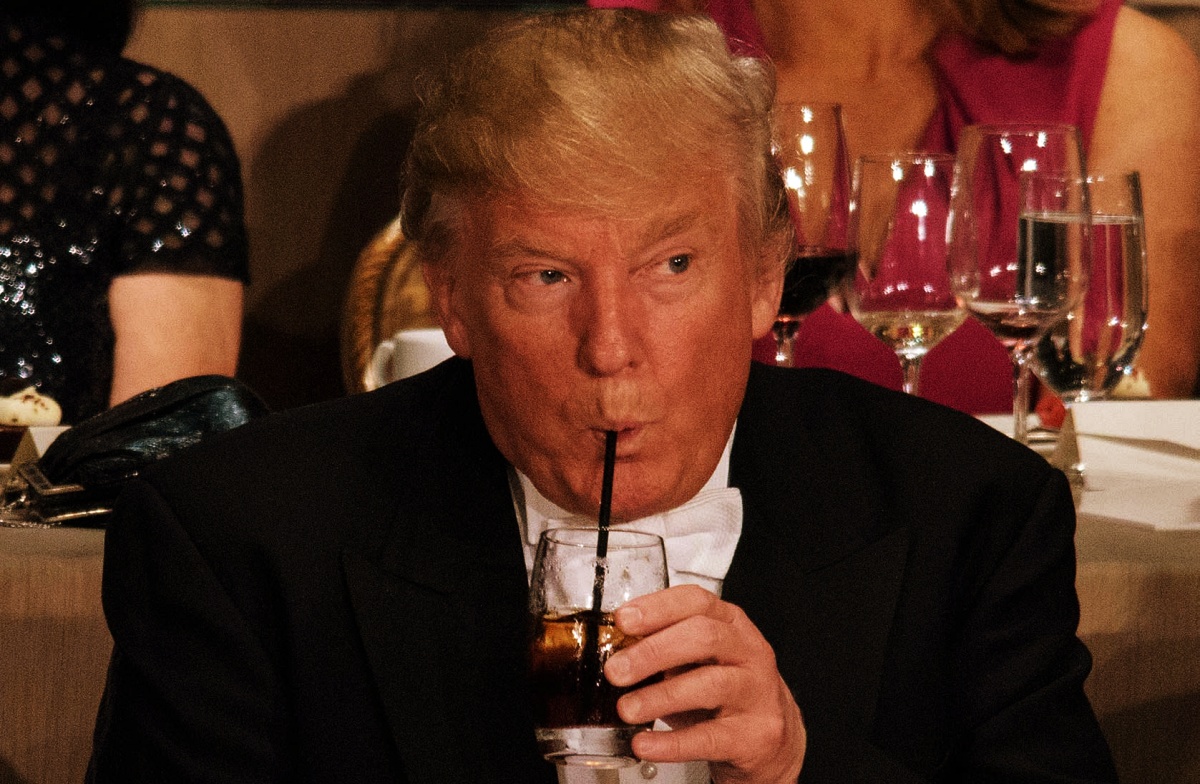
- “Imagine your country’s on fire and Fox News is debating the gender politics of straws. Grown men on primetime TV clutching pearls over plastic tubes,” wrote another. “If masculinity is this fragile, maybe let it melt with the ice in their sad little cups.” Some simply posted uncaptioned pictures of President Trump and Burchett himself using straws.
Imagine! Trump the Red himself, sipping like a debutante from his chalice of Diet Coke, demurely engaged in a violation of manhood.
But it’s not only straw men who are to be condemned. Are you ready for this?
If so, read on.
As Arwa Mahdawi writes in The Guardian, “Watters' man commandments aren't about self-improvement. They're about self-policing. They're about defining masculinity through constant paranoia and petty prohibitions. They’re about telling men they need to be hyper-vigilant at all times lest they do something feminizing like eat a yogurt or, God forbid, enjoy themselves.”
Indeed, the MAGA movement’s gender orthodoxy is less John Wayne and more junior high lunchroom monitor—obsessed with decorum, performative in bravado, yet utterly terrified of the human body’s complexity and its capacity for softness. In Watters’ ”rules for men,” we do not find an ethic of virtue or a code of courage, but a checklist of anxieties.
In the liturgy of Foxian manhood, masculinity is no birthright but a ceaseless trial—an unholy sacrament that must be performed anew with each breath. One does not feel manhood in this gospel; one proves it, again and again, beneath the leering eye of a wrathful altar. Always there lingers the phantom of the “girlie-man,” like a specter in the rafters, ready to descend at the slightest misstep. Every handshake, every grunt, every sideways glance is a prayer for pardon, a desperate plea that the high priests of performative virility might not sniff out weakness and cast the sinner down.
Tim Burchett, a Republican representative, would like you to know that he is not a straw man. No sir. Speaking to Fox News on Thursday, the Tennessee lawmaker explained that he is a red-blooded American male who does not “drink out of a straw” because “that’s what the women in my house do”. And no self-respecting man wants to be like the women in their house, do they? Yuck.
Why did Burchett feel the need to tell us all what he likes to put in his mouth? Because the Fox News host Jesse Watters has some very strange ideas about masculinity and, back in March, came up with “rules for men”. These include: don’t drink soup in public, don’t cross your legs, don’t drink from a straw (it makes your lips purse in an “effeminate” manner), don’t drink milkshakes and “don’t wave simultaneously with two hands”.
The Fox News host is so proud of these rules that he now has his producer running around Washington DC asking lawmakers their thoughts on Watters’ guide to masculinity. Burchett, as we’ve seen, is fully on board. So is the Missouri senator Josh Hawley, who has written a book called Manhood: The Masculine Virtues America Needs.
In every collapsing empire, there arrives a moment when the court jester begins to speak in sermons, and the crowd—restless, anxious, bewildered—starts to mistake the jokes for doctrine. Jesse Watters is such a jester, slick-haired and smirking, with just enough polish to pass as clever, and just enough poison to be dangerous. He laughs as he lies. He winks as he wounds. And the camera loves him for it.
Do not be fooled. Beneath the veneer of charm is a man who represents something ancient and cruel: the return of the father-king who sees daughters as ornamental and wives as conquest.
Do not be fooled. Beneath the veneer of charm is a man who represents something ancient and cruel: the return of the father-king who sees daughters as ornamental and wives as conquest. Watters once declared on air that fathers are not truly responsible for raising their daughters—because “it’s different.” Different, presumably, like houseplants are different from sons. Sons must be taught to rule. Daughters, one suspects in Watters’ worldview, are merely to be traded, protected, or ignored.
This is no idle philosophy. This is ideology with teeth. He has mocked fathers who leave work early to spend time with their children, as though time spent nurturing the next generation is a dereliction of masculine duty. And of course, the personal is never far from the political. Watters, now on his second marriage to a much younger woman who once worked beneath him at Fox News, has boasted on national television about courting her by letting the air out of her car tires. “She needed a lift,” he said, grinning. “I offered one.”
It is the kind of story that ought to raise alarms in any workplace, let alone a network claiming to uphold "family values".
But Fox did not blink. The laugh track rolled. And another brick in the house of televised misogyny was laid.
Why? Because Watters is not an outlier. He is the weather vane. He tells us which way the cultural winds are blowing—backward, downward, inward toward a future where women are wombs and fathers are warlords. This is not just locker room talk; it is legislative fuel. There is a straight, unbroken road from Watters’ smirking reduction of women to the policies that follow: states forcing brain-dead women to carry pregnancies to term; laws that criminalize care; a culture that teaches men to take and teaches women to comply.
It’s all just “a bit of fun,” he says. But his audience is listening. They are nodding. They are voting. In Mahdawi’s words:
Again: Watters isn’t just some kook with a niche show. A large body of research shows that Fox News shapes American politics. There is a direct line between the misogyny and rigid gender roles amplified on Fox News and laws that treat women as nothing more than incubators and walking wombs. There’s a direct line between the sort of attitude towards women that Watters espouses and the fact that a brain dead woman in Georgia is being kept alive to carry out her pregnancy because of the state’s abortion ban. Watters may say his rules for men are just a bit of fun, but his viewers are gulping it all down. Obviously without a straw.
And here lies the peril: Watters is not screaming. He is laughing. He is not waving a pitchfork; he is offering a ride. And in a culture that increasingly mistakes cruelty for wit and entitlement for strength, the damage he does is dressed in a joke—and swallowed without pause.
History has seen this before: the clown in the coxcomb hat who flatters the tyrannical king, the minstrel who mocks the fallen, the entertainer who tells a broken people that their anger is sacred and their dominion divine. Jesse Watters may not wear a crown, but he is helping shape a kingdom—a kingdom where women are trapped, fathers are tyrants, and laughter masks the closing of the gates.
So pay attention. The jester is writing the rules now.
It’s almost funny—if it weren’t so bitterly tragic—how Jesse Watters, the Fox News anti-fop, flinches at the word effeminate as if it were a slur, when women across the country are redefining strength every damn day. Take Olivia Jaquith, who calmly read the news with labor pains rippling through her body like quiet waves before a storm. “If I disappear, that’s what’s going on,” she said with poise that would put ten Jesse Watterses under the table. That’s strength—not the smug snickering of a man who boasts about deflating a woman’s tires to trap her in his car.
Watters mocks men who clock out early to be with their kids—fathers who choose presence over posturing. To him, fatherhood is dominion, not devotion.
Watters mocks men who clock out early to be with their kids—fathers who choose presence over posturing. To him, fatherhood is dominion, not devotion. Daughters are someone else’s responsibility, like dishware or democracy. He laughs. The audience claps. But what’s really happening is darker: the normalization of contempt.
This is what happens when the theater of misogyny becomes statecraft. The Southern Poverty Law Center reports that white nationalist groups are shrinking—not because hate is fading, but because its dog whistles are now sung from podiums and pundit desks. What once was whispered on fringe message boards now blasts through prime time, dressed in suit jackets and studio lights.
Watters isn’t just a talking head—he’s a weathervane of regression. A man who jokes about sabotage as seduction, who presents entitlement as humor, and whose every punchline is a blueprint for someone else’s policy. Every time he performs his tired routine of dominance-as-charm, someone else out there nods along, writes a law, denies a woman pain meds during IUD insertion, or ignores a boxer like Georgia O’Connor until it’s too late. A woman cried on the floor, begged for help. Doctors shrugged. Now she’s gone. That’s not disconnected from Watters—it’s downstream from him.
The problem isn’t just that men like Watters say these things. It’s that they say them into a megaphone built by institutions that know better but crave ratings more than responsibility. While Jaquith pushes through contractions at a news desk, and Tik-Tokers share their agony to demand medical respect, Watters gets airtime to chuckle about manipulation, to shrug at care, to treat misogyny like entertainment.
So laugh at Watters. But don’t forget the darker circus: the rise of entertainers who rewrite masculinity as menace and make derision into doctrine. That’s the joke Jesse Watters is telling, and he’s dead serious about it. Jesse Watters at Fox is a jester in a crumbling court, a goofy, mean-spirited misogynist playing the fool for power. He struts across the stage in his rhetorical coxcomb hat and diamond-shaped leotards, bells jingling on his toes—a court fool drunk on his own reflection. All sneers and smirks, he delivers punchlines that punch down—at women, at fathers who dare to nurture, at the fragile scaffolding of decency itself. Watters is not a thinker but a repeater, a coward’s echo bouncing around the Fox studio halls, parroting Trump’s gospel of grievance with the breathless devotion of a man who’s never taken a risk that didn’t come with a camera and a cue card.
His comedy is cruelty. His shtick is sabotage dressed in smarm. And behind that ever-grinning mask lies a deep fear: fear of women with agency, fear of men who choose care over conquest, fear of a world in which his cheap tricks and schoolyard taunts are no longer mistaken for strength. He plays the fool not because he’s brave, but because he knows he can always hide behind the laugh track.
This is not satire—it’s spite. Watters jingles for the crowd, but the bells toll for the rest of us.
He mocks compassion, scoffs at care, and dresses up manipulation as masculine charm. But there’s nothing brave about bullying. Nothing clever about belittling. Watters is the kind of man who lets the air out of tires to get a date and calls it a joke, the kind who sees women’s autonomy as a threat and other men’s tenderness as weakness. A sycophant through and through, he polishes Trump’s image with his own oily grin, hoping to catch some reflected glow from a golden idol that’s all-rust underneath.
He wants you to laugh with him. But the punchline is always power.
And the joke is on us.
One wonders what Jesse Watters and Tim Burchett—the self-appointed paladins of performative masculinity—would say if confronted with that jewel of American absurdity tucked away in the annals of elite self-reinvention: JD Vance.
Long before he became the scowling Vice President and finger-wagging emissary of Appalachia’s imagined moral code, he could be found beneath Yale’s gothic arches not in somber suit and regulation haircut, but in a shimmering golden wig and a skirt.
Yes, JD Vance in drag—an image as exquisite as it is inconvenient. A man now famed for lecturing sovereign leaders on their wardrobes, once twirling in playful defiance of everything he now claims to defend. The photo is no scandal—it is theater, glorious and human—but it lingers like a ghost at the feast of the new American right, whose leaders build their politics on brittle notions of gender and strength while their own pasts shimmer with contradiction.
Watters might snort and call it satire; Burchett might grunt something about God and girded loins. But they wouldn’t laugh too hard. Because deep down, they know: the image doesn’t mock manhood—it mocks their cartoon version of it.
According to witnesses from his law school days, it was all in good fun—a costume party, perhaps, or a lark from a future culture warrior before the culture war came calling. His makeup? Minimal. Eyeliner? Debated. But then former Congressman George Santos—himself a walking jukebox of identities, resumes, and rhinestones—weighed in.
“No eyeliner,” Santos said with a practiced air of authority. “That’s just JD’s lashes. Long, luscious lashes casting shadows. He’s always had those.” When pressed, he added, “Believe me, I’d know.”
And he would.
This peculiar crossover episode of American political theater — Hillbilly Elegance Meets RuPaul’s Realpolitik — arrived in a moment when drag itself had become a conservative boogeyman. Ironically, some of its most vocal critics, like Vance, have more glitter in their pasts than they’d care to admit. The image of a future senator in synthetic gold hair wafted through the internet like Aqua Net in a dressing room.
But there’s something almost poetic here: the culture warriors, weaponizing morality and nostalgia, secretly know the costume changes all too well. And Santos, exiled but unrepentant, remains the court jester of the right—always ready to remind us: “Honey, everyone’s in drag. Some of them just call it patriotism.”
The Red Baseball Cap
I am sure Jesse Watters agrees that we have enshrined the MAGA baseball cap as a kind of crown of masculine bravado—an everyday helmet for the casual warrior of the culture war. But even this most American of accessories has its limits, as made painfully clear during Donald Trump’s recent commencement address to the graduates of West Point.
I am sure Jesse Watters agrees that we have enshrined the MAGA baseball cap as a kind of crown of masculine bravado—an everyday helmet for the casual warrior of the culture war.
The former president arrived wearing not a military uniform, nor a civilian suit of presidential dignity, but his trademark red MAGA cap — a campaign slogan atop an institution sworn to remain apolitical.
Standing before rows of cadets who had endured one of the most grueling academic and physical regimens in the country, Trump delivered not a speech but a stream-of-consciousness ramble about trophy wives, real estate developers, and personal grievances.
Beneath the vaulted skies of the republic’s springtime rites—where once the cap and gown bore the gravitas of learning's solemn torch—a crimson emblem now stole the gaze, not in reverence, but in revulsion. What was meant to be a ceremony of ascent, a benediction for fledgling minds poised to soar, unfurled instead as a strange and jarring masque: half the oration a time-honored call to courage and conscience, the other half a carnival sermon echoing from the coliseums of the mad MAGA cult. The scarlet sigil perched atop the speaker's crown—a relic of grievance, not glory—drew gasps not of admiration but of a collective, choking incredulity, as if a herald of Caesar had crashed the convocation with a trumpet of fury rather than of measured wisdom. Upon the scrolls of Bluesky—our modern parchment of murmurs and dispatches—scribe David Bernstein etched his astonishment for all to behold: "Our President is currently delivering the commencement address at West Point while wearing a MAGA hat and talking about his great campaign victory and various fantastic accomplishments wtaf.”
The cadets bore witness to a sky heavy with the ghosts of better republics, where there strode a man not garlanded in wisdom but swaddled in the drapery of grievance. He did not approach the field as a leader bearing solemn charge, but as a showman high on his own mythos—a merchant prince peddling vengeance as virtue, grievance as gospel.
Upon his head sat not a laurel wreath earned through sacrifice or statesmanship, but a red relic of a long, unraveling spectacle. "The only difference between a MAGA hat and KKK hood is that the KKK were ashamed to show their faces," economist Patrick Chovanec suggested. The MAGA hat, once the talisman of an insurgent campaign, now reads as costume: a cap not of policy but of pantomime, stitched not with unity but tribal spite. It is not a symbol of national service, but a banner for the theater of inflated self.
In this moment—beneath the stone towers of West Point, where generations have pledged their lives not to a man but to a mission—the image was grotesque. A commander-in-chief, not bowing to the gravity of the occasion, but grinning through the garish filter of his own brand. The hat said everything. It always does.
Where once the general stood to speak of duty, sacrifice, and the long arc of peace, now came the carnival crier, flanked by flag and fury. He spoke not to elevate the young warriors of West Point standing before him, but to enthrone himself anew in the theater of their obedience. The military, that ancient steward of the republic’s reluctant violence, became in his tongue not a shield, but a sword unsheathed for domestic crusade.
His words, salted with old resentments, clanged like bronze from a cracked bell. He boasted of rebuilding legions he had not forged, of vanquishing foes he had conjured, and of purging the ranks not of corruption, but of diversity and difference. It was not the unity of command he sought, but the uniformity of creed—an army not of citizens, but of shadows reflecting his image.
And as he preached from the pulpit of West Point, he recast the officer’s oath—not as solemn vow to the Constitution, but as a pledge of fealty to the man who would be king. The words were wrapped not in the velvet of nostalgia, but their core was clear: loyalty not to law, but to legend. To him. To the image of the man, the myth, the magic.
He stood there—a Caesar without the poetry, without the tragic grandeur, without the laurels earned in battle, without the victory parade displaying Vercingetorix, the Gallic leader, in chains, designed to showcase the extent of Caesar’s power and the subjugation of his enemies.
A would-be conqueror of institutions he neither built nor understands, he strides the marble halls like a vandal in borrowed robes—a marshal of megalomania, rallying legions not of duty, but of decibels. His armies do not bleed; they clap. No Cleopatra graced his side, no equal to whisper caution or truth—only the flickering ghost of cable-news adoration, and a court of hollow-eyed flatterers, each too frightened to mutter what the drapes cannot hide: that the empire is threadbare, its glory a mirage, and its compass—moral or otherwise—spinning wildly in search of true north.
This was no address to the republic’s stewards, but a sales pitch to its saboteurs—a sermon in the church of self. The cadets stood in disciplined rows, silent heirs to a tradition he cheapened with every crazed grin. And atop it all, that red crown—less MAGA than masquerade—blazed like a warning flare across the twilight of American civics.
Indeed, we are fortunate—if such fortune can still be measured in what did not come to pass—that he refrained from commissioning for himself a bespoke uniform, epauletted and gold brocaded like some sunburnt marshal of a parody republic, a North Korean style tunic festooned with the gaudy Trump meme coin, pinned by sycophants to the silken fabric of delusion. One could almost see it: the stiff jacket glittering under stadium lights, like JD Vance’s eyes meeting their waterline, not with the earned honor of campaigns waged in defense of liberty, but with baubles forged in the foundry of ego—each medal a monument to grievance, each ribbon a thread of delirium, stitched together in the style of Pyongyang’s pageantry.
Have we forgotten the man who once sneered at prisoners of war—“I like people who weren’t captured”—as if valor could be measured only by avoiding vulnerability?
Have we forgotten Trump’s bone spurs? That invisible ailment, diagnosed in the mists of privilege, that spared him from the draft while others bled in rice paddies and jungle swamps? Have we forgotten the man who once sneered at prisoners of war—“I like people who weren’t captured”—as if valor could be measured only by avoiding vulnerability?
And yes, have we forgotten the bombshell Atlantic report, later confirmed by multiple outlets and former officials, in which Trump dismissed fallen soldiers as “losers” and “suckers”? A commander-in-chief who recoils at sacrifice, who cannot fathom duty without reward, who mistakes service for servility because he has never served anything but himself.
This is the same man who now wraps himself in military pageantry, who strides before West Point cadets as if auditioning for a role in a history he has only ever mocked. A Caesar of cowardice, cloaked not in armor but grievance, followed by jesters like Watters and Burchett, who mistake cruelty for courage and gender panic for patriotism.
Let us remember not to shame him—he is beyond shame—but to guard the truth from the gaslight.
Have we forgotten Trump’s cowardly allegiance to Putin?
In the fog of slogans and flags waved like weapons, memory can feel like a casualty. But we must not forget. Not Helsinki, where Trump stood beside Vladimir Putin—not as a president defending his nation’s sovereignty, but as a supplicant, disavowing his own intelligence community in favor of the word of a hostile autocrat. It was a moment that should have frozen the blood of patriots: a commander-in-chief abdicating his oath, not under duress, but with a smile.
He did not defend democracy; he deferred to dictatorship.
This was no anomaly—it was emblematic. From the soft refusals to condemn Russian aggression and war crimes, to the whispered admiration for “strongmen,” Trump’s foreign policy was never about national interest or strategic clarity. It was about ego alliances and grievance-driven theater. Putin, with his shirtless propaganda and iron-fisted image, represented everything Trump longed to be: adored without question, obeyed without law, feared without merit.
And now, as the stars-and-stripes are once again unfurled to mask the machinery of his second-term ambitions, we are asked to pretend this history never happened. But the shadow of Putin still stretches long across this stage, because Trump never left it. He merely changed the scenery.
That he limited himself to the red cap alone—already a symbol potent enough to sunder truth from memory—may be the only restraint he still remembers. But the temptation lingers in the wings of power: to dress not as a servant of the people, but as their idol, their emperor-in-waiting, his garments crying out what his words already dare—I alone can fix it.
No republic breathes easy beneath such pageantry. No democracy endures beneath such dragooning of pride.
This was not the martial valor of Cincinnatus, but the stagecraft of Caligula. Not the gravity of Lincoln at Gettysburg, but the giddy menace of a man who mistakes applause for absolution. And in that moment, under the proud banners of a fractured nation, the commencement became a coronation—a ceremony not of duty fulfilled, but of dreams defiled.
Lo, in this late hour of the Republic, when the plague has passed but the fires yet smolder upon the body politic, a strange and almost comical contest has arisen—not in the courts, nor on the fields of legislation, but in that arena where power and theater become indistinguishable: the contest of style.
It is not fought with law or logic, but with fabric and flair. And so the red cap—emblazoned not with the seal of state, but with the crude sigil of a movement that worships grievance more than governance—has become the crown jewel of this aesthetic insurrection.
From the benches of the Commons to the pulpits of propaganda, this garish hat has been lifted high, not as a mere accessory but as a sacrament of submission. It is the vestment of the New Court Jester, whose gospel is outrage, whose hymns are hashtags, whose miracles are metrics.
And yet, the absurdity is not without consequence. For in elevating style over substance, and loyalty over the rule of law, we find ourselves governed not by statesmen, but by swaggerers in costume. In his second term, President Donald Trump has significantly deepened the integration of Fox News personalities into his administration, appointing at least 23 former contributors, and producers to prominent government positions. This trend underscores the increasingly blurred lines between conservative media and political power.
Among the most high-profile appointments is Jeanine Pirro, the former host of Justice with Judge Jeanine, who now serves as the interim U.S. Attorney for the District of Columbia—a role that places her at the heart of the nation’s legal apparatus. Former Fox Business host and U.S. Representative Sean Duffy has been named Secretary of Transportation, while Tammy Bruce, once a regular Fox commentator, now serves as spokesperson for the U.S. Department of State.
Meanwhile, Dan Bongino, a former Fox News host and ex-Secret Service agent, has been tapped as Deputy Director of the FBI. Leo Terrell, a one-time Fox News contributor, now holds a senior counsel position within the Department of Justice, overseeing initiatives related to antisemitism on college campuses. Kimberly Guilfoyle, another familiar Fox face and former co-host of The Five, has been appointed U.S. Ambassador to Greece.
Pete Hegseth, once a weekend host on Fox & Friends and a fixture of conservative infotainment, now presides over the Pentagon—a transformation that would feel satirical if it weren’t real. A man whose most public qualifications were culture war monologues and coffee-cup tantrums on morning television now holds the levers of the largest military on Earth. Hegseth, who has made a brand out of dismissing so-called "woke generals" and championing a jingoistic version of patriotism, now steers an institution that requires strategic nuance, diplomatic foresight, and the sober weight of command. His ascension is not an aberration—it is the embodiment of the Trumpian ethos: spectacle over substance, loyalty over expertise, war paint over war plans.
Where once there stood secretaries steeped in military doctrine and international law, now there is a man who famously said he doesn’t wash his hands because “germs aren’t real.” The symbolic power of this appointment lies not just in who Hegseth is, but in what it signals: that the empire’s arsenal is now managed by yet another of the empire’s court jesters, a Fox News warrior turned war chief, blurring forever the line between the theater of war and the theater of television personalities.
This pattern of appointments reflects a broader strategy of aligning media influence with governmental authority—effectively transforming a partisan entertainment empire into a governing infrastructure. It raises serious questions about the integrity of democratic institutions and the traditional wall separating a free press from state power.
All of Trump’s Fox News appointments proudly wear the MAGA hat—if not perched literally atop their heads, then emblazoned in their very meaning and manner. This hat—this soft, stitched idol—has become both mask and message, symbol and symptom. It crushes not only fashion but memory: the fading memory of humility in power, of service placed above spectacle, of leaders who bore no crown but that of solemn duty. Once you see it, it cannot be unseen. For atop the head of Trump, it exudes not patriotism but parody—a mockery of decorum, a crimson flare of cruelty, a beacon of self-serving megalomania masquerading as populist zeal.
What else could one do but marvel, aghast, as the Commander-in-Chief stood before the nation’s anointed guardians not with the humility of a statesman, but with the boastful cadence of a carnival prince? Clad in the livery of a faction, crowning himself with the crimson cap of division, he turned the hallowed ground of West Point into a pageant stage, where laurels of merit bowed before the gaudy parade of self-congratulation. The moment passed into the annals of history not as a testament to the republic’s virtue, but as a tableau of its vertigo.
While more than a few critics of Donald Trump were appalled that he decided to talk about "trophy wives" and Al Capone at Saturday's West Point graduation, another faction couldn't get over his decision to wear a "Make America Great Again" (MAGA) hat for the occasion.
President Donald Trump used the first service academy commencement address of his second term to laud graduating West Point cadets for their accomplishments and career choice while also veering sharply into a campaign-style recitation of political boasts and long-held grievances.
“In a few moments, you’ll become graduates of the most elite and storied military academy in human history,” Trump said at the ceremony at Michie Stadium. “And you will become officers of the greatest and most powerful army the world has ever known. And I know, because I rebuilt that army, and I rebuilt the military. And we rebuilt it like nobody has ever rebuilt it before in my first term.”
Wearing a red “Make America Great Again” hat, the Republican president told the 1,002 members of the class of 2025 at the U.S. Military Academy that the United States is the “hottest country in the world” and underscored an “America First” ethos for the military.
Trump’s speech at West Point was less a call to duty than a culture war sermon, an authoritarian aria cloaked in the language of patriotism.
Trump’s speech at West Point was less a call to duty than a culture war sermon, an authoritarian aria cloaked in the language of patriotism. “We’re getting rid of distractions,” he declared, as though dignity, inclusion, and the very complexity of democracy were detours on the road to glory. “Crushing America’s adversaries, killing America’s enemies and defending our great American flag”—not since the days of tinpot generals and banana republic strongmen has martial rhetoric been so hollow and so loud coming from the Oval Office.
Trump’s words clanged like swords on marble, not because of their power, but because of their performance. Gone was any mention of alliance, restraint, or moral clarity or leadership. In its place: a vision of the military as pure instrument—of vengeance, of cultural cleansing, of blind nationalism. The enemies he spoke of were not just foreign, but domestic: drag performers, transgender soldiers, professors of race and history. His war is not just over borders, but over bodies and ideas.
This was not strategy, but spectacle. He offered the cadets not a noble burden but a purified mission, one scrubbed clean of the messiness of reality, complexity, or conscience. No more peacekeeping. No more uncomfortable truths. Only the gleam of the flag and the grindstone of obedience.
The tragedy is not just that Trump speaks these words, but that men like Pete Hegseth—now heading the Pentagon—cheer them on. The chain of command has become a feedback loop of grievance and spectacle. The republic, once guarded by a citizen-soldier ideal, now risks becoming a stage for militarized ideology, where uniforms mask the collapse of civic values and the flag is wielded not as a symbol of unity, but as a cudgel of exclusion.
The red MAGA cap has become a searing symbol of fascism—no less potent, no less chilling, than the swastika once was in another century’s fever dream. The MAGA hat, in its banal red and white, cloaks itself in patriotism while broadcasting menace. It is the uniform of a movement that sanctifies vengeance, glorifies ignorance, and exalts the strongman's will over the people's voice. Like all totalitarian symbols, its power lies in its simplicity and ubiquity—a threadbare crown for a nation in peril, stitched not with stars or stripes, but with the smirk of vengeance and the sneer of authoritarian longing. Since 2022, when he began preparing for the presidential campaign, Trump has issued more than 100 threats to investigate, prosecute, imprison or otherwise punish his perceived opponents.
This is the architecture of authoritarianism—public threats of imprisonment, calls for extrajudicial tribunals, and a gleeful embrace of retribution as governing principle. Trump’s second-term rhetoric doesn’t just flirt with the strongman fantasy; it shouts it from the rally stage and scrawls it in all caps across Truth Social.
Trump has threatened to prosecute his sitting successor, Vice President Harris, and his former allies, like Liz Cheney, for the crime of disloyalty—recasting dissent not as the engine of democracy, but as treason. “TELEVISED MILITARY TRIBUNALS,” he reposted, as if turning the machinery of the state into the set of a fascist reality show.
He has threatened journalists with prison—and worse. “Bye-bye,” he smirked, imagining reporters jailed for protecting their sources, and hinted darkly at the abuse they might face behind bars. This is not rhetoric. This is incitement.
When asked if he would lock up his political opponents, Trump replied: “You have no choice.” The logic is not legal but tribal. He does not distinguish between justice and vengeance, between rule of law and rule of man. The message is clear: if he regains power, justice will be reversed—not blind, but weaponized. Political loyalty will be the only shield from persecution.
Legal experts warn that institutional guardrails are thin. In his first term, Trump pressured the DOJ into investigating his rivals—roughly a dozen times, according to documented analysis. In a second term, with more loyalists in place, he may not even need to pressure. Retribution could become policy.
And the chilling effect is already here. His enemies—journalists, public officials, and poll workers—are setting aside money, considering exile, preparing for persecution. These are the acts of people living under the shadow of a regime, not a republic.
As Ian Bassin of Protect Democracy put it plainly: “This is how autocrats cement their permanent grip on power”.
Trump is not hiding his intentions. He is advertising them. The only question left is whether we listen.
By naming names—Harris, Biden, Cheney—and demanding public punishment, Trump is following a familiar autocratic script: isolate dissent, personalize enemies, criminalize opposition.
By naming names—Harris, Biden, Cheney—and demanding public punishment, Trump is following a familiar autocratic script: isolate dissent, personalize enemies, criminalize opposition. The invocation of tribunals, particularly military ones, bypasses civilian legal norms in favor of raw power and spectacle. These aren’t the mechanisms of a constitutional republic; they are the shadows of Freisler's Volksgerichtshof (People’s Court) reimagined for an American audience.
The phrase “Retruth if you want televised military tribunals” is especially ominous. It transforms a crowd into a mob, a post into a decree, and social media into a digital scaffold. It reduces justice to a crowd-sourced execution order.
This isn't just dangerous talk—it’s an attempt to acculturate the public to the normalization of political persecution. It's what autocrats do when preparing the ground for repression: test the waters, desensitize the public, and turn the machinery of the state inward.
The warning signs are no longer metaphor—they are manifesto.
Thus unfolds the drama of our decline, with a cap in place of a helm, and a grin or golf swing in place of a plan. And the question before us is no longer merely what to wear—but whether there remains anything worth dressing up to defend.
It was supposed to be a moment of honor. A day etched in granite and tradition — the commencement ceremony at West Point, where the nation’s most disciplined young officers step into the long shadow of duty, service, and sacrifice.
Instead, they got Donald J. Trump.
At one point, he digressed for a full thirty seconds into a surreal monologue about William Levitt — the suburban housing magnate — and his supposed misadventures with women. "Trophy wife," Trump muttered, twice. "It didn’t work out too well." The crowd stood in uniformed silence, their expressions fixed somewhere between disbelief and stoicism.
It would have been merely bizarre if it weren’t so pointedly disrespectful. This was no roast at Mar-a-Lago. It was a commencement address at the United States Military Academy — a place where rhetoric matters, where legacy is earned, and where leadership is meant to be modeled, not mocked.
The White House reportedly erased the transcript from its website. Social media, however, did not forget. The clip has gone viral, amassing millions of views and sparking a deluge of commentary: “Disrespectful.” “Lazy.” “Inappropriate.” One commenter nailed the paradox: "Imagine spending four grueling, incredible years at one of the best universities in the world with the goal of serving your country — and this is the commencement address you get.".
What should have been a solemn celebration of future service turned into a bizarre one-man show — part campaign rally, part therapy session, and entirely beneath the dignity of the office holds. The red hat, once a political symbol, became something else entirely that day: a crimson flag of decline.
Behold, then, the doctrine of Watters—a Foxian friar of manhood’s mysteries—who speaks with the solemnity of a court eunuch on the proper comportment of the male species. No soup in public, he says. No crossing of legs. No dainty tubes. For the mouth must not purse, lest it betray softness. The fingers must not clasp, lest they reveal grace. These are his proverbs. This is his Psalter.
And so the creed spreads—no longer confined to the taverns of TikTok nor the hermitages of YouTube, but now etched upon the scrolls of Congress. The word has gone forth: A man shall not suck lest he be suspected.
O, what alchemy of idiocy this is—this manufacturing of masculinity not in the smithy of virtue, but in the factory of performative dread! Not with sword nor plough is the man proven now, but by how he holds a beverage.
Ah—who could forget the now-infamous “two-handed water bottle moment”? It was during a 2017 speech at the Pentagon, when Donald Trump paused mid-sentence to take a drink and lifted the bottle to his mouth with both hands, as if cradling a relic. The image went viral almost instantly. Critics mocked him for the awkward gesture, interpreting it as a sign of frailty or lack of coordination. Supporters dismissed it as trivial, a nothing-burger turned media feeding frenzy.
But what’s interesting is how something so seemingly small—how a president holds a bottle of water—became a symbol in the national psyche. Because when power feels unstable or absurd, we reach for metaphors. And in that moment, the gesture seemed to reveal something deeper: not just physical awkwardness, but a kind of infantilism, a performative masculinity constantly on the brink of collapse.
It was, in a way, the perfect visual for the Trump Crime Family era—every small moment a meme, every minor tick mined for meaning in a presidency that often blurred the line between governance and reality TV. And now, in his second term, that meme has metastasized into policy, that performance into personnel—Fox News talking heads becoming heads of departments, conspiracy replacing competency.
The water bottle, gripped like a rattle, was just the beginning.
The ancients laughed at effeminacy, the gestures of the dandy, the fop; we manufacture it as an idol to smash. What once was a straw—a tool for drinking—is now a trial by fire, a moral gauntlet, a threat to the republic's crown jewels—its sacred gonads.
And so the modern man, forged in Foxfire and fear, dare not purse his lips for water lest his virility evaporate like mist upon the moor.
And so the modern man, forged in Foxfire and fear, dare not purse his lips for water lest his virility evaporate like mist upon the moor.
What next, noble Watters? Shall forks be deemed too pronged? Shall napkins be banned as the handkerchiefs of cowards? Will we, at last, return to lapping our broths from hollowed skulls, as the Vikings did, to prove the girth of our souls and our gonads?
Here lies the irony: that in their fury to sculpt the ideal of manhood, these jesters have rendered it as delicate as spun glass. A masculinity so brittle it trembles at the bend of a plastic tube.
Regardless of how serious Watters claims to be about his rules for men, there are quite a few poor souls out there pushing the same idea.
Thus is manhood reduced—not to courage, but to choreography. Not to character, but to consumer habit.
At West Point, where stone and sacrifice consecrate a lineage of duty, President Donald Trump did not rise to honor the cadets so much as use them as a backdrop for his own imperial soliloquy. The speech, a fevered fresco of boast and bile, placed him not among leaders of a republic but among tyrants of old, for whom armies exist not to protect the realm, but to ornament the throne.
Katie Hawkinson writes of Trump’s comparison of himself to Al Capone: “I was investigated more than the great late Alphonse Capone,” Trump told the West Point graduates. “Alphonse Capone was a monster. He was a very hardened criminal. I went through more investigations than Alphonse Capone, and now I'm talking to you as president. Can you believe this?”
Alas, we can—and that bitter truth casts a long, unflattering shadow across the American soul. It speaks of a public too often seduced by spectacle over substance, by grievance dressed in gold leaf. It reveals a hunger not for truth, but for affirmation, even if laced with poison. The mirror it holds up is not kind—it shows a people willing, at times, to trade away their birthright of liberty for the cheap thrill of domination dressed as strength.
Gone was the quiet gravity of Eisenhower. Gone was the hopeful vision of Kennedy. In their place, a rhetoric of vengeance, cleansing, and spectacle. Drag shows and transgender troops, critical race theory and cultural nuance—all were named as heresies to be purged from the martial temple, as if the enemy were not at the gates but within the ranks.
So it was that West Point—this citadel of continuity—became, for one afternoon, a throne room for the Mad Emperor of Mar-a-Lago. And as the scarlet crest gleamed beneath the sun, one could feel history recoil. For this was no republican statesman, but a wandering Caesar, auditioning for dictatorship in the garments of democracy, insisting not only that he alone could fix it, but that it had never truly existed until he arrived.
It was not a graduation. It was an augury. A reminder that democracy’s pageantry, once defiled, becomes too easily the stage for the empire’s return.
Thankfully Trump did not wear his signature red cap during his speech at Arlington National Cemetery. David Edwards reports that
Trump spoke about the "American heroes and their immense and ultimate sacrifices" before bragging about his own good fortune.
"250 years, we're going to have a big, big celebration, as you know, 250 years," the president said of a military parade on his birthday. "In some ways, I'm glad I missed that second term where it was, because I wouldn't be your president for that, most important of all."
"In addition, we have the World Cup and we have the Olympics," he continued. "Can you imagine? I missed that four years, and now look what I have. I have everything. Amazing the way things work out. God did that."
Has anyone asked if God drinks from a straw? One might think Fox News would’ve floated the question by now—perhaps in defense of the chalice over the paper cup, the sacred vessel over the biodegradable indignity of modernity. Imagine the segment: “Tonight—liberals want your deity sipping soy lattes through compostable tubes. But our Founding Fathers? They drank from goblets, by God.” In their theology of optics, even the divine must be curated—no dribbled grace, no smudged glass, just golden brim and filtered lighting, holy in high definition.
Drink, then, O America—drink deep and without shame. From goblet or straw, from flask or fountain. For it is not how you drink, but what you stand for, that determines your stature.
And may our leaders preserve us from those who think otherwise.
Now is the hour to both reclaim and deepen the weary soil of democracy, to till it with vigilance and seed it with courage. Each time Trump casts his hexes at Biden, he reveals not strength but trembling—a theater of bluster masking a soul haunted by its own hollowness. His proclamations of divine favor rise like incense gone sour, failing the nose of any spirit not dulled by spectacle. What he offers is not providence but pageantry, not faith but a counterfeit gospel stamped with his own reflection.
Comments

Powered by RoundtableAn AI/DeFi-powered Enterprise Media Operating System. Learn more at Roundtable.io.© Roundtable 2026. By using this site you agree to the Terms of Use and Privacy Policy