


Feb 20, 2026 7:04 PM
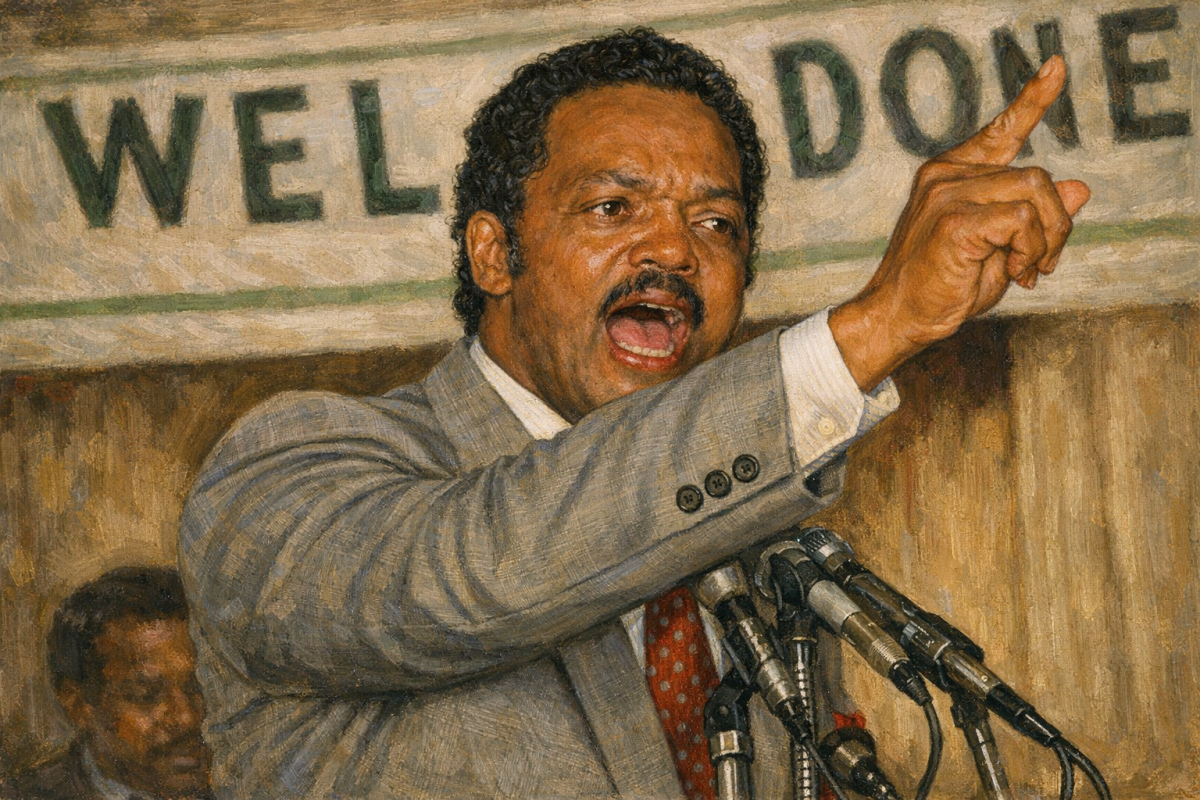
Jackson’s “I Am Somebody” creed fueled my generation, a generation trying nightly to carve normal lives out of what often felt like a horror story with a beautiful musical soundtrack.
Some people judge a man by the company he keeps. I’ve always been of the mind that you weigh, measure, and pound an individual not solely by their friends, but also by their enemies. Friends can be polite. Friends can be convenient. Enemies, though, tell the truth. Enemies show you exactly whose comfort you’ve disrupted, whose power you’ve threatened, whose carefully arranged world you’ve forced to wobble just enough to reveal the cracks underneath the paint. Enemies don’t lie for you. They testify.
That noted, Jesse Jackson was despised by the “Right” in America for half-a-century. Not disliked. Not debated. Despised. From his apprenticeship with Dr. King, when he stood in the shadow of a movement that demanded America live-up to its high-and-mighty words it printed but rarely practiced, to his breaking bread with Black Power advocates like Angela Davis, Bobby Seale, and Stokely Carmichael in the 1970s as the Civil Rights era evolved into something louder, sharper, and far less patient. America wanted gratitude. Jackson kept delivering demands. America wanted quiet integration. Jackson insisted on loud transformation.
Jackson’s “I Am Somebody” creed fueled my generation, a generation trying nightly to carve normal lives out of what often felt like a horror story with a beautiful musical soundtrack. Kids repeating those words in classrooms and churches weren’t just reciting slogans. We were rehearsing survival. His organizing of a “Rainbow Coalition” laid political groundwork that would help carry Barack Obama into the White House a quarter century later, whether pundits want to admit it or not. That unified front, multiracial, working class, unapologetically inclusive, still makes MAGA uncomfortable today because it represents the one thing grievance politics fears most: shared power.
Jesse represented uncomfortableness to Reagan’s America. He made them uncomfortable because he didn’t buy the smiles and grins, didn’t confuse photo-ops with progress. He understood even then that the MAGA mentality was ever-present. It was simply undercover, boxed-up and stored in the cellar beside coveted Confederate relics and polite segregationist language waiting for a political moment to breathe again.
Related stories
Jackson was a man who made the establishment powers nervous, he was the man MAGA learned to hate Before MAGA had a name.
He moved from confrontation in the American South to confrontation with apartheid South Africa and eventually confrontation with Corporate America itself. From Operation PUSH to his two attempts to paint the White House Black, Jesse Jackson represented something deeply unsettling to the self-proclaimed “color-blind conservatives,” the former Confederates in khakis who insisted racism had magically expired sometime around 1965. The same crowd, now proudly waving Trump banners, never forgave him for refusing to sit down, shut up, and be thankful for incremental crumbs handed down like charity instead of justice.
And while critics tried to confine him to domestic agitation, Jackson built another reputation many Americans forget or never fully understood. He became one of the country’s most effective unofficial diplomats. Long before pundits invented the phrase “back-channel negotiations,” Jackson was traveling into hostile territory to bring Americans home alive. He negotiated with Syrian officials for the release of a captured American airman, worked toward freeing Cuban political prisoners, and most famously stepped into the volatile 1985 hijacking of TWA Flight 847, where Hezbollah held 153 passengers hostage, including dozens of Americans.
The Reagan administration publicly scolded him for interfering, yet when diplomacy stalled, Jackson went anyway.
Sitting face-to-face in Lebanon, he relied not on threats but empathy, persistence, and moral pressure, helping secure the release of hostages and laying groundwork for the others’ eventual freedom.
Years later, during the Kosovo conflict in 1999, he again entered tense negotiations in Belgrade that resulted in the release of three captured American service members. Jackson understood something politicians often forget: sometimes dialogue saves lives faster than bravado.
He had global respect and clout, that angered his enemies, and you know who they were, right?
In 1984, as president of my college Black Student Union, I was amongst a throng of students out to Denver’s Airport to see Jackson during his run for president. He was the only one on a national level still talking openly about “Black Power.”Not as a threat, but as a reminder that dignity required agency. By then, the fire had been dampened by tokenism and window-dressing integration. Prosperity had softened some edges. We were not as visibly angry as we had been for the previous 350 years. Maybe that was understandable.
He bridged the "Imagination Gap, ” he made the impossible possible.
But since Black folks still dwell in a hostile environment, comfort has always been temporary housing. We learned to live alert. We learned to smile while scanning exits. We as a people have learned how to be comfortable when we are uncomfortable. That is both our strength and America’s excuse.
The Good Ol’ Boys on Wall Street hated him. In their telling, he was “extorting” them. Funny how asking corporations to hire Black executives, invest in Black communities, and open doors previously welded shut suddenly became moral blackmail. Jackson understood something most activists eventually learn the hard way: power doesn’t respond to polite requests. Power responds to pressure. He walked into boardrooms not asking permission but presenting invoices centuries overdue, reminding executives that diversity was not generosity. It was debt repayment.
By the 1980s, Black America had found itself in a precarious position. We were free. Technically. We were living in suburbs next door to middle-class white folks. Interracial dating wouldn’t automatically get a Black man beaten to death anymore. White men weren’t just forcing themselves upon Black women but were, shockingly enough, actually winning hearts and minds. On paper, progress looked undeniable. The brochures said America was healing, smiling families posed under freshly planted trees.
But then again, it wasn’t.
Poverty remained stubborn. Crime rose in neighborhoods abandoned economically but heavily patrolled politically. The blue-collar working-man middle class, Black and white alike, was being shipped overseas in cargo containers labeled “efficiency.” Factories closed. Paychecks shrank. Communities hollowed out. Meanwhile unions, once the backbone of upward mobility, were being kneecapped by Ronni n’ “666” Ray-gun and a leisure-class investment culture that preferred quarterly profits to generational stability.
Schools told another story. A subpar educational system mass-produced Black children still reading and writing grade levels behind their white counterparts, then blamed those same children for the outcome. America congratulated itself for integration while quietly underfunding the very institutions meant to make equality real. Opportunity existed, but mostly as a rumor whispered during election seasons.
This was the best of times for some, and the worst of times for others. For the first time, Blacks who had made it over the previous two decades were doing great, better than most even. Corporate positions opened. Political offices became attainable. Television screens slowly diversified. A Black middle class emerged and flourished, proof that barriers could fall.
But Jesse Jackson kept reminding America that individual success did not equal collective justice.
He kept the pressure on. He kept the flame burning. He kept pushin’ and pushin’, refusing to let the nation declare victory while millions remained locked outside prosperity’s front door. That persistence irritated people who preferred symbolic progress over structural change. Jackson wouldn’t let America take a bow and exit the stage early while the work remained unfinished backstage.
Most of White America did not like him. He was uppity, refusing to remain in the assigned seat they imagined for him. Too loud. Too visible. Too unwilling to perform gratitude on command. He talked about economic justice when America wanted colorblind mythology. He talked about systemic inequality when America wanted inspirational anecdotes. He insisted racism wasn’t just a Southern accent but a national operating system running quietly in the background.
And that made him dangerous.
Just as they didn’t like Dr. King at the moment. Just as they didn’t like Muhammad Ali when he refused to play obedient champion and instead questioned war, patriotism, and power itself. History has a funny habit of polishing rebels into saints decades after trying to destroy them. In real time, courage makes people deeply uncomfortable because it demands participation.
Jackson, like King and Ali, wore that hatred openly. Not because he enjoyed conflict, but because he understood what it meant. When powerful institutions line up against you, it usually means you’ve touched something real. Something expensive. Something they never intended to share.
I loved all three men because they carried that hatred with pride on their strong shoulders. They understood that popularity is cheap currency when justice is the goal. Approval comes easy when you ask for nothing. Transformation requires disruption, and disruption always earns enemies.
That, more than speeches or headlines, may be Jesse Jackson’s real legacy. He forced America to argue with itself in public. He refused to let progress become a bedtime story told to soothe the all-ready comfortable. He demanded receipts before the phrase even existed, insisting the nation reconcile its promises with its practices. And for that, generations benefited, even the ones who never quite realized who kept pushing the door open while others walked through.
History tends to remember victories. It forgets the exhausting work of agitation that made those victories possible. Jesse Jackson lived in that exhausting space, absorbing criticism so others could inherit possibility. If enemies are the truest measure of a man, then Reverend Jackson’s résumé reads less like controversy and more like confirmation, a ledger filled not with apologies but with proof that he mattered exactly where it counted most.
Comments

Powered by RoundtableAn AI/DeFi-powered Enterprise Media Operating System. Learn more at Roundtable.io.© Roundtable 2026. By using this site you agree to the Terms of Use and Privacy Policy