


Apr 17, 2025 3:10 PM
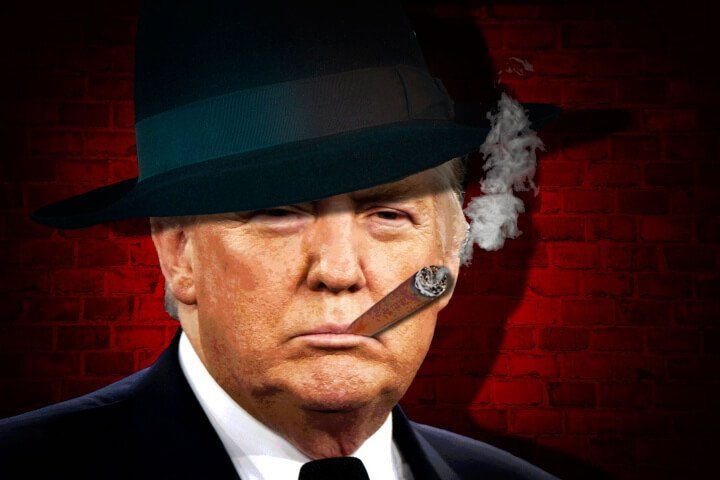
Trump’s preference for a government that allows wheeler-dealers like him to do what he wants has some similarities to mafia preferences.
Now, almost three months into Donald Trump’s second term as president, there is little doubt that he is attacking some of the most important pillars of our democracy. But what type of rule is he trying to create? That is not so clear. Fascism? Authoritarianism? Patrimonialism? Or his own unique brand of one-man mafia-like rule? One thing is certain: The threat to our traditional democracy of Trump 2 (my reference to his second presidential term) is now more acute than it was during his first term.
One early alarmist (in the best sense of the word) was Steven Levitsky. In 2023 he co-authored Tyranny of the Minority: Why American Democracy Reached the Breaking Point. But in a February 2025 issue of Foreign Affairs (FA), he co-authored an essay that has updated his view. It states that “the breakdown of democracy in the United States will not give rise to a classic dictatorship in which elections are a sham and the opposition is locked up, exiled, or killed...Trump will not be able to rewrite the Constitution or overturn the constitutional order. He will be constrained by independent judges, federalism, the country’s professionalized military, and high barriers to constitutional reform...But authoritarianism does not require the destruction of the constitutional order. What lies ahead is not fascist or single-party dictatorship but competitive authoritarianism.”
According to Levitsky and Lucan Way (his co-author in the FA article) the best Trump comparisons are not to Hitler—though the similarities are certainly there. Rather it is to modern authoritarians like Hugo Chávez in Venezuela, Viktor Orban in Hungary, and Recep Erdogan in Turkey that the likenesses are greatest. This view is close to that of Anne Applebaum, who in her recent Autocracy, Inc. (2024) or in new interviews has pointed out all the damage, pain, and injustice non-democratic, authoritarian rulers—including Trump—can inflict.
Another view maintains that Trump’s governing style more resembles (or attempts to) patrimonialism. Max Weber introduced this term in 1920 when he described it as a type of authority resting on the arbitrary and direct control of a ruler whose authority is essentially unrestrained.
Related stories
In the long course of my university-teaching of Russian history, I once used Richard Pipes’ Russia under the Old Regime(1974) in which he maintained that “the patrimonial system best defines the type of regime which emerged in Russia between the twelfth and seventeenth centuries and which, with certain lapses and modifications, has survived until the present.” He added that “in such states political authority is conceived and exercised as an extension of the rights of ownership, the ruler (or rulers) being both sovereigns of the realm and its proprietors.” Moreover, a patrimonial ruler does not recognize property rights. “In a patrimonial state there exist no formal limitations on political authority, nor rule of law, nor individual liberties. . . . The same man or men . . . dispose of the the country’s entire human and material resources.”
More recently, several U. S. scholars have listed Trump as a patrimonial ruler. In a 2022 journal article, "Understanding the Global Patrimonial Wave," Stephen Hanson and Jeffrey Kopstein include Trump (during his first term) as one, along with others such as Putin in Russia (the trend-setter for modern patrimonialism), Orbán in Hungary, Erdogan in Turkey, Bolsonaro in Brazil, and Duterte in the Philippines. The authors argue that Trump’s assault on our traditional democracy “encompassed the entire state. From the first days of the [first-term] administration, political appointees regarded as unqualified were deployed to purge the bureaucracy...Trump distrusted anyone who might diminish his personal power and authority...Trump repeatedly sidelined experts until he hit on those less likely to appear to challenge his wisdom and instincts.” In the almost three months of his second term, such patrimonialism has become even more acute.
More recently, in mid 2024, the two authors restated and elaborated some of their findings in The Assault on the State: How the Global Attack on Modern Government Endangers Our Future. There we read that a “series of global crises in the twenty-first century has unexpectedly made the rule of the supposedly benevolent father and his extended family newly attractive to angry, marginalized publics in countries on every continent. A slew of self-aggrandizing leaders has taken full advantage of this historical moment by seizing state assets for themselves and their loyalists, while labeling anyone who opposes them as part of the deep state. In every case, the result has been a steep decline in the state’s ability to provide essential services such as health care, education, and safety.”
The authors explain Trump’s puzzling admiration of Vladimir Putin partly by his admiration of Putin’s patrimonialism. The practice of Trump, like Putin, “is to ignore, sideline, or dismantle their expert agencies. These leaders staff the state with family members, friends, and sycophants, regardless of their level of incompetence.”
In a March 3, 2025 podcast of “Keen on America,” host Andrew Keen titles it “Why Trump wants to be the Godfather,”and claims that “Trump’s patrimonial ideology means that holding political power requires him to be The Godfather” (as portrayed in the film by Marlon Brando). In the podcast Keen interviews Kopstein and writer Jonathan Rauch, whose “One Word Describes Trump,”—and that being patrimonialism—appeared in Feb. 2025 in the Atlantic magazine. (As columnist David Brooks said about the essay, he benefited greatly from it, which explained Trump’s connection with patrimonialism—an “attempt to turn the government into a family business. . . . Trump is treating the justice system the way the head—the father of this patrimonialistic system would treat it. And he's going after things that are just personal. And so that's the erosion of democracy, which is supposed to be about clear laws that apply to everybody. And we no longer live in that system.”)
Keen sums up his interview with Kopstein and Rauch by stating that they believe that “loyalty to Trump as an individual supersedes institutional structures and processes, similar to how a mafia boss operates”; “the current administration is in a ‘demolition phase’ where Trump and allies like Elon Musk are working to dismantle the modern bureaucratic state”; “the ruler sees state resources as personal property”; “Trump's patrimonialism” appeals “to those uncomfortable with rapid social changes in modern society, particularly around issues of gender, sexuality, and cultural diversity”; and “effective government bureaucracies actually benefit citizens' daily lives” and help develop better policies.
Keen also refers to Rauch’s Atlantic essay as concluding that if Trump continues his polices he will “more and more kind of asymptotically approach the ideal of the mafia state.”
Nine days after Keen’s podcast, Hanson expanded upon the earlier views that Kopstein and he stated. He did this in aninterview with Selcuk Gultasli of the European Center for Populism Studies. In it Hanson emphasized certain points that helped, as he put it, to get “the rhetoric right.” First, he noted that “key features” of patrimonialism “are that the ruler governs the entire state as if it were his personal possession, viewing the state as a kind of family business. He distributes parts of the state and its protection to loyalists, cronies, and even family members directly. At the same time, he attacks the impersonal and impartial administration of the state as an obstacle to his arbitrary power.” Secondly, Hanson avers that “we need to recognize that patrimonialism can exist within democratic systems without immediately eroding their democratic nature”—eventually it will make democracy collapse, but this may take a while to occur. Thirdly, the main enemy of patrimonialism is modern government, the state. Since “fairness, accountability, and good governance...depend on the survival of the modern state,” patrimonialism “doesn’t create a fair society. It fosters corruption, undermines integrity, and ignores public opinion.”
In addition, Hanson makes an important point that we shouldn’t think of patrimonial rulers as primarily ideological. Trump himself, Hanson insists, “has no coherent ideology. He has shifted positions on all sorts of issues...His center is that he alone can fix it. He sees himself as the anointed leader.” This viewpoint fits in well with a point I have been making for years (see, e.g., here, here, and here): egoism is Trump’s most glaring trait. (Thus, unless it serves his ego, Trump will dismiss any ideology that fails to serve it.)
He is not a wise man. Wisdom scholar and psychologist Robert Sternberg has written that “people are wise to the extent that they use their intelligence to seek a common good. They do so by balancing, in their courses of action, their own interests with those of others and those of larger entities, like their school, their community, their country, even God.” But the scholar also believes that some people are unwise because of fallacies that reflect too big an ego, overestimating one’s own importance and powers.
Applying similar thinking to presidents, Doris Kearns Goodwin in Leadership: In Turbulent Times writes of four presidents (Lincoln, both Roosevelts, and Lyndon Johnson) who were at their best, “when guided by a sense of moral purpose, they were able to channel their ambitions and summon their talents to enlarge the opportunities and lives of others.” But Trump’s colossal egoism disdains any higher moral purpose.
Such an absence, however, does not rule out certain preferences and inclinations. One is a deep distrust of any higher authority (like laws) that would restrict what Sen. Bernie Sanders calls “unfettered capitalism.” Whereas Max Weber thought that patrimonialism would hinder the development of capitalism, Trump seems to wish for a more lax, less restrictive government, than the type preferred by Weber—thus the present-day talk of his privatizing the postal system and his encouragement of private prisons, etc. (One of his first confrontations with the government was in 1973 when the Justice Department, in “United States of America v. Fred C. Trump, Donald Trump and Trump Management, Inc.” proclaimed that the Trumps had broken the law “by refusing to rent and negotiate rentals with blacks, requiring different rental terms and conditions because of race, and misrepresenting that apartments were not available.”)
But Trump’s preference for a government that allows wheeler-dealers like him to do what he wants has some similarities to mafia preferences. Francis Ford Coppola, the director of “The Godfather” films, has stated that “both the Mafia and America. . . . are totally capitalistic phenomena and basically have a profit motive.”
The Trump description provided here helps explain some of his recent behavior regarding tariffs. A 2019 essay by MIT professor Thomas Kochan sums up Trump’s negotiating style. He “seeks and values admiration and personal gratification, a behavioral trait that makes him vulnerable to overvaluing small concessions when combined with deferential (authentic or feigned) demonstrations of respect.” And “he cannot be trusted to maintain a relationship if circumstances change in ways that suggest to him that the other party will no longer serve his immediate interests.”
Finally, we come to the question of how long will we have to endure Trumpism. We may like to take comfort in truisms like “Pride comes before destruction, and an arrogant spirit before a fall” (Proverbs 16:18), but Russia’s Putin—the trailblazer of modern patrimonialism—has remained in power for a quarter of a century. Sure, Russia and the USA have very different histories and traditions, but still...The only thing we can be certain of is that our future remains uncertain. In no small measure it will depend on how wisely we voters—including all those who voted for Trump last November, but also we anti-Trumpers—respond to Trump’s assault on the best of our past practices.
Comments

Powered by RoundtableAn AI/DeFi-powered Enterprise Media Operating System. Learn more at Roundtable.io.© Roundtable 2026. By using this site you agree to the Terms of Use and Privacy Policy